Electroplating on Metal Eyewear: Colors, Durability, and What to Ask Your Supplier
When brands order custom metal sunglasses, most of the conversation centers on frame shape, material grade, and lens spec. Electroplating rarely gets the same attention — yet it is the process that determines how the frame looks in-store, how long that look holds up under daily wear, and whether the product can legally enter certain markets.
This article covers what electroplating actually does to a metal frame, how the two main plating methods compare, what drives durability, and the specific questions worth asking before you place an order.
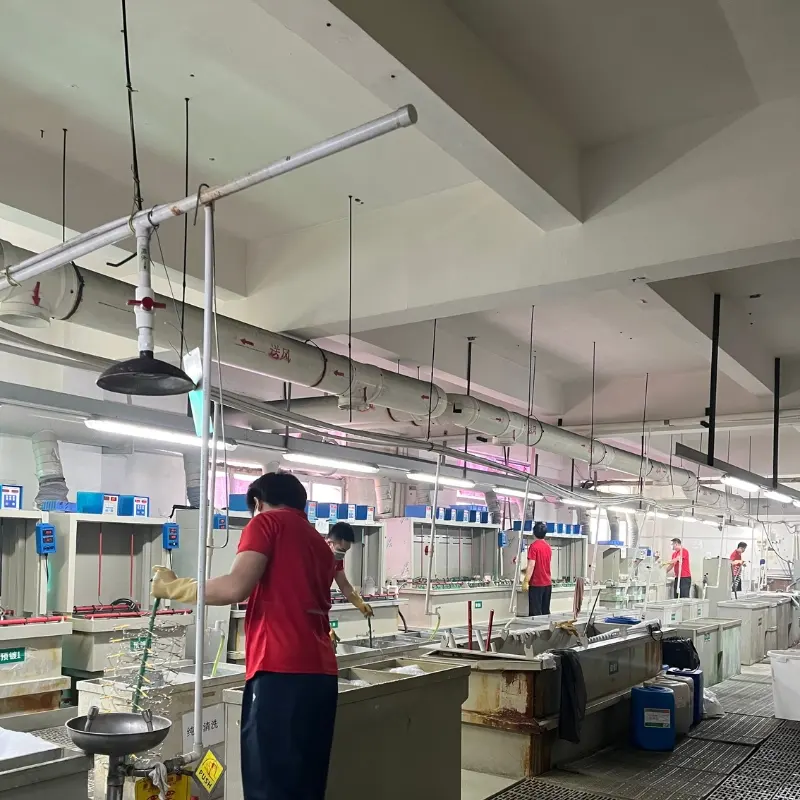
What Electroplating Does to a Metal Frame
Electroplating deposits a thin layer of metal — or a sequence of metal layers — onto the surface of a frame through an electrochemical reaction. The frame is submerged in a chemical bath and connected to an electrical circuit, which causes metal ions in the solution to bond to the frame surface.
The result is not a coating applied on top of the metal. It is a metallurgical bond. This distinction matters because it affects adhesion strength, corrosion resistance, and how the surface behaves over time.
In metal sunglasses manufacturing, electroplating serves three functions simultaneously:
- It gives the frame its final color — gold, silver, gunmetal, rose gold, and others
- It provides a protective barrier against oxidation, sweat, and humidity
- It creates the surface texture — high gloss, matte, satin, or brushed
The base metal of a metal sunglasses frame — typically stainless steel, Monel, or white copper alloy — has none of these properties in its raw state. Electroplating is what transforms a stamped metal component into a finished product.
Water Plating vs. IP Plating: The Core Difference
There are two main electroplating methods used in eyewear manufacturing. Understanding the difference between them affects both product decisions and supplier conversations.
Water Plating (Electrolytic Plating)
Water plating is the standard method for most metal sunglasses frames. The frame is immersed in an electrolyte solution and connected to a current, which deposits metal ions — typically copper as a base layer, nickel as an intermediate layer, and the color layer on top.
The process runs at room temperature (15–40°C) and produces a bright, uniform finish. It is cost-effective and well-suited to large-volume production.
Key characteristics of water plating:
- Produces high-gloss metallic colors: gold, silver, gunmetal, rose gold
- Suitable for stainless steel, Monel, white copper alloy frames
- Color results are consistent across large batches
- Adhesion depends on the quality of the base layer and sealing coat
One structural constraint: achieving certain colors through water plating alone is complex. Colors outside the metallic range — such as white, yellow, or green — require a metallic base coat first, followed by spray painting on top of the plated surface. The plating provides the adhesion foundation; the spray color provides the final hue.

IP Plating (Ion Plating / Physical Vapor Deposition)
IP plating is a vacuum-based process. The frame is placed in a sealed chamber where metal and gas compounds are deposited onto the surface through ionization. No liquid chemical bath is involved.
IP plating is the standard method for titanium frames, where it is required due to titanium’s surface properties. For non-titanium metal frames, IP plating is used when higher durability or a deeper matte finish is the priority.
Key characteristics of IP plating:
- Extremely strong adhesion — does not peel in the way water plating can if poorly executed
- Produces matte and satin finishes with a slightly deeper, less reflective tone
- Harder surface, more resistant to scratching
- Significantly higher cost than water plating
- Color range is somewhat narrower; bright-gloss gold is harder to achieve without additional steps
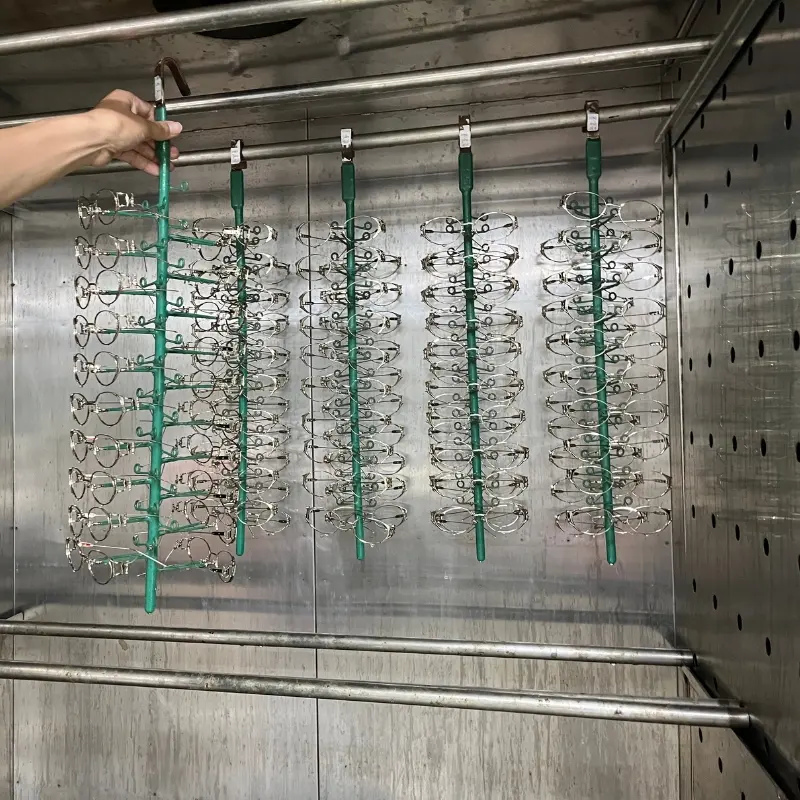
Which Method Is Right for Your Product?
The choice depends on the market positioning and base material:
| Factor | Water Plating | IP Plating |
|---|---|---|
| Base material | Stainless steel, Monel, white copper | Titanium, high-end stainless steel |
| Finish appearance | High gloss, bright metallic | Matte, satin, understated |
| Durability | Good (with quality sealing coat) | Excellent |
| Color range | Broad, including multi-color via spray | Narrower, deeper tones |
| Cost | Standard | Premium |
| Market fit | Fashion, mid-range, commercial | Luxury, professional, outdoor |
| Nickel compliance | Requires nickel-free specification | Inherently cleaner process |
For most fashion metal sunglasses sold in the US, EU, and Australian markets, water plating with a quality nickel-free specification is the standard. IP plating becomes relevant when the brand positioning justifies the cost premium or when the base material requires it.
Standard Color Options and How They Are Achieved
The color available through electroplating is not unlimited. Understanding which colors are native to the electroplating process and which require additional steps helps set realistic expectations when briefing a supplier.
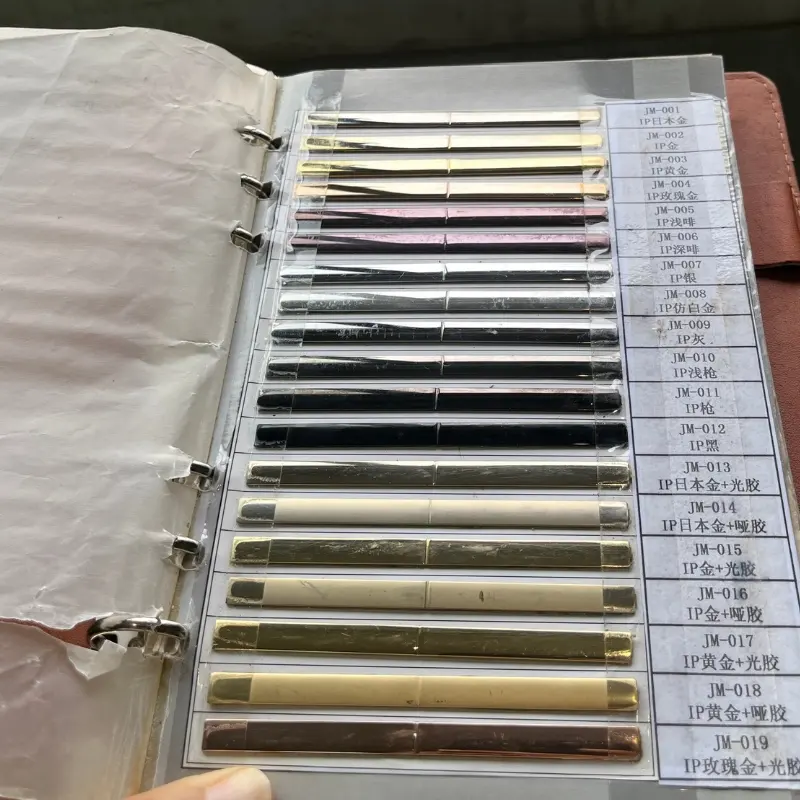
Colors Achievable Through Electroplating Alone
These colors are produced directly by the metal layer deposited during plating:
- Gold — deposited using gold alloy or titanium nitride; varies from light champagne to deep yellow gold
- Silver / Chrome — achieved with nickel, chrome, or silver plating; produces bright mirror-like finish
- Gunmetal / Dark Grey — alloy plating produces this mid-to-dark metallic grey
- Rose Gold — copper-alloy-based plating with a warm pink-gold tone
- Black — black chrome or black zinc plating; also achievable via IP as a matte black
Colors That Require Plating + Spray Color
Colors outside the metallic range require a metallic base coat through electroplating, then a spray color layer applied on top:
- White, ivory, cream tones
- Bright fashion colors: red, blue, orange, green, yellow
- Gradient or two-tone effects
- Translucent color effects
The spray color is applied after the plating base is complete and sealed, then baked to cure. The adhesion of the spray layer depends directly on the quality of the plating base beneath it.
Surface Finishes
Color is one dimension; surface texture is another. Both can be specified:
- High gloss — mirror-reflective surface, most common for gold and silver
- Matte — non-reflective, uniform flat texture
- Satin / Brushed — directional texture visible in certain light angles; common in minimalist and professional styles
- Two-tone — different finishes on different parts of the frame, e.g., brushed temple with gloss front
What Determines Plating Durability
Plating durability is not a single variable. It is the outcome of several production decisions made across the plating process.
Layer Structure
A correctly plated metal sunglasses frame uses a multi-layer system:
- Base layer (copper or alkaline copper): smooths microscopic surface irregularities and creates a strong adhesion surface for subsequent layers
- Intermediate layer (nickel or alternative): provides the core corrosion resistance; nickel thickness has a near-linear relationship with oxidation resistance
- Color layer (gold, silver, chrome, etc.): delivers the final appearance
- Sealing coat (electroplating frame oil / topcoat lacquer): protects the color layer from physical wear, sweat, and chemical exposure
The sealing coat is often the variable that most directly separates acceptable from poor quality in finished product. A standard sealing coat can sustain 24 hours in an anti-sweat test; a quality imported sealing coat sustains 65+ hours; a double-coat application can reach 72+ hours.
Layer Thickness
Plating layer thickness is measured in microns (µm). Thicker layers provide better corrosion resistance but add marginal cost. For eyewear frames, the color layer is typically in the range of 0.1–0.3 µm for standard finishes.
A supplier who specifies thickness in microns rather than describing the finish visually is indicating production-level quality control. A supplier who cannot answer this question is likely relying on appearance assessment rather than measurement.
Salt Spray Testing
Salt spray testing (also called neutral salt spray / NSS testing) is the standard method for evaluating plating durability in eyewear. The frame is placed in a sealed chamber where a salt mist is applied continuously. The duration before visible corrosion or color change occurs is measured.
Typical standards in the eyewear industry:
| Test Duration | What It Indicates |
|---|---|
| 24 hours | Minimum acceptable level; common in lower-cost products |
| 48 hours | Mid-range standard |
| 65–72 hours | Quality production standard; expected for export-grade product |
| 96+ hours | Premium specification; relevant for high-humidity markets (Southeast Asia, tropics) |
A frame intended for markets with high humidity or active outdoor use should be specified at 65 hours minimum. Frames sold in EU and UK markets are also increasingly expected to meet this range.
Pre-Treatment Quality
Before any plating begins, the raw frame must be polished and chemically cleaned. Surface irregularities, oil residues, or oxidation on the base metal will cause uneven plating, poor adhesion, and premature failure — regardless of how well the plating itself is executed. Pre-treatment quality is invisible in the finished product but determines long-term performance.
Nickel-Free Plating and Regional Compliance
Nickel is one of the most common contact allergens. EU regulations under the REACH framework set strict limits on nickel release from products that come into prolonged contact with skin — including eyewear frames. The US and UK markets have also moved toward preferring or requiring nickel-free construction, particularly for frames targeting sensitive skin claims or children’s products.
In practical terms for metal sunglasses:
- EU market: Nickel release must stay below 0.5 µg/cm²/week for parts in contact with skin (EN 12472 / EN 1811 standards)
- US market: No federal mandate, but major retailers and quality-conscious brands require nickel-free spec
- Water plating: The intermediate nickel layer can be replaced or modified to achieve nickel-free compliance; this is now standard practice for export-oriented Chinese factories
- IP plating: The vacuum deposition process does not rely on nickel in the same way; generally considered cleaner from a compliance standpoint
When briefing a supplier, specify “nickel-free plating” explicitly. Do not assume it is standard. A reputable manufacturer will confirm this and should be able to provide test documentation.
8 Questions to Ask Your Supplier Before Ordering
The questions below are structured around the actual production decisions that determine plating quality. Asking them before sampling gives you the information needed to evaluate the supplier’s capability — and to specify what you need precisely.
1. What plating method do you use for this frame — water plating or IP plating? The answer tells you immediately what finish range and durability level to expect, and whether the frame is positioned for standard or premium production.
2. What is the layer structure? What is the base layer material? A copper base layer indicates proper multi-layer construction. If the supplier cannot describe the layer structure, the frame is likely using a minimal plating approach.
3. What is the plating thickness in microns for the color layer? Any answer expressed as a visual description rather than a measurement is a flag. Quality factories specify thickness.
4. What is the sealing coat specification, and what anti-sweat test result does it achieve? 65+ hours is the target for export-grade product. Ask whether the result is guaranteed by the sealing coat supplier, and whether double-coat application is available.
5. Is the plating nickel-free? Can you provide test documentation? For EU, UK, and any market with nickel sensitivity requirements, this is non-negotiable. Documentation should reference EN 1811 or equivalent standard.
6. How do you handle color consistency across a production batch? Color variation across units is one of the most common quality complaints in metal frame production. Ask whether color is measured by instrument (colorimeter) or by visual comparison to a reference sample.
7. Can you produce the color I need within the range achievable through electroplating alone, or will it require spray color on top? This affects both cost and durability. Spray color adds a process step and a potential adhesion variable.
8. What salt spray test standard does your plating process meet, and do you test in-house or through a third-party lab? In-house testing with documented results is acceptable. Third-party certification (SGS, BV, Intertek) is a stronger signal and required for certain retail channels.
How the Plating Process Works in Production
For brands placing orders for the first time, it helps to understand where electroplating sits in the production sequence.
A metal sunglasses frame typically passes through these stages before reaching the plating line:
- Material cutting — stamping or CNC cutting of the frame components
- Assembly — welding or screwing components together (front, temples, hinges, nose bridge)
- Rough polishing — removes weld marks and surface irregularities
- Fine polishing — produces the smooth surface required for uniform plating
- Pre-treatment cleaning — chemical degreasing and acid bath to prepare the surface
- Electroplating — base coat, intermediate layer, color layer
- Color spray (if required) — for non-metallic colors
- Sealing coat — topcoat lacquer application and baking
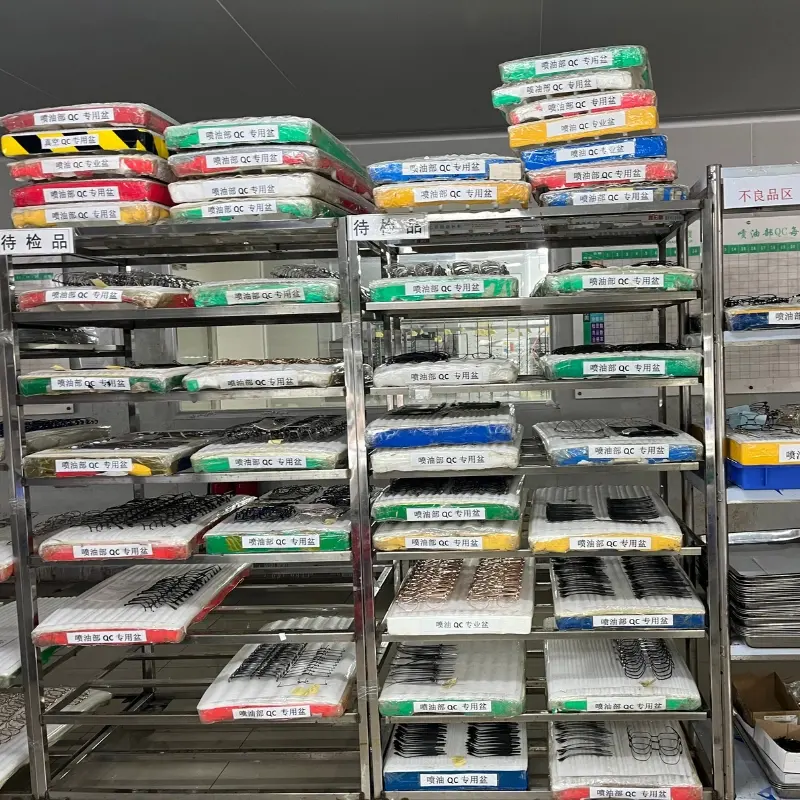
- QC inspection — surface uniformity, color consistency, adhesion check
- Logo application — laser engraving, pad printing, or metal inlay
Plating is step 6 in a 10-step process. If the polishing at step 4 is inadequate, or the pre-treatment at step 5 is rushed, the plating at step 6 cannot compensate. This is why production-level quality control — not just end-of-line inspection — matters in metal frame manufacturing.
At Sailook, the electroplating stage is handled by a designated specialist plating facility — the same supplier network approved by Luxottica for their own production requirements. This is a deliberate sourcing decision: electroplating is a process where equipment investment, chemical management, and accumulated process knowledge matter significantly. Partnering with a facility that operates to that benchmark gives our clients’ products consistent, auditable plating quality without the variability of in-house processing. Our production quality control — IQC (incoming materials), IPQC (in-process), and OQC (outgoing) — covers the plating output as a defined inspection stage before any frame moves to the next step.
Frequently Asked Questions
How long does electroplating last on metal sunglasses?
Durability depends on the plating method, layer structure, and sealing coat specification. A frame with a quality multi-layer water plating system and a sealing coat rated at 65+ hours in a salt spray test will typically maintain its finish for 2–3 years under normal daily use. Frames with a minimal plating structure or low-grade sealing coat may show wear within months. IP plating generally outlasts water plating in terms of scratch resistance, but both require proper pre-treatment and post-plating sealing to perform well over time.
What is the difference between water plating and IP plating on metal frames?
Water plating is an electrochemical process performed in a liquid bath; it produces bright, high-gloss finishes and is the standard method for most metal sunglasses frames in fashion and mid-range markets. IP plating (ion plating / PVD) is a vacuum-based process that produces harder, more scratch-resistant finishes with a deeper matte or satin tone. IP plating is required for titanium frames and is used for non-titanium frames when premium durability or a specific matte aesthetic is the priority. The cost of IP plating is significantly higher.
Is nickel-free plating required for metal sunglasses sold in the EU?
Yes. EU regulations under the REACH framework (EN 1811 / EN 12472 standards) set strict limits on nickel release from products that come into prolonged contact with skin. For eyewear frames, nickel release must stay below 0.5 µg/cm²/week. This applies to any metal component that contacts the face or ears. Brands selling into the EU market should specify nickel-free plating explicitly and request test documentation from their supplier.
Can electroplating achieve any color on a metal frame?
Not directly. Colors in the metallic range — gold, silver, gunmetal, rose gold, black — can be achieved through electroplating alone. Colors outside this range, such as white, red, blue, or green, require a metallic plating base coat first, followed by a spray color layer applied on top. The plating base provides adhesion; the spray layer provides the final hue. Both the quality of the plating base and the spray process affect how well the color holds over time.
What does salt spray testing measure in eyewear electroplating?
Salt spray testing (neutral salt spray / NSS test) measures how long a plated frame can withstand continuous exposure to a salt mist environment before visible corrosion or color degradation appears. It is the standard durability benchmark in eyewear manufacturing. A result of 24 hours represents a minimum acceptable level; 65–72 hours is the export-grade standard; 96+ hours is relevant for high-humidity markets. When sourcing metal sunglasses, ask your supplier what salt spray rating their plating process achieves and whether results are documented.
Why do some manufacturers outsource electroplating instead of doing it in-house?
Electroplating requires significant investment in equipment, chemical management systems, and process expertise to maintain consistent quality at production scale. Many frame manufacturers — including those producing for major international brands — outsource plating to specialist facilities that operate exclusively in this process. This is not a shortcut; it is often a higher-quality approach than attempting to run plating in-house with insufficient scale or expertise. The key is whether the manufacturer has quality control over the plating output, not whether the plating happens on their own premises.
Summary
Electroplating on metal sunglasses frames involves more decisions than most buyers realize at the sourcing stage. The choice between water plating and IP plating, the layer structure, the sealing coat specification, and the nickel compliance standard each affect the finished product in ways that become visible only after the goods have reached market.
The questions in this article are not technical hurdles — they are the minimum information needed to specify a product correctly and evaluate a supplier’s capability. A manufacturer who can answer them in specific, measurable terms is a manufacturer with production-level process control.
For brands building or expanding a metal sunglasses line, our metal sunglasses page covers the full range of frame materials, construction options, and customization available through Sailook.
Let's get started!
Get in touch with a custom eyewear specialist now for a free consultation and instant price quote.
WHATSAPP ME GO!
📱 Scan with your phone to start chatting