CE and UKCA Marking for Sunglasses: A 2026 Guide for Brands Selling in the UK and EU
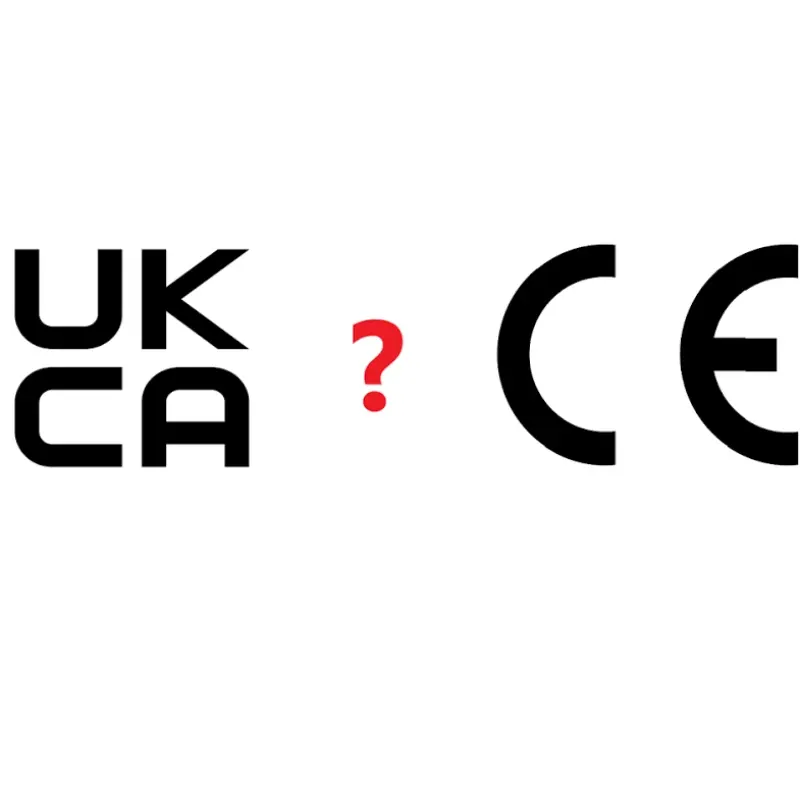
A lot of the guidance circulating online about UKCA marking is out of date — including, we noticed, parts of some otherwise well-maintained compliance sites. The short version keeps getting repeated: “the UK is replacing CE with UKCA, so you need both.” That was the plan back in 2021. It isn’t the current rule. Below is where things actually stand as of mid-2026, plus what belongs in your compliance file regardless of which mark you’re using.
One note before we get into it: this is general reference information, not legal advice. Regulations in this space have moved several times already, and your specific product, sales channel, and market mix can change what applies to you. Treat this as a starting point for the conversation with your compliance advisor, not a substitute for one.
The Short Answer: What You Actually Need
- Selling into the EU: CE marking is required. This hasn’t changed and isn’t likely to.
- Selling into Great Britain (England, Scotland, Wales): CE marking alone is currently sufficient. The UK government granted indefinite recognition of CE marking for PPE and most other consumer goods categories in 2024, which made UKCA marking voluntary rather than mandatory for products like sunglasses.
- Selling into Northern Ireland: Follows EU rules under the Windsor Framework — CE marking applies.
In practice, this means most brands selling sunglasses into both the UK and EU only need CE marking and don’t need to obtain UKCA marking separately, unless they have a specific commercial reason to want it (more on that further down).
Why the Confusion Persists
The UKCA timeline has shifted enough times that it’s worth laying out plainly:
- 2021: UKCA introduced as the UK’s post-Brexit replacement for CE marking, with an initial deadline to phase out CE recognition.
- 2022–2023: That deadline was pushed back more than once as businesses and testing bodies weren’t ready.
- January 2024: The UK Department for Business and Trade announced it would indefinitely extend CE marking recognition for a wide range of product categories, including PPE.
- October 2024: The Product Safety and Metrology etc. (Amendment) Regulations 2024 made that extension law, covering 21 product regulations.
- 2025–2026: CE marking remains valid for the UK market under this framework. UKCA is still available and still used by some brands, but it’s no longer a requirement for categories like PPE.
A lot of content written in 2021–2023, when “UKCA is about to become mandatory” was accurate advice, is still online and still gets cited — which is why the outdated version keeps circulating, especially in cross-border sourcing content translated from other languages.
Where Sunglasses Sit Under the Rules
Under the EU’s PPE Regulation (and its UK equivalent), sunglasses are classified as Category I — low risk. This matters because it determines how a product can be certified:
- Category I (sunglasses): Self-certification. The manufacturer or brand can declare conformity themselves, without third-party testing by a Notified Body, provided they hold valid test reports and documentation to back the declaration.
- Category II (e.g., safety/impact-protection eyewear): Requires assessment by a Notified Body (EU) or Approved Body (UK) before the mark can be applied.
Most fashion and lifestyle sunglasses fall into Category I. This keeps the compliance process relatively lightweight compared to, say, safety goggles — but “self-certified” doesn’t mean “untested.” You still need real test data behind the declaration; it just doesn’t have to come from a third-party certification body.
What Belongs in Your Compliance File
Whether you’re marking a product CE, UKCA, or both, the paperwork behind it is broadly the same. At minimum, expect to keep:
- A Declaration of Conformity (DoC) — a signed document stating the product meets the relevant standards.
- Test reports against the applicable standard. For sunglasses, that’s typically EN ISO 12312-1, which covers UV protection, light transmittance categories (0–4), and general optical requirements. Labs like Intertek, TÜV SÜD, and SATRA commonly handle this testing, among others.
- A risk assessment covering the main hazards for the product — UV exposure and physical breakage are the standard ones for sunglasses.
- Labelling and instructions — care and use instructions in the languages relevant to your markets.
- Material and substance compliance documentation, particularly REACH compliance for any plastics, dyes, or metal components.
These documents typically need to be kept for a set retention period (commonly cited as around 10 years) and made available if a market surveillance authority requests them.
Where the Mark Actually Goes
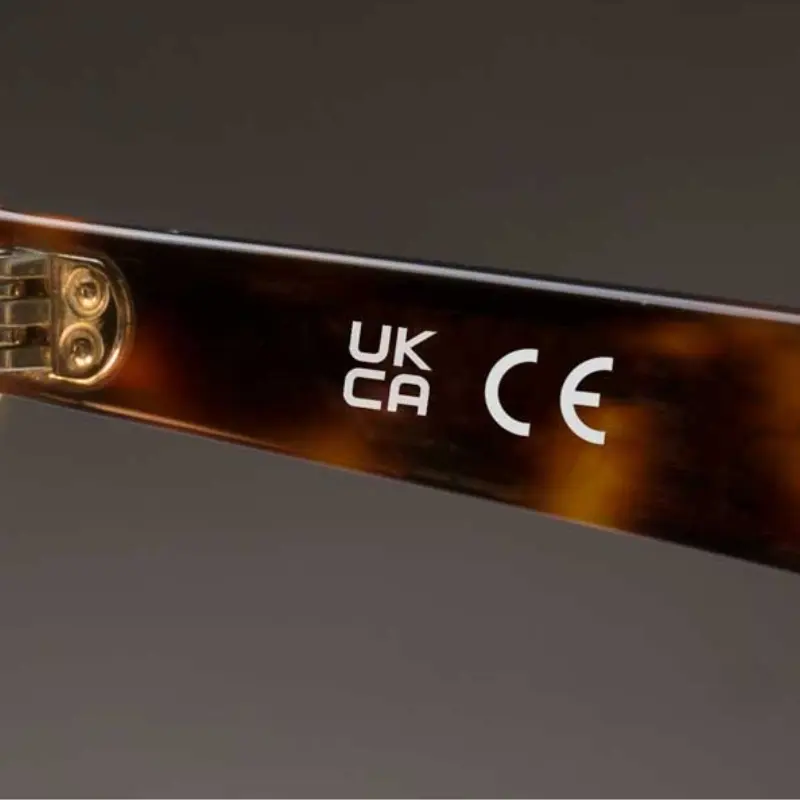
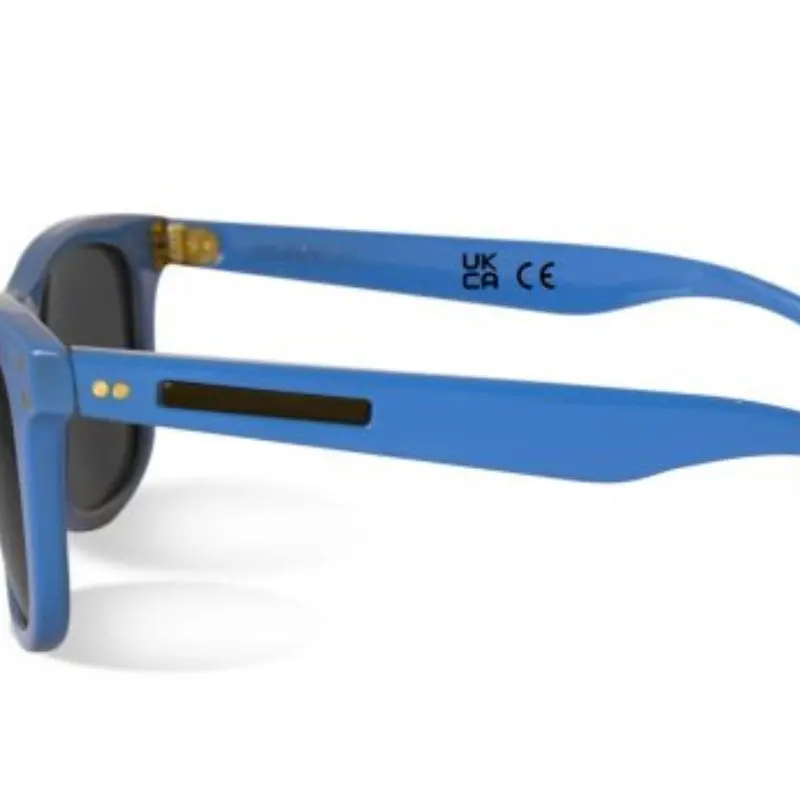
CE (and UKCA, if used) needs to be visible on the product itself — usually molded or printed on the inside of the temple arm — and referenced on the packaging. Separately from the conformity mark, packaging or product documentation generally needs to identify a responsible business with a contact address in the relevant market (EU or UK), so the product can be traced back to someone accountable if there’s an issue.
Does It Ever Make Sense to Add UKCA Anyway?
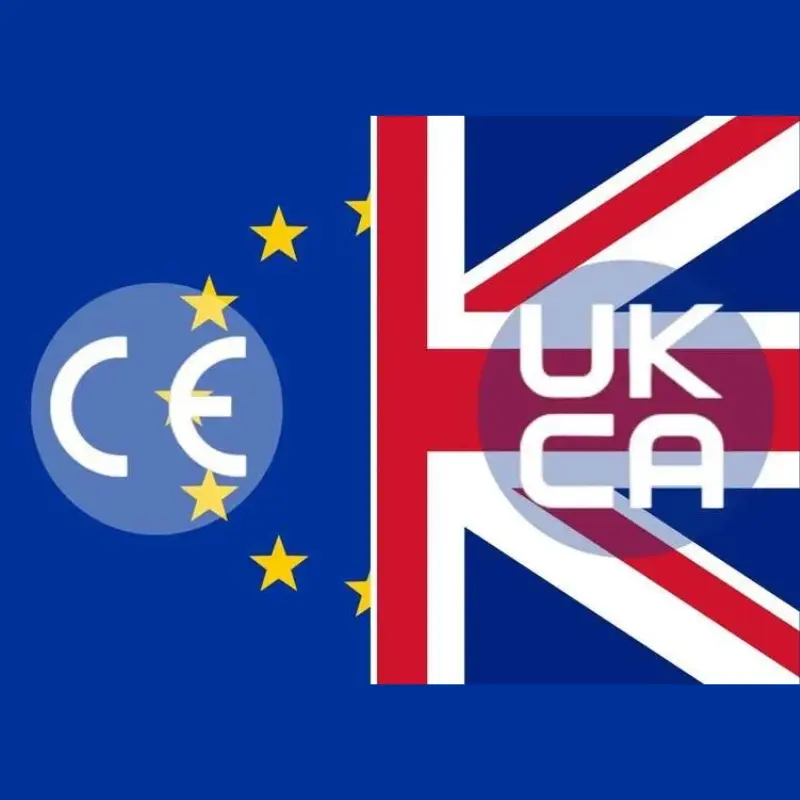
Given CE alone currently covers both markets, some brands still choose to apply UKCA as well. The common reasons:
- Retailer requirements. Some UK retailers or marketplaces ask for UKCA regardless of the legal minimum, simply because their own compliance policy hasn’t caught up with the 2024 change — or because they want the extra assurance.
- Future-proofing. “Indefinite” recognition isn’t the same as “permanent” — it means no end date has been set, not that one couldn’t be introduced later. Brands with a long-term UK strategy sometimes treat UKCA as insurance against a future policy shift.
- Existing packaging. Brands that already retooled packaging for dual marking in 2023–2024 often see no reason to remove it now.
None of these make UKCA mandatory for sunglasses today — they’re commercial judgment calls, not compliance requirements.
Who’s Actually on the Hook: Manufacturer vs. Importer
One point that gets lost in a lot of compliance guidance: if you’re a brand importing private-label sunglasses from a factory like ours into the EU or UK, you are generally the one carrying the legal responsibility as the importer of record — not the factory. That means the Declaration of Conformity, the technical file, and the labelling ultimately need to be in your name, even if the underlying test reports and product documentation come from your manufacturing partner.
In practice, this is a shared effort. On our side, we can supply lab-tested UV400 and EN ISO 12312-1 documentation, coordinate additional third-party testing when a client needs it for a specific market, and apply CE marking to the product and packaging as specified. What we can’t do is take on your legal responsibility as the importer — that part stays with the brand placing the product on the market, which is exactly why it’s worth having your own compliance advisor sign off before a first shipment, not just relying on supplier paperwork.
Frequently Asked Questions
Do sunglasses need CE marking to be sold in the EU?
Yes. CE marking is required for sunglasses sold in the EU under the PPE Regulation, and this requirement hasn’t changed. Sunglasses fall under Category I (low risk), which allows self-certification based on valid test reports rather than mandatory third-party certification.
Is UKCA marking mandatory for sunglasses in the UK in 2026?
No. As of 2026, the UK indefinitely recognizes CE marking for PPE products including sunglasses, so UKCA marking is optional rather than required. A product with valid CE marking and supporting documentation can be legally sold in Great Britain without a separate UKCA mark.
What testing standard applies to sunglasses?
The primary standard is EN ISO 12312-1, which covers UV protection, light transmittance categories, and general optical and mechanical requirements for sunglasses. Testing is typically carried out by an accredited lab.
Who is legally responsible for compliance — the factory or the brand?
The brand importing the product into the EU or UK market is generally the party legally responsible, as the importer of record. The manufacturer can supply test data, documentation, and marking support, but the compliance declaration and traceability requirements sit with the business placing the product on the market.
Is this article a substitute for legal advice?
No. Regulations around CE and UKCA marking have changed multiple times since 2021 and can vary by product category and market. This guide reflects the general rules as understood in mid-2026; for a specific product launch, confirm current requirements with a qualified compliance advisor before shipping.
If you’re bringing a new sunglasses line to market and need UV400/EN ISO 12312-1 test documentation or CE-marked samples to share with your compliance advisor, that’s something we handle as part of standard sampling — worth raising early in the conversation rather than after a first shipment is already booked.
Let's get started!
Get in touch with a custom eyewear specialist now for a free consultation and instant price quote.
WHATSAPP ME GO!
📱 Scan with your phone to start chatting