From First Sketch to First Sale
How our engineering team supported a first-time founder in Saudi Arabia through a stubborn structural design, a real MOQ negotiation, and a banking mix-up — without ever going quiet on her. A four-style collection, from concept to a repeat bulk order.
Solving the Core Challenges of Custom Eyewear Sourcing
Starting with sketches, not specs
We were contacted by a new brand founder based in Saudi Arabia, planning to launch a direct-to-consumer sunglasses label. There was no physical store yet — just a business license, a set of hand-drawn sketches, and a plan to start small. She had never sourced eyewear before, and said so plainly.
What she needed wasn't just a factory. It was a team willing to explain the reasoning behind every material choice, every lens option, and every cost — patiently, more than once.
- Market
- GCC · Online DTC launch
- Starting point
- 5 hand sketches, no tech pack
- Must-haves
- UV400 protection, build quality
- Constraint
- Startup budget, below-standard MOQ
- Materials
- Stainless steel & acetate
Three problems no brief mentions
The budget ceiling
Standard MOQ across the requested designs sat at 400–500 pieces per style. The founder's budget supported roughly that total across her entire first collection — not per style.
One design wouldn't behave
A sculpted, textured metal temple detail called for jewelry-level tooling, not standard frame production. A two-week 3D modeling step stretched into most of a month, across several revisions.
The payment that went missing
Days after the deposit was sent, it hadn't arrived. A routing error meant the transfer landed on the wrong account number — resolving it took two banks and roughly two weeks of back-and-forth.
What we did about it
None of the three problems above were solved by being agreeable. They were solved by being specific, honest, and willing to go to bat internally.
Advocating internally — without breaking our own numbers
We took the MOQ request to management directly and made the case for the founder's clarity of vision. The result: 300 pieces on two styles, 400 on the most complex one, with its mold fee handled separately — so the factory's own economics still held up.
Engineering judgment over quiet compliance
When a requested change risked the structural integrity of the sculpted temple design, our engineers said so directly, with the reasoning laid out — then left the final call with the founder.
Updates before being asked
Every delay was flagged the day it happened, with a reason and a revised date — including an honest "we're still not satisfied with this yet" on the hardest design.
Sketch to shipment, phase by phase
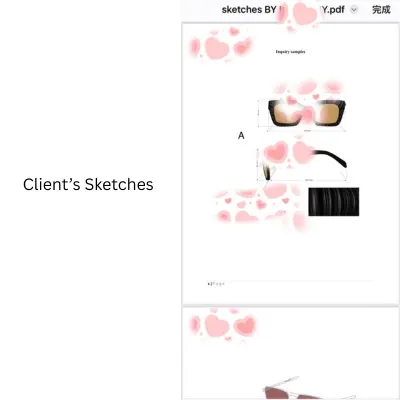
Sketches become a system
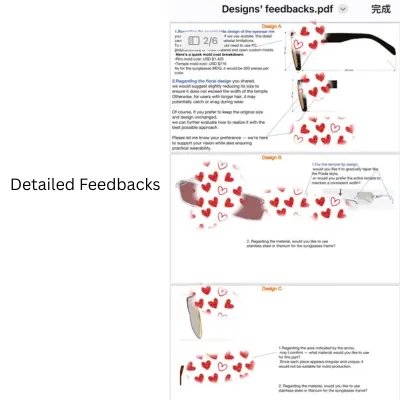
Five hand sketches were reviewed by our engineering team and returned with material recommendations, lens options, per-style MOQ, and mold costs where relevant.
Refining under budget
Two designs were dropped for cost and complexity. The remaining four were narrowed to specific materials, finishes, and hardware — and the MOQ conversation began.
Sampling begins
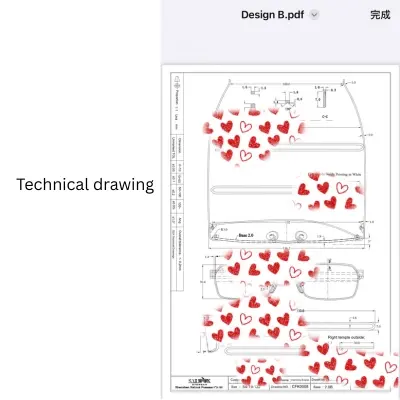
Deposit received, technical drawings issued for all four styles, and sign-off collected detail by detail — logo placement, lens tint, plating finish.
The hard one
The sculpted temple design required multiple 3D revisions before mold development could even start. We chose to delay rather than mold something we weren't confident in.
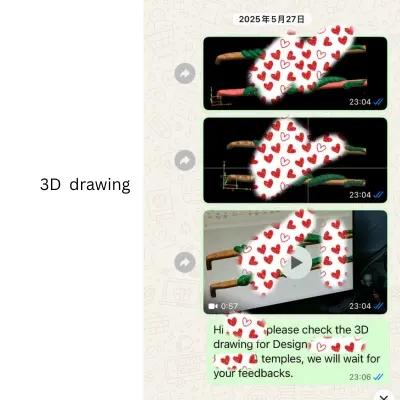
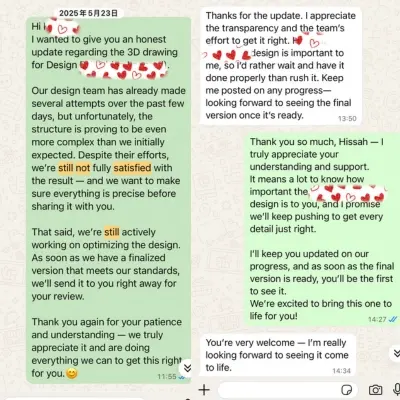
"We're still not fully satisfied with the result — we want to make sure everything is precise before sharing it with you."
From mold to finish
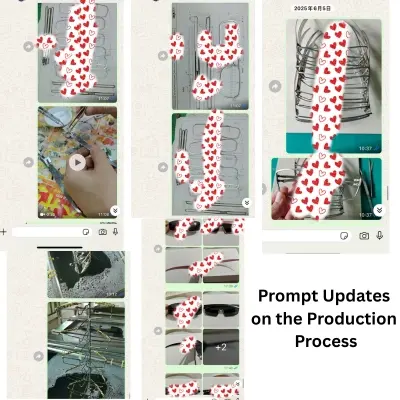
Mold opened, samples moved through plating and finishing, with progress photos shared at each stage — raw metal, plated, boxed.
Delivered, reviewed, adjusted
Samples shipped and arrived. Small measurement and finish adjustments were requested and folded into the bulk production drawings.
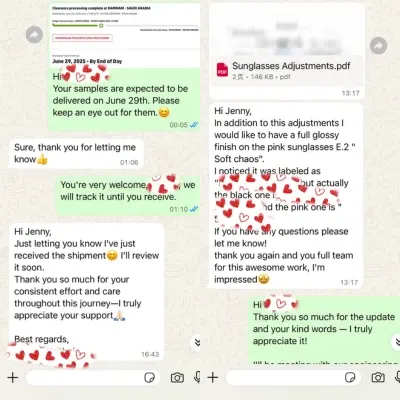
"Thank you for the update. I'll review your adjustments and get back to you shortly."
The first bulk order
The founder returned once funding was in place — ready to scale, but starting deliberately with one 200-piece style rather than the full range, to test the market before reinvesting.
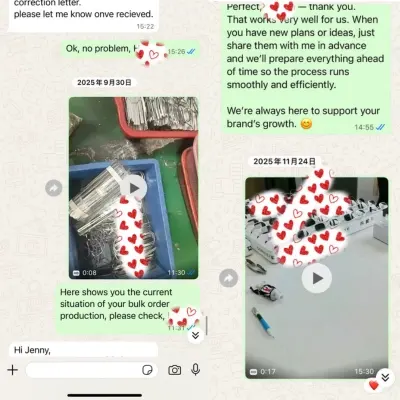
What the founder said along the way
"I really appreciate the effort your team put into refining the design. I understand your design intent and trust your expertise."
"I appreciate the transparency and the team's effort to get it right. I'd rather wait and have it done properly than rush it."
"Thank you all for your hard work — I hope soon we have a new bulk order too."
A first collection that made it to market — with a second order already underway
A founder without a tech pack. A design that fought us on every revision. A payment that briefly went to the wrong account. None of it derailed the collection — because the plan was never to avoid problems, only to be honest about them, fast. That's the same approach behind every private label collection we build, whether it's someone's first 300 pieces or their fifth reorder.
From Inquiry to Bulk Shipment
Here's how it works, step by step.
Start Your Own Eyewear Project
Bulk production timeline: after the sample is confirmed, bulk orders typically take 2–3 months depending on design complexity.