Metal Aviator Sunglasses: Construction Details That Separate Premium from Cheap
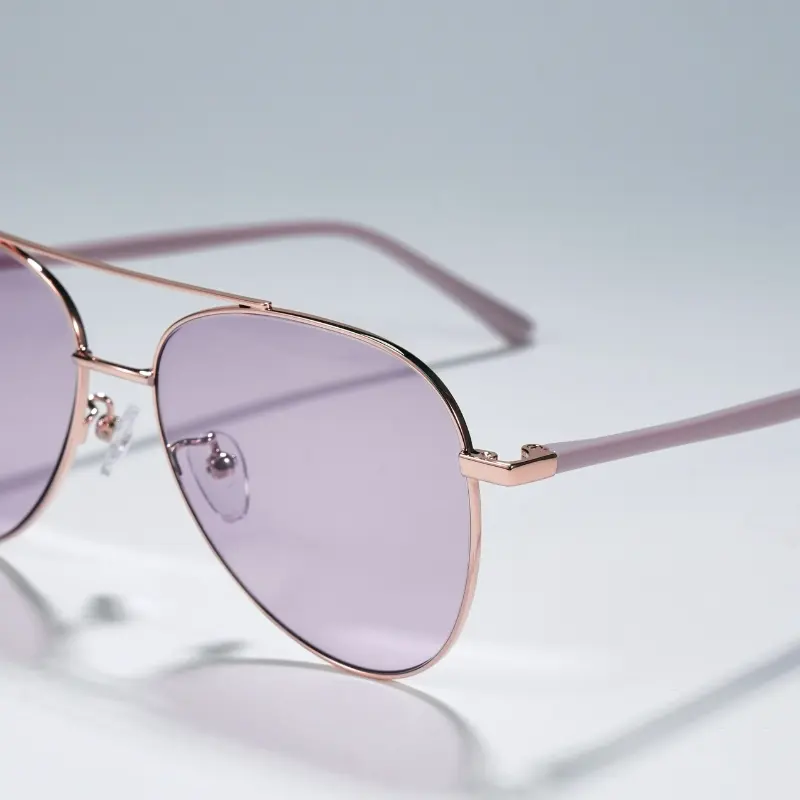
The aviator silhouette has changed very little since Bausch & Lomb developed the original design for US military pilots in the 1930s. Teardrop lenses, a thin metal frame, a brow bar above the bridge, and adjustable nose pads — these elements remain constant across every price point, from a five-dollar pair on a beach vendor’s rack to a three-hundred-dollar frame from a heritage optical brand.
That visual consistency is exactly what makes construction quality so easy to overlook. Two pairs of metal aviators can look nearly identical on a shelf and perform entirely differently after six months of daily use. The difference is not in the silhouette — it is in the specific construction decisions that determine how the frame holds its shape, how the hinges open and close after two years, and whether the plating holds up to daily contact with skin, sweat, and UV exposure.
This article breaks down the construction variables that matter, component by component, for brands sourcing or developing custom metal sunglasses in the aviator category.
Why Aviator Construction Is More Complex Than It Looks
Most sunglasses frames are relatively straightforward to assess from a construction standpoint. An acetate frame is either well-cut or not; a plastic injection frame either holds its shape or warps. Metal aviators are different because the same silhouette can be achieved through dramatically different manufacturing approaches — and the shortcuts are genuinely invisible until the product fails.
An aviator frame consists of more individual components than most other sunglass styles: front frame (two lens rims joined by a lower bridge), brow bar (upper bridge), temples (two), hinges (two, connecting temples to front), nose pad arms (two), nose pads (two), and all associated hardware. Each of these components has its own material specification, joining method, and finish requirement.
A cheap aviator compresses cost at every component. A premium one makes deliberate decisions at each. Understanding where the decisions are made — and what the alternatives look like — is the starting point for specifying a product that performs.
Frame Wire: The First Quality Signal You Can Feel
The front frame and temples of a metal aviator are formed from metal wire — typically drawn from a base alloy into the specific gauge and cross-section required. Wire gauge is the first physical quality signal in any metal aviator.
What Cheap Looks Like
Budget aviators use thin, light wire. The frame is easy to flex with light finger pressure. It may feel comfortable due to its lightness, but it is also the frame that bends permanently if you sit on it, and the one that slowly loses its alignment as the metal fatigues under daily use. Thin wire also provides less surface area for the plating to adhere to, which accelerates wear at stress points — particularly the brow bar joints and hinge mounts.
What Premium Looks Like
A well-constructed aviator uses wire with appropriate gauge for the frame size. The frame has a slight resistance when you flex it by hand — not rigid, but purposeful. It returns to its original geometry. The brow bar connects to the lower bridge at two soldered or welded points that are flush and smooth, not raised or rough. The cross-section of the wire may be round, oval, or rectangular depending on the design — and on a premium frame, that cross-section is consistent along the entire length.
What to Specify
When ordering custom aviators, specify wire gauge in millimeters and the alloy. Common specifications:
| Wire Type | Gauge Range | Typical Application |
|---|---|---|
| Round wire | 1.0–1.4 mm | Standard fashion aviator |
| Flat wire | 0.8–1.2 mm width | Minimalist / thin profile |
| Oval wire | 1.2–1.5 mm | Structural front frame |
Request a physical sample before production approval and flex-test it by hand against your reference standard.
The Double Bridge: Structural Role vs. Decorative Detail
The double bridge — the combination of the lower nose bridge and the upper brow bar — is the defining visual element of the aviator. It is also a structural component, and the quality difference between a premium and cheap brow bar is significant under close inspection.
Function of the Double Bridge
The brow bar serves two purposes. Structurally, it distributes the weight of the large teardrop lenses across a wider span, reducing stress concentration at the single lower bridge. Historically, it also acted as a sweat barrier for pilots. In modern construction, it remains a load-bearing structural element — not merely a styling feature.
Where Cheap Frames Cut Corners
On budget frames, the brow bar is often a thin strip of metal stamped to shape and spot-welded to the front frame at two points. The weld points are visible as small bumps, sometimes with residual oxidation around them. The brow bar itself has little structural depth — it is surface area only.
On cheaper constructions, the brow bar and lower bridge may not be aligned in the same plane, creating a slight twist in the front frame that is visible when you look at the frame face-on. This misalignment is a manufacturing tolerance issue that affects both appearance and how the frame sits on the face.
What Premium Construction Looks Like
A well-made brow bar has a consistent cross-section — either round wire or flat-section bar — and is joined to the front frame with soldered joints that are fully flush after filing and polishing. No solder bumps are visible. The junction of the brow bar ends with the lens rim is smooth, with a clean radius, not a sharp corner. The brow bar and lower bridge are in the same plane when the front frame is laid flat.
Hinges: Where Most Cheap Aviators Fail First
Hinge quality is consistently the most cited construction failure in consumer reviews of budget metal aviators. The hinge is also the component where the difference between cheap and premium is most directly measurable.
Hinge Barrel Count
Hinges are classified by the number of interlocking barrels (also called knuckles) that form the joint:
| Barrel Count | Common Name | Typical Application |
|---|---|---|
| 1-barrel | Single hinge | Cheapest production; minimal durability |
| 3-barrel | Standard hinge | Mid-range; acceptable for fashion product |
| 5-barrel | Five-barrel hinge | Premium; smooth action, longest service life |
| 7-barrel | Extended hinge | High-end specialty; maximum durability |
A 5-barrel hinge distributes the opening and closing force across more contact surface, which means each barrel experiences less wear per cycle. A 1-barrel hinge concentrates all force on a single joint — the single point that will loosen, wobble, and eventually fail.
On a budget aviator, hinges are often 1- or 2-barrel constructions. The temple opens with a loose, wobbly action from the first use. On a well-made frame, a 5-barrel hinge has a consistent, damped feel — not too stiff, not loose, with the same resistance across the full arc of motion.
Spring Hinges vs. Standard Hinges
Spring hinges add a small spring mechanism inside the barrel that allows the temple to flex outward beyond the standard 90-degree open position. This accommodates wider head shapes and reduces pressure on the temples.
The quality variable in spring hinges is the spring mechanism itself. A cheap spring hinge uses a thin flat spring that loses tension within months of regular use. A quality spring hinge — such as those manufactured by OBE in Germany — uses a coil or leaf spring with consistent return force over thousands of cycles, and the barrel enclosing the spring is properly sealed to prevent the mechanism from loosening.
When specifying custom aviators with spring hinges, ask your supplier to identify the hinge manufacturer. Generic hinge supply from unspecified sources is a consistent quality variable.
Hinge Mounting
The hinge connects to the front frame end-piece and to the temple. On budget frames, the hinge is often welded at a single point to a flat metal end-piece soldered to the lens rim. The joint is the weakest point of the assembly.
On premium frames, the end-piece is part of the frame structure — not a surface-attached component — and the hinge is mounted with mechanical fasteners (screws) in addition to or instead of welding. The screw mounting means the hinge can be tightened or replaced without affecting the surrounding frame structure.
Temple Width and Hinge Compatibility
There is a physical constraint that connects wire gauge and hinge barrel count — one that is rarely explained but directly affects what is achievable in production.
A hinge is welded or embedded into the end of the temple. Each barrel occupies approximately 1–1.5 mm of width. This means the total hinge width must fit within the temple cross-section — a hinge wider than the temple cannot be cleanly recessed, and will protrude visibly or create an assembly problem.
The consequence: a thin-wire temple physically cannot accommodate a high-barrel hinge. A frame built with 1.0 mm round wire temples is limited to 1- or 2-barrel hinges. To specify a 5-barrel hinge, the temple must be wide enough to accept it.
| Temple Wire Diameter | Maximum Hinge Barrel Count |
|---|---|
| ≤1.0 mm | 1–2 barrels |
| 1.2–1.4 mm | 3 barrels |
| 1.5–1.8 mm | 5 barrels |
| ≥2.0 mm or flat end-piece | 7 barrels |
This is why wire gauge and hinge specification must be considered together, not separately. A brand that specifies “5-barrel hinges” on a design using 1.2 mm temple wire will either receive pushback from a competent manufacturer, or worse, receive a frame where the hinge is surface-attached rather than properly recessed — creating a weak joint from the start.
When developing custom metal sunglasses in the aviator category, confirming temple wire diameter before finalizing hinge specification is a step that prevents costly redesign after sampling.
Nose Pad System: Adjustability Is Just the Starting Point
Adjustable nose pads are standard on metal aviators. The presence of adjustable nose pads is not itself a quality indicator — what matters is the specification of the pad material, the pad arm, and the mounting method.

Nose Pad Material
| Material | Characteristics | Typical Use |
|---|---|---|
| Hard PVC | Rigid, low cost, may yellow over time | Budget frames |
| Soft PVC | Slightly flexible, common mid-range | Standard fashion aviator |
| Silicone | Soft, non-slip, does not yellow, hypoallergenic | Quality and premium frames |
| Acetate | Firm but smooth, sometimes used for aesthetic finish | Design-forward frames |
Silicone nose pads are the correct specification for any frame positioned at mid-range or above. They are softer on skin, maintain their grip without leaving marks, and do not degrade in color with UV exposure the way soft PVC does.
Nose Pad Arms
The pad arms are the bent metal extensions that connect the nose pad to the frame bridge. On cheap frames, the pad arms are thin and bend easily — sometimes intentionally, as they are meant to be user-adjustable. The problem is that they bend too easily and lose their set position within weeks.
On well-made frames, pad arms are formed from a slightly thicker or harder alloy, hold their adjusted position firmly, and can be re-adjusted multiple times without work-hardening and snapping. The pad arm should bend when deliberately adjusted with pad arm pliers, but not shift under the pressure of normal wear.
Mounting Method
Nose pads are mounted to pad arms via either a push-in clip system or a screw. Screw-mounted pads (with a small flathead or pin screw) are more secure and allow replacement. Clip-on pads — common on cheaper frames — are faster to assemble but prone to popping off.
Base Material: The Foundation Everything Else Depends On
The wire and components used in a metal aviator are formed from a base alloy that determines the frame’s structural properties, its compatibility with electroplating, and its corrosion resistance over time.
Common Base Materials and What They Mean
Zinc alloy (Zamak) Used in the lowest-cost frames. Easy to cast into complex shapes but brittle — it snaps rather than bends. Plating adhesion is poor, which is why zinc alloy frames often show plating failure at stress points within months. A zinc alloy frame feels heavy for its size due to the density of the material.
White copper alloy (Nickel silver / German silver) The standard material for mid-range metal eyewear. Bendable, good plating adhesion, cost-effective. Most fashion metal aviators at mid-price use white copper for the front frame and temples. It is not a premium material, but it performs well when the rest of the frame construction is done correctly.
Stainless steel Higher tensile strength than white copper, excellent corrosion resistance, good plating adhesion. Harder to form, which means more tooling cost, but the resulting frame is more resistant to permanent deformation. Stainless steel frames can be made thinner for the same structural rigidity — which is why stainless steel aviators can feel light without feeling flimsy.
Monel alloy A nickel-copper alloy with excellent corrosion resistance and flexibility. Common in higher-end fashion and optical eyewear. More expensive than stainless steel but easier to adjust without breaking — useful for frames that will be fitted by opticians.
Titanium The premium specification. Extremely light, biocompatible, hypoallergenic, and highly corrosion-resistant. Requires IP plating rather than water plating. The cost is significantly higher than other materials. Titanium aviators are appropriate for luxury positioning or markets where material quality claims are a purchase driver.
For a detailed comparison of how stainless steel, Monel, and aluminum perform across key purchasing criteria, see Metal Sunglasses Materials Compared: Stainless Steel, Monel, Aluminum.
Material and Plating Compatibility
The base material determines which plating method can be used. Zinc alloy and white copper are compatible with standard water plating. Stainless steel and Monel can use either water plating or IP plating. Titanium requires IP plating. If a brand wants IP-plated finishes — deeper matte tones, stronger adhesion — the frame material needs to be specified accordingly.
For a full breakdown of plating methods, color options, salt spray testing, and nickel-free compliance, see Electroplating on Metal Eyewear: Colors, Durability, and What to Ask Your Supplier.
Lens Construction in the Context of the Frame
Lens quality is a separate topic from frame construction, but the two interact in ways that matter for aviators specifically. The large teardrop lens of an aviator puts more stress on the lens-to-frame junction than a smaller lens, because the mass and leverage of the lens exerts more force on the rim at any given impact.

Lens Mounting Method in Metal Aviators
Metal aviators typically use one of two lens mounting methods:
Groove mount (rimway): A groove is cut around the perimeter of the lens, and a metal wire or nylon thread is threaded through the rim to hold the lens in. This is the standard construction for most fashion metal aviators. The tension of the wire/thread holds the lens; it can be re-strung if the lens is replaced.
Screw mount (three-piece or rimless): Less common in full-rim aviators, but used in semi-rimless and rimless variants. Lenses are held by screws through drilled holes at the frame contact points.
For groove-mount aviators, the quality variable is the stiffness of the metal rim and the tension of the groove wire. A cheap frame uses a thin, soft rim that deforms under lens pressure, eventually causing the lens to shift or pop out. A well-made frame uses a consistent-gauge rim with enough stiffness to maintain its shape under lens tension.
Lens Material Options
| Lens Material | Optical Quality | Impact Resistance | Weight | Typical Use |
|---|---|---|---|---|
| CR-39 (resin) | Excellent | Moderate | Light | Standard quality |
| Polycarbonate (PC) | Good | High | Very light | Active / sport use |
| TAC (polarized laminate) | Good | Moderate | Light | Fashion polarized |
| Glass (mineral) | Excellent | Low | Heavy | Premium / optical |
| Nylon (NXT) | Excellent | Very high | Light | High-performance |
For fashion metal aviators at mid-to-premium positioning, CR-39 with a polarized coating or TAC polarized lenses are the standard specification. Polycarbonate is appropriate for active or sport-positioned products. Glass lenses are used for premium positioning where optical clarity is a primary claim.
What to Specify When Ordering Custom Metal Aviators
For brands developing custom aviator frames through an OEM manufacturer, the following specifications are the minimum required to define a product correctly. Generic product descriptions — “stainless steel frame,” “spring hinges,” “polarized lenses” — are insufficient to ensure quality consistency across production runs.
Frame wire:
- Alloy composition (stainless steel, Monel, white copper — specify grade)
- Wire gauge in millimeters
- Cross-section profile (round, oval, flat)
Double bridge:
- Brow bar diameter / section
- Joint method (soldered, welded) and finish standard (flush, polished)
- Alignment tolerance between brow bar and lower bridge
Hinges:
- Barrel count (specify 5-barrel minimum for mid-range and above)
- Spring hinge: yes / no; if yes, specify hinge supplier or approved brands
- Mounting method (welded end-piece, screw-mount end-piece)
Nose pads:
- Pad material (silicone for mid-range and above)
- Pad arm alloy and thickness
- Mounting method (screw-mount preferred)
Plating:
- Method (water plating or IP)
- Nickel-free: yes / no
- Sealing coat standard (salt spray test hours)
Lenses:
- Material (CR-39, PC, TAC, glass)
- Polarized: yes / no
- UV standard (UV400)
- Mounting method (groove mount, screw mount)
At Sailook, when clients develop custom metal sunglasses in the aviator category, we work through each of these specification points before sampling begins. A reference sample that passes on these parameters produces consistent batch quality. A sample approved without these parameters leaves the quality variables undefined — and they will resolve themselves in production, not always in the direction you want.
FAQ
What makes a metal aviator frame premium vs cheap?
The differences are distributed across every component: wire gauge, brow bar joint quality, hinge barrel count, nose pad material, and base alloy. A premium metal aviator uses heavier-gauge wire, smooth soldered brow bar joints, 5-barrel hinges, silicone nose pads, and a base material of stainless steel, Monel, or titanium. A cheap frame compromises on most or all of these. The visual difference is subtle; the performance difference over time is significant.
How many barrels should a good aviator hinge have?
Five barrels is the standard specification for mid-range and premium metal aviators. Three-barrel hinges are acceptable for entry-level fashion product. One- and two-barrel hinges are inadequate for any frame intended for daily use — they loosen quickly and are difficult to tighten without replacing the entire hinge assembly.
That said, hinge barrel count is constrained by temple wire diameter.
A 5-barrel hinge requires a temple of at least 1.5 mm to be properly recessed — if the temple wire is too thin, the hinge cannot be cleanly embedded and will be surface-attached instead, which undermines the durability advantage. Specifying 5-barrel hinges only makes sense when the frame design uses a temple gauge wide enough to accommodate them.
What is the difference between a spring hinge and a standard hinge on metal aviators?
A standard hinge opens to approximately 90 degrees — the position where the temple is perpendicular to the front frame. A spring hinge includes a spring mechanism that allows the temple to flex further outward, accommodating wider head shapes and reducing clamping pressure. Quality spring hinges maintain their return force over thousands of cycles; cheap spring hinges lose tension quickly. For most fashion aviators, spring hinges are worth specifying at mid-range and above.
What base material should I specify for my custom aviator frames?
For entry-level fashion product: white copper alloy. For mid-range and above: stainless steel. For premium or luxury positioning: Monel or titanium. Avoid zinc alloy (Zamak) for any product intended for regular daily use — it is structurally brittle and has poor plating adhesion.
What is the brow bar on aviator sunglasses, and does it affect quality?
The brow bar is the upper of the two bridges that define the aviator silhouette. It is a structural component that distributes lens weight and frame stress across a wider span. On cheap frames, the brow bar is thinly stamped metal spot-welded to the front frame, with visible joint bumps. On well-made frames, it is a proportionally sized wire or bar soldered flush to the front, polished smooth, and aligned precisely with the lower bridge. A misaligned brow bar is visible when the front frame is laid flat and is a direct indicator of production tolerance quality.
Can I order aviator frames with titanium construction from a Chinese manufacturer?
Yes. Titanium aviator frames are produced by manufacturers in China; premium production is concentrated in Shenzhen. The material requires different tooling and processing than steel or white copper, and the plating must use IP (ion plating / PVD) rather than water plating. MOQ requirements and per-unit cost are higher than for steel or white copper frames.

Summary
The metal aviator silhouette is visually stable across price points. The construction beneath that silhouette is not. Wire gauge, brow bar joint quality, hinge barrel count, nose pad material, base alloy, and lens mounting method each represent a decision point where a manufacturer either invests in quality or compresses cost. These decisions are invisible at the point of purchase and visible only after months of use.
For brands sourcing custom metal aviators, translating visual reference into a written specification — wire gauge, hinge barrel count, pad material, alloy grade — is the step that converts a sample approval into a consistent production standard.
Let's get started!
Get in touch with a custom eyewear specialist now for a free consultation and instant price quote.
WHATSAPP ME GO!
📱 Scan with your phone to start chatting