OEM vs ODM vs Private Label Eyewear: Which Model Is Right for Your Brand?
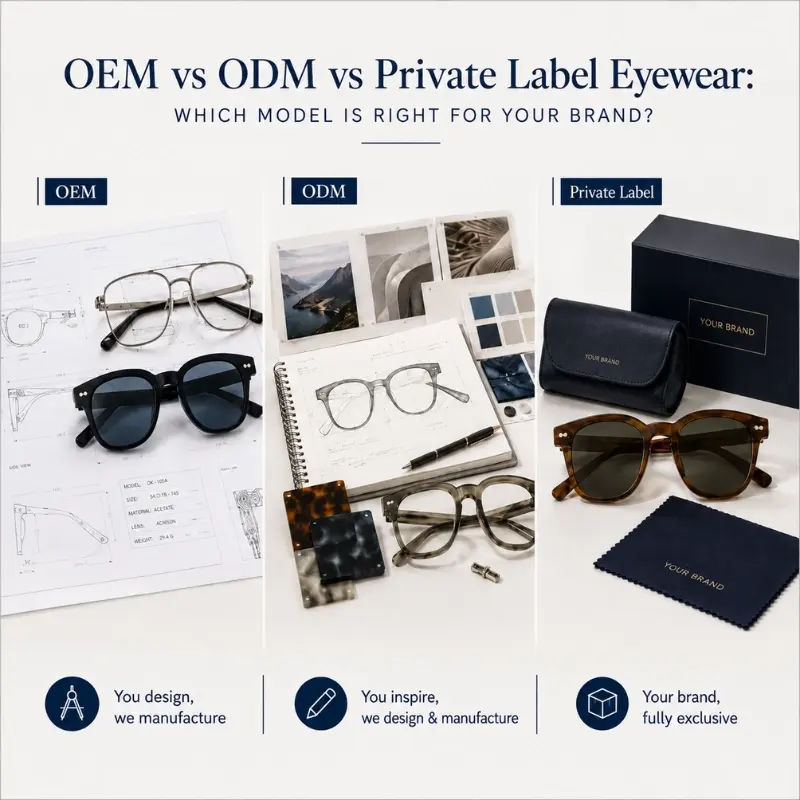
You want to launch an eyewear brand. You contact a factory. They ask: “Do you need OEM, ODM, or private label?” And suddenly you’re stuck.
OEM eyewear, ODM eyewear, and private label manufacturing are three ways to work with a factory — but they’re not the same thing. The difference comes down to who designs the product, how much customization you get, and whether your final frames are exclusive to your brand. Choosing the wrong model costs you time, money, and market position.
So what does each model actually mean? And which one fits where your brand is right now? Let’s break it down clearly.
What Is OEM Eyewear — And Who Is It For?
Most brand owners hear “OEM” and assume it covers any custom factory order. It doesn’t.
OEM eyewear (Original Equipment Manufacturer) means you provide the complete design — technical drawings, 3D files, or detailed specs — and the factory produces it to your exact requirements. You own the design. The factory owns the production process. Every structural detail is yours.
Here’s how a real OEM project works.
You come in with a design. That could be a CAD file, a 3D model, or a set of technical drawings with detailed measurements. The factory’s engineering team reviews your specs, identifies any production constraints, and confirms what’s achievable within your material and budget requirements. If a new mold is needed for your frame shape, that tooling cost is quoted and agreed upfront — typically between $800 and $3,000 per style depending on complexity.
Once tooling is confirmed, the factory produces a first sample. You review it physically, request any adjustments, and go through revision rounds until it matches your spec exactly. After sample sign-off, bulk production begins. A full OEM cycle from design submission to bulk shipment runs approximately 90 to 150 days.
The defining feature of OEM is ownership. Your mold is yours. No other brand can use it. Your frame geometry, your hinge design, your temple width — these are proprietary. That exclusivity is the core reason brands invest in OEM.
Here’s what most people miss: OEM isn’t just for large brands. It’s the right model whenever your product design is a core part of your brand’s value — when the frame itself needs to be something nobody else has. If you’re building a brand at a $100+ retail price point, or if your design is the thing that differentiates you, OEM protects that investment.
The trade-off is upfront cost and time. You need a design ready to hand off, budget for tooling, and a longer development runway. For brands testing a new category or launching their first collection, those barriers are real.
Who should use OEM eyewear?
- Established brands with finished design assets and a clear aesthetic direction
- Brands at premium retail price points where frame exclusivity matters
- Companies where the product design is the primary point of differentiation
- Fashion houses or designer brands launching eyewear as a signature line
What Is ODM Eyewear — And Why Do Growing Brands Use It?
ODM is where most serious eyewear brands actually start — and it’s often misunderstood as a shortcut. It isn’t.
ODM eyewear (Original Design Manufacturer) means you start from a concept, reference, or brand direction — and the factory’s design and engineering team develops the product with you. You guide the direction. They handle the technical development. The final design is built to your brand’s requirements and produced exclusively for you.
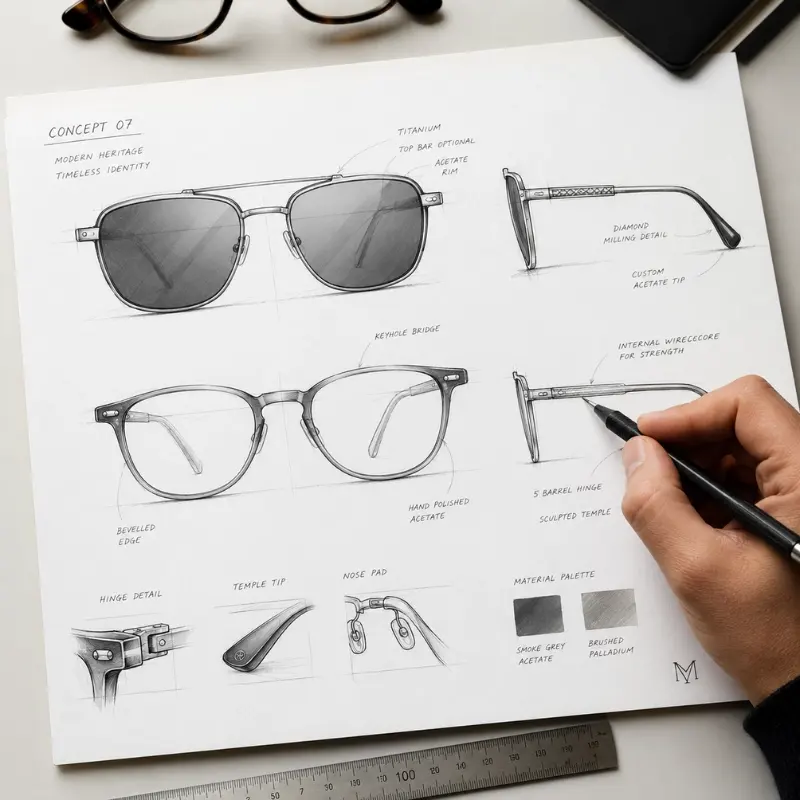
This is a collaborative process, not a catalog selection. Here’s what it actually looks like in practice.
You come in with a direction — maybe a mood board, a reference frame you like the shape of, a sketch, or simply a clear sense of your target customer and price point. The factory’s design team takes that input and develops technical drawings and 3D renderings before a single sample is cut. You review those drawings, make adjustments, align on materials, color palette, lens options, and branding placement. Once the design is confirmed on paper, sampling begins.
The sample goes through revision rounds until it matches your expectations. Every detail — frame shape, hinge mechanism, temple finish, nose pad style, logo application method — is confirmed against your brief. After sample approval, bulk production runs to the locked spec. Your design is not resold or shared with any other client.
Here’s the deal: ODM gives you a fully custom product without requiring you to arrive with finished technical specs. You don’t need a design team or a 3D file to start. You need a brand direction and a clear idea of what you’re trying to achieve for your customer. The factory bridges the gap between concept and manufacturable product.
MOQs for ODM typically start at 300 to 500 pieces per style, depending on material. Sampling takes 10 to 20 days from approved design. Bulk lead time runs 45 to 60 days after sample sign-off.
The bottom line? For brands that know what they want but don’t have an in-house design or engineering team, ODM is the most practical route to a fully branded, exclusive product. It combines real customization with the factory’s manufacturing expertise.
Who should use ODM eyewear?
- Brands launching their first eyewear collection without in-house design capability
- Fashion or lifestyle brands adding eyewear as a product category
- Growing brands that want exclusive designs without the full OEM development investment
- Any brand where the product needs to reflect a specific aesthetic — not just a logo on a stock frame
What Is Private Label Eyewear — And What Does It Actually Mean?
Private label is one of the most misused terms in the eyewear industry. It’s worth getting the definition right.
In the eyewear industry, “private label” broadly means manufacturing under your brand name — with the final product exclusive to you. Depending on the factory, this can range from logo customization on existing frames all the way to full design development from scratch. What stays consistent is that your brand owns the product identity.
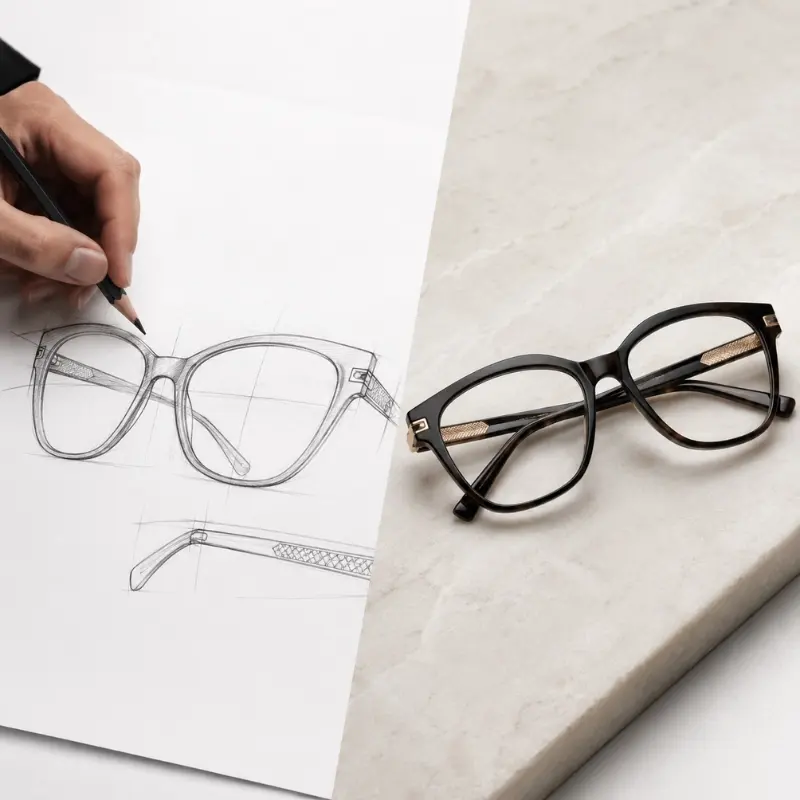
You might be wondering why this definition is broader than what you’ve read elsewhere. Here’s why it matters.
Many manufacturers use “private label” and “ODM” interchangeably — because in practice, the two overlap heavily. A private label eyewear manufacturer that offers real design development is doing something fundamentally different from a supplier who just prints your logo on a shelf frame. The word “private label” tells you about brand ownership. It doesn’t automatically tell you how much design input you have.
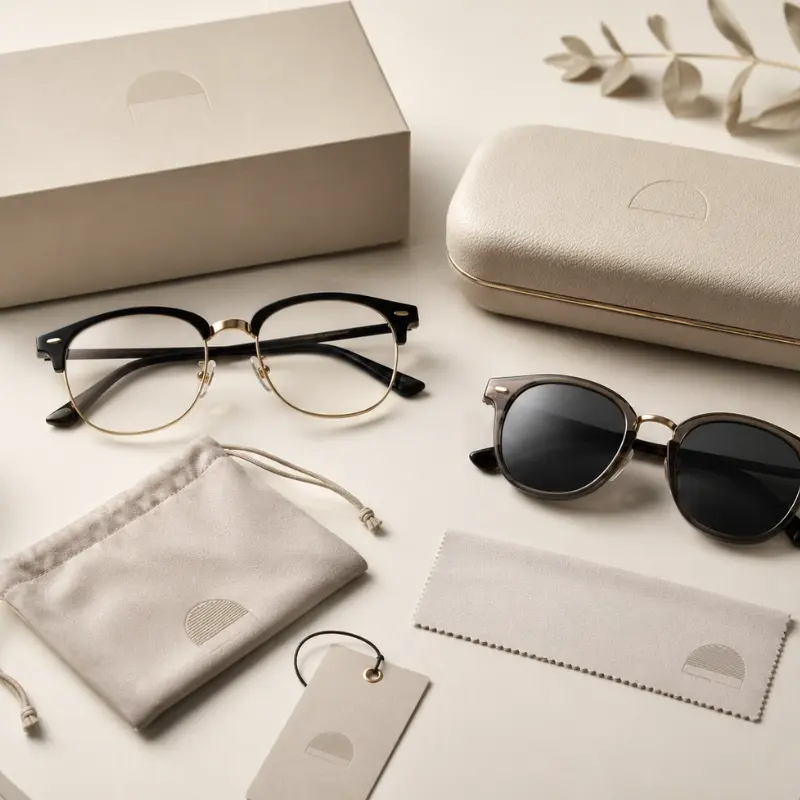
At a full-service private label manufacturer, the process looks like this: you share your concept, references, or brand direction. The factory develops technical drawings and specifications with you. You approve a sample. Bulk production runs to your confirmed spec — and that design is yours exclusively, not sold to any other client. Packaging, cases, cleaning cloths, hang tags, and retail boxes are all developed to match your brand identity.
This is not a stock frame with a sticker. It’s a complete branded product developed around your brief.
The practical parameters: MOQ typically starts at 300 to 500 pieces per style for most frame materials. Sampling takes 10 to 20 days. Bulk production runs 45 to 60 days. IP protection — including NDA — is standard before any design work begins.
What most people miss: “Private label” done right is not the low-investment shortcut people assume it is. It’s a serious manufacturing partnership where the factory’s expertise compensates for design resources you may not have internally. The output is a product that carries your brand and only your brand.
Who should use private label eyewear manufacturing?
- Independent designers and emerging brands building their first collection
- Established eyewear brands scaling production with a trusted manufacturing partner
- Fashion labels launching an eyewear line with no prior manufacturing experience
- Any brand that wants a fully custom, exclusive product but doesn’t want to manage a design team
OEM vs ODM vs Private Label: Side-by-Side Comparison
Here’s a direct comparison across the factors that matter most when choosing a manufacturing model.
| Aspect | OEM | ODM | Private Label (full-service) |
|---|---|---|---|
| Who designs the frame? | You (bring finished specs) | Factory develops with you | Factory develops with you |
| Design starting point | Technical drawings / CAD files | Concept, reference, or brief | Concept, reference, or brief |
| Frame exclusivity | Full — your mold, your design | Full — design built for your brand only | Full — not resold to other clients |
| Customization depth | Complete control over every spec | Shape, material, color, lens, logo, packaging | Shape, material, color, lens, logo, packaging |
| IP ownership | You own the design and mold | Design files yours; factory owns mold tooling | Design files yours; factory owns mold tooling |
| MOQ (per style) | 300–1,000 pcs | 300–500 pcs | 300–500 pcs |
| Sampling lead time | 15–25 days after spec approval | 10–20 days after design approval | 10–20 days after design approval |
| Bulk lead time | 60–90 days | 45–60 days | 45–60 days |
| In-house design required? | Yes | No | No |
| Best for | Brands with finished designs, premium exclusivity | Brands with a concept but no design team | First collections, scaling brands, fashion labels |
The truth is, OEM and full-service ODM/private label produce comparable levels of product quality and brand exclusivity. The real difference is your starting point: do you arrive with finished technical specs, or do you need the factory to help develop the product from your brand direction?
Which Model Is Right for Your Brand? A Practical Framework
You’ve seen the definitions. Now here’s how to actually make the decision.
Ask yourself these three questions first
1. Do you have finished technical drawings or a design file ready to hand off?
If yes, OEM is your path. You’re paying for production, not development. You get the highest level of structural exclusivity because the mold is built to your exact spec.
If no — if you’re starting from a concept, a reference frame, or a brand direction — ODM or full-service private label is the right fit. You’re working with a factory that brings both manufacturing and design capability to the table.
2. How important is speed to market?
OEM with a new mold takes 90 to 150 days from design sign-off. If your launch timeline is tighter than that, ODM or private label — which starts from a concept rather than a finished spec — typically gets you to sample faster because the design development happens in parallel with your input, not before it.
3. What’s your budget for the first order?
OEM with custom tooling requires upfront mold investment on top of per-unit costs. ODM and private label programs typically have lower tooling requirements because design development is part of the service. Either way, plan for 300+ pieces per style as your production baseline.
The most common path for growing brands
Most brands don’t start with OEM. They start with ODM or private label — get a fully custom, exclusive product to market — validate what sells — then consider OEM tooling for their hero styles once they have real data.
That’s not a compromise. That’s the smart sequence. You’re not gambling tooling money on designs you haven’t tested. You’re building with a partner who can take you from concept to market, then scale with you as your brand grows.
This is part of our complete guide to private label eyewear manufacturing. If you want to talk through which model fits your specific situation — your brand stage, product category, and timeline — we respond within 4 business hours.
Conclusion
OEM eyewear requires finished designs and gives you full mold ownership. ODM and private label start from your concept and give you a fully exclusive product developed with the factory’s design team. For most brands, the right starting point is the model that matches where your designs are — not just where you want to end up.
Frequently Asked Questions
What is OEM eyewear in simple terms?
OEM eyewear means you provide completed design specifications and a factory produces the frames to your exact requirements. You own the design. The factory owns the manufacturing process. Your frame geometry is exclusive to your brand.
What’s the difference between OEM and ODM eyewear?
With OEM, you bring finished technical drawings and the factory builds to your spec. With ODM, you bring a concept or brand direction and the factory’s design team develops the product with you. Both produce exclusive, branded results — the difference is your starting point.
Is private label eyewear the same as putting a logo on a stock frame?
Not with a full-service manufacturer. Real private label eyewear manufacturing means developing a product to your brand’s requirements — shape, material, color, lens, and packaging — that is produced exclusively for your brand and not resold to other clients.
Do I need technical drawings to start a private label project?
No. A full-service private label manufacturer can start from a concept, reference frame, mood board, or brand direction. Technical drawings and 3D renderings are developed as part of the design process before sampling begins.
What is the minimum order quantity for private label eyewear?
MOQ typically starts at 300 to 500 pieces per style for acetate, stainless steel, and titanium frames. Some materials or mixed-material projects may have higher minimums. Early-stage brands can discuss flexible options based on their specific project.
How long does it take to produce custom private label eyewear?
Sampling takes 10 to 20 days after design approval. Bulk production runs 45 to 60 days after sample sign-off. The full cycle from first inquiry to bulk shipment is typically 60 to 90 days, depending on revision rounds and material.
Who owns the design in an ODM or private label project?
The design files and IP developed for your project belong to you. A reputable manufacturer will sign an NDA before any design work begins and will not resell or share your exclusive designs with other clients.
Which model is best for a fashion brand adding eyewear to their product line?
ODM or full-service private label is almost always the right fit. You can start from a brand direction — color palette, aesthetic references, target customer — and the factory develops a product that matches your brand’s visual identity. No in-house design team required.
Let's get started!
Get in touch with a custom eyewear specialist now for a free consultation and instant price quote.
WHATSAPP ME GO!
📱 Scan with your phone to start chatting