PC Sunglasses Color and Coating Options: UV, Mirror, and Polarized Combinations
Lens color and coating are the decisions that most directly affect how a sunglasses product looks and performs — and they are also the area where brand briefs are most often incomplete. Most brands spend significant time selecting a frame shape and logo placement, then specify the lens with a single line: “UV400, blue mirror, polarized.” That line combines three separate decisions that interact in specific ways, and leaving any of them underspecified produces either a result that does not match expectations or a quote that does not match the actual product.
This guide covers how lens color, UV protection, mirror coatings, and polarization actually work for PC sunglasses — what each one is, what it costs, and how they combine — from the perspective of a manufacturer that specifies these decisions in production every day.
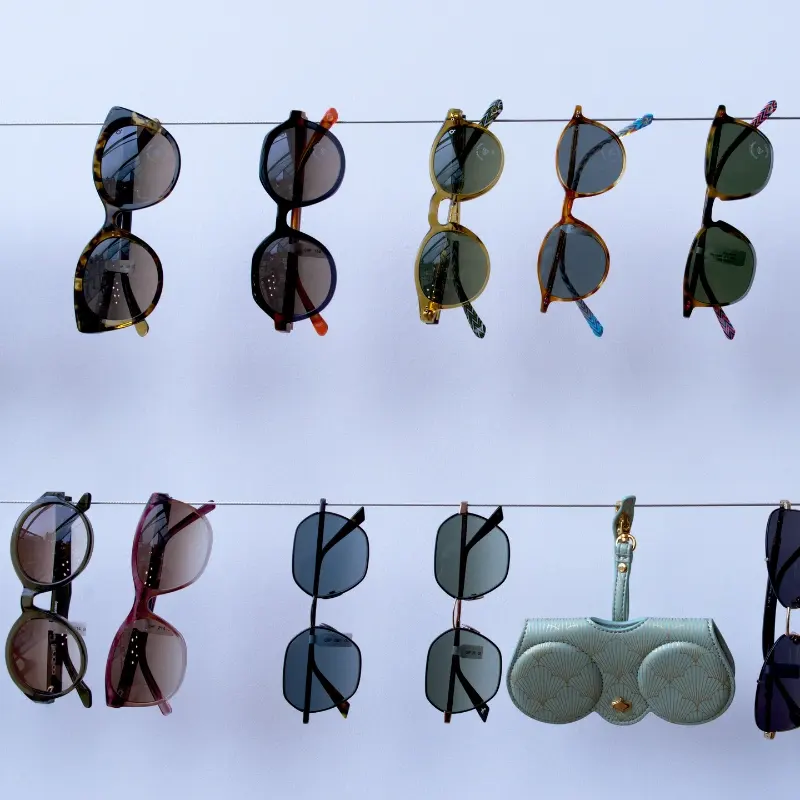
Lens Color and UV Protection Are Independent — What This Means for Your Brief
The single most common misconception in sunglasses lens specification is that lens color determines UV protection. It does not.
UV400 protection is a property of the lens material itself — specifically, of what the material blocks in the ultraviolet spectrum. Polycarbonate has inherent UV-blocking properties built into the material, which means a clear PC lens blocks UV radiation regardless of whether it has any tint at all. Adding a dark tint to that lens does not increase UV protection; removing the dark tint does not reduce it.
This has direct implications for a brand brief:
- A pink-tinted PC lens can be UV400 — the tint color and UV protection are independently specified
- A very dark lens is not automatically better UV protection than a lighter one — darkness and UV protection are different
- A mirror coating on a lens does not add UV protection — the mirror reflects visible light, not UV radiation
- Specifying “UV400” in a brief does not remove the need to specify tint, mirror, or polarization separately — these are four different specifications
For brands that communicate any UV protection claim to their customers, the relevant specification is UV400, and for PC lenses manufactured correctly, this is inherent to the material rather than an add-on. The brief should still confirm UV400 explicitly — but understanding that it is independent of color and coating prevents the common error of treating “dark lens” or “mirror lens” as a proxy for good UV protection.
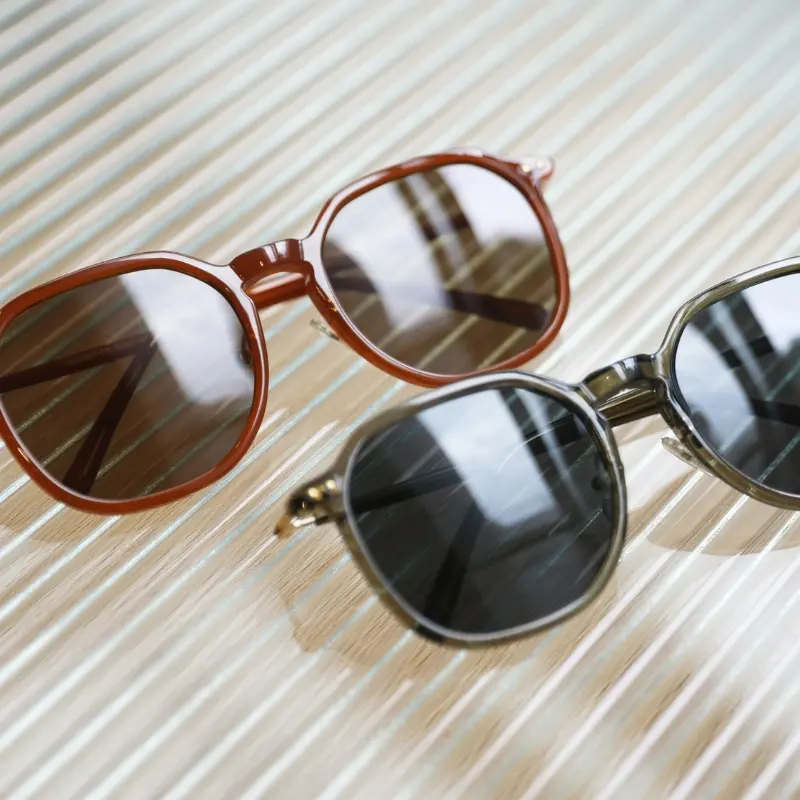
The Standard Coating Stack: What Every PC Lens Includes — and What Costs Extra
A commercially finished PC sunglass lens is not just the base PC material — it has a stack of coatings applied in sequence, each addressing a different property. Understanding this stack is what allows a brand to specify sensibly rather than asking for things that are always included or missing things that significantly affect product quality.
What Is Standard
Hard coating (scratch-resistant coating): Because PC is softer at the surface than glass or CR-39, a hard coating is applied as standard on virtually all commercially sold PC sunglass lenses. Without it, the lens surface would scratch too easily for consumer use. Hard coating can be applied to one side (typically the front face) or both sides. Single-sided hard coating is more common in mid-range commercial production; double-sided is an upgrade that adds cost and improves scratch resistance on the inner face as well.
UV400 blocking: As discussed above, inherent to PC as a material. No additional processing cost for UV400 in PC lenses.
Tint: The base tint — the color of the lens — is standard and can be specified as solid (uniform density throughout) or gradient (darker at the top, fading toward the bottom). Solid tint is less expensive to produce; gradient requires a more controlled dip process and costs more per lens.
What Costs Extra
Mirror coating: A thin metallic or dielectric layer applied to the front surface of the lens in a vacuum chamber, creating the reflective appearance. Mirror coating reduces visible light transmission — how much depends on the density of the coating — and adds a visual effect that has no relationship to UV protection. Mirror coatings come in a range of colors (silver, gold, blue, green, red, rose gold, and more), each of which is a separate coating formulation. Specifying mirror color precisely — including a reference sample or RAL/PMS equivalent — is important because “blue mirror” covers a wide range of actual results in production.
Back-side anti-reflective (AR) coating: Applied to the inner surface of the lens to reduce the internal reflections that occur when light enters from behind or at an angle. Without back-side AR, wearers may see their own eye reflected in the lens interior in certain lighting conditions. Back-side AR is an upgrade that improves comfort in outdoor use and is worth including for any product positioned at mid-range and above.
Polarization: A separate optical layer — different from both mirror and UV — that filters horizontally polarized reflected light (glare from water, pavement, snow). Polarization adds meaningful cost over a non-polarized lens and is not interchangeable with mirror coating, though the two can be combined.
Hydrophobic and oleophobic coatings: Water-repellent and oil-repellent surface treatments that improve ease of cleaning and reduce fingerprint visibility. These are optional upgrades more commonly specified for outdoor and sport-positioned products.
Solid Tint, Gradient, and Mirror: What Each Looks Like in Production
Solid Tint
A solid tint lens has uniform color density across the entire lens surface. The tint is introduced either as a coloring agent in the lens material itself or through a dip process after the lens is formed.
Common solid tint colors in PC sunglass production: grey (most common, visually neutral), brown/amber (contrast-enhancing, warm), green (good color balance), blue, and various fashion colors. Grey and brown are the most requested for functional positioning; fashion colors (pink, yellow, orange) are more common in trend-driven collections.
Tint density is expressed as a percentage of visible light transmission (VLT): lighter tints have higher VLT (more light passes through); darker tints have lower VLT. Standard fashion sunglasses typically run 15–25% VLT for a dark tint; lifestyle and fashion-forward collections sometimes use higher VLT (40–60%) for a lighter, more colored-lens effect.
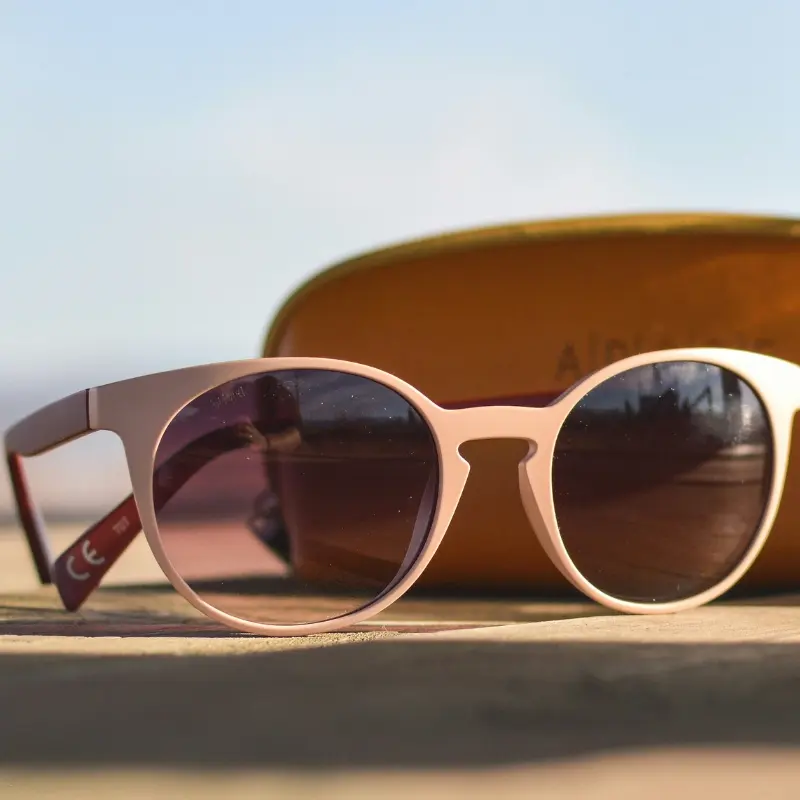
Gradient Tint
A gradient lens transitions from a darker tint at the top of the lens to a lighter tint (or clear) at the bottom. The gradient is achieved by controlled partial dipping — the top of the lens sits in the tint bath longer than the bottom.
Gradient lenses add a small production cost over solid tints and have more potential for inconsistency across a production run, particularly at the gradient transition point. Confirming gradient placement, transition depth, and acceptable variation tolerance in the sample approval stage avoids the most common gradient production complaints.
Mirror Coating
Mirror coatings are vacuum-deposited metallic layers applied over the base tint of the lens. Key points for briefing:
- The mirror coating color is what the lens looks like from the outside; the base tint is what the wearer sees through the lens. A blue-mirror lens with a grey base tint looks blue from the front and gives the wearer a grey-tinted view. These are specified separately.
- Mirror density affects how strongly reflective the coating appears — flash coatings (lighter, semi-transparent mirror) and full mirrors (highly reflective) are different specifications with different appearances and different effects on VLT.
- Mirror coatings are a surface treatment and can scratch more easily than an uncoated lens surface. A hard coating under the mirror (applied first in the coating sequence) is essential; some manufacturers apply an additional protective top coat over the mirror.
- Confirming color consistency across a bulk production run requires a physical reference sample at approval — “blue mirror” in a factory reference catalog may not match “blue mirror” in a different batch without explicit reference control.
Polarized PC Lenses vs TAC Polarized — Which Fits Your Collection
Polarization is the lens specification that generates the most questions from brands developing sunglasses collections, partly because the technology is not always clearly explained and partly because the choice between polarized lens materials has real positioning implications.

How Polarization Works
A polarized lens contains a thin optical filter — a layer of aligned molecules — that blocks horizontally polarized light. Glare from flat reflective surfaces (water, roads, snow) is primarily horizontal polarized light, which is why polarized lenses are particularly effective in outdoor and driving contexts. The filter is separate from UV protection and separate from any mirror or tint on the lens.
PC Polarized vs TAC Polarized
The two most common substrates for polarized sunglass lenses in commercial production are TAC (tri-acetate cellulose) and PC (polycarbonate), and they are not interchangeable in every situation.
TAC polarized lenses are the most common polarized lens in commercial fashion sunglasses. TAC is a layered composite material specifically designed for polarized lens production — the polarizing filter is laminated between layers of TAC film. TAC polarized lenses are cost-effective, produce accurate optical quality, and are the standard for mid-range fashion sunglasses. Their limitation is impact resistance: TAC is not as resistant to shattering as PC, which is why it is less common in safety and sport-positioned eyewear.
PC polarized lenses combine polycarbonate’s impact resistance with a polarizing filter. The polarizing filter is laminated to or incorporated within the PC lens during production. PC polarized lenses cost more than TAC polarized lenses at comparable optical quality, and their Abbe value (optical clarity indicator) is somewhat lower than TAC, which is acceptable for most outdoor use cases but worth being aware of.
| Specification | TAC Polarized | PC Polarized |
|---|---|---|
| Impact resistance | Moderate | High |
| Optical clarity (Abbe value) | Higher | Lower |
| Cost vs non-polarized | Lower premium | Higher premium |
| Standard application | Fashion, lifestyle sunwear | Sport, safety, outdoor |
| FDA drop-ball compliance | Generally not designed for | Yes, when manufactured correctly |
For brands developing a sport or outdoor-positioned PC sunglasses collection where the impact resistance of the frame is part of the product story, PC polarized lenses complete that specification consistently — the lens and frame both meet the same performance standard. For fashion collections where polarization is a comfort feature rather than a safety claim, TAC polarized lenses are the more cost-efficient choice.
Common Coating Combinations and When to Use Each
Most sunglasses products use a combination of the above options rather than any single specification. The combinations that most commonly appear in commercial production:
Solid tint + hard coating + UV400 (base configuration) The minimum viable lens specification for a commercial sunglass product. No mirror, no polarization. Appropriate for entry-level fashion sunglasses and promotional programs where cost per unit is the primary driver.
Gradient tint + hard coating + UV400 The same base configuration with a gradient tint for a more premium visual effect. Common in fashion-forward collections where lens appearance is part of the design story.
Solid or gradient tint + mirror coating + hard coating + UV400 The most common specification for mid-range fashion sunglasses. The mirror adds a strong visual element and is a significant part of many brand collections across multiple colorways. Back-side AR is a recommended addition at this level.
Solid tint + TAC polarized + hard coating + UV400 Standard for lifestyle and outdoor sunglasses where glare reduction is a functional selling point. Appropriate for DTC collections targeting the beach, driving, or casual outdoor market.
Solid tint + PC polarized + hard coating + back-side AR + UV400 The appropriate specification for sport and safety-positioned eyewear combining impact resistance with polarization. Higher per-unit cost, but supports a product story centered on genuine outdoor performance.
Solid tint + mirror coating + polarized + hard coating + UV400 Mirror and polarization can be combined in the same lens — the mirror coating is applied on top of the polarized substrate. This combination is common in premium sport and outdoor collections and is often described in marketing as “polarized mirror” lenses. Per-unit cost is higher than either feature alone.
What to Specify in Your Brief: Lens Coating Checklist
A lens specification that prevents production surprises and revision rounds:
- Lens material: PC (confirmed)
- UV standard: UV400 (confirm explicitly even though inherent in PC)
- Base tint color: Name specifically (grey, brown, green, blue, rose, etc.) with a physical reference sample or Pantone equivalent
- Tint type: Solid or gradient; if gradient, specify transition depth and acceptable tolerance
- Tint density / VLT: Target percentage, or reference a physical sample
- Mirror coating: Yes or no; if yes, specify color with a physical reference, and confirm flash vs. full mirror
- Polarization: Yes or no; if yes, specify PC polarized or TAC polarized based on product positioning
- Hard coating: Confirm standard; specify one-side or both-sides
- Back-side AR: Yes or no; recommended for mid-range and above
- Hydrophobic/oleophobic: Yes or no
- Reference samples for approval: For mirror and gradient, a physical reference sample must be approved before bulk production — written color descriptions alone are not sufficient
At Sailook, lens coating specifications are confirmed in writing as part of the sample approval process, with close-up photographs of the approved sample included in pre-shipment documentation. Mirror color and gradient transition are among the most common sources of color-match disputes between sample and bulk production when reference samples are not explicitly approved before the production run begins.

FAQ
Does lens color affect UV protection? No. UV400 protection is a property of the lens material itself — in PC lenses, it is inherent to the polycarbonate. A pink, yellow, or clear PC lens provides the same UV protection as a dark grey one. Lens color affects visible light transmission and appearance; UV protection is a separate specification.
Is a mirror coating the same as polarization? No. Mirror coating is a surface treatment that reflects visible light and affects the appearance of the lens from the outside. Polarization is an internal optical filter that specifically blocks horizontally polarized reflected glare. They solve different problems and are specified independently, though they can be combined in the same lens.
Which is better for outdoor sunglasses — PC polarized or TAC polarized? It depends on the product positioning. For sport and safety-positioned eyewear where impact resistance matters, PC polarized is the appropriate specification — it combines polycarbonate’s impact resistance with glare-reduction. For fashion and lifestyle sunwear where polarization is a comfort feature rather than a safety claim, TAC polarized is more cost-efficient and delivers accurate optical quality.
Can a mirror lens also be polarized? Yes. Polarized mirror lenses are a standard specification — the mirror coating is applied over a polarized substrate. This combination appears in premium sport and outdoor collections. Both the mirror color and the polarization substrate (PC or TAC) should be specified separately in the brief.
What is back-side AR, and do I need it? Anti-reflective coating on the inner surface of the lens reduces light reflections that occur when light enters from behind. Without it, wearers may see their own eye reflected in the lens interior in certain lighting conditions. For entry-level and promotional sunglasses, it is typically not included. For any collection positioned at mid-range or above, back-side AR is a recommended inclusion that noticeably improves lens comfort and perceived quality.
Why does the mirror color need a physical reference sample? Mirror coating color varies between production batches, coating formulas, and different manufacturers’ standard references. Two factories’ “blue mirror” can look meaningfully different from each other and from the brand’s intended reference. A physical reference sample approved before bulk production begins is the only reliable way to confirm that the production output matches the brand’s expectation — written color names are insufficient for mirror specification.
Summary
PC sunglasses lens color and coating involve several independent specifications that combine in specific ways, and a brief that leaves any of them underspecified produces either a product that does not match expectations or a production dispute that could have been prevented at the approval stage. UV400 is independent of tint color. Mirror coating is independent of polarization. PC polarized suits sport and safety positioning; TAC polarized suits fashion and lifestyle. Mirror color requires a physical reference sample to control correctly across a production run.
For Sailook’s full range of PC sunglasses lens options, coating specifications, and production parameters, visit our PC sunglasses page.
Let's get started!
Get in touch with a custom eyewear specialist now for a free consultation and instant price quote.
WHATSAPP ME GO!
📱 Scan with your phone to start chatting