Blue Light Blocking Glasses: What Brands Need to Know Before Adding Them to Your Line
Blue light blocking glasses have grown into a real product category — millions of pairs sold every year, strong repeat demand from remote workers, students, and gamers, and a low barrier to entry for brands looking to add a functional SKU. If you’re considering this category, the demand is genuine.
What’s less straightforward is the science behind it. Most marketing in this space — including a lot of what’s on competitor and even manufacturer websites — states as fact that blue light causes eye strain and that blocking it solves the problem. The current clinical research doesn’t actually support that as cleanly as the marketing suggests, and that gap matters for how you position and sell this product.
This guide covers both sides: the honest state of the science, and the practical manufacturing decisions — lens type, frame material, MOQ, customization — that actually determine whether a blue light blocking collection performs well for your brand.
What the Science Actually Says (And Why It Matters for Your Marketing)
Blue light sits in the 400–495 nanometer range of visible light, emitted by phone, tablet, and laptop screens along with most LED lighting. The basic physics of this isn’t in dispute. What’s in dispute is what blue light exposure actually does to the people looking at those screens, and whether blocking it changes anything.
The honest summary: A 2023 Cochrane review — generally considered the gold standard for clinical evidence — found that blue-light filtering lenses showed no significant benefit for reducing digital eye strain compared to standard lenses. Several more recent studies through 2025 have reached similar conclusions, and a number of researchers now attribute most “digital eye strain” symptoms to factors like uncorrected refractive error, screen distance, blink rate, and posture — not the blue light wavelength itself. At the same time, some individual studies have found measurable reductions in visual fatigue with blue-light-blocking lenses, so the evidence isn’t unanimous either way. The most accurate description of where the science currently stands is mixed and unsettled, not proven and not debunked.
Why this matters for a B2B buyer specifically: if your brand or your retail partners make explicit health claims on packaging or marketing — “reduces eye strain,” “improves sleep,” “protects your eyes” — without qualifying language, you’re making claims the current evidence doesn’t clearly support. In the US, this is squarely within FTC advertising guidelines on substantiated health claims. In the EU, similar restrictions apply. This isn’t a reason to avoid the category — it’s a reason to market it accurately.
What You Can Say With More Confidence
- Blue light glasses are a comfort and lifestyle product for heavy screen users
- Many individual users report feeling more comfortable during long screen sessions (this is well documented, even where controlled studies don’t show a measurable physiological effect)
- The lenses reduce glare and harsh contrast from screens, which is a real, measurable optical effect
- For evening use, reducing blue light exposure before bed is a reasonable precaution within current sleep-hygiene guidance, even though large-scale trial evidence on sleep outcomes remains inconsistent
What to Avoid Claiming Outright
- “Clinically proven to reduce eye strain” — not supported by the highest-quality current evidence
- “Prevents digital eye damage” — no evidence blue light from screens causes retinal damage at normal exposure levels
- “Doctor recommended” — without a specific, named, verifiable source
Brands that position this category around comfort, lifestyle, and screen glare reduction — rather than unqualified medical claims — build a more durable, defensible product story, and avoid the compliance risk that comes with overstating efficacy.
A note on terminology: “blue light glasses” vs. “computer glasses”
You’ll encounter these two terms used interchangeably across both consumer and B2B markets, and the distinction is loose enough that treating them as separate categories is usually unnecessary. “Computer glasses” is a broader umbrella term covering any eyewear designed for screen use — it may include blue light filtering, anti-reflective coating, minor magnification for reading distance, or some combination. “Blue light glasses” specifically names the filtering function as the lead feature. In practice, most products marketed as computer glasses include blue light filtering as their primary lens feature, and most blue light glasses are designed for computer and screen use. For SEO and marketing purposes, both terms are worth including — your product serves both audiences.
Lens Options: Clear, Yellow, or Tinted
Different lens tints serve different use cases and customer expectations. Offering more than one tint option lets your collection serve more of your customer base without adding SKU complexity.
| Lens Type | Appearance | Best For |
|---|---|---|
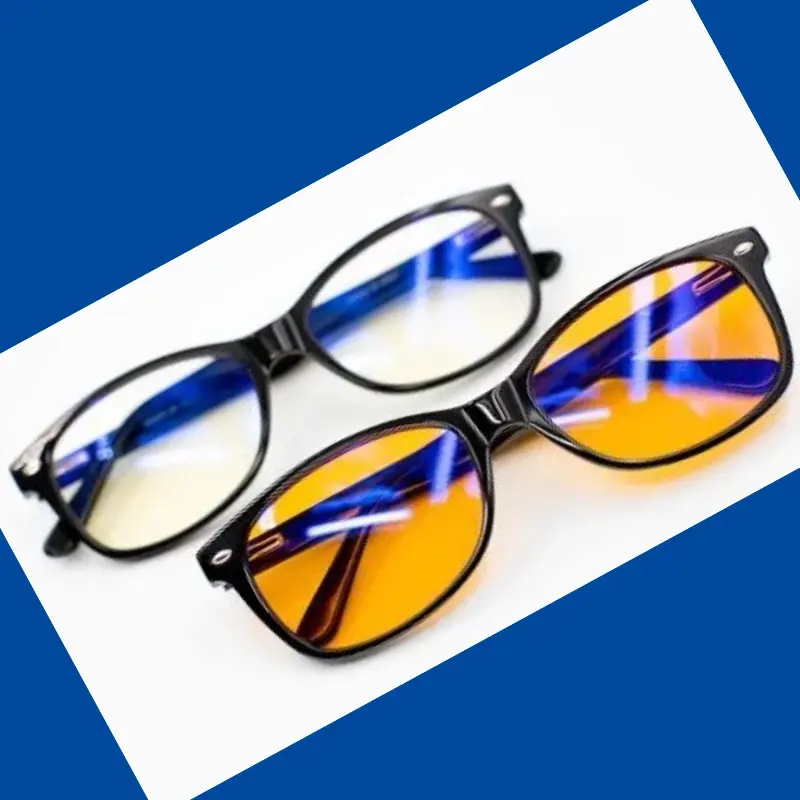
| Clear (low filter) | Virtually invisible coating | Office wear, all-day use, customers who don’t want a visible tint |
| Slight yellow | Warm tone, mild visibility | Work-from-home, high screen hours, the most common mid-tier option |
| Amber / orange | Strong, visible tint | Gaming, night shift work, customers who want maximum filtering |
| Blue mirror / tinted | Fashion-forward reflective coating | Style-driven buyers who want the look as much as the function |
Lens coatings can be combined — blue light filtering paired with anti-reflective coating, UV400 protection, or photochromic functionality — to build a more complete product without adding frame variations.
Who Actually Buys This Category
The buyer base for blue light eyewear has broadened well past the early “gamer glasses” niche:
- Office and remote/hybrid professionals — the largest and most consistent segment
- Students and teenagers — driven by both study screen time and gaming
- Parents buying for children — a growing but more sensitive segment (see note below)
- Corporate wellness and gifting programs — bulk orders for employee wellness kits
- Style-driven younger buyers — purchasing for the aesthetic as much as the function, often influenced by social media trends
One honest note on the children’s segment: current research is more cautious here than the marketing in this space often suggests. There’s no strong evidence that blue light from screens causes measurable harm to children’s eyes at typical exposure levels, and some researchers point to reduced outdoor time and excessive near-work — not blue light specifically — as more likely drivers of rising childhood myopia. Brands selling into this segment should be especially careful with claims and should consider featuring comfort and screen-glare benefits rather than implied protective health claims.
Frame Design Still Drives the Sale
The lens technology is the functional hook, but frame design is usually what closes the sale. Customers in this category still expect lightweight, flattering, contemporary silhouettes — a blue light lens in an unflattering frame doesn’t sell well regardless of the lens claims.
Frame styles that consistently perform well in this category:
- Thin acetate classics — round and square shapes with a refined, less “tech” look
- TR90 lightweight builds — for all-day comfort during long screen sessions
- Transparent or pastel-tone frames — strong appeal with younger, style-driven buyers
- Metal + acetate combination frames — a premium positioning option
- Oversized or “geek chic” styles — performs particularly well for social-driven, DTC brands
Material Options for a Blue Light Collection
TR90 frames paired with polycarbonate (PC) lenses are the dominant combination in this category — across both wholesale listings and consumer retail, this pairing accounts for the large majority of blue light eyewear on the market, for straightforward reasons: TR90 is light, flexible, and inexpensive to produce at the volumes this category typically runs, and PC is the standard lens substrate for non-prescription blue light filtering. If you’re entering this category for the first time, TR90 + PC is the default starting point most brands should plan around.
| Material | Why It Works | Typical Position |
|---|---|---|
| TR90 (frame) | Lightweight, flexible, cost-efficient, the most common frame choice in this category | Volume / mid-tier — default starting point |
| Polycarbonate / PC (lens) | Standard lens substrate for blue light filtering, impact-resistant, low cost at volume | Standard across nearly all price tiers |
| Acetate | Richer color and finish, more premium tactile feel — used selectively for flagship SKUs | Premium tier |
| Stainless steel | Minimalist, durable, sleek professional look | Mid-to-premium, office-focused |
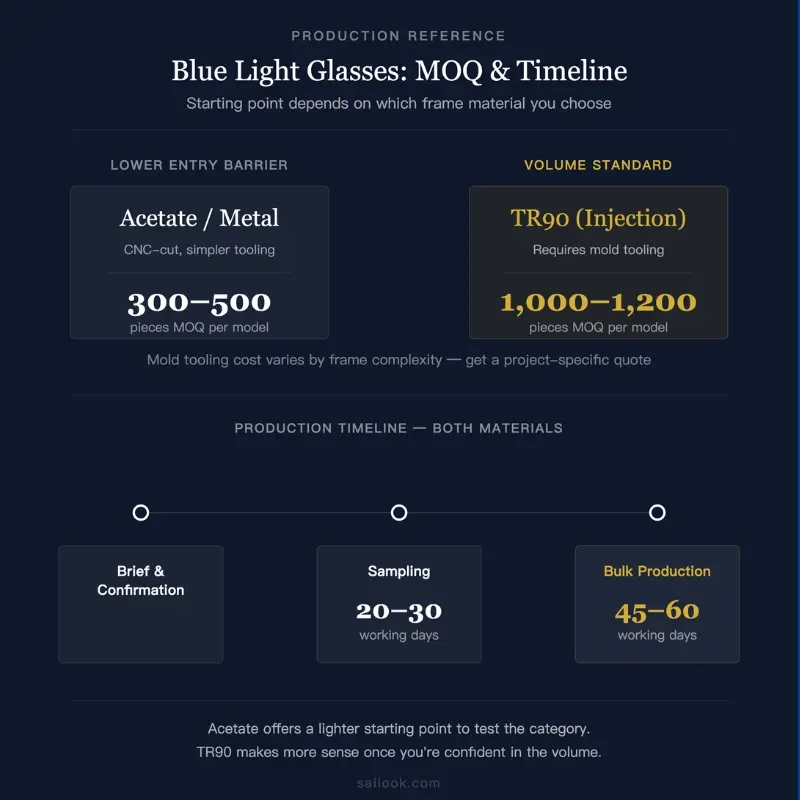
Acetate and metal builds do show up in this category, but mainly as a premium tier layered on top of a TR90-based core line, rather than as the default. TR90 does require injection mold tooling upfront, with MOQ starting around 1,000–1,200 pieces — tooling cost varies by frame complexity and cavity count, so it’s worth getting a specific quote for your design rather than assuming a fixed number. Acetate isn’t tooling-free either — CNC cutting templates and forming tools are still part of the process — but the tooling involved is typically simpler and lower-cost than a full injection mold, and the MOQ is lower (300–500 pieces). If you want to test the category with a smaller upfront commitment before scaling into TR90, acetate is generally the lighter starting point — TR90 tends to make more sense once you’re confident in the volume.
Custom Branding Options
Blue light eyewear is a functional product, but that doesn’t mean it has to look generic. Standard customization options include:
- Logo printing — temple, inner arm, or lens etching
- Custom colorways — frame and lens combinations aligned with your brand palette
- Branded packaging — anti-scratch cases, microfiber cloths, branded boxes
- Retail-ready kits — hang tags, point-of-sale cards, care instruction booklets
These details matter more in this category than in pure fashion eyewear, because a meaningful share of buyers are purchasing this as a wellness or gifting product — the unboxing experience reinforces that positioning.
MOQ and Production Timeline
| Stage | Typical Range | Notes |
|---|---|---|
| MOQ (acetate / metal) | 300–500 pcs per model | Lower starting point for premium-tier frames |
| MOQ (injection / TR90) | 1,000–1,200 pcs per model | Standard for injection-molded frame programs |
| Lens options | In-stock and custom order | Custom tints add lead time; in-stock tints ship fastest |
| Sampling | 20–30 working days | Includes structural confirmation before bulk |
| Bulk production | 45–60 working days | Depending on frame material and lens specification |
Blue light eyewear follows the same MOQ and lead-time structure as the frame material you choose — acetate and metal builds start around 300–500 pieces, while injection-molded or TR90 frames typically run 1,000–1,200 pieces. This makes it straightforward for e-commerce brands, wellness subscription boxes, and brands testing a new accessory line to plan the category alongside their existing material and volume strategy, rather than needing a separate sourcing approach.
The Practical Takeaway
Blue light blocking glasses are a legitimate, accessible product category with genuine consumer demand — that part of the original pitch is true. Where this category requires more care than most is in the marketing: the science is genuinely mixed, and brands that overstate the medical benefit are taking on real compliance risk for very little upside, since the category sells well on comfort and lifestyle positioning alone.
For brands building or expanding into this space, the more durable approach is to lead with what’s well-supported — comfort, screen glare reduction, lifestyle fit — and let the frame design and customization carry the rest of the value proposition.
If you’re working out frame materials, lens options, or packaging for a blue light blocking glasses collection, start a conversation with our team — we’re happy to walk through what’s realistic for your price point and target market.
Frequently Asked Questions
Do blue light glasses actually work?
The evidence is mixed. A 2023 Cochrane review and several more recent studies found no significant reduction in digital eye strain compared to standard lenses, while some other studies have found measurable benefits for visual fatigue. Most researchers agree that much of what’s labeled “digital eye strain” is actually caused by factors like screen distance, blink rate, and uncorrected vision — not blue light exposure specifically. Many users do report subjective comfort improvements, even where controlled studies show no measurable physiological effect.
Is it safe to market blue light glasses with health claims?
Brands should be cautious with unqualified claims like “clinically proven to reduce eye strain” or “prevents eye damage,” since current evidence doesn’t clearly support them — this can create regulatory exposure under FTC guidelines (US) or similar advertising standards elsewhere. Positioning the product around comfort and screen glare reduction is more accurate and lower-risk than implied medical benefit.
What’s the difference between clear and tinted blue light lenses?
Clear lenses use a coating that filters a portion of blue light with minimal visible tint, suited to office and all-day wear where customers don’t want a visible color cast. Yellow, amber, and mirror-tinted lenses filter more aggressively and are more visible, often preferred for gaming, night use, or fashion-driven purchases. Filtering strength and visible tint generally increase together.
What is the typical MOQ for custom blue light glasses?
MOQ depends on frame material: acetate and metal builds typically start at 300–500 pieces per model, while injection-molded or TR90 frames run 1,000–1,200 pieces per model. Custom lens tints may require slightly higher minimums than in-stock tint options.
Can blue light filtering be combined with other lens features?
Yes. Blue light coatings are commonly combined with anti-reflective coating, UV400 protection, or photochromic (light-adaptive) functionality on the same lens, allowing a single product to address screen glare and outdoor UV exposure without requiring separate eyewear.
Let's get started!
Get in touch with a custom eyewear specialist now for a free consultation and instant price quote.
WHATSAPP ME GO!
📱 Scan with your phone to start chatting