Who Invented Sunglasses? A Manufacturer's Look at How Eyewear Evolved
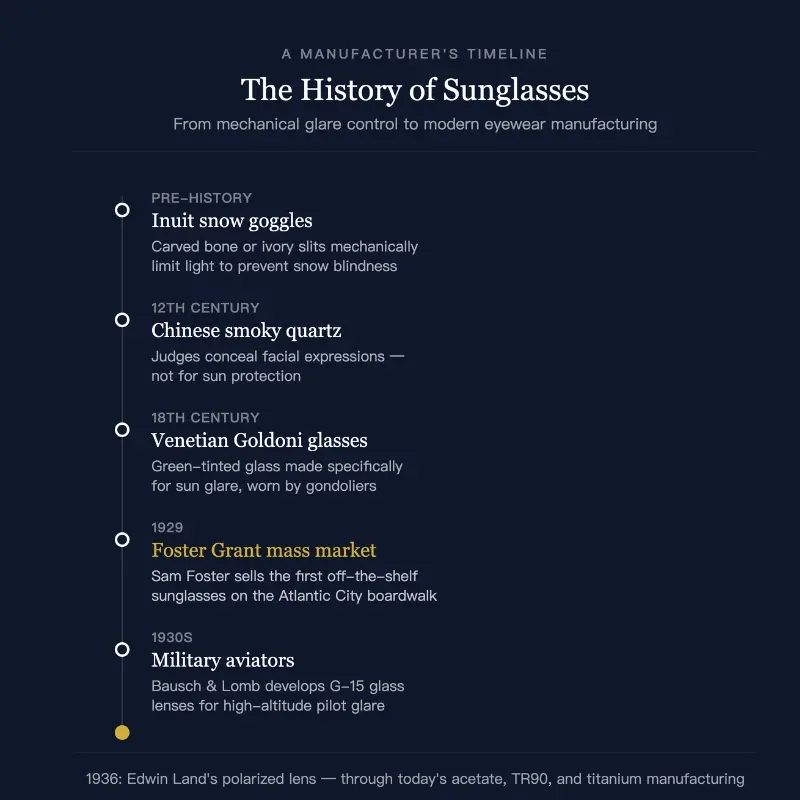
“Who invented sunglasses” doesn’t have a single answer. The honest version of this story is that glare protection was solved independently, in different forms, by different cultures, over roughly a thousand years — and the modern sunglasses industry is the result of several unrelated lines of innovation eventually converging.
As a manufacturer, we don’t usually have a reason to think about this history day to day. But understanding where today’s materials, shapes, and manufacturing methods came from is a useful way to see why the industry looks the way it does now — and it’s a more interesting story than the version most “who invented sunglasses” articles tell.
Before Glass: The Inuit Solution to Snow Blindness
The earliest known eye protection against glare wasn’t tinted at all. Inuit and other Arctic peoples carved narrow slits into walrus ivory, bone, or caribou antler, worn close to the eyes to block reflected sunlight off snow and ice — a problem that causes snow blindness, a genuinely painful and disabling condition.
The mechanism is closer to a pinhole camera than to a lens: narrowing the aperture of light reaching the eye reduces glare without needing any tinted or transparent material at all. It’s a purely mechanical solution, and it predates manufactured lenses by centuries. The same principle — limiting the volume of light reaching the eye, rather than filtering its wavelength — still shows up in some specialized eyewear today, even though virtually all modern sunglasses rely on tinted or polarized lenses instead.
12th-Century China: Tinted Glass for a Different Reason
Separately, in 12th-century China, judges used flat panes of smoky quartz over their eyes during court proceedings. This wasn’t sun protection — it was about concealing facial expressions during interrogation, so that a judge’s reactions couldn’t be read by witnesses or the accused.
The quartz was roughly cut and offered no optical correction; it likely distorted vision more than it improved anything. What’s worth noting here is that the idea of darkened eyewear existed in this context well before it had anything to do with sunlight — its first documented use was social and psychological, not functional in the way we think of sunglasses today.
18th-Century Venice: The First Glasses Made Specifically for Sun Glare
By the 18th century, Venetian glassmakers — already known for mirrors and decorative glass — began producing green-tinted spectacles intended specifically to address sun glare. These became known as “Goldoni glasses,” after the playwright Carlo Goldoni, who was known to wear a pair and helped popularize the style. They were used by gondoliers working long hours on reflective canal water, as well as by sailors and other workers exposed to similar glare conditions.
This is generally considered the first eyewear designed with the explicit purpose of blocking sun glare, rather than for vision correction or concealment. The choice of green tint wasn’t arbitrary — green glass was found to reduce brightness while preserving enough contrast and color information to remain useful, a basic principle that still guides lens tint selection today.

1752: A British Optician Argues Tinted Lenses Are a Medical Necessity
In 1752, English optician James Ayscough began advocating for blue and green tinted lenses — not for sun protection, but because he believed clear glass aggravated certain vision problems. Ayscough’s position was that bright, untinted light was harmful to weaker eyes, and that tinted lenses offered genuine therapeutic value.
He’s often credited as an early figure in the development of tinted eyewear as a medical, rather than purely functional or fashionable, category. Whether his specific theory about color and vision correction held up isn’t really the point — what matters is that his work helped establish tinted lenses as something opticians took seriously, rather than dismissing as a novelty.
Early 20th Century: Hollywood and “Klieg Eyes”
By the 1910s and 1920s, film studio lighting — the powerful arc lights used on early movie sets — was bright enough and rich enough in UV to cause a painful eye condition nicknamed “Klieg eyes,” similar to the burn welders can get from looking at an arc without protection. Actors began wearing dark glasses on set largely as basic eye protection.
The practical need overlapped with something else happening at the same time: dark glasses also let performers avoid being easily recognized off-set, and the visual association between fame and sunglasses took hold quickly. By the time sunglasses reached the mass market a few years later, that association was already part of the product’s appeal.
1929: Sam Foster and the First Mass-Market Sunglasses
Sam Foster, an Austrian immigrant who had founded the Foster Grant Company in 1919 with William Grant to manufacture women’s hair accessories, began selling sunglasses on the Atlantic City boardwalk in 1929 — first through Woolworth’s, alongside other small consumer goods.
This is the point where sunglasses became something the general public could buy off the shelf rather than have custom-made by an optician. Foster Grant’s frames were inexpensive and produced from celluloid, a flammable but workable early plastic; the company didn’t fully adopt injection molding — the production method that defines plastic eyewear manufacturing today — until the mid-1930s. The shift from custom-made eyewear to a mass-produced consumer product is really the origin point of the sunglasses industry as a commercial category, separate from the centuries of earlier glare-protection innovations.
| Era | Driver | Primary Material |
|---|---|---|
| Arctic peoples, pre-history | Survival / snow blindness | Bone, ivory, antler |
| 12th-century China | Social concealment | Smoky quartz |
| 18th-century Venice | Sun glare (water) | Tinted glass |
| 1929 onward (USA) | Mass-market consumer good | Celluloid |
| 1930s onward | Military / aviation | Optical glass |
| Today | Brand-driven product design | Acetate, TR90, metal, polycarbonate |
The 1930s: Aviators and the Military Influence on Design
Around the same period, the U.S. Army Air Corps commissioned Bausch & Lomb to develop eyewear that could reduce the glare and discomfort pilots experienced at high altitude. The result was a green-tinted optical glass lens (often referred to by the G-15 designation) paired with a distinctive teardrop frame shape designed to cover a wide field of vision — the design now known as the Aviator.
The shape became closely associated with military authority partly through high-profile public moments, most famously photographs of General Douglas MacArthur. It remains one of the most enduring shapes in eyewear, largely because the original design constraints — full coverage, stable fit, minimal distortion when looking down at instruments — still produce a shape people find functional and flattering nearly a century later.
1936: Edwin Land and Polarized Lenses
Edwin Land, who later founded Polaroid, developed the first polarized filter for sunglasses in 1936. Polarization works on a different principle than tinting: rather than simply dimming all incoming light, a polarized filter blocks horizontally oriented light waves specifically — the type of light responsible for the sharp glare that reflects off flat surfaces like water, wet roads, or snow.
This was a genuine technical advance, not just an aesthetic one. Polarized lenses improve visual clarity and contrast in glare-heavy conditions in a way that tinting alone cannot, which is why polarization remains the standard for driving, fishing, and water-sports eyewear today rather than being treated as a legacy feature.
Post-War Fashion: From Function to Style
After World War II, the trajectory of sunglasses shifted decisively toward fashion. The 1950s and 1960s saw new frame shapes — the Wayfarer, the Cat-Eye — that weren’t derived from any specific functional requirement the way Aviators or polarized lenses were. Celebrities including James Dean, Audrey Hepburn, and Marilyn Monroe wore sunglasses as a visible style statement as much as a practical one, and frame design began responding primarily to fashion trends rather than optical engineering problems.
This era also marked plastic’s shift from a purely cost-driven material to one capable of premium positioning — the move from metal-and-glass construction toward molded and hand-finished plastics opened up a much wider range of shapes and colors than metal frames alone ever allowed.
What This History Means for Manufacturing Today
Modern eyewear production draws on all of these threads at once: the optical seriousness that came out of Ayscough’s medical framing and the aviation programs of the 1930s, the mass-production logic Foster Grant introduced in 1929, and the fashion-led design language that took hold after the war.
In practice, that shows up as a few parallel manufacturing traditions that still coexist:
- Hand-finished materials like acetate, descended from the same celluloid-to-plastic transition Foster Grant pioneered, but refined over a century into a material capable of much richer color and texture
- Injection-molded plastics like TR90 and polycarbonate, the direct technical descendants of the molding processes that made mass-market sunglasses possible in the first place
- Precision metal and titanium construction, owing a debt to the optical-glass rigor of military aviation eyewear
- Polarized and coated lenses, built on Edwin Land’s 1936 filter principle and now standard rather than specialty
None of these traditions replaced the others — they sit side by side in any modern product line, and the decision of which to use for a given frame is still, in essence, the same question Foster Grant and the Army Air Corps were each solving in their own way: what does this specific use case actually require.
Frequently Asked Questions
What is the earliest known form of eye protection from glare?
Arctic peoples, including Inuit communities, carved narrow slits into walrus ivory, bone, or caribou antler to block reflected sunlight off snow — a mechanical solution that predates tinted or transparent lenses by centuries.
What are Goldoni glasses?
Goldoni glasses were green-tinted spectacles produced in 18th-century Venice, named after playwright Carlo Goldoni, who was known to wear them. They were used primarily by gondoliers and others exposed to strong glare off water, and are generally considered the first eyewear made specifically to address sun glare rather than vision correction or concealment.
Who is credited with starting the mass market for sunglasses?
Sam Foster, founder of the Foster Grant Company (established 1919), began selling sunglasses on the Atlantic City boardwalk in 1929. This is widely considered the start of sunglasses as an affordable, off-the-shelf consumer product rather than a custom-made item.
Did Chinese judges invent sunglasses for sun protection?
No. 12th-century Chinese judges used smoky quartz lenses to conceal their facial expressions during court proceedings, not for UV or glare protection. The use of darkened lenses for sun protection developed separately, centuries later.
Who invented polarized sunglasses?
Edwin Land, founder of the Polaroid Corporation, developed the first polarized lens filter in 1936. Unlike standard tinting, polarization blocks horizontally oriented light specifically, which is what causes glare reflecting off water, wet roads, and snow.
Let's get started!
Get in touch with a custom eyewear specialist now for a free consultation and instant price quote.
WHATSAPP ME GO!
📱 Scan with your phone to start chatting