What Actually Changes When You Source Eyewear From China as a US Brand
Tariffs, customs, Prop 65, fit for a US face, time-zone-friendly communication — the parts of sourcing that are specific to the US market, not the general OEM/ODM basics you've probably already read elsewhere.
Import & Compliance
CE and UKCA get you into the UK and EU — they don't get eyewear into the US. Getting a container held at port because of a tariff classification or a missing warning label is a preventable, expensive mistake. Here's what's specific to US import, separate from the product safety standards already covered for PC sunglasses and for kids' eyewear.
| Requirement | Key Figure | What It Means |
|---|---|---|
| HTS Classification | 9004.10 / 9004.90 9003.11 / .19 / .90 |
Code depends on whether it's complete sunglasses, complete non-sunglass eyewear, or frames only, and the material. Confirm exact code with your broker per shipment. |
| Tariff Rate | ~30–35% Aug 2026 |
MFN + Section 301 (×2) + reciprocal duty, stacked. Fast-moving — under review ~Nov 2026. Treat as a planning estimate, confirm with your broker before pricing. |
| Customs Bond | $50–100/entry or $400–600/yr |
Single-entry vs. continuous — continuous breaks even after 4–5 shipments/year. Arranged through a broker or surety company, not us. |
| Country-of-Origin | "Made in China" | Must be legible, permanent, conspicuous. We confirm placement at sample approval. |
| California Prop 65 | Buyer's responsibility | Some alloys/coatings/inks can trigger it. We don't test for this in-house — arrange via a third-party lab if selling into CA. |
Logistics to the US
Our production timeline already covers sample and color-sample shipping via DHL/EMS/UPS/FedEx (3–5 working days, door to door). For a first bulk order to the US, there are three freight paths, plus the choice of who handles customs.
Sea Freight (self-cleared)
Air Cargo (self-cleared)
Express Courier (DHL / UPS / FedEx)
Sea Freight, Shenzhen → US: Transit Breakdown
| Destination | Vessel | Port-to-Port | Door-to-Door |
|---|---|---|---|
| West Coast (LA / Long Beach) |
Express | 11–18 days | 15–30 days |
| Standard | 14–26 days | 25–40 days | |
| East Coast (NY / Houston) |
Express / Standard | 25–40 days | 30–50 days |
Sea, air, and express courier are all self-cleared by default — you (or your broker, on your behalf) are the importer of record and responsible for customs clearance on each of these three paths. Express couriers can arrange brokerage as an add-on for a fee, but it isn't automatic. The one path where you hand that off entirely is DDP, below.
DDP — Duty Paid, Fully Cleared SIMPLEST OPTION
For sea or air cargo shipments, we can arrange freight through our partner on a DDP (Delivered Duty Paid) basis. Our freight partner — not you — takes on the importer-of-record role, handles HTS classification, pays the duty, and clears customs on your behalf. Your shipment arrives ready to receive, with no customs bond or importer registration needed on your end.
Shipping Straight to Amazon FBA?
Since January 1, 2026, Amazon no longer preps or labels inbound units itself — every shipment has to arrive fully compliant, or it's hit with a per-unit defect fee (roughly $0.32–$8.25) or rejected outright. That shifted the prep work upstream, to either the factory or a US-based prep center. What FBA actually requires:
- FNSKU labeling — a scannable barcode unique to your seller account on every unit, fully covering any existing UPC/EAN barcode. Required for all non-Brand-Registry sellers as of March 2026.
- Poly bagging — sealed poly bags with a printed suffocation warning (24-point font) on any bag with a 5"+ opening.
- Drop-test-rated protection — eyewear counts as breakable/fragile, so units need enough bubble wrap or equivalent cushioning to survive a 3-foot drop test.
- Carton-level rules — one FBA shipment label per carton (generated from your Seller Central shipping plan, addressed to a specific fulfillment center), 50 lb max carton weight, no mixing SKUs from different shipping plans in the same box.
We can apply FNSKU labels, poly-bagging, and drop-test-rated packaging in-house — this isn't a default on every order, so raise it during Style Confirmation if you're shipping straight to FBA, and we'll build it into the sample and production plan from the start.
Fit & Sizing for a US Face
A frame that fits well on the head shape a design was originally built around doesn't always fit well on a different market's average face. Brands that reuse an existing mold as-is sometimes hear the same feedback back from US customers: too tight at the temple, sliding down the nose, sitting too close to the brow. Here's the sizing system we work within, and the standard ranges available to adjust against.
Where These Measurements Sit on the Frame
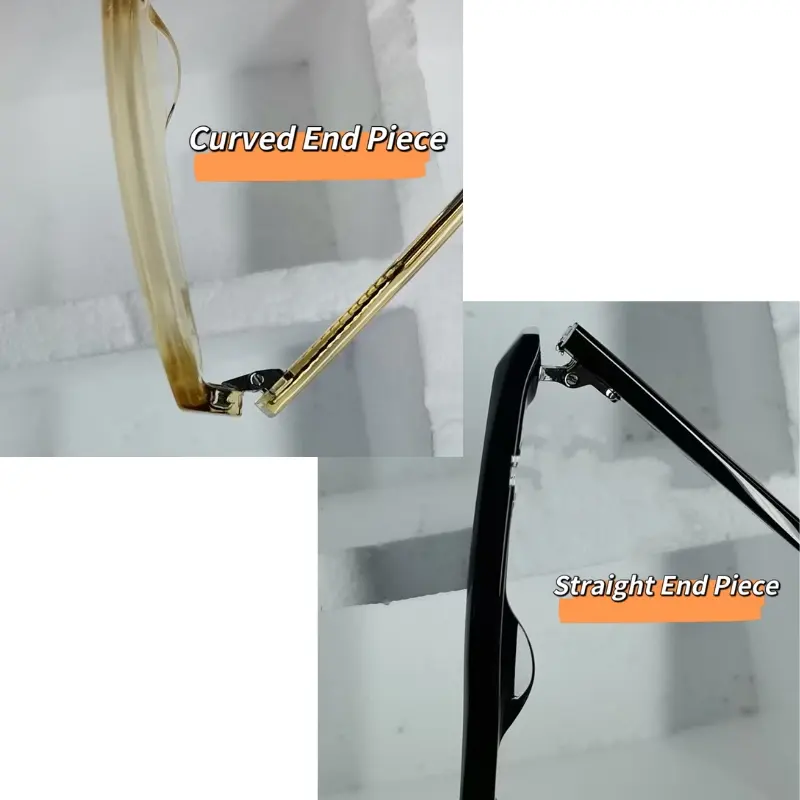 End-piece detail — actual frame
Standard Frame Measurements
| Measurement | Standard Range | Notes |
|---|---|---|
| Lens Width (A) | 50–58mm | Depends on eye shape — oversized/aviator styles run toward the wider end, round/cat-eye narrower. |
| Lens Height (B) | 30–50mm | Varies by design — this is the vertical dimension of the lens opening. |
| Temple Length — Straight End-piece | 145mm | Standard length typically paired with a straight, blocky end-piece — this style is available in both acetate and metal builds, it's not material-specific. |
| Temple Length — Curved End-piece | 135mm | Standard length typically paired with a curved end-piece that flows smoothly into the rim — also available in either material. |
| Nose Pad | 8–9.5mm | Standard range; exact size selected based on bridge fit. |
Payment Practicalities for US Buyers
Separate from how to evaluate a supplier, this is about the mechanics of actually sending money once you've chosen one — the operational questions that come up specifically for US-based businesses wiring funds to China.
- Wire transfer timing — we hold a local US bank account for receiving payments, so a domestic US wire typically clears in 1–2 business days rather than going through a slower international transfer.
- Currency & settlement — invoiced and settled at the actual exchange rate at time of payment, not a marked-up rate.
Working Backward From the US Retail Calendar
US sunglasses and reading-glasses demand follows a fairly predictable seasonal shape — spring restock, back-to-school, holiday gifting, summer sports/swim peak. But there's no single "start by this month" answer that holds across projects: the real runway depends on a few variables that shift the timeline more than the season does.
- New tooling vs. existing mold — a brand-new injection mold adds the full tooling sequence from our production process (roughly 25 days for tooling alone, plus mold testing and mold sampling on top). Reusing or lightly modifying an existing mold skips that entirely.
- Color & finish complexity — a solid, in-stock color ships faster than a custom gradient, layered acetate pattern, or a new plating finish, each of which usually adds review rounds before a color sample is approved.
- Style newness — a new silhouette needs full drawing revisions and sample rounds; an existing style getting a rebrand or recolor can often skip straight to sampling.
Communication Across the Time-Zone Gap
Shenzhen runs 13–16 hours ahead of the contiguous US depending on which time zone you're in (further still for Alaska and Hawaii) — closer to a full day than a same-day overlap. Left unmanaged, this turns every round of feedback into a 24-hour cycle, and it's more pronounced the further west your team is. To keep that from stalling a project, here's how we manage the rhythm:
- Day-to-day communication — mainly through WhatsApp and email. Message us anytime — we don't need both sides online at once, and you'll get a reply as soon as we see it.
- Response window — messages sent during 9:00–18:00 Beijing time get a reply within 4 hours; anything outside that window is picked up first thing the next morning.
- Sample confirmation — instead of trickling feedback back and forth, we package drawings, photos, measurements, and our own suggested changes into one complete confirmation set and send it all at once, so you only need to respond once, in one sitting.
Retail Channel Fit
How you're planning to sell changes what a sensible first order looks like — but the mechanics of MOQ itself are already covered in full in our MOQ guide. In short: testing multiple styles before committing to a full production run usually points toward our low-MOQ stock-frame program; a defined seasonal collection for wholesale or boutique accounts points toward full custom development.
What We've Built for US Brands
Not one category — US partners span a genuine range of use cases, which means whatever you're building, it's likely we've solved an adjacent version of the same problem before.
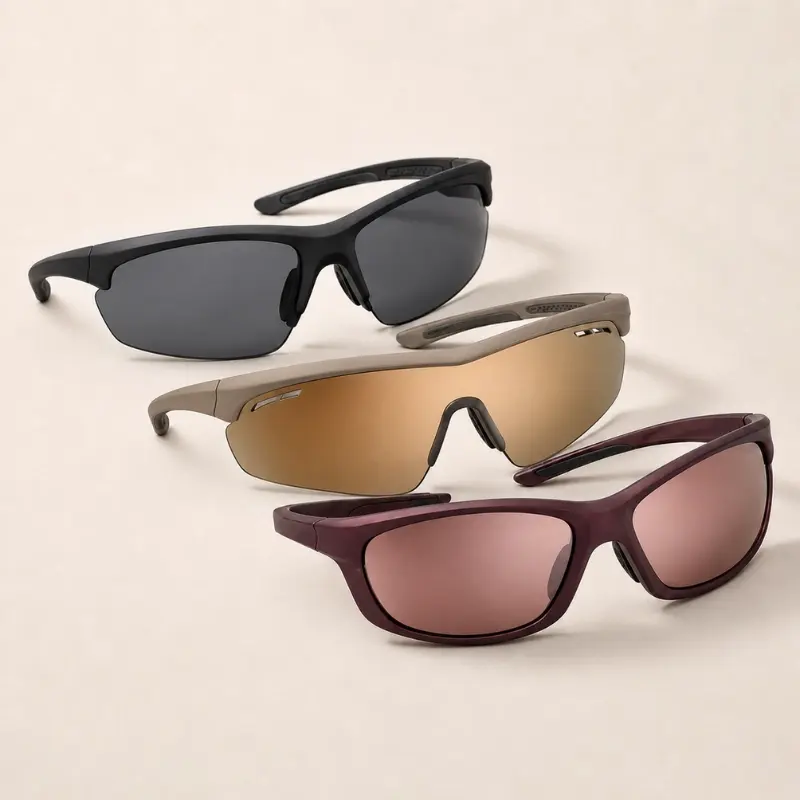
Water & Sport Eyewear
Polarized, floating-frame sunglasses built for active, water-facing use.
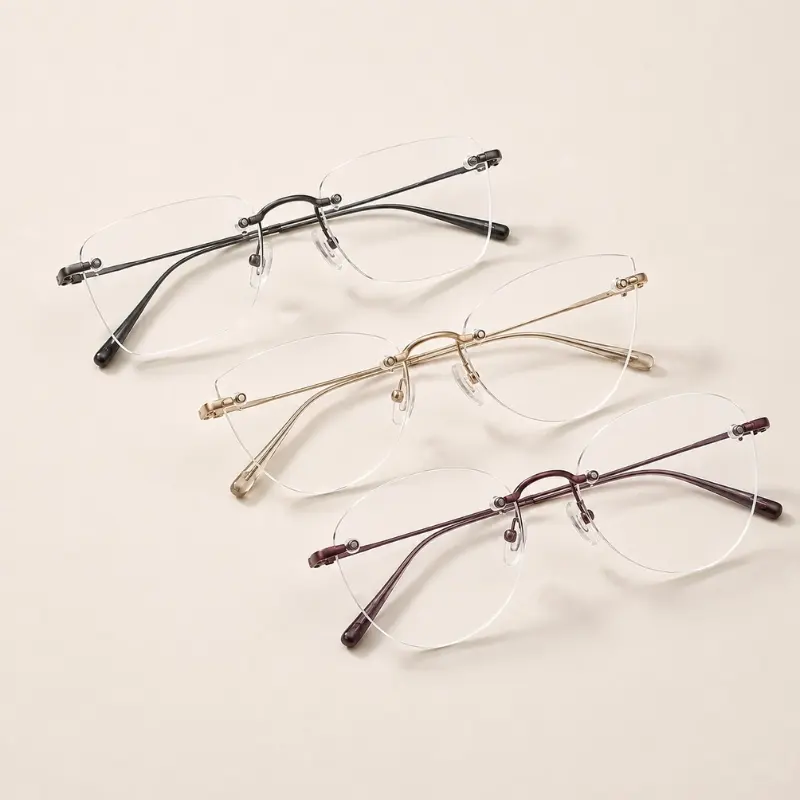
Rimless & Minimal Frames
Precision-dependent construction where alignment and hinge tolerance carry the whole design.
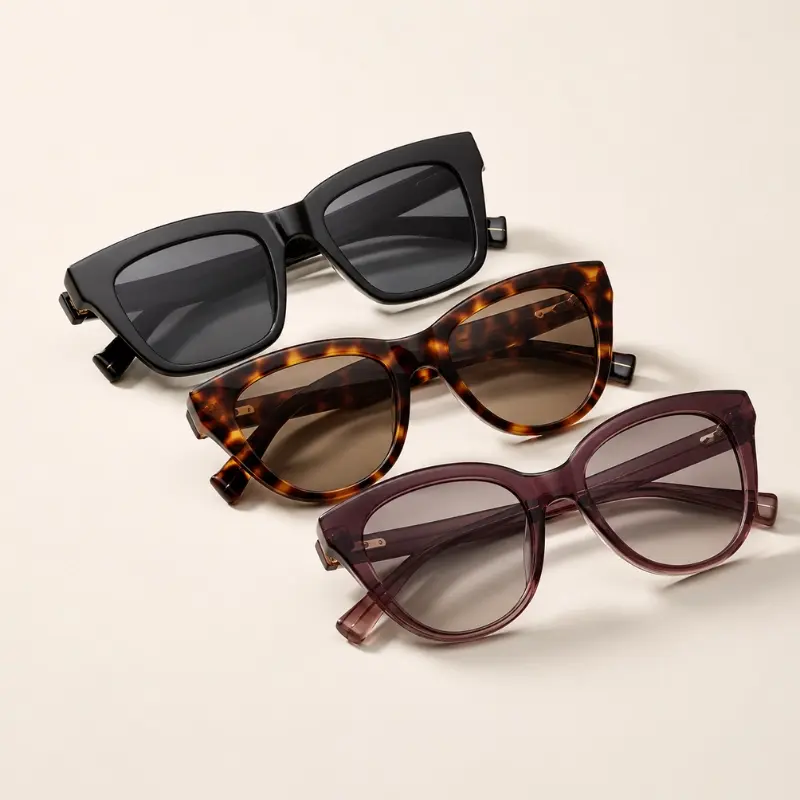
Fashion & Lifestyle Collections
Seasonal acetate and metal collections built around a brand's existing identity.
Bringing a US eyewear project to life?
Tell us your target retail window and category — we'll map the realistic timeline and flag anything US-specific before you commit to a design.
Start Your US Project