How to Choose a Private Label Eyewear Manufacturer: A B2B Buyer's Checklist
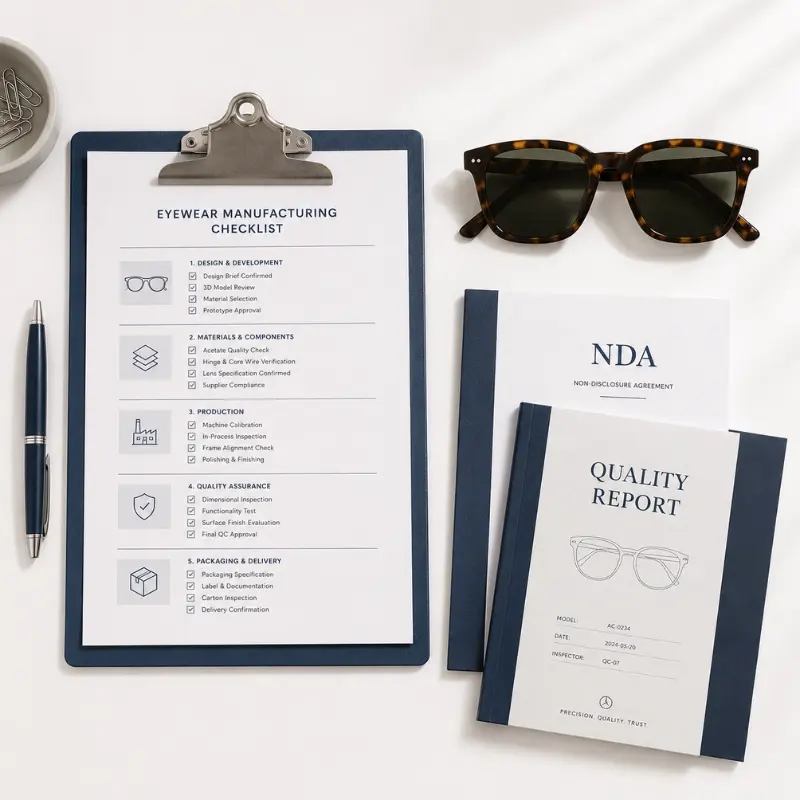
You’ve found ten factories online. They all look professional. They all claim great quality. Now what?
Choosing a private label eyewear manufacturer is one of the most important decisions your brand will make. The wrong partner costs you more than money — it costs you time, your designs, and your market reputation. This checklist gives you a structured way to evaluate any manufacturer before you commit.
We’ve supported brand clients across multiple continents — from independent designers launching their first collection to established labels scaling seasonal production. Here’s what actually separates a reliable manufacturing partner from one that looks good until the first bulk order arrives.
Why Most Brands Get This Decision Wrong
Most buyers compare the wrong things. They look at price, catalog size, and website quality. Those matter — but they don’t tell you whether a factory will protect your IP, match your samples in bulk, or communicate clearly when something goes wrong.
The brands that regret their manufacturer choice almost always made the same mistake: they moved too fast. A low sample price or a polished pitch deck is not a vetting process. A real private label eyewear manufacturer checklist covers seven areas — and skipping any one of them is where problems start.
Here’s what to check, in the order that matters.
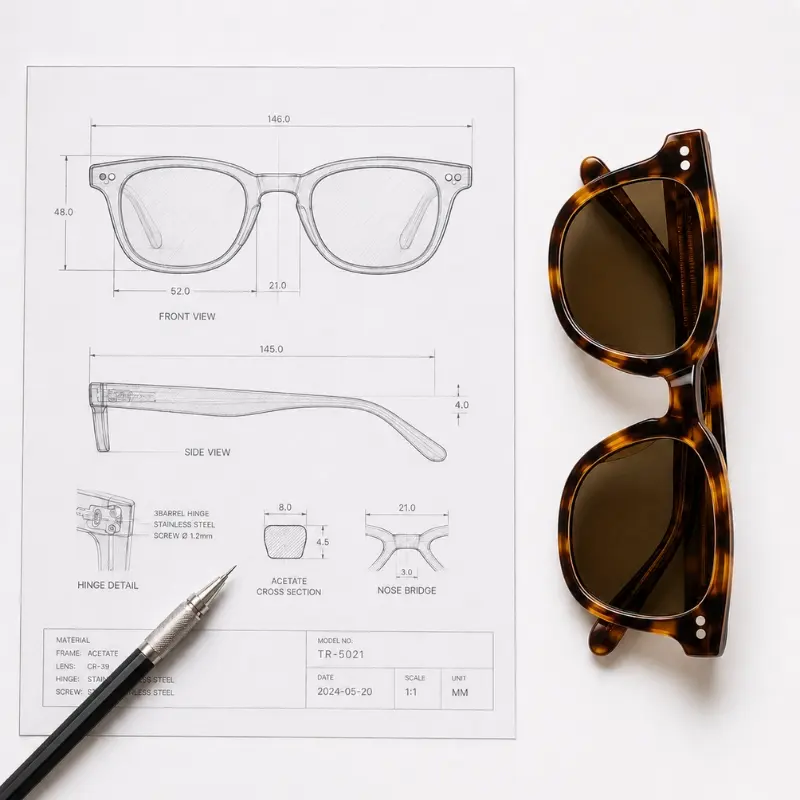
Checklist Item 1: Manufacturing Capability — Can They Actually Build What You Need?
Before anything else, confirm the partner can produce your specific product.
Not every eyewear supplier works with every material. A partner that specializes in injection-molded plastic frames may not have the expertise or supply chain to deliver titanium or hand-polished acetate at consistent quality. Confirm their core capability matches your product before spending time on anything else.
Here’s what to verify:
Ask for evidence of capability — not just finished product photos. This might mean production videos, material sample books, or a walkthrough of how they manage quality across their supply chain. A reliable partner is transparent about how their production works and who handles what. One who can only show you a polished catalog but can’t explain their production process is one who won’t have answers when quality issues arise.
Also confirm their range of frame construction experience:
| Frame Type | What to Ask |
|---|---|
| Full-rim acetate | Can they show acetate-specific samples and explain the finishing process? |
| Metal / titanium | How do they handle surface treatment — and can they show examples? |
| TR90 / injection | What injection capacity do they have, and what brands have they produced for? |
| Semi-rimless / rimless | Have they produced this construction before? Can they show samples? |
Here’s what most people miss: the real test is whether they ask you technical questions back. A partner who knows eyewear production will immediately ask about your hinge type, temple thickness, and lens base curve. If they just say “yes, no problem” to everything — that’s your first red flag.
Checklist Item 2: IP Protection — Will They Keep Your Designs Yours?
This is the question most buyers forget to ask until it’s too late.
In private label manufacturing, your designs are your most valuable asset. A trustworthy eyewear partner will protect your IP before production begins — with a written confidentiality agreement that covers your design files, colorways, tooling, and branding. If they hesitate to sign an NDA, walk away.
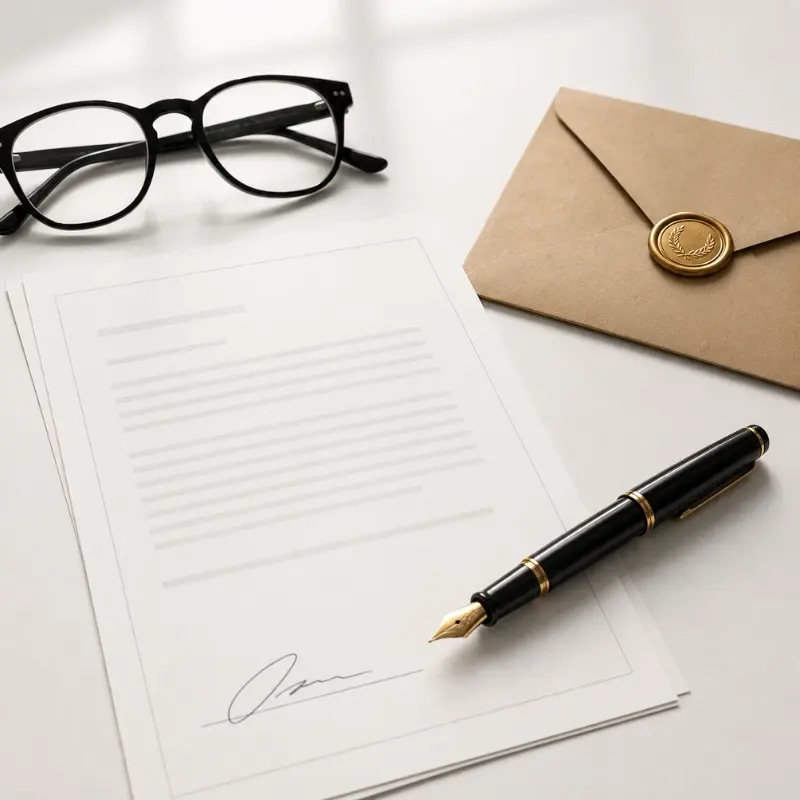
Here’s what solid IP protection looks like in practice.
Before you share any design files, references, or brand materials, request a Non-Disclosure Agreement (NDA). A reliable partner will have a standard NDA template ready — or will readily agree to sign yours. If a supplier says “we don’t usually do NDAs” or delays the process, treat that as a serious warning sign.
Beyond the NDA, ask these specific questions:
- “Do you share design files or mold data with other clients?” The answer should be an unequivocal no, with a clear explanation of how files are stored and access-controlled.
- “Is my colorway exclusive to my brand?” For ODM projects, confirm in writing that your specific color and material combination won’t be replicated for a competitor.
- “Who owns the design files after the project?” Your design files should belong to you. Mold tooling ownership depends on whether you paid for the mold — confirm this before tooling begins.
- “Can you provide examples of how you’ve handled IP disputes in the past?” A partner who has never dealt with this question is one who hasn’t had serious brand clients.
The truth is, IP protection isn’t just about legal documents. It’s about the partner’s culture and systems. Ask whether they have internal confidentiality policies, whether production staff sign agreements, and whether they maintain separate file storage for different clients. These questions tell you far more than any brochure.
Checklist Item 3: Quality Control — Will Bulk Match the Sample?
The most common complaint from eyewear brands isn’t bad samples. It’s bulk orders that don’t match them.
A reliable private label eyewear partner has a multi-stage quality control process — not just a final inspection before shipment. They inspect raw materials on arrival, check frames at each production stage, and confirm finished goods against your approved sample before anything is packed. Ask for this process in writing.
Here’s a practical QC checklist to run through with any potential partner:
| QC Stage | What Should Happen | What to Ask |
|---|---|---|
| Raw material inspection | Acetate sheets, metal rods, lens blanks checked on arrival | “Do you test incoming material batches?” |
| In-process inspection | Frame dimensions, hinge fit, color tone checked mid-production | “At what production stages do you inspect?” |
| Logo / branding check | Logo placement, depth, color accuracy verified before assembly | “Who checks logo quality and against what standard?” |
| Pre-shipment inspection | Finished goods compared against signed-off sample | “Do you have a written AQL standard?” |
| Third-party audit option | SGS, Bureau Veritas, or QIMA can conduct independent audits | “Are you open to third-party factory audits?” |
You might be wondering: how do you verify any of this before placing an order? The sample order is your answer.
A sample isn’t just about approving a design. It’s your single most important due diligence tool. When you receive your sample, check:
- Are the materials the same weight and finish as what was specified?
- Is the hinge tight and smooth, with no play when opened and closed?
- Does the logo placement match your brief exactly — depth, position, method?
- Is the frame symmetrical when placed on a flat surface?
- Does the lens sit flush with no distortion at the edges?
A partner that produces an excellent sample from the correct production materials — not a handmade prototype — is demonstrating that their bulk output will match. Ask them directly: “Is this sample made using the same materials and processes as bulk production?”
Checklist Item 4: Certifications and Compliance — Do You Know What Your Market Requires?
If you’re selling in the EU or the US, compliance is non-negotiable. But here’s what most brands get wrong: they treat certification as the supplier’s problem. It isn’t. It’s yours.
Before you approach any partner, know exactly what your target market requires. Compliance is your responsibility as the brand owner — not something to figure out after sampling begins. The right question isn’t “does this supplier have certifications?” It’s “do I know what certifications my product needs, and have I confirmed my supply chain can support them?”
Here’s what your product likely needs depending on your target market — understand these requirements before you brief any supplier:
- EU market: CE marking under EN ISO 12312-1 for sunglasses; REACH compliance declaration for chemical safety of materials
- US market: ANSI Z80.3 compliance for sunglasses; UV400 lens performance verification from an accredited lab
- Both markets: UV400 test reports from third-party labs (SGS, Bureau Veritas, TÜV) are standard practice; ISO 9001 from your supply chain confirms baseline quality management systems are in place
Early in your conversations, ask: “Have you worked with brands selling into [your target market] before, and what compliance support does your supply chain provide?” A partner with real international experience will know exactly what you’re asking — and will walk you through how compliance documentation is typically handled for your market.
The bottom line? Walk into supplier conversations knowing your compliance requirements. It signals you’re a serious buyer, and it immediately filters out partners who haven’t worked with international brands before.
Checklist Item 5: Red Flags — What Should Make You Walk Away?
Knowing what good looks like is important. Knowing what bad looks like is essential.
The eyewear industry has no shortage of suppliers who look professional online but can’t deliver consistently. The red flags below are patterns that experienced B2B buyers recognize — and that cost brands real money when ignored.
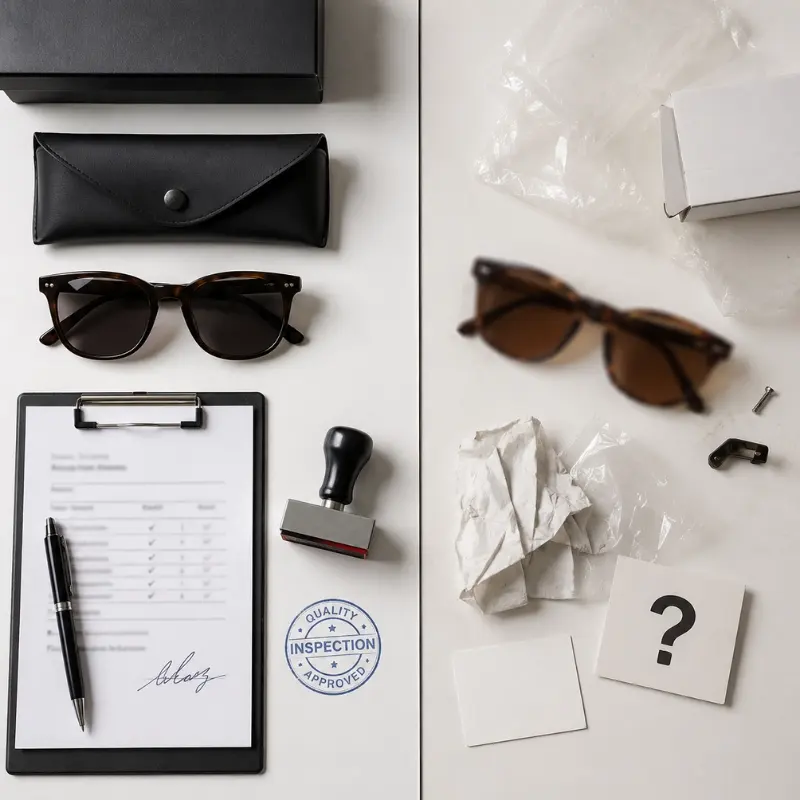
Watch for these warning signs:
They say yes to everything immediately. A supplier that agrees to every spec, every timeline, and every price expectation without asking clarifying questions is either not reading your brief carefully or telling you what you want to hear. A knowledgeable partner asks about hinge tolerances, material availability, and production constraints. Blank agreement is a red flag.
They can’t explain their production process. Ask how they handle your specific product — what the workflow looks like, who manages quality at each stage, and how they’ve handled similar projects before. A partner who genuinely knows their supply chain will walk you through it clearly. One who gives vague or generic answers can’t be held accountable when things go wrong.
The sample is handmade, not production-made. Some suppliers produce beautiful handcrafted samples that their production process can’t replicate at scale. Ask directly: “Is this sample made using the same materials and processes as bulk orders?” If the answer is no, the sample tells you nothing about bulk quality.
They refuse or delay signing an NDA. Already covered in the IP section — but worth repeating here. Any hesitation on confidentiality documentation is a serious red flag for a private label relationship.
Communication is slow or unclear during the vetting process. If they take four days to answer a basic question before you’re a client, imagine the communication when there’s a production issue and your launch date is in three weeks. Response speed and clarity during the enquiry stage is the best predictor of communication quality during the project.
They can’t give you client references. An established private label partner has worked with real brands. They should be able to provide references — even if anonymized for confidentiality. “We can’t share any client information” is very different from “Here’s a reference you can contact; they’ve agreed to speak with prospective clients.”
They’re not who they say they are. Not every reliable eyewear partner owns a factory outright. Some of the best private label operations work with a network of specialized facilities — one for acetate, one for titanium, one for TR90 — because no single factory does every material equally well. What matters is whether they have real production oversight, direct supply chain relationships, and accountability for quality outcomes. A supplier who can’t tell you which facility produces which product, or who has no QC presence during production, is the red flag — not the business model itself. Ask instead: “Which facility handles which material in your line, and how do you manage quality across those relationships?” That’s the question that actually tells you whether your partner has real oversight — regardless of whether they own the building.
Checklist Item 6: Communication and Project Management — Will They Speak Your Language?
Manufacturing quality is one half of the equation. The other half is whether you can actually work together.
For international private label brands, communication quality is a non-negotiable. You need a partner who responds within one business day, provides clear written updates at each project stage, and has a dedicated account manager who knows your project — not a rotating team that makes you repeat your brief every time.
Here’s what good communication looks like in a manufacturing partnership:
- Response time: Under 24 hours for routine questions, under 4 hours for urgent production issues
- Project updates: Written status updates at key milestones — design approval, tooling confirmation, first sample dispatch, bulk production start, pre-shipment inspection
- Language: Clear, written English with no ambiguity on specs, quantities, timelines, or pricing
- Issue escalation: A clear point of contact for problems — not a general email inbox
Ask these questions during the vetting process:
- “Who will be my dedicated contact for this project?”
- “How do you typically communicate with brand clients — email, WhatsApp, a project management tool?”
- “Can you walk me through how you handled a production issue with a recent client?”
The bottom line? A partner who communicates poorly during the easy part — the sales process — will communicate worse when things get complicated. Test them before you commit.
Checklist Item 7: MOQ, Lead Times, and Scalability — Can They Grow With You?
The right partner for your first order should also be the right partner for your tenth.
Confirm MOQ, sampling timelines, and bulk lead times in writing before signing any agreement. A trustworthy partner gives you specific numbers — not ranges that shift after you’ve committed. And they should be able to scale production as your brand grows, without compromising quality or pushing you to a different production line.
Here are the numbers to confirm and document:
| Parameter | What to Confirm | Typical Range |
|---|---|---|
| MOQ per style | Minimum units per colorway, not per order | 300–500 pcs (acetate, steel, titanium) |
| Sample lead time | Days from design approval to sample dispatch | 10–20 days |
| Bulk lead time | Days from sample sign-off to shipment | 45–60 days |
| Revision rounds | How many sample revision rounds are included | 2–3 rounds standard |
| Sample cost | Whether sample cost is credited against bulk order | Usually credited |
| Tooling cost | If new mold required — who owns it, what’s the fee | $800–$3,000 per style |
Also ask about their capacity ceiling. If your brand scales from 500 to 5,000 units per style, can they handle that without compromising quality? A partner who can’t answer this question clearly isn’t thinking about your long-term growth.
This is part of our complete guide to private label eyewear manufacturing. If you want to run through this checklist with us directly — covering your specific product, material, and market — we respond within 4 business hours.
The 20 Questions to Ask Any Private Label Eyewear Partner
Before you make your final decision, run through this list. A partner who answers all of these clearly and specifically is worth serious consideration. One who hedges, deflects, or gives generic answers on more than two or three of them is showing you who they are.
About Capability
- What materials and frame types do you specialize in, and can you show me examples for each?
- Can you show me evidence of how you handle production for this specific frame type?
- Which facility or supply chain partner handles each material in your line — and how do you manage quality across those relationships?
- What is your combined production capacity, and what’s the maximum volume you’ve handled for a single brand client?
About Quality
- What are the QC inspection stages in your production process?
- Are samples produced using the same materials and processes as bulk orders?
- What is your AQL standard for pre-shipment inspection?
- Are you open to third-party factory audits (SGS, Bureau Veritas, QIMA)?
About IP and Confidentiality
- Will you sign an NDA before we share design files?
- Are my colorway and design exclusive to my brand — not resold to other clients?
- Who owns the design files after project completion?
- Who owns the mold tooling if I pay the tooling fee?
About Compliance
- Have you worked with brands selling into the EU market — and what compliance support does your supply chain provide?
- Have you worked with brands selling into the US market — and what compliance support does your supply chain provide?
- If my product requires new certification testing, can you coordinate that process?
About Communication and Partnership
- Who will be my dedicated account manager for this project?
- What is your standard response time for client enquiries?
- Can you provide a client reference I can speak with?
- How do you handle production issues or delays — what’s the escalation process?
- Can you support my brand as I scale from 500 to 5,000+ units per style?
Conclusion
The right private label eyewear partner isn’t the one with the lowest price or the biggest catalog. It’s the one that protects your IP, matches your samples in bulk, communicates clearly, and thinks about your brand’s long-term growth — not just the next order.
Frequently Asked Questions
What is the most important thing to check when choosing a private label eyewear manufacturer?
IP protection and quality consistency are the two highest-stakes factors. Before sharing any designs, confirm the partner will sign an NDA. Before placing a bulk order, verify that samples are made using production materials — not handcrafted prototypes.
How do I know if an eyewear supplier is reliable if they don’t own their own factory?
Factory ownership isn’t the deciding factor. What matters is whether they have direct relationships with specialized production facilities, real QC oversight during production, and full accountability for the final product. Ask which facility produces which material, and how quality is managed across those relationships.
What certifications does my eyewear product need?
It depends on your target market. For the EU, CE marking under EN ISO 12312-1 is required for sunglasses, along with REACH compliance for materials. For the US, ANSI Z80.3 is the standard. UV400 lens verification from accredited labs applies to most markets. Know your requirements before briefing any supplier — compliance is the brand owner’s responsibility.
What is a realistic MOQ for private label eyewear?
For acetate, stainless steel, and titanium frames, most reliable partners start at 300 to 500 pieces per style. Be cautious of suppliers offering MOQs significantly lower than this for fully custom designs — it may indicate they’re working with stock frames rather than producing to your spec.
How long does it take to produce private label eyewear from start to finish?
From first enquiry to bulk shipment, budget 60 to 90 days. Sampling takes 10 to 20 days after design approval. Bulk production runs 45 to 60 days after sample sign-off. More complex designs or new mold tooling will add time.
What are the biggest red flags when evaluating an eyewear supplier?
Agreeing to everything without asking technical questions, refusing to sign an NDA, providing handmade samples instead of production samples, slow communication during the vetting process, and inability to explain which production facility handles which product or how quality is managed.
Should I visit the production facility before placing a bulk order?
If possible, yes. A partner who welcomes facility visits — or offers a video call walkthrough — is demonstrating transparency. Those who discourage in-person visits or virtual audits should be approached with caution.
How do I protect my eyewear design from being copied?
Get a signed NDA before sharing anything. Confirm in writing that your colorway and design are exclusive to your brand. For custom mold tooling, confirm in the contract that you own the mold. Work with partners who can clearly explain how client design files are stored and access-controlled internally.
Let's get started!
Get in touch with a custom eyewear specialist now for a free consultation and instant price quote.
WHATSAPP ME GO!
📱 Scan with your phone to start chatting