Private Label Eyewear MOQ Explained: What Brands Need to Know Before Placing Their First Order
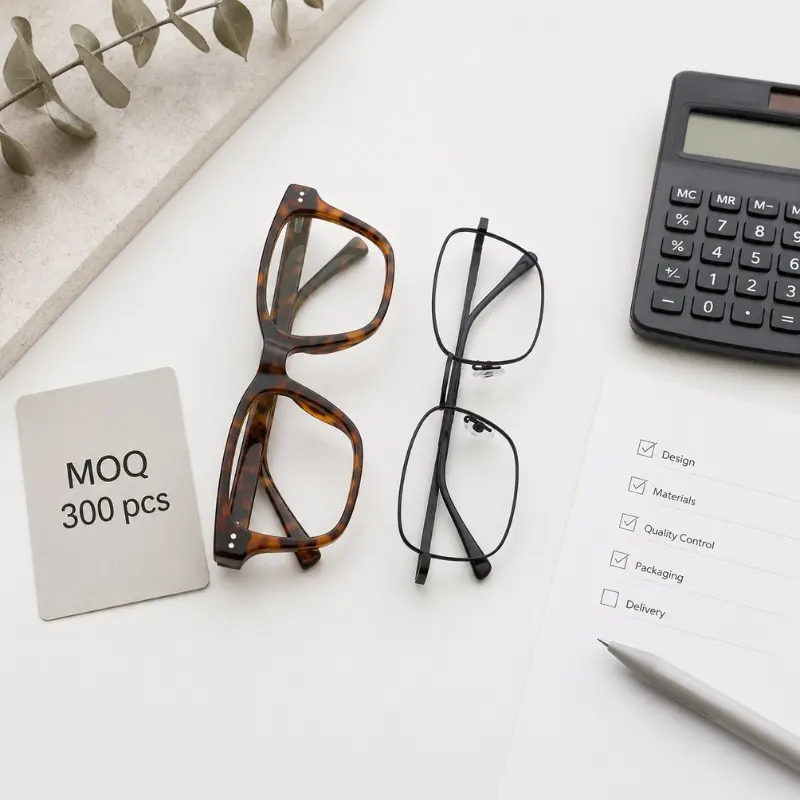
You found a manufacturer you like. The samples look good. Then they send you the MOQ — and suddenly the numbers don’t add up.
MOQ — minimum order quantity — is one of the first real barriers brands hit when entering private label eyewear. Get it wrong and you’re either over-committed on inventory you can’t move, or under-prepared for what production actually costs. This guide breaks down how eyewear MOQ works, what drives it, and how to plan your first order around it.
We’ve guided brands across multiple markets through their first private label eyewear orders. Here’s what the numbers actually mean — and how to use them to your advantage.
What Is MOQ in Private Label Eyewear?
Most brands think MOQ is just a number a factory pulls out of thin air. It isn’t.
MOQ — minimum order quantity — is the lowest number of units a manufacturer will produce in a single production run. In private label eyewear, MOQ typically applies per style, per colorway, or sometimes per material. It exists because production has fixed costs that only make sense above a certain volume.
Here’s what that means in practice.
Every time a factory starts a production run, they incur setup costs regardless of how many units you order. Material sourcing has minimum purchase requirements from suppliers. Machinery needs to be calibrated for your specific frame spec. Workers need to be allocated. Quality control needs to be run at each stage. If you order 50 units, those fixed costs are spread across 50 pairs — making the per-unit cost prohibitive for both you and the factory. At 300 or 500 units, those same costs spread out and the economics start working for everyone.
This is why MOQ isn’t arbitrary. It’s a reflection of how manufacturing actually works.
In private label eyewear, MOQ typically applies at three levels — and most brands only think about one of them:
| MOQ Level | What It Covers | Typical Range |
|---|---|---|
| Frame MOQ | Units per style per colorway | 300–500 pcs |
| Logo / branding MOQ | Minimum units for custom logo application | Often same as frame MOQ |
| Packaging MOQ | Custom cases, boxes, cleaning cloths | 500–1,000 pcs (separate minimums) |
Here’s what most people miss: packaging MOQ is the most commonly overlooked cost in a first order. Your frame MOQ might be 300 units — completely manageable. But your custom-printed retail box might require 1,000 units minimum from the packaging supplier. Your branded microfiber cleaning cloth might have its own 500-unit minimum. These add up fast, and they hit your budget before a single frame is produced.
Why Do Eyewear Manufacturers Have MOQ?
Understanding why MOQ exists helps you negotiate it more effectively.
Eyewear manufacturers set MOQ because production efficiency depends on volume. Small batches cost more per unit to produce — not because factories want to discourage small orders, but because fixed costs like material sourcing, machine setup, mold allocation, and quality control don’t scale down proportionally with quantity.
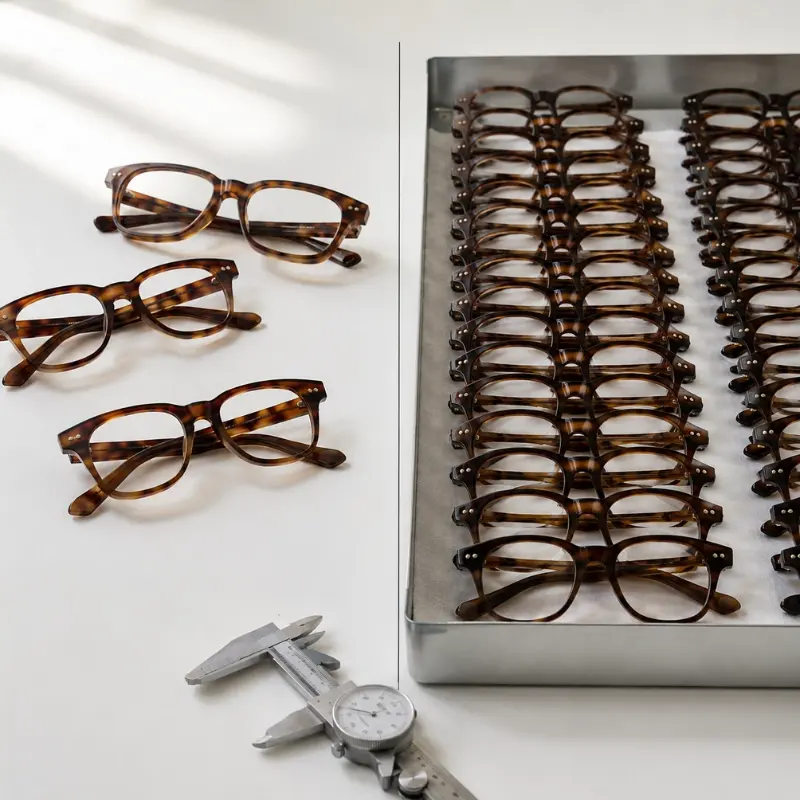
Here are the specific cost drivers behind eyewear MOQ:
Material sourcing minimums
Raw material suppliers — acetate sheet mills, metal rod suppliers, lens blank manufacturers — all have their own minimum purchase requirements. A factory can’t buy 30 sheets of a specific acetate color for your 50-unit order. They buy a minimum quantity, which means your small order either gets bundled with other clients’ orders (raising IP risk) or the factory absorbs the surplus material cost and passes it back to you in a higher per-unit price.
Machine setup and mold allocation
Every frame style requires specific machine setup — calibrating cutting tools, adjusting hinge press parameters, setting tumbling times for that acetate thickness. That setup takes time regardless of run length. A 50-unit run and a 500-unit run require the same setup hours. The factory needs enough volume in your run to justify that allocation.
Quality control staging
Multi-stage QC — material inspection, in-process inspection, pre-shipment inspection — has fixed labor costs at each checkpoint. On small runs, QC cost per unit becomes disproportionately high. Larger MOQs allow factories to absorb QC costs within a viable per-unit price.
Labor and production planning
Production scheduling works in batches. A factory running acetate frames allocates a production line for a set period. Slotting a 50-unit run into that schedule is disruptive and inefficient. MOQ ensures the run is worth planning.
The bottom line? MOQ is not a barrier designed to exclude small brands. It’s the minimum volume at which production is economically viable for both sides. Understanding this shifts the conversation from “can you lower the MOQ?” to “how do I plan an order that works at this MOQ?”
How MOQ Varies by Material and Frame Type
Not all eyewear MOQs are equal — and the differences matter when you’re planning your first collection.
MOQ in private label eyewear varies significantly by material, frame construction, and customization depth. Acetate frames typically carry higher MOQs than TR90 or metal because of the material sourcing and hand-finishing involved. Fully custom mold projects start higher still.
Here’s a practical breakdown by material:
| Material | Typical MOQ per Style | Why |
|---|---|---|
| Acetate | 300–500 pcs | Sheet sourcing minimums, hand-cutting, tumbling, polishing |
| Stainless steel | 300–500 pcs | Metal rod sourcing, CNC machining, plating line allocation |
| Titanium | 300–500 pcs | Premium material sourcing, precise machining, longer QC |
| TR90 / injection | 500–1,000 pcs | Injection mold amortization, color masterbatch minimums |
| Mixed materials | Negotiable | Depends on which components drive the MOQ |
Custom mold vs. existing mold
This distinction has the biggest impact on your MOQ and upfront cost.
If you’re working with an existing mold — choosing a frame shape already in the manufacturer’s lineup and customizing color, lens, logo, and packaging — MOQ stays at the standard range above. No tooling cost required.
If you’re developing a custom mold for an original frame shape, you’re paying a one-time tooling fee ($800–$3,000 per style depending on complexity) and your MOQ for that mold typically starts higher — often 500–1,000 units — to amortize the tooling investment. The mold belongs to you after that, meaning reorders have no additional tooling cost.
Per style vs. per colorway
This is where brands often miscalculate their first-order budget — and the numbers vary significantly by material.
For acetate frames, colorway MOQ is more flexible. Because acetate is cut from sheet material, factories can often run as few as 100 units per color on the same frame shape. This makes acetate a friendlier material for brands who want to test multiple colorways without committing to large quantities per color.
For injection-molded frames — TR90, PC, or nylon — the colorway MOQ is higher. Injection molding uses color masterbatch mixed into the material itself, which means each color requires a separate production run with its own minimum. Expect 300 units per colorway as the standard starting point for injection frames, sometimes higher depending on the mold and material combination.
In practice, this means: if you want the same injection frame in black, tortoiseshell, and clear, you’re looking at 900 units minimum across three colorways. For a first order across three injection styles in two colors each, that’s potentially 1,800 units before packaging is even considered.
Plan your colorway count carefully on your first order — especially for injection materials. One or two colorways per style lets you test the market without over-committing inventory.
The Hidden MOQ: Packaging, Logo, and Accessories
Frame MOQ is just the starting point. Most brands don’t realize packaging has its own separate minimums.
In private label eyewear, the full product — frame, lens, logo, case, cleaning cloth, retail box — each has its own minimum production quantity. A frame MOQ of 300 units does not automatically mean you can order 300 custom retail boxes. Packaging suppliers often require 500 to 1,000 units minimum, billed separately from the frame production.
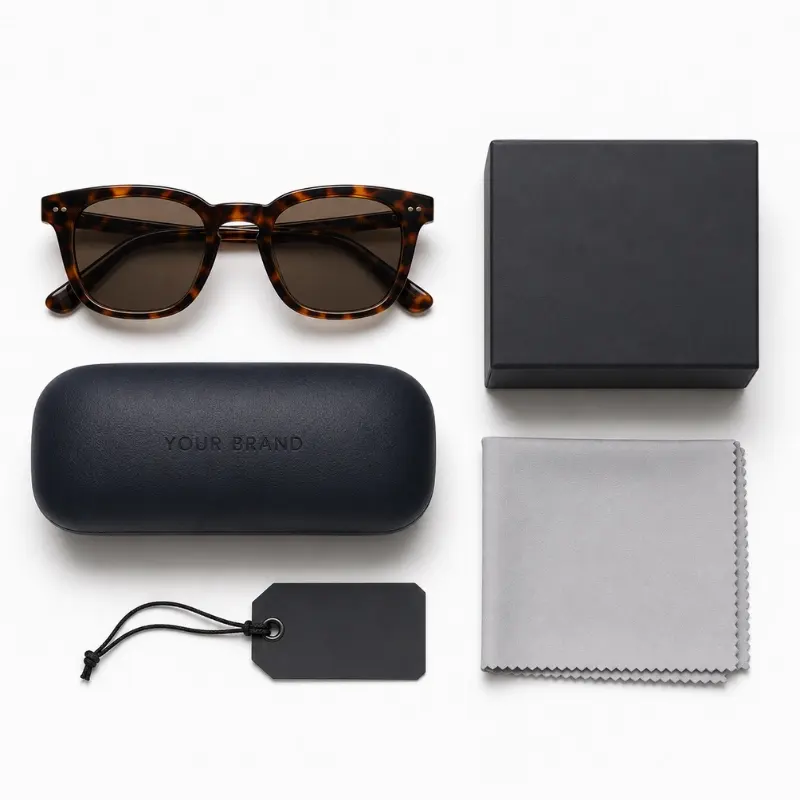
Here’s how the layered MOQ structure typically looks on a first order:
| Component | Typical Minimum | Notes |
|---|---|---|
| Frame (per colorway) | 300–500 pcs | Core MOQ |
| Logo application | Usually same as frame MOQ | Laser, hot stamp, or metal inlay |
| Soft pouch | 300–500 pcs | Often matched to frame MOQ |
| Hard case | 300–500 pcs | Depends on case type |
| Custom retail box | 500–1,000 pcs | Printed packaging has higher minimums |
| Microfiber cleaning cloth | 500–1,000 pcs | Custom logo print requires volume |
| Hang tags / lens stickers | 500–1,000 pcs | Often overlooked |
You might be wondering: what’s the smarter approach for a first order?
For your first production run, semi-custom packaging is often the right call. Use a standard case or pouch in a brand-appropriate color, add a branded cleaning cloth, and keep the retail box simple. This keeps your packaging MOQ aligned with your frame MOQ — and gets your product to market without locking budget into packaging you haven’t tested.
Once you know which styles sell, invest in fully branded packaging for your reorders. The market will tell you which products deserve the packaging investment before you make it.
How to Plan Your First Private Label Eyewear Order Around MOQ
Knowing the numbers is one thing. Building a realistic first-order plan is another.
The goal of a first private label eyewear order isn’t to minimize MOQ. It’s to order the right quantity to validate demand, generate real sales data, and fund a confident reorder. Most brands that struggle with their first order ordered too many styles in too many colorways — not too many units per style.
Here’s a practical framework for your first order:
Step 1: Start with fewer styles, not fewer units
Spreading 300 units across five styles gives you 60 units per style — not enough inventory to generate meaningful sales data or support a reorder cycle. Concentrating 300–500 units on one or two hero styles gives you real market feedback.
For a first collection, two to three styles in one colorway each is a more disciplined starting point than ten styles across multiple colors.
Step 2: Align your packaging MOQ to your frame MOQ
Before confirming your frame order, confirm your packaging quantities. If your retail box requires 1,000 units minimum but your frame order is 300 units, you have a mismatch that either forces you to overstock packaging or pushes you toward a larger frame order than you planned.
Start with semi-custom packaging — standard cases, branded cloths — to keep all minimums aligned.
Step 3: Factor in sampling cost
Sample costs are separate from bulk MOQ. For most eyewear projects, expect to spend $100–$300 per sample style before bulk production begins. Most manufacturers credit this against your bulk order. Confirm this in writing before committing.
Step 4: Understand reorder thresholds
A good manufacturing partner should be able to tell you what the reorder MOQ is for your style once the mold exists. For existing-mold styles, reorder MOQ is typically the same as the first order. For custom-mold styles, reorder MOQ may be lower once tooling is amortized. Knowing this upfront helps you plan inventory and cash flow for your second order before your first one ships.
Step 5: Negotiate from a long-term partnership position
MOQ is sometimes negotiable — but not through pressure. Manufacturers are more likely to offer flexibility to brands who demonstrate serious intent: a clear brief, realistic timelines, and a stated plan for scaling. Coming to the conversation with “we’re starting at 300 units but plan to reorder 1,000 within six months” is a very different conversation from “can you lower the MOQ?”
This is part of our complete guide to private label eyewear manufacturing. If you want to discuss your first order plan — specific styles, materials, and realistic MOQ structure — we respond within 4 business hours.
MOQ Quick Reference: What to Confirm Before You Order
Before committing to any private label eyewear order, get these numbers in writing:
| What to Confirm | Question to Ask |
|---|---|
| Frame MOQ | “What is the MOQ per style, per colorway?” |
| Packaging MOQ | “Do cases, boxes, and cloths have separate minimums?” |
| Logo MOQ | “Is logo application included in frame MOQ or separate?” |
| Sample cost | “Is sample cost credited against the bulk order?” |
| Tooling cost | “Is a new mold required, and who owns it?” |
| Reorder MOQ | “What is the minimum for a reorder on this style?” |
| Lead time | “What is the production timeline after sample sign-off?” |
Conclusion
MOQ in private label eyewear isn’t just one number — it’s a layered structure covering frames, packaging, branding, and accessories. The brands that plan well start with fewer styles, align their packaging minimums to their frame order, and treat their first order as a market test — not a full collection launch.
Frequently Asked Questions
What is MOQ in private label eyewear?
MOQ stands for minimum order quantity — the lowest number of units a manufacturer will produce in a single production run. In private label eyewear, MOQ typically applies per style and per colorway, not per total order. Standard MOQ for custom eyewear starts at 300 to 500 pieces per style depending on material.
Why do eyewear manufacturers have minimum order quantities?
MOQ exists because production has fixed costs — material sourcing minimums, machine setup, mold allocation, and quality control — that only become economically viable above a certain volume. Small batches cost more per unit to produce, making very low quantities impractical for both manufacturer and brand.
Is packaging MOQ the same as frame MOQ?
Not always. Frames, cases, retail boxes, cleaning cloths, and hang tags each have their own minimum production quantities. Custom-printed packaging often requires 500 to 1,000 units minimum — separate from your frame MOQ. Brands often discover this mismatch after committing to a frame order.
What is the minimum order for private label sunglasses?
For fully custom private label sunglasses — with your choice of frame shape, material, color, lens, and logo — MOQ typically starts at 300 to 500 pieces per style for acetate, stainless steel, and titanium. TR90 injection frames may start higher due to mold amortization requirements.
Can I negotiate MOQ with an eyewear manufacturer?
Sometimes, yes. Manufacturers are more flexible with brands who demonstrate long-term intent — a clear brief, realistic timelines, and a stated reorder plan. Approaching the conversation as a partnership rather than a price negotiation gives you the best chance of a flexible arrangement on your first order.
Does MOQ apply per colorway or per style?
In most eyewear manufacturing, MOQ applies per colorway — meaning each color variation of the same frame requires its own minimum quantity. If you want one style in three colors, you’ll need to meet MOQ for each color separately. Plan your colorway count carefully on your first order.
What is the difference between MOQ for an existing mold vs. a custom mold?
For existing molds — frame shapes already in the manufacturer’s lineup — MOQ stays at the standard range with no tooling cost. For custom molds — original frame shapes you develop — you pay a one-time tooling fee ($150–$3,000) and MOQ may start higher. The mold belongs to you after that, so reorders carry no additional tooling cost.
How many styles should I order for my first private label eyewear collection?
Two to three styles in one or two colorways each is a disciplined starting point for most first collections. Concentrating volume on fewer styles gives you enough inventory per style to generate real sales data and fund a confident reorder — rather than spreading budget thin across too many untested designs.
Let's get started!
Get in touch with a custom eyewear specialist now for a free consultation and instant price quote.
WHATSAPP ME GO!
📱 Scan with your phone to start chatting