How to Brand Eyewear with Your Own Logo: Laser, Hot Stamp, Metal Inlay and More
You’ve chosen your frame. You’ve confirmed the material. Now comes the question every brand asks next: how do I put my logo on it?
Custom logo eyewear branding isn’t one-size-fits-all. The method you choose affects how your logo looks, how long it lasts, what it costs, and — most importantly — what it says about your brand. This guide covers every major eyewear logo technique, when to use each one, and how to choose the right method for your material, price point, and brand positioning.
We’ve applied logos across thousands of frames in acetate, titanium, stainless steel, and TR90. Here’s what actually works — and what to avoid.
Why Your Logo Method Matters More Than You Think
Most brands treat logo application as an afterthought. It shouldn’t be.
The logo method you choose is a brand signal. A deep laser engraving on a titanium temple reads differently from a gold foil hot stamp on acetate. A flush metal inlay communicates something a pad-printed logo never can. Before you pick a technique, know what you want your product to say — because the method and the message are inseparable.
Here’s the full picture of what your logo choice affects:
- Durability: Some methods last the lifetime of the frame. Others fade within a year of regular wear.
- Material compatibility: Not every technique works on every frame material. The wrong combination produces poor results no matter how good the artwork is.
- Cost per unit: Logo methods vary from a few cents to several dollars per unit. On a 500-unit order, that difference adds up fast.
- Brand positioning: A luxury frame with a pad-printed logo undercuts the premium you’re charging. A budget frame with an expensive metal inlay doesn’t make financial sense either.
- Artwork requirements: Each method has specific file requirements. A logo that looks perfect on screen may not translate to production without adaptation.
Get this decision right early. Changing logo methods after sampling adds time, cost, and revision rounds.
Laser Engraving — The Most Versatile Eyewear Logo Method
Laser engraving is the default starting point for most private label eyewear brands — and for good reason.
Laser engraving uses a focused beam to etch your logo directly into the frame surface. The result is a permanent, precise mark that won’t peel, fade, or scratch off. It works on metal, acetate, TR90, and titanium — making it the most material-versatile logo method available for eyewear production.
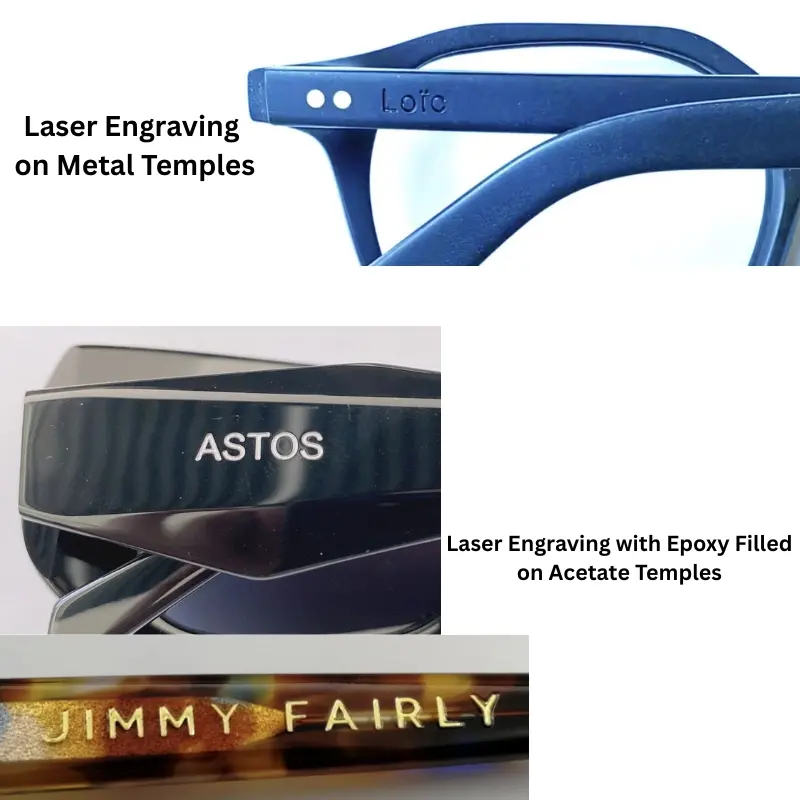
Here’s how laser engraving works in practice.
The frame is mounted in a laser machine that follows the vector path of your logo file. The laser removes a controlled depth of material — typically 0.1 to 0.3mm — leaving a clean recessed mark. On metal frames, the result is a bright, precise line against the base material. On acetate, the engraved area reveals the lighter inner layer of the sheet, creating contrast against the surface color.
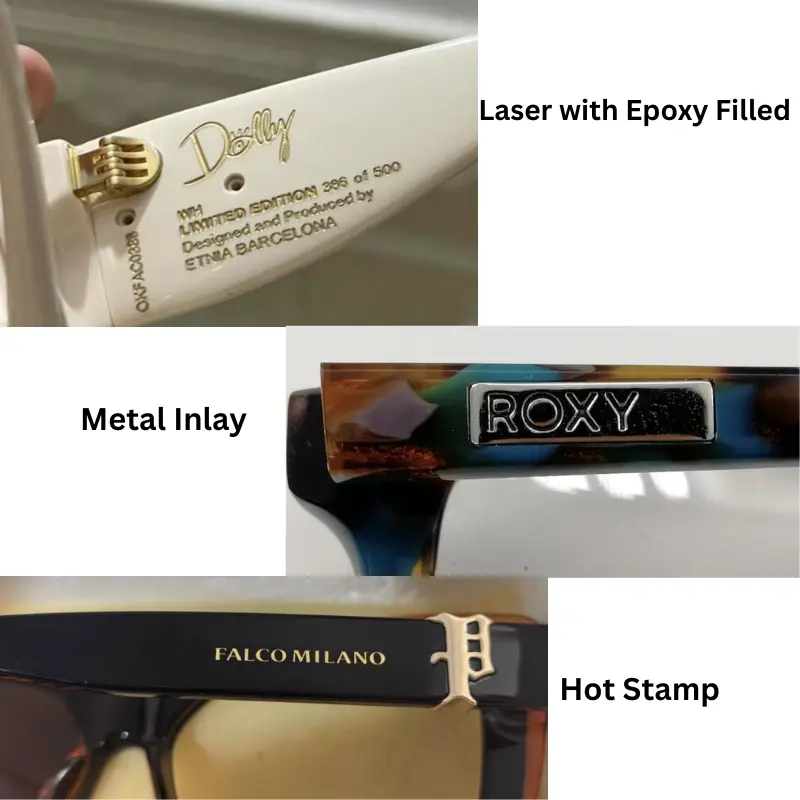
For brands who want color in the engraving, an epoxy fill can be added after the laser step — pushing colored ink (most commonly gold, silver, or white) into the recessed groove. This is one of the most durable colored logo options available, because the color sits inside the frame material rather than on top of it.
When laser engraving is the right choice
- Metal frames: stainless steel, titanium, monel — laser is the standard method
- Acetate frames: works well, especially with epoxy color fill for visibility
- Brands at any price point — laser reads as clean and considered, not cheap
- Complex logo designs with fine lines and tight detail
- Brands prioritizing long-term durability above all else
Laser engraving limitations
- On dark acetate colors, the contrast can be subtle without epoxy fill
- Very thin lines (under 0.3mm in the artwork) may not engrave cleanly at small sizes
- No metallic sheen — if your brand identity requires gold or silver visual impact, hot stamping or metal inlay may serve you better
Deep laser engraving
Deep laser — sometimes called engraving vs. marking — removes more material to create a more pronounced groove. This is common on high-end acetate and titanium frames where a tactile, three-dimensional logo effect is part of the product’s premium feel. Deep laser combined with epoxy fill is one of the most sophisticated logo options available at the ODM/private label level.
Hot Stamping — The Classic Premium Finish
Hot stamping is the go-to method when a brand wants immediate visual impact without the cost of a metal inlay.
Hot stamping transfers metallic or colored foil onto the frame surface using heat and pressure. The result is a flat, high-gloss logo in gold, silver, rose gold, matte black, or custom foil colors. It’s fast, cost-effective, and gives even entry-level frames a polished, branded appearance.
Hot stamping works by pressing a heated die — cut to the shape of your logo — against a foil sheet and the frame surface simultaneously. The heat activates the adhesive layer on the foil, transferring it cleanly to the frame. The die can be flat or slightly embossed to create a 3D stamped effect.
Standard hot stamping vs. 3D hot stamping
Standard hot stamping produces a flat foil logo — clean, precise, and widely used across acetate and injection frames at all price points.
3D hot stamping uses an embossed die to create a raised logo surface. The result has a tactile quality — the logo sits above the frame surface slightly, catching light differently and communicating a more premium finish. This is popular with mid-to-high-end acetate brands who want a logo that feels as considered as the frame itself.
When hot stamping is the right choice
- Acetate and injection-molded (TR90, PC) frames — hot stamping bonds well to these surfaces
- Brands wanting gold or silver visual impact without the cost of metal inlay
- Classic, heritage, or fashion-forward brand aesthetics
- Medium to large production runs — the die cost is low and per-unit cost drops with volume
Hot stamping limitations
- Not ideal for metal frames — the surface is too hard for reliable foil adhesion
- Less durable than laser engraving — on high-contact areas (like the outer temple surface), foil can wear over time with heavy use
- Logo complexity is limited — very fine details and thin lines may not transfer cleanly
- Placement must be on relatively flat or slightly curved surfaces; deep curves cause inconsistent pressure and patchy results
Metal Inlay — The Premium Standard for Luxury Eyewear
If hot stamping communicates “quality,” metal inlay communicates “craftsmanship.”
Metal inlay involves pressing a separately manufactured metal logo plate — usually in brass, zinc alloy, or stainless steel — into a pre-cut recess in the frame. The logo sits flush with the frame surface, or slightly proud of it, creating a three-dimensional branded element that is visually distinct, tactilely satisfying, and highly durable.
Here’s how metal inlay is produced.
The logo is manufactured as a separate metal component — die-cast, stamped, or CNC-cut depending on the complexity and finish required. The frame has a corresponding recess machined or molded into the temple at the logo position. The metal piece is pressed into the recess and secured with epoxy adhesive. The result is a logo that is flush or slightly raised, typically in silver, gold, or gunmetal finish, with a weight and substance that no printed or engraved method can replicate.
When metal inlay is the right choice
- Acetate frames targeting premium or luxury retail price points ($80+ retail)
- Brands whose visual identity relies on a recognizable logo element (think the metal logo bar on premium optical frames)
- Products where the logo is a design feature, not just a brand mark
- Brands building a long-term product line where the logo hardware becomes part of the product recognition
Metal inlay limitations
- Higher per-unit cost — the metal component itself, plus the machining of the recess, adds cost per frame
- Minimum order requirements may apply for the metal component production
- Lead time is longer — the metal piece needs to be produced and quality-checked separately before frame assembly
- Logo design complexity is limited by what can be manufactured as a small metal component — very fine details may not be feasible
Pad Printing — The Practical Choice for Color and Volume
Pad printing doesn’t get the same attention as laser or hot stamp, but for specific use cases it’s the most practical option on the list.
Pad printing transfers ink from an etched plate to the frame surface via a silicone pad. It’s the most color-flexible logo method — capable of reproducing multi-color logos, gradients, and complex graphics — and works well on curved and irregular surfaces where other methods struggle.
The silicone pad conforms to the frame surface during transfer, allowing ink to reach areas that flat-press methods like hot stamping can’t access. For logos that include multiple colors, fine graphic detail, or gradient effects, pad printing is often the only method that can faithfully reproduce the design at eyewear scale.
When pad printing is the right choice
- Logos with multiple colors or graphic elements that other methods can’t reproduce
- Injection-molded TR90 or PC frames at mid-range price points
- Inner temple surfaces or other curved areas where hot stamping won’t apply cleanly
- High-volume production runs where per-unit cost needs to be minimized
- Promotional or corporate eyewear where logo accuracy matters more than premium finish
Pad printing limitations
- Less durable than laser or metal inlay — ink sits on the surface and can wear with extended use
- Not suitable for premium or luxury brand positioning — the finish reads as commercial, not crafted
- Color consistency across large production runs requires careful quality control
- Not ideal for very small logos with fine detail — ink spread can blur thin lines at small sizes
UV Printing — High Detail for Complex Logos
UV printing is the newest standard method in eyewear logo application, particularly suited to brands with complex brand marks.
UV printing uses ultraviolet-cured ink applied directly to the frame surface. Because the ink cures instantly under UV light, the result is a sharp, high-resolution logo with strong color accuracy and fine detail reproduction — superior to pad printing for complex multi-color graphics. It’s most commonly used on TR90 frames, accessories, and packaging components.
When UV printing is the right choice
- Logos with gradients, fine typography, or detailed graphic elements
- TR90, injection plastic, or nylon frames
- Brands who need exact color matching to their brand guidelines
- Packaging components — cases, boxes, cleaning cloths — alongside frame application
UV printing limitations
- Sits on the surface layer — durability depends on the protective coating and surface preparation
- Less suitable for high-friction areas on metal or acetate frames
- Not typically associated with premium or luxury brand positioning
Eyewear Logo Method Comparison
Here’s a direct comparison of all five methods across the factors that matter for a brand decision:
| Method | Best Materials | Durability | Color Options | Brand Positioning | Relative Cost |
|---|---|---|---|---|---|
| Laser engraving | Metal, acetate, titanium | ★★★★★ | Natural + epoxy fill | All levels | Low–Medium |
| Hot stamping | Acetate, injection | ★★★★ | Gold, silver, custom foil | Mid to premium | Low |
| 3D hot stamping | Acetate, injection | ★★★★ | Gold, silver, custom foil | Premium | Low–Medium |
| Metal inlay | Acetate | ★★★★★ | Silver, gold, gunmetal | Premium to luxury | High |
| Pad printing | Injection, TR90 | ★★★ | Full color | Entry to mid | Very low |
| UV printing | Injection, TR90 | ★★★ | Full color, gradients | Entry to mid | Low |
How to Choose the Right Logo Method for Your Brand
The comparison table above gives you the data. Here’s how to apply it to a real decision.
The right logo method comes down to three things: your frame material, your retail price point, and your brand’s visual identity. Match all three, and the decision is usually straightforward. Mismatch any one of them, and the logo will undermine the product.
By material
| Frame Material | Recommended Method | Why |
|---|---|---|
| Acetate | Laser + epoxy fill, hot stamp, metal inlay | All three work well; choice depends on price point |
| Stainless steel | Laser engraving | Standard method; clean and durable on metal |
| Titanium | Laser engraving | Deep laser works especially well on titanium surface |
| TR90 / injection | Pad printing, UV printing, hot stamp | Laser is possible but less common; pad/UV give more color options |
| Mixed materials | Depends on dominant material | Apply the metal rule to metal components, acetate rule to acetate |
By brand positioning
Entry-level ($20–$50 retail): Pad printing or standard hot stamping. Keep logo application cost low; invest in frame quality and packaging instead.
Mid-range ($50–$100 retail): Laser engraving with epoxy fill, or hot stamping on acetate. Clean, durable, reads as intentional.
Premium ($100–$200 retail): Deep laser engraving, 3D hot stamping, or entry-level metal inlay. The logo should feel as considered as the frame.
Luxury ($200+ retail): Metal inlay, deep laser on titanium, or custom hardware. The logo at this level is a design element, not just a brand mark.
Logo Placement: Where to Put Your Logo on Eyewear Frames
Choosing the right method is half the job. Placing it correctly is the other half.
Standard logo placement in eyewear is the outer surface of the right temple — approximately one-third of the way from the hinge end. This is the industry standard because it’s visible when the glasses are worn or displayed, readable from the side, and accessible for all logo application methods.
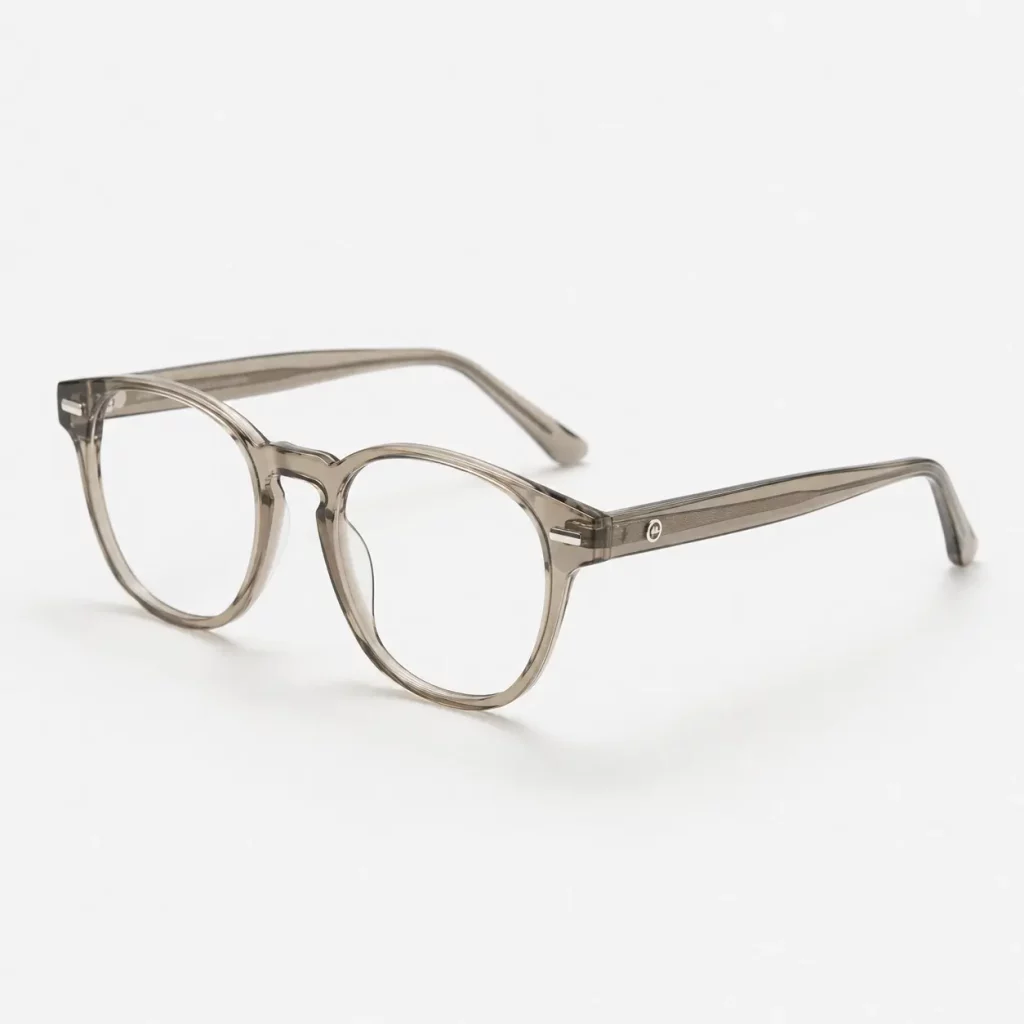
Here’s a full breakdown of placement options and what each communicates:
Right temple outer surface (standard)
The most common placement. Visible when worn, clean when photographed. Works with all methods. Recommended for most brands as the primary logo position.
Left temple outer surface
Some brands place a secondary mark or model name here. Avoid placing the same logo on both temples — it reads as over-branded.
Inner temple surface
A subtle, considered placement preferred by minimalist or luxury brands. The logo is only visible when the glasses are removed. Works well with laser engraving. Communicates restraint — the brand knows what it is without needing to announce it.
Nose bridge
Unusual but effective for brands with distinctive logo marks (symbols, monograms). Visible from the front when worn. Requires careful sizing — too large reads as costume, too small reads as accidental.
Nose pads (metal frames)
Small laser-engraved or embossed logo on the nose pad. A detail-level brand touch that adds perceived craftsmanship without dominating the frame aesthetic. Common in premium optical frames.
Hinge area
Logo applied to or integrated into the hinge plate. Works best with metal inlay or engraved hardware. Adds a luxury touch that reads well in close-up product photography.
Here’s the deal: for most private label brands, one clean logo placement on the right temple is the right answer. Resist the temptation to place logos in multiple locations — it rarely improves brand recognition and often undermines the frame’s design integrity.
Logo Artwork Requirements: How to Prepare Your File for Production
This is the step most brands underestimate — and it’s where many logo applications go wrong.
A logo that looks perfect on screen is not automatically ready for eyewear production. Each method has specific artwork requirements, and files that aren’t prepared correctly produce blurry edges, lost detail, or inconsistent results across a production run. Get this right before sampling begins.
File format requirements
Always provide vector files — AI (Adobe Illustrator) or EPS format. Vector artwork scales without quality loss and can be converted to the machining paths or die shapes each method requires. JPEG, PNG, and PDF are not acceptable for production unless they contain embedded vector data.
If your logo was designed as a raster image and you don’t have a vector file, have it redrawn as a vector before submitting to production. Most manufacturers can do this, but it adds time and a redraw fee.
Line weight and detail
Every logo method has a minimum line weight it can reproduce:
| Method | Minimum Line Weight | Notes |
|---|---|---|
| Laser engraving | 0.3mm | Thinner lines may burn unevenly or disappear |
| Hot stamping | 0.5mm | Fine lines don’t transfer cleanly under heat/pressure |
| Metal inlay | 0.8mm | Limited by what can be manufactured as metal component |
| Pad printing | 0.3mm | Can handle fine lines but color spread affects small detail |
| UV printing | 0.2mm | Highest detail resolution of all methods |
Color separation
For methods that involve color — hot stamping, pad printing, UV printing — provide a color-separated version of your logo file with exact Pantone or CMYK references. Don’t rely on screen color — what looks “gold” on a monitor may print as yellow without proper Pantone specification.
For laser engraving with epoxy fill, specify the fill color using RAL or Pantone codes, and confirm whether the fill is fully opaque or translucent — this affects how it reads against different acetate colors.
Production-specific logo version
Here’s what most brands don’t do but should: create a production-specific version of your logo for eyewear application.
This means:
- Simplifying fine details that won’t survive at 15–20mm application size
- Adjusting line weights to meet the minimum for your chosen method
- Removing gradients if using laser, hot stamp, or metal inlay
- Confirming proportions work when the logo is applied at the actual temple width
The standard brand logo used on your website and packaging can stay as is. The production version is adapted for the constraints of manufacturing. Many established eyewear brands maintain both — it’s not a compromise, it’s a professional production standard.
This is part of our complete guide to private label eyewear manufacturing. If you want to discuss which logo method suits your frame material, brand positioning, and production volume — send us your logo and brief, and we’ll come back with a specific recommendation within 4 business hours.
Conclusion
The right logo method isn’t the most expensive one or the most common one. It’s the one that matches your material, fits your brand positioning, and holds up through the life of the product. Laser engraving for durability and versatility. Hot stamping for classic premium impact. Metal inlay for craftsmanship and luxury. Pad printing and UV for color and volume. Get the method right, prepare your artwork properly, and your logo becomes part of what makes the product worth buying.
Frequently Asked Questions
What is the most durable logo method for eyewear?
Laser engraving and metal inlay are the most durable methods. Laser engraving etches directly into the frame material — it cannot peel, fade, or wash off. Metal inlay presses a separate metal logo component into the frame — equally permanent and adds a tactile quality. Both outlast the frame itself under normal wear conditions.
What is the best logo method for acetate eyewear frames?
Acetate supports multiple methods well. For mid-range brands, laser engraving with epoxy color fill gives clean, permanent results. For premium brands, deep laser or 3D hot stamping adds a tactile quality that reads as luxury. For the highest tier, metal inlay is the benchmark — it’s the method most associated with designer eyewear at $150+ retail.
What is the difference between hot stamping and laser engraving for eyewear logos?
Hot stamping transfers metallic foil onto the surface using heat and pressure — the result is a flat, shiny logo in gold, silver, or custom foil colors. It sits on the surface and can wear over time. Laser engraving removes material to create a recessed mark — permanent, precise, and works without adding anything to the surface. Hot stamping gives more immediate visual impact; laser engraving gives more long-term durability.
What file format do I need to submit for eyewear logo production?
Always provide vector files — AI or EPS format from Adobe Illustrator. Vector artwork scales without quality loss and can be converted to the machining paths required for each logo method. JPEG and PNG files are not suitable for production. If you only have a raster version of your logo, it needs to be redrawn as a vector before production begins.
Where should the logo be placed on eyewear frames?
The industry standard is the outer surface of the right temple, approximately one-third from the hinge end. This position is visible when worn, clean in photography, and accessible for all logo methods. Secondary placements — inner temple, nose bridge, nose pads, hinge area — can add brand touches but shouldn’t replace the primary temple placement.
Can I use my existing brand logo on eyewear frames without modification?
Often no — at least not without a production-specific version. Logos designed for screen or print typically have fine details, thin lines, or gradients that don’t translate cleanly to eyewear production at temple-scale sizing. Most manufacturers recommend creating a simplified production version of the logo that meets the minimum line weight and detail requirements of the chosen application method.
What is the minimum line weight for laser engraving on eyewear?
For laser engraving on eyewear, the minimum reliable line weight is 0.3mm in the vector artwork at the final production size. Lines thinner than this may burn unevenly or disappear entirely during the engraving process. When preparing artwork, always check line weights at the actual application size — not at the document’s full scale.
How much does logo application cost per unit?
Cost varies by method and volume. Pad printing and standard hot stamping are the most cost-effective — typically fractions of a cent to a few cents per unit at scale. Laser engraving with epoxy fill runs slightly higher. Metal inlay is the most expensive — the metal component itself plus machining adds a meaningful per-unit cost that is appropriate for premium price points but not for entry-level products. Always confirm logo application cost is included in your per-unit quote — some manufacturers price it separately.
Let's get started!
Get in touch with a custom eyewear specialist now for a free consultation and instant price quote.
WHATSAPP ME GO!
📱 Scan with your phone to start chatting