How to Start a Private Label Eyewear Brand: Step-by-Step Guide for B2B Buyers
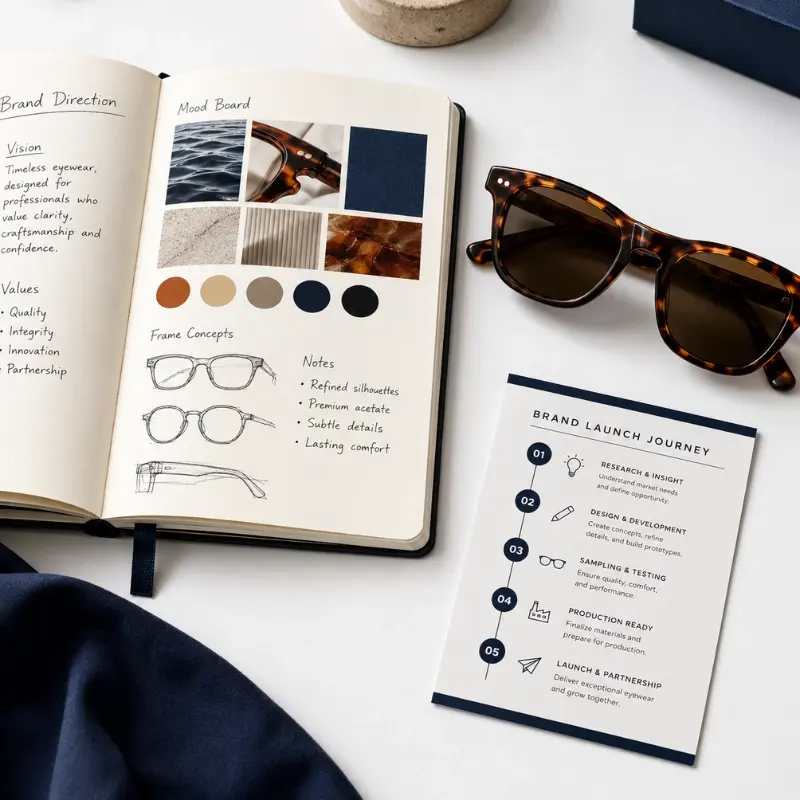
You already know how to run a brand. You understand sourcing, margins, and what it takes to get a product to market. Now you want to add eyewear to your line — or launch a dedicated eyewear brand from scratch.
Starting a private label eyewear brand as a B2B buyer is a different process from launching a consumer startup. You’re not figuring out business basics — you’re navigating manufacturing decisions, IP protection, compliance requirements, and supplier relationships. This guide walks you through every step, with the real numbers and timelines that actually matter.
We’ve helped brands across fashion, retail, and lifestyle categories launch and scale their own eyewear lines. Here’s how the process actually works.
Who This Guide Is For
Before we get into steps, it’s worth being specific about who this is written for — because most eyewear brand guides are written for first-time entrepreneurs, not experienced buyers.
This guide is for B2B buyers who already operate at a professional level: fashion brands adding eyewear as a new category, retailers building a house brand, independent designers with an existing customer base, and sourcing managers tasked with launching a branded eyewear line. If you know what MOQ means and have placed factory orders before, this is your guide.
If you’re a fashion or lifestyle brand adding eyewear to your existing product line, skip to the section on that specific path — the considerations are different from a ground-up brand launch, and the decisions come in a different order.
Step 1: Define Your Brand Position and Target Category
Every successful eyewear launch starts with the same question: who is this for, and what are they buying?
Before you contact a single manufacturer, lock down your brand positioning. Your price point, target customer, and product category determine every downstream decision — from material selection to MOQ to logo method. Brands that skip this step waste money on samples that don’t fit their market.
Here’s what to define before you brief any supplier:
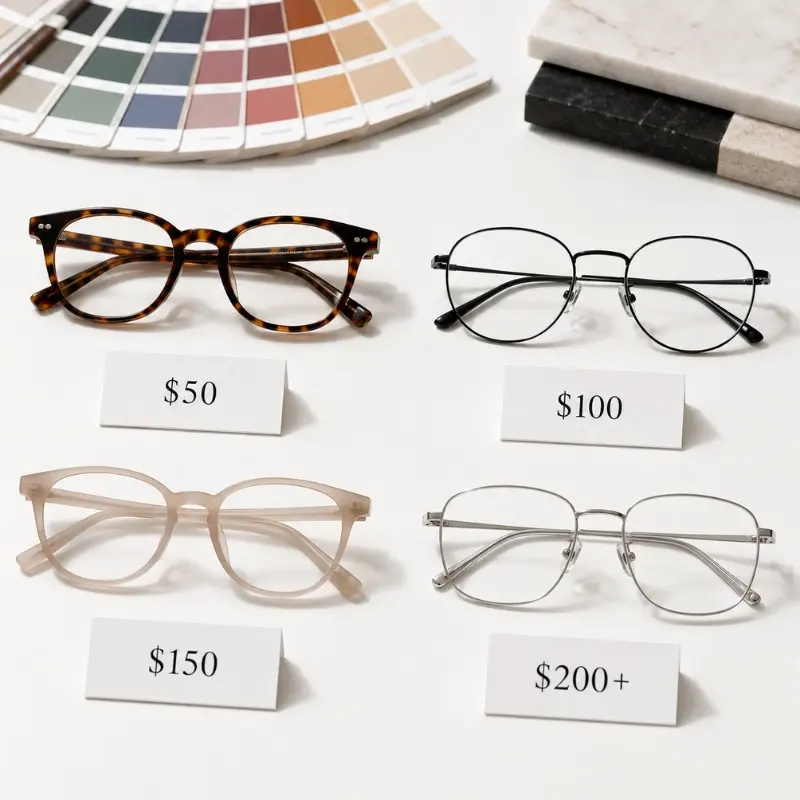
Price point and retail positioning
Your retail price point determines your material options, your MOQ economics, and how much you can spend on each unit. Be specific:
| Retail Price Point | Typical Unit Cost Range | Material Sweet Spot |
|---|---|---|
| Entry ($20–$50) | $4–$12 | TR90, injection PC, basic metal |
| Mid-range ($50–$100) | $12–$28 | Stainless steel, TR90, entry acetate |
| Premium ($100–$200) | $28–$60 | Acetate, titanium, quality metal |
| Luxury ($200+) | $60–$150+ | Premium acetate, titanium, custom hardware |
Product category
Sunglasses, optical frames, blue light glasses, reading glasses, sports eyewear — each category has different compliance requirements, different buyer expectations, and different material norms. Don’t try to cover all categories in your first collection. Pick one and own it.
Target customer profile
Who buys this product? A fashion buyer for a boutique retailer has completely different expectations from an office worker buying blue light glasses online. Know your buyer’s decision-making criteria before you design your product.
Here’s what most people miss: your brand positioning document is also your brief to your manufacturer. A clear brief gets you better quotes, faster sampling, and fewer revision rounds. An unclear brief gets you a generic product that doesn’t fit your market.
Step 2: Choose Your Manufacturing Model
Once your positioning is clear, you need to decide how you’re going to make the product.
Private label eyewear manufacturing works across two core models: OEM (you bring finished designs) and ODM / private label (factory develops from your concept, result is exclusive to your brand). For most B2B buyers launching a new eyewear line, ODM is the most practical starting point — it gives you a fully custom, exclusive product without requiring an in-house design team.
The right model depends on where you are:
OEM — if you have finished designs
You provide technical drawings or CAD files. The factory produces to your exact spec. Full IP ownership, highest exclusivity, longest lead time, highest upfront cost. Best for brands with existing design capability or a signature frame concept that must be exclusively yours.
Every structural detail — frame shape, hinge type, temple thickness, lens base curve — is defined by you. The factory builds the tooling to your spec, and that tooling belongs to you. No other brand can produce the same frame.
ODM / Private Label — if you have a direction but not a design
You provide a concept, references, or brand direction — sketches, mood boards, reference frames, or simply a clear description of your target customer and price point. The factory’s design team develops technical drawings and 3D renderings with you before a single sample is cut.
The result is fully custom and exclusive to your brand. Your colorway, your logo, your packaging — all developed to your brief, and not resold or replicated for any other client. No design team required on your side.
This is the model that makes private label eyewear accessible to brands at any stage — from independent designers placing their first 300-piece order to established fashion labels launching a new category. The factory’s design and engineering capability bridges the gap between your brand vision and a manufacturable product.
Most established brands start with ODM, validate the market, then move specific bestselling styles into OEM for full mold ownership in year two. That’s the smart sequence — you’re not gambling tooling investment on designs you haven’t tested yet.
Step 3: Build Your Realistic Budget
This is the step most guides skip — and it’s the one that causes the most problems.
The total investment for a private label eyewear brand first launch is not just the per-unit cost multiplied by your MOQ. It includes sampling, tooling, packaging, compliance, and shipping. Understanding the full cost structure before you commit is the difference between a profitable first order and an inventory problem.
Here’s a realistic budget breakdown for a first private label eyewear collection (2–3 styles, ODM model):
| Cost Component | Typical Range | Notes |
|---|---|---|
| Sample costs | $200–$600 | $100–$300 per style; usually credited against bulk order |
| Tooling / mold fee | $0–$6,000 | $0 for existing molds; $800–$3,000 per style for custom molds |
| Frame production (per style) | $3,600–$15,000 | Based on 300–500 pcs × unit cost |
| Logo application | Included or $0.05–$0.50/pc | Confirm whether included in frame quote |
| Branded packaging | $800–$3,000 | Cases, boxes, cloths — separate MOQ applies |
| Compliance testing | $500–$2,000 | CE, UV400, ANSI — depends on target market |
| Shipping (sea freight or express) | $300–$1,500 | Sea freight to major ports; express courier (3–5 business days to US/EU/AU) runs higher but eliminates warehousing wait |
| Total first launch | $6,000–$28,000 | Varies widely by style count, material, mold choice |
Here’s the deal: the biggest variable in this table is tooling. If you’re working with existing molds — no tooling cost — your entry point is much lower. If you’re developing two or three custom mold styles, tooling alone adds $2,000–$9,000 before you order a single unit. For first-time eyewear launches, starting with existing mold frames and ODM customization keeps your initial investment manageable while still producing an exclusive branded product.
The bottom line on budget: a realistic entry point for a properly branded, market-ready private label eyewear launch — with quality frames, branded packaging, and compliance documentation — is $8,000 to $15,000 for two styles at standard MOQ. Below $5,000, you’re compromising on either quality, packaging, or exclusivity in ways that will hurt your brand long-term.
Step 4: Find and Evaluate Your Manufacturing Partner
With your positioning and budget clear, you’re ready to find a supplier.
The right private label eyewear manufacturer for a B2B buyer is not the one with the lowest price or the biggest catalog. It’s the one with direct production capability in your frame material, a design team that can develop from your brief, IP protection policies that protect your investment, and the communication standards that match how you work.
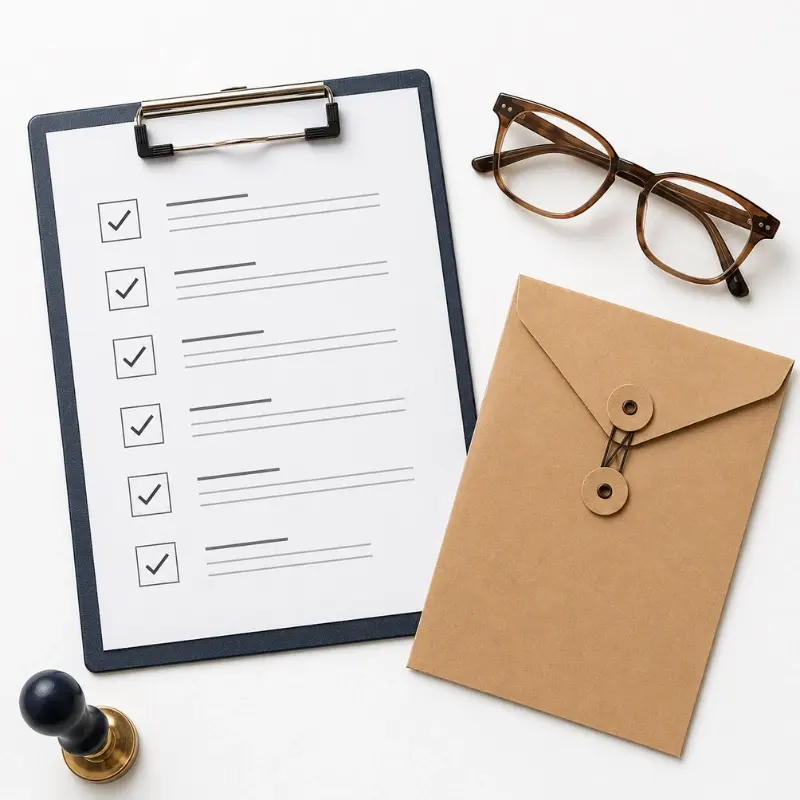
Here’s what to verify before committing:
Production capability match
Confirm the manufacturer works primarily in your material category. A factory that mostly runs injection frames but claims to do acetate is not your acetate manufacturer. Ask for their production split by material — you want your category to be a core part of their volume, not a side project.
Design development capability
For ODM, confirm they have an in-house design team that produces technical drawings and 3D renderings before sampling begins. Ask to see examples of design development work — not just finished product photography.
IP protection
Request an NDA before sharing any design files or brand materials. Confirm your colorway and design will not be resold to other clients. For custom mold tooling, confirm mold ownership in writing before paying.
Communication standards
Test response time during the enquiry process. Under 24 hours is the baseline. Under 4 hours for urgent questions is the standard for professional B2B manufacturers. If they take three days to respond to an initial enquiry, the communication will be worse during production.
References
Ask for client references from brands selling in your target market. An established manufacturer has worked with real brands and should be able to provide at least one reference contact.
Step 5: Brief Your Manufacturer and Develop Your Collection
Once you’ve selected a partner, the development process begins.
A good manufacturer brief is the single most important document in your first eyewear launch. It determines the accuracy of your quote, the relevance of design proposals, the efficiency of your sample rounds, and — ultimately — whether the final product matches what your brand needs. Invest the time here.
Your brief should include:
- Brand overview: Who you are, your price point, your target customer, and your aesthetic direction
- Product category: Sunglasses, optical frames, blue light, etc.
- Frame references: 3–5 reference images showing the style direction you’re targeting
- Material preference: Acetate, metal, TR90 — and why
- Color direction: Key colorways you want to launch in, with Pantone references if available
- Logo: Your logo file (vector AI or EPS format) and preferred application method
- Packaging direction: Case type, branded elements, retail box requirements
- Target markets: EU, US, or other — this determines compliance requirements
- Timeline: Your target launch date and any hard deadlines
The manufacturer will use this to develop design proposals, confirm material feasibility, and produce a detailed quote. The more specific your brief, the less back-and-forth is required before sampling begins.
Step 6: Sample, Revise, and Approve
Sampling is where the product becomes real — and where most first-time eyewear buyers lose time.
Plan for two to three sample rounds for a first-time ODM development. The first sample establishes the design direction. The second confirms material, fit, and logo application. The third — if needed — locks in final details before bulk approval. Each round takes 10–20 days. Factor this into your timeline from the start.
When you receive each sample, evaluate systematically:
Design and fit
- Does the frame shape match your brief and references?
- Are the proportions right for your target customer’s face shape?
- Is the temple length appropriate for your market (EU and US sizing differs slightly)?
Material and finish
- Is the acetate color and pattern accurate to your specification?
- Is the surface finish — glossy, matte, satin — consistent across the frame?
- Is the material weight appropriate for the price point?
Construction quality
- Is the hinge movement smooth, tight, and consistent on both sides?
- Are the nose pads (if present) symmetrical and correctly positioned?
- Does the frame sit flat on a surface without twisting?
Logo application
- Is the logo position, depth, and finish exactly as specified?
- Is the epoxy fill color (if applicable) accurate to your Pantone reference?
- Is the logo edge clean with no bleeding or inconsistency?
Document every revision with annotated photos — not just written descriptions. Visual reference eliminates ambiguity and speeds up the revision cycle.
Step 7: Confirm Compliance Before Bulk Production
This step saves brands from expensive problems after they’ve already paid for production.
Compliance is the brand owner’s responsibility — not the manufacturer’s. Before approving bulk production, confirm your product meets the certification requirements for every market you intend to sell in. The right question isn’t “does my manufacturer have certifications?” — it’s “do I know what my product needs, and have I confirmed my supply chain can support those requirements?”
Know your requirements before you brief anyone. Here’s what your product likely needs depending on your target market:
- EU market: CE marking under EN ISO 12312-1 for sunglasses; REACH compliance declaration for chemical safety of materials
- US market: ANSI Z80.3 compliance for sunglasses; UV400 lens performance verification from an accredited lab
- Both markets: UV400 test reports from third-party labs (SGS, Bureau Veritas, TÜV) are standard practice; ISO 9001 from your supply chain confirms baseline quality management systems are in place
Ask your manufacturing partner early in the conversation: “Have you worked with brands selling into [your target market], and what compliance support does your supply chain provide?” A partner with real international export experience will know exactly what you’re asking — and will walk you through how compliance documentation is typically handled for your market.
Getting clear on compliance requirements before bulk production begins protects your market entry and signals to your manufacturing partner that you’re a serious buyer who has done their homework.
Step 8: Place Your Bulk Order and Manage Production
With samples approved and compliance confirmed, you’re ready to commit to bulk production.
Confirm all production parameters in writing before transferring payment: quantity per style per colorway, exact material and color specifications, logo method and placement, packaging specifications, and shipment timeline. A production confirmation document signed by both parties is standard professional practice — not optional.
Production timeline from order confirmation to shipment:
| Stage | Typical Duration |
|---|---|
| Design & specification alignment | 5–10 days |
| Sample production | 10–20 days |
| Sample revision rounds (1–2) | 10–20 days each |
| Bulk production | 45–60 days |
| Pre-shipment inspection | 3–5 days |
| Sea freight (to US/EU/AU) or express courier | Sea freight: 20–35 days; Express courier: 3–5 business days |
| Total: first enquiry to delivery | 90–150 days |
Plan your launch timeline backwards from your target on-shelf date. For a seasonal launch, brief your manufacturer at least five months before your target delivery date. For a non-seasonal launch, three to four months is workable if your design direction is clear from the start.
This is part of our complete guide to private label eyewear manufacturing. If you’re ready to brief a manufacturer on your first eyewear collection, we respond to new project enquiries within 4 business hours.
A Special Path: Fashion Brands Adding Eyewear as a New Category
If you already run a fashion, lifestyle, or accessories brand and you’re adding eyewear as a new product category, your path is different from a ground-up eyewear brand launch — and most guides don’t acknowledge this.
The biggest advantage you have is brand equity. Your customers already trust you. You don’t need to build brand recognition — you need to extend it into a new category in a way that feels consistent and credible. That changes how you approach design, positioning, and launch strategy.
Here’s what’s different for fashion brands extending into eyewear:
Your brief is already half-written
You have an existing brand identity — color palette, aesthetic direction, target customer, price positioning. All of this translates directly into your eyewear brief. You’re not starting from scratch; you’re applying an established identity to a new product form. This means your design development rounds are typically faster and your sample approval is more decisive.
Start with one hero style, not a full collection
The temptation is to launch a complete eyewear range. Resist it. Your existing customers need one perfect product that feels unmistakably like your brand — not ten options that dilute the launch. One acetate frame in two of your brand’s signature colors is a stronger launch than six styles that feel like they came from anywhere.
Align your eyewear price point with your existing brand positioning
If your brand sells fashion accessories at $80–$120 retail, your eyewear should land in the same zone. A mismatch — eyewear significantly cheaper or more expensive than your brand’s existing products — creates friction with your existing customer base and confuses new buyers.
Your packaging infrastructure is an asset
You already have packaging relationships, branding assets, and possibly retail distribution. Apply those to your eyewear launch. Custom eyewear packaging that matches your existing brand’s unboxing experience is a significant advantage over a ground-up eyewear brand building those assets from zero.
The compliance piece is non-negotiable
Even if your existing product line doesn’t require CE or FDA compliance documentation, your eyewear will. Build compliance requirements into your first manufacturer conversation — don’t treat it as something to figure out later.
From First Enquiry to First Shipment: A Realistic Timeline
One of the questions B2B buyers ask most often is simply: how long does this actually take?
For a first private label eyewear launch using ODM manufacturing — two to three styles from concept to first shipment — budget 90 to 150 days from first manufacturer contact. That’s three to five months. The variables are how many sample rounds you need, whether custom tooling is required, and how quickly you make approval decisions.
Here’s a realistic week-by-week timeline for a standard ODM eyewear launch:
| Week | Activity |
|---|---|
| Week 1–2 | Brief manufacturer, receive design proposals and quote |
| Week 3–4 | Confirm design direction, approve for sampling |
| Week 5–7 | First samples produced and shipped |
| Week 8–9 | Review samples, provide revision feedback |
| Week 10–12 | Revised samples produced and approved |
| Week 13 | Confirm bulk order, transfer deposit |
| Week 14–21 | Bulk production |
| Week 22 | Pre-shipment inspection |
| Week 23–26 | Sea freight to destination (or 3–5 business days via express courier) |
| Week 26–28 | Product in hand, ready for launch |
The most common cause of timeline overrun is slow decision-making on the buyer side — delayed sample feedback, unclear revision instructions, or late approval of bulk production. The manufacturer can only move as fast as you give them clear direction to move.
Conclusion
Starting a private label eyewear brand as a B2B buyer is a process, not a gamble — when you know the steps. Define your positioning before briefing anyone. Choose the manufacturing model that fits your design capability and budget. Understand the full cost structure before committing. Find a partner who can develop from your brief, protect your IP, and communicate at your level. Sample methodically. Confirm compliance before bulk. And if you’re a fashion brand extending into eyewear, use the brand equity you’ve already built — it’s your biggest advantage in the category.
Frequently Asked Questions
How long does it take to launch a private label eyewear brand? From first manufacturer contact to product in hand, budget 90 to 150 days for a standard ODM eyewear launch. This covers design development, two to three sample rounds, bulk production, and sea freight. Air freight can compress the shipping portion, but production timelines are fixed. Plan your launch date backwards from this window.
How much does it cost to start a private label eyewear brand? A realistic entry point for a properly branded, market-ready first launch — two styles, ODM model, standard MOQ, branded packaging, compliance documentation — is $8,000 to $15,000. Using existing molds rather than custom tooling keeps costs at the lower end. Custom molds for original frame shapes add $800–$3,000 per style in tooling fees.
What is the minimum order quantity for private label eyewear?
For fully custom private label eyewear in acetate, stainless steel, or titanium, MOQ typically starts at 300 to 500 pieces per style per colorway. TR90 injection frames may start higher. Packaging components — cases, retail boxes, cleaning cloths — have separate MOQs, often 500 to 1,000 pieces.
Do I need my own designs to start a private label eyewear brand?
No. The ODM model allows you to start from a concept, reference image, or brand direction — and the manufacturer’s design team develops the product with you. You don’t need CAD files or technical drawings to begin. You need a clear brief covering your brand direction, target customer, price point, and aesthetic references.
What certifications does private label eyewear need?
For EU market entry, sunglasses require CE marking under EN ISO 12312-1 and REACH compliance for materials. For the US, ANSI Z80.3 is the standard. UV400 lens performance verification from accredited labs (SGS, Bureau Veritas, TÜV) applies to most markets. Confirm compliance requirements with your manufacturer before bulk production begins.
Can a fashion brand add eyewear without starting from scratch?
Yes — and established fashion brands have a significant advantage in eyewear launches. You already have brand identity, customer relationships, pricing architecture, and packaging infrastructure. The key is extending your existing brand consistently into the new category — not treating eyewear as a separate brand-building exercise. Start with one hero style that feels unmistakably like your brand.
What’s the difference between OEM and ODM / private label eyewear?
OEM means you provide finished technical drawings and the factory produces to your exact specification — full mold ownership, highest exclusivity. ODM / private label means the factory develops the product from your concept or brand direction, producing a fully custom result that is exclusive to your brand. Both models deliver a branded product that no other client can replicate. The difference is your starting point: finished design versus brand direction. Most B2B buyers entering eyewear for the first time use ODM — it delivers real customization without requiring an in-house design team.
How do I protect my eyewear designs from being copied by the factory?
Sign an NDA before sharing any design files or brand materials. Confirm in writing that your colorway and design are exclusive to your brand and will not be sold to other clients. For custom mold tooling, confirm mold ownership in the contract before paying the tooling fee. Work with manufacturers who have clear internal confidentiality policies and can explain how client files are stored.
Let's get started!
Get in touch with a custom eyewear specialist now for a free consultation and instant price quote.
WHATSAPP ME GO!
📱 Scan with your phone to start chatting