Intellectual Property and Confidentiality in Eyewear Manufacturing: What to Ask Your Factory
You’ve spent months developing a frame shape that’s genuinely yours. You’ve chosen the color, refined the hinge, confirmed the logo placement. Then you share everything with a factory — and wonder whether it stays yours.
IP theft in eyewear manufacturing is not a hypothetical risk. It’s a documented, recurring problem — and most of the brands it happens to didn’t ask the right questions before they started sharing files. This guide covers what intellectual property protection in eyewear actually looks like in practice, what agreements you need before you share anything, and the specific questions to ask any factory before you trust them with your designs.
We work with brands across multiple markets globally. IP protection comes up in every project conversation we have — and the questions brands should ask are the same whether they’re working with us or evaluating any other manufacturer. Here’s what we’ve learned about what actually matters.
Why IP Risk in Eyewear Manufacturing Is Real — and Specific
Most brands think about IP risk in general terms. In eyewear manufacturing, the risks are specific and worth understanding clearly.
There are three distinct IP risks in private label eyewear manufacturing: unauthorized use of your design for other clients, unauthorized circumvention of your customer relationship, and loss of mold ownership when you change manufacturers. Each requires a different protective mechanism. A standard NDA addresses none of them completely.
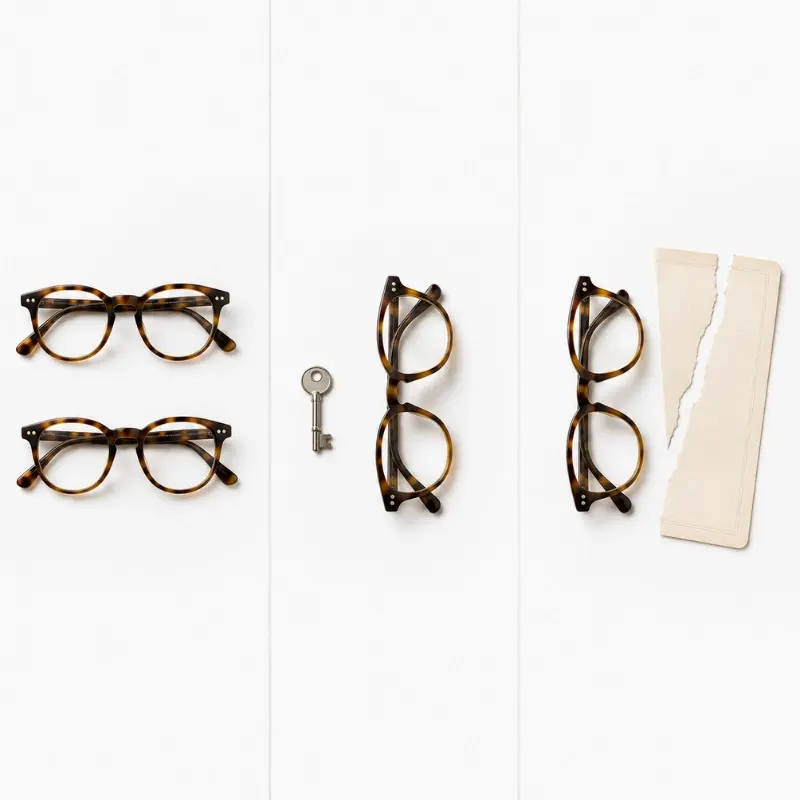
Here’s what each risk actually looks like:
Risk 1: Design copying and unauthorized use
A factory produces your exclusive frame design, then quietly makes the same frame — or a close variant — for another brand. This sounds straightforward, but in practice it’s rarely clear-cut.
Here’s the honest reality: eyewear frame shapes are highly similar across the industry. Round, rectangular, aviator, cat-eye — the geometric range is limited, and most frame shapes sit within a small variation space that has existed for decades. Proving that a factory reproduced your specific frame shape, rather than independently producing a similar one from the same broad category, is genuinely difficult. Frame shape copyright claims in eyewear are hard to enforce unless the design is truly distinctive and demonstrably original.
Colorways carry a similar challenge. Tortoiseshell, black, clear, and gradient acetate are industry-standard options. A factory producing another brand’s frames in a brown tortoiseshell is not automatically copying yours, even if the frames look similar. True colorway copying — where a distinctive proprietary combination is reproduced for a competing brand — does happen, but “our colors look similar” is not itself proof of unauthorized copying.
This matters for how you approach IP protection: contractual protection is most valuable as a deterrent and as documentation of intent, not as a reliable enforcement mechanism after the fact. The goal is to make copying structurally less likely through systems and agreements — not to rely on being able to prove a violation after it has happened.
Risk 2: Post-launch copying from public visibility
Once your product is on the market — visible on your website, in retail, on social media — anyone can see it. Competitors, other factories, other brands. A frame shape that looks distinctive and sells well will attract imitation, and that imitation doesn’t require any breach of your factory’s confidentiality. It only requires someone looking at your product page and briefing a different factory.
This is a separate and equally important risk from factory-side IP leakage. Post-launch copying is harder to prevent contractually because it doesn’t involve any breach — it’s simply market observation. The practical protections here are different: design registration in your target markets (particularly China, EU, and US), trademark registration covering your brand mark, and rapid market presence that establishes your product as the original before copies appear.
The key distinction: your factory’s NNN Agreement protects your designs during development and production. It does not protect your products from being seen and imitated once they are publicly available. For post-launch protection, design patents and trademark registration are the relevant tools.
Risk 3: Client circumvention
A factory that has developed a relationship with you as the intermediary buyer may attempt to approach your end clients directly. For brands sourcing on behalf of retail partners, or for sourcing agents managing multiple brand clients, this is a real operational risk.
Risk 4: Mold loss when changing manufacturers
If you’ve invested in custom mold tooling and the mold ownership isn’t explicitly established in writing, your old manufacturer will very likely retain the mold when you try to move production to a new factory. Without the mold, you lose access to your frame shape — or have to pay to recreate it.
Understanding these risks separately matters because they require different protective mechanisms. A single standard NDA doesn’t adequately cover any of them completely — and no contract prevents post-launch market observation.
NDA vs. NNN: Why the Difference Matters for Eyewear Brands
This is the most important IP protection concept most eyewear brands have never heard of — and it’s the single most common reason standard agreements fail.
A standard NDA (Non-Disclosure Agreement) only prohibits disclosure of confidential information. It does not prohibit use — meaning a factory can technically comply with your NDA while still using your design to produce frames for another client, as long as they don’t explicitly “disclose” it. For eyewear manufacturing, a standard NDA is not enough.
The correct agreement for manufacturing in China is an NNN Agreement — Non-Disclosure, Non-Use, Non-Circumvention. Here’s what each element covers:
| Element | What It Covers | Why It Matters for Eyewear |
|---|---|---|
| Non-Disclosure | Factory cannot share your design files, colorways, or brand materials with third parties | Prevents your files from being shared with competing factories or buyers |
| Non-Use | Factory cannot use your design, colorway, or mold to produce frames for any other client | Prevents your design being replicated for a competitor even if files aren’t “shared” |
| Non-Circumvention | Factory cannot approach your customers, retail partners, or distribution channels directly | Protects your client relationships from being bypassed by the factory |
Why standard NDAs often fail in China
Standard NDAs are drafted under Western legal frameworks that assume the primary risk is information leakage — someone telling your secrets to a competitor. In manufacturing contexts, particularly in China, the more common risk is use, not disclosure. A factory doesn’t need to “tell” anyone your design. They simply produce it again for someone else.
An NNN Agreement — drafted under Chinese law and enforceable in Chinese courts — addresses use and circumvention directly, not just disclosure. This is not a technicality. It’s the difference between a contract that provides real protection and one that looks protective but isn’t.
What your agreement should explicitly cover
Before signing anything, confirm your agreement includes:
- Scope of confidential information: Design files, technical drawings, colorway specifications, Pantone references, logo files, packaging specs, and any prototypes or samples produced during development
- Non-use clause: Factory may not use any design elements, colorways, or frame shapes developed for your brand to produce product for any other client
- Non-circumvention clause: Factory may not approach your customers, retail partners, end clients, or distribution channels directly or indirectly
- Duration: Two to three years after the end of the business relationship is the most common and enforceable standard in Chinese legal practice. Five years from the date of last disclosure is sometimes used as a negotiating starting point for brands that want stronger protection — Chinese factories often push back to one year, which is too short. Don’t accept one year. Two to three years after relationship end is a reasonable middle ground.
- Governing law: Chinese law if the factory is in China — an agreement governed by foreign law is significantly harder to enforce in Chinese courts
- Consequences of breach: Specific financial remedies, not just “legal action”
Here’s what most people miss: get the NNN Agreement signed before you share anything — before design files, before colorway specs, before reference images. Once information is shared without a signed agreement, your ability to claim it was confidential is significantly weakened.
Mold Ownership: The Clause Most Brands Forget
Custom mold tooling is often the single largest upfront investment in a private label eyewear project. And it’s the one most brands fail to protect properly.
If you pay for custom mold tooling and the mold ownership is not explicitly established in writing, the mold legally belongs to whoever holds it — typically the factory. When you attempt to move production to a new manufacturer, the factory can and often will refuse to release the mold. You either stay with the factory on their terms, or pay again to recreate your mold elsewhere.
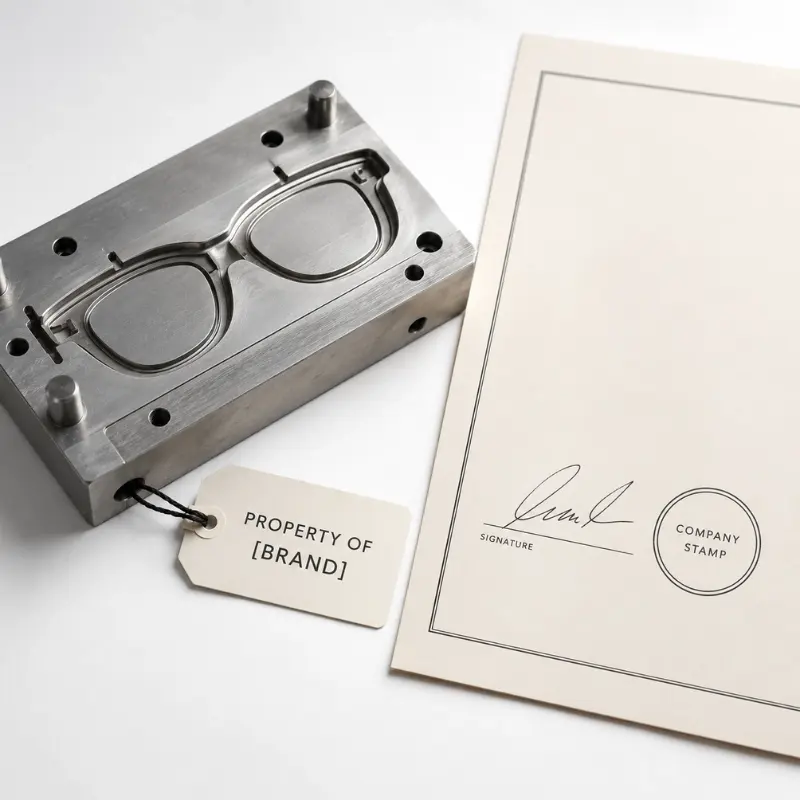
Here’s what mold ownership protection actually requires:
The mold ownership clause
Mold ownership is not automatic — it depends on who paid for the mold and what the agreement says. Two common scenarios produce different outcomes:
Scenario 1: You pay the full tooling cost If you pay 100% of the mold tooling fee, the mold belongs to you. Your production agreement should explicitly state this, and the clause should cover:
- The mold was paid for by you and belongs exclusively to you
- The factory may use the mold only to produce frames for your brand, under your active purchase orders
- The factory may not use the mold to produce frames for any other client, at any time
- Upon your written request, the factory must release the mold within a specified timeframe (typically 30 days)
- The factory may not retain copies of the mold design files or technical specifications
Scenario 2: Co-development — shared cost or factory-invested tooling In many ODM projects, mold tooling is either shared-cost (brand and factory each contribute) or factory-invested (the factory absorbs tooling as part of the production economics). In these cases, the mold does not exclusively belong to you.
A co-developed or factory-owned mold can still come with an exclusivity commitment — the factory agrees not to use that mold for any other brand — but the mold itself remains at the factory. If you later want to move production, you cannot take the mold with you. You would need to either negotiate a mold buyout at that point, or commission new tooling at a new manufacturer.
This is a legitimate and common arrangement. It reduces your upfront cost. The trade-off is that you don’t own the tooling asset. Understand this distinction clearly before signing any production agreement, and make sure your agreement specifies which scenario applies.
The key question to confirm upfront: “If I pay the full mold fee, will the mold ownership clause in our agreement explicitly state the mold belongs to me? And if production costs include tooling (or we share the tooling cost), what are my rights regarding exclusivity and future production transfer?”
The mold marking requirement
A written clause is necessary but not sufficient. In practice, physical mold marking is an important additional layer. Your mold should be physically marked with your brand name, your mold reference number, and the date. This creates a physical record of ownership that is harder to dispute than a contractual claim alone.
Ask your manufacturer: “Will you mark our mold with our brand name and reference number before production begins?” A manufacturer who hesitates at this request is giving you important information about their IP practices.
The sub-supplier risk
Here’s a risk most brands don’t know about. When a factory commissions mold tooling, they often use a specialist mold-making sub-supplier — a separate company that fabricates the mold to the factory’s specifications. That sub-supplier may sell copies of the mold design to other interested factories.
Ask your manufacturer directly: “Is mold fabrication done in-house, or do you use a sub-supplier?” If they use a sub-supplier, ask: “What confidentiality agreement is in place with your mold fabrication supplier that covers our mold design?”
The ODM mold situation
For ODM projects — where you’re developing from a concept and the factory creates the frame design — the ownership situation is more nuanced. The factory has contributed design work. Clarify upfront who owns the resulting frame shape and mold:
- If you’re paying a design development fee on top of production, you can typically negotiate full mold and design ownership
- If design development is included in the production pricing, the factory may retain mold ownership but commit to exclusivity — meaning they won’t produce that shape for any other brand
Get this discussion done before design work begins, not after.
Colorway Exclusivity: The IP Risk Nobody Talks About — and Its Real Limits
Frame shape exclusivity gets most of the attention. Colorway exclusivity is equally important — but it also has real limits that brands need to understand clearly.
In private label eyewear, a truly custom colorway — a color or pattern combination that was specifically developed for your brand and doesn’t exist in any standard acetate catalog — can be protected through an exclusivity agreement. Standard industry colors cannot. Black, clear, tortoiseshell, and standard gradient acetates are available to any buyer from any factory. No exclusivity agreement covers generic colors that exist independently of your brand.
The distinction matters:
- Custom developed color: You work with the factory to develop a specific acetate color, pattern, or finish that does not exist in standard supplier catalogs — a proprietary gradient, a specific multi-layer pattern, a unique matte finish formula. This can legitimately be protected as exclusive to your brand.
- Standard catalog color: You select an existing acetate color from the supplier’s standard range. Any factory can order the same color from the same supplier. No exclusivity claim is enforceable on a color that exists independently of your project.
What colorway exclusivity protection looks like — where it applies
For genuinely custom colors, your agreement should include:
- Colorway specification document: A written record of your exact color specifications — Pantone codes, acetate supplier references, pattern descriptions, surface finish specs, lens tint percentages — signed by both parties
- Exclusivity clause: Factory may not produce frames in your specifically developed colorway for any other client for the duration of your relationship and a defined period afterward (minimum two years). This applies only to colors or combinations that were developed specifically for your brand.
- Color formula confidentiality: If custom acetate color formulation was developed for your project, that formula is treated as confidential information under the NNN Agreement
For standard catalog colors, the honest answer is that exclusivity claims are not enforceable. Your protection in those cases comes from your brand identity, your design differentiation in other elements (frame shape, logo, packaging), and your market positioning — not from the color itself.
Ask your manufacturer: “Is this colorway available in standard acetate supplier catalogs, or was it developed specifically for our project?” The answer determines whether an exclusivity clause is meaningful.
Evaluating a Factory’s Internal Confidentiality Systems
Signing an NNN Agreement is a necessary first step. It’s not a sufficient one. A contract defines what’s legally prohibited. A factory’s internal systems determine whether those prohibitions are practically enforced.
The question is not just “will you sign an NDA?” — it’s “what systems do you have in place that make IP violations unlikely to happen in the first place?” A factory whose internal operations make IP leakage structurally difficult is more valuable than a factory that signs comprehensive agreements but has no practical enforcement mechanisms.
Here is a factory confidentiality system evaluation checklist — questions to ask and what the answers tell you:
File access and storage
Ask: “How do you store client design files, and who has access to them?”
What good looks like: Files stored in a restricted-access system, accessible only to production staff actively working on the specific project. Different clients’ files are stored in separate, access-controlled folders. Access logs are maintained.
What to be cautious about: Files stored on shared drives accessible to all factory staff. No documented access control policy. Vague answers like “we keep them safe.”
Ask: “Do you delete client design files after production is complete, or retain them? If retained, under what access restrictions?”
What good looks like: A documented file retention policy with restricted access. Client consent required to retain files beyond project completion.
Staff confidentiality
Ask: “Do your production staff and design team members sign confidentiality agreements as a condition of employment?”
What good looks like: Yes, with documentation available to show. Staff NDAs are standard employment practice.
What to be cautious about: “We trust our staff” without documentation. Seasonal or contract workers without confidentiality agreements.
Ask: “How do you prevent production staff from photographing your clients’ frames during development and sampling?”
What good looks like: No-phone policies in sample development areas. Physical security measures during sample production.
Sample and production control
Ask: “During sample production, which staff members have visibility of the complete design? How is this limited?”
What good looks like: Design information is compartmentalized — the person cutting the acetate knows the color, but not the logo spec; the logo application team knows the logo, but not the frame color formula.
What to be cautious about: Open production floor where any staff member can see the complete assembled frame at any stage.
Ask: “What happens to rejected samples and production waste that shows the frame shape and color?”
What good looks like: Rejected samples are destroyed or returned to the client. Production waste containing design information is handled under a documented disposal process.
Client separation
Ask: “Do you produce frames for any of our direct competitors? How do you ensure our designs are kept separate?”
What good looks like: Honest answer about who they work with, paired with a clear explanation of how client designs are kept separate in production scheduling and file management.
What to be cautious about: Evasion about client list. Claims of total client confidentiality that can’t be substantiated.
Ask: “If we needed to verify that our design files are not accessible to staff working on other clients’ projects, how would you demonstrate that?”
What good looks like: They can describe a clear process — separate project folders, role-based access, or project-specific credentials. They may not be able to show you live systems, but they can explain how the separation works operationally.
What to be cautious about: No operational answer — just assurances that “files are kept safe.”
The full evaluation checklist:
| Area | Question | Green Flag | Red Flag |
|---|---|---|---|
| File storage | How are client files stored and who has access? | Restricted access, separate folders, access logs | Shared drives, all-staff access, vague answer |
| File retention | Are files deleted after production? | Documented retention policy | Files kept indefinitely with no access restriction |
| Staff NDAs | Do staff sign confidentiality agreements? | Yes, employment standard | “We trust our staff” |
| Sample & waste control | How is design info compartmentalized, and what happens to rejected samples? | Compartmentalized access; samples destroyed or returned | Open production floor; no documented process |
| Mold marking | Will you mark our mold with our name? | Yes, standard practice | Hesitation or refusal |
| Sub-suppliers | Is mold fabrication done in-house? | In-house, or sub-supplier with documented NDA | Third party, no confidentiality documentation |
Protecting Your Designs After Launch: A Different Problem
Everything discussed so far covers protecting your designs during development and production — before and while your product is being made. Post-launch protection is a separate problem, and it requires different tools.
Once your frames are on your website, in retail, or on social media, they are publicly visible. Any competitor, factory, or buyer can see them, brief a manufacturer with reference photos, and produce a similar product. This does not require any breach of your factory’s confidentiality agreements. It only requires someone looking at your product page. No NNN Agreement prevents this.
The eyewear industry has always had a fast-follow copying dynamic. A frame shape that looks commercially successful will attract imitations — sometimes within months of launch. This is a market reality, not a legal failure.
The practical tools for post-launch protection are different from manufacturing agreements:
Design registration
In China, registering an external design patent (外观设计专利) provides legal standing to challenge copies manufactured in China or exported from Chinese ports. It is faster and cheaper than an invention patent, and is specifically designed for aesthetic product designs. For truly original frame shapes, filing a China design patent before or immediately after launch is advisable.
In the EU, a Registered Community Design (RCD) provides protection across all EU member states for up to 25 years. Unregistered Community Design protection also exists automatically for three years from first disclosure — useful for fashion cycles, though harder to enforce.
In the US, a design patent protects ornamental product designs for 15 years. The application process takes 1–2 years, so filing before launch is ideal.
Trademark registration
Your brand name and logo, registered as trademarks in your target markets, protect against branded imitation — someone making a product that uses your brand mark. Trademark registration in China, the EU, and the US is strongly recommended for any brand manufacturing in China and selling internationally.
The honest limitation
Design registration is a valuable deterrent and legal tool, but enforcement takes time, money, and legal expertise. For most independent eyewear brands, the most practical approach to post-launch copying is market speed — establish your product as the original clearly and quickly, build customer recognition of your specific product, and price and position in a segment where fast-follow copies don’t directly compete.
The brands that are most vulnerable to post-launch copying are those that launch quietly without establishing clear market presence. The brands that are most resilient are those that build strong customer associations with their specific product before copies appear.
The bottom line: use manufacturing agreements (NNN, mold ownership, colorway exclusivity) to protect your designs during development. Use design registration and trademark registration to create legal standing after launch. Use rapid market presence and customer relationship building to make your product the one that matters, even if copies appear.
The 15 IP Questions to Ask Any Eyewear Factory Before You Start
Before you share a design file, a Pantone reference, or a logo with any manufacturer, get answers to these questions. Written answers, not verbal ones.
About agreements
- Will you sign an NNN Agreement (Non-Disclosure, Non-Use, Non-Circumvention) before we share any design information?
- Is your NNN Agreement governed by Chinese law and enforceable in Chinese courts?
- What financial remedies are specified in your agreement for breach of confidentiality?
About design files
- Where are client design files stored, and who has access?
- Do you delete client files after project completion, or retain them? Under what access restrictions?
- Have you ever had a client’s design files accessed by unauthorized parties? How was it handled?
About mold ownership
- If we pay for custom mold tooling, will our ownership of that mold be explicitly stated in the production agreement?
- Is mold fabrication done in-house, or do you use a sub-supplier? If a sub-supplier, what confidentiality agreement covers our mold design?
- If we decide to move production to another factory, what is the process for releasing our mold to us or our new manufacturer?
- Will you physically mark our mold with our brand name and reference number?
About colorway exclusivity
- If we develop a custom colorway for our brand, will you commit in writing not to produce that colorway for any other client?
- How do you track which colorways are assigned to which brands in your production system?
About internal systems
- Do your production staff and design team members sign confidentiality agreements as a condition of employment?
- How do you compartmentalize design information during production — and what happens to rejected samples and production waste that shows our frame design?
- Can you walk us through how your production scheduling ensures that two competing brands’ frames are not being produced on the same line at the same time?
A manufacturer who answers all fifteen questions clearly, specifically, and in writing is demonstrating that IP protection is an operational reality for them — not just a sales point.
This is part of our complete guide to private label eyewear manufacturing. If you want to discuss IP protection arrangements before starting a project, we respond within 4 business hours and will walk you through the specific confidentiality documentation we use before any design information is exchanged.
Conclusion
IP protection in eyewear manufacturing is not a single document — it’s a layered system. The NNN Agreement covers disclosure, use, and circumvention. The mold ownership clause protects your tooling investment. The colorway exclusivity clause protects your visual identity. And the factory’s internal systems are what make all of these contractual protections practically meaningful. Ask all fifteen questions. Get written answers. Sign before you share.
Frequently Asked Questions
What is the difference between an NDA and an NNN Agreement for eyewear manufacturing?
An NDA (Non-Disclosure Agreement) only prohibits sharing your confidential information with third parties. It does not prevent a factory from using your design to produce frames for another client, as long as they don’t explicitly “disclose” the files. An NNN Agreement adds Non-Use (factory cannot use your design for any other client) and Non-Circumvention (factory cannot approach your customers directly). For eyewear manufacturing in China, an NNN Agreement governed by Chinese law provides substantially stronger protection.
Who owns the mold tooling for private label eyewear?
Mold ownership depends on what’s in your production agreement. If nothing is specified, the factory that physically holds the mold effectively controls it. If you pay for custom mold tooling, your agreement must explicitly state that the mold belongs to you, may only be used for your production orders, and must be released to you upon request. Without this clause, you risk losing access to your frame shape when you change manufacturers.
How do I prevent a factory from copying my eyewear design?
The most effective approach combines three layers: a signed NNN Agreement before sharing any files, an explicit mold ownership clause in your production agreement, and a colorway exclusivity commitment for your specific color and pattern specifications. Beyond contracts, evaluate the factory’s internal systems — file access controls, staff confidentiality agreements, sample disposal processes — to confirm that IP protection is an operational reality, not just a contractual claim.
What should an eyewear NDA cover?
For eyewear manufacturing, a standard NDA is insufficient. Your agreement should cover non-disclosure of design files and brand materials, non-use of your designs for other clients, non-circumvention of your customer relationships, explicit colorway exclusivity, and mold ownership. It should be governed by the law of the country where the factory is located — Chinese law for Chinese factories — and include specific financial remedies for breach.
What is colorway exclusivity in eyewear manufacturing?
Colorway exclusivity means the factory commits in writing not to produce frames in your specific color and pattern combination for any other client. Your acetate color, pattern, surface finish, and lens tint combination define your product’s visual identity. Without an exclusivity commitment, the factory can produce the same colorway for a competing brand. Get the exact colorway specification documented and signed, with an exclusivity clause covering at least two years.
Do I need to register a patent to protect my eyewear design?
Patent registration provides the strongest legal protection but is not always practical for every design. For brands manufacturing in China, registering a design patent in China is advisable for truly original frame shapes — it provides legal standing to prevent copying within China and at Chinese export ports. For colorways and aesthetic elements, the NNN Agreement and colorway exclusivity clause are more immediately practical protections. Consult an IP attorney with China manufacturing experience for advice specific to your situation.
What happens to my mold if I change eyewear manufacturers?
Without a written mold ownership and release clause, your old manufacturer is likely to retain your mold. With a properly drafted clause, the factory is contractually obligated to release the mold to you or your designated new manufacturer within a specified timeframe (typically 30 days) upon your written request. Always confirm the mold release process before signing a production agreement, not after a dispute arises.
How do I know if a factory’s IP protection systems are real?
Ask operational questions, not just policy questions. Ask who specifically has access to your design files, how production scheduling separates competing brands, and whether staff sign confidentiality agreements. A factory with real IP protection practices can describe how the separation works — even if they can’t give you a live system tour. A factory that responds only with general assurances and cannot explain the operational mechanics is telling you that no structured system exists. Pay attention to how specific and consistent their answers are across different questions.
Let's get started!
Get in touch with a custom eyewear specialist now for a free consultation and instant price quote.
WHATSAPP ME GO!
📱 Scan with your phone to start chatting