Custom Promotional Sunglasses: What Brands Need to Know
Promotional sunglasses get treated as a category unto themselves — something you order in bulk, stamp a logo on, and hand out at events. That framing is broadly accurate but leaves out the decisions that determine whether the product actually works as a brand asset or just ends up discarded two days after the event.
The specific considerations that make promotional sunglasses different from a retail eyewear development project — cost structure, material logic, compliance requirements, and lead time pressure — are rarely explained in content that shows up when brands search for a supplier. This guide covers them directly, from the perspective of a manufacturer that handles both promotional programs and retail-positioned collections, and understands where the two diverge.
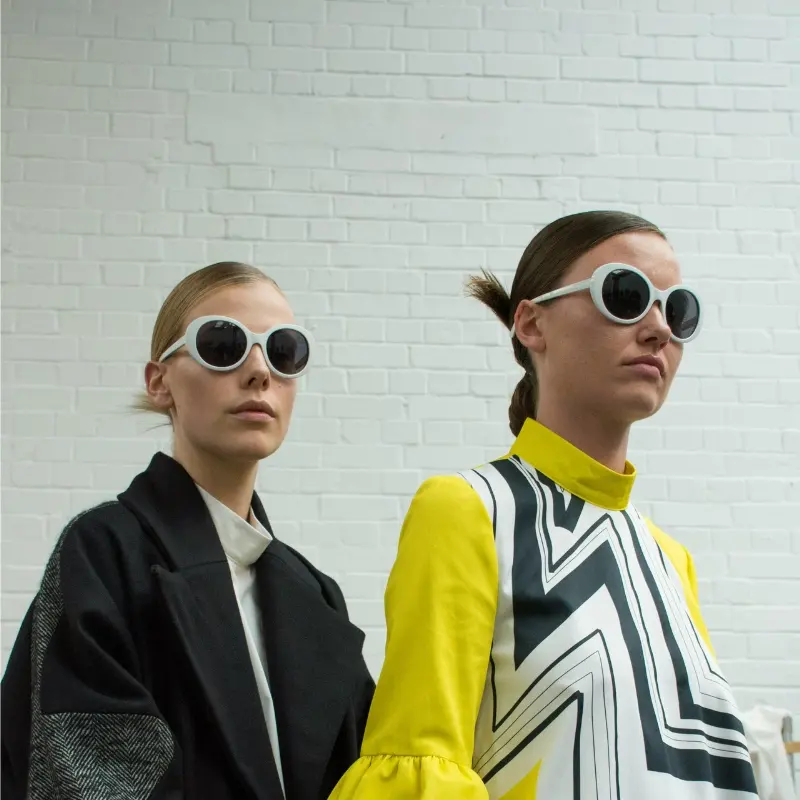
Promotional vs Retail: A Different Set of Priorities
The most important thing to understand about promotional sunglasses is that they operate on a different cost and quality logic than a retail-positioned collection, and trying to apply retail standards to a promotional program — or cutting corners that matter even for giveaways — both create problems.
What promotional programs prioritize:
- Low per-unit cost at volume, since promotional products are often given away or included with purchase rather than sold at a margin
- High order volume in a single run, often driven by an event date, campaign timeline, or seasonal window
- Visible, consistent logo placement across every unit
- Basic product functionality: UV protection, comfortable wear for the duration of an event
What retail programs additionally require:
- Materials chosen for durability and premium feel over multi-year wear
- Surface finishes and color options suited to boutique retail display
- Higher mechanical standards for hinges, lens mounting, and coating durability
- Design exclusivity — the frame shape itself is often proprietary
A promotional program that tries to achieve retail-product durability at promotional pricing will run into the same structural limit every time: the per-unit cost at the volume required for a giveaway program cannot support the material and construction standards a retail product justifies. The correct approach is to be deliberate about where the specification sits — building a product that meets the functional requirements for the promotional context it is actually being used in.

Why PC Is the Default Material for Promotional Sunglasses
Among injection-molded frame materials, polycarbonate (PC) is the standard choice for promotional sunglasses, and the reasons are specific rather than arbitrary.
Cost efficiency at volume. PC is the most cost-efficient injection-molded material at the volumes typical of promotional programs — typically 1,200 pieces or more per style. Its lower per-unit cost relative to TR90 makes it the natural fit when unit cost is the primary driver.
Impact resistance that matters for giveaways. Promotional sunglasses change hands in environments where careful handling is not guaranteed — festivals, trade shows, outdoor events, hospitality settings. PC’s impact resistance means the product holds up to the casual handling that promotional products typically receive.
UV protection without additional coating. Polycarbonate inherently blocks UV radiation without requiring a separate applied UV coating, simplifying the specification for high-volume programs and ensuring every unit provides basic UV400 protection.
Simple colorway programs. Promotional programs often run one or two colorways across a large total volume. PC’s injection-molded color process supports this efficiently, with consistent color matching across large batches.
For brands considering TR90 for a promotional program: TR90 is a legitimate choice where the product will be worn regularly and durability over time matters — a branded giveaway intended for long-term use, a premium corporate gift, or merchandise sold rather than given away. For pure promotional giveaways at high volume, PC’s cost and performance profile is generally better matched to the use case.
For a full comparison of how PC and TR90 differ in cost, performance, and appropriate use cases, see PC vs TR90: Which Injection Material Fits Your Sunglasses Line?.

Logo and Branding Options for Promotional Programs
The logo is the functional point of a promotional product. For injection-molded PC frames, the practical branding options are:
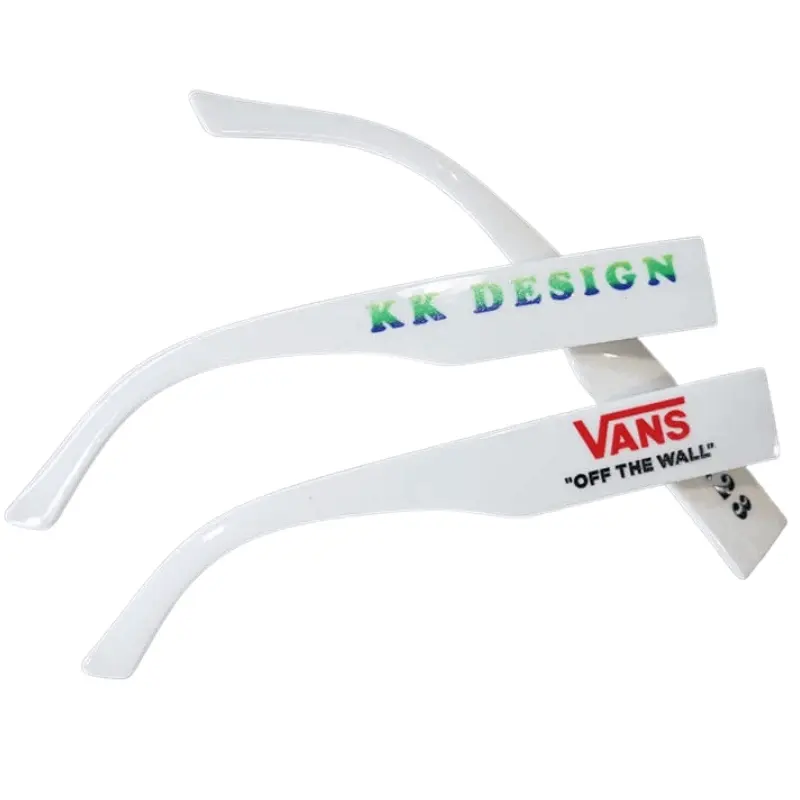
Pad Printing
Pad printing transfers ink from a flat plate to the frame surface via a flexible silicone pad, which conforms to the curved temple surface. It supports full-color logos and is the most common method for promotional sunglasses because it accommodates color and detail that laser engraving cannot.
For promotional programs, pad printing is typically the right default: it handles color logos cleanly, carries a modest setup fee, and the per-unit cost at promotional volumes is manageable. The durability consideration: pad-printed logos can fade with sustained UV exposure or chemical cleaning. For a one-day event giveaway, this is irrelevant. For a promotional product worn regularly over months, it is worth factoring in.
Laser Engraving
Laser engraving is less commonly used on injection-molded plastic frames than on metal frames, and the reason is practical: the laser burns through the surface color layer to expose the base material beneath, so the result depends entirely on the contrast between the frame’s surface color and its base material color. On a black sprayed frame with a light-colored base, the contrast can be sufficient. On most colored injection-molded frames, the base material is also pigmented, leaving little contrast and a logo that is difficult to read.
For injection-molded PC promotional frames, laser engraving is worth considering only when the frame color and base material combination provides clear contrast. In most cases, pad printing is the more reliable and legible option for plastic frames. Laser engraving is more commonly applied to metal hardware elements — such as end-pieces — rather than directly to the plastic temple surface.
Frame Color as Branding
For some promotional programs, the most effective approach is a frame in the brand’s signature color with a subtle logo treatment. A brand with a distinctive color palette can produce a frame that reads as branded before the logo is even seen. This works best when the brand color is distinctive and volume justifies a custom color batch with Pantone matching.
Logo Placement
The standard position is the outer temple mid-section — visible when worn and when displayed. Inner temple placement is an alternative when discretion matters more than visibility.
MOQ, Timeline, and Event Deadlines

Promotional programs are almost always deadline-driven, which changes how the production timeline needs to be managed.
Standard MOQ: 1,200 pieces per style, 300-piece minimum per colorway. For single-colorway programs at high total volume, the full run consolidates into one production batch.
Lead time from confirmed sample to delivery:
| Path | Sample Lead Time | Bulk Production | Total |
|---|---|---|---|
| ODM (existing frame, logo + color modification) | 5–10 working days | 35–55 working days | Approx. 9–13 weeks + shipping |
| OEM (new custom design) | RP 3–5 days + mold 20–30 days + sample 5–7 days | 35–55 working days | Approx. 15–19 weeks + shipping |
The practical implication: a promotional program with a hard event deadline needs the full production timeline plus shipping time built in from the start. Brands approaching a manufacturer four weeks before an event with a new OEM design cannot be served on that timeline. Brands working from an existing ODM frame with a confirmed logo and color have a meaningful chance of meeting a tighter deadline.
What to confirm when a deadline is involved:
- Production start date after sample approval
- Production completion date
- Shipping transit time to destination
- Customs clearance buffer for international shipments
At Sailook, when a client has a firm event deadline, we work backward from that date through the full production and shipping timeline to confirm feasibility before committing — rather than discovering the problem midway through production.
Compliance Basics — What Promotional Sunglasses Still Need to Meet
A common misconception is that compliance requirements are relaxed for promotional giveaways versus retail products. They are not.
UV400 protection: Any sunglasses distributed in the US, EU, UK, and most developed markets are expected to provide UV400 protection — blocking 99% or more of UVA and UVB radiation. This applies regardless of price point or whether the product is sold or given away. PC lenses meet this standard when properly manufactured.
FDA drop-ball impact test (US market): The FDA requires sunglasses sold in the US to pass a drop-ball impact test demonstrating basic impact resistance. PC lenses meet this standard. Confirm that your manufacturer provides test documentation for any product entering the US market.
CE marking (EU/UK markets): Sunglasses entering the EU or UK require CE marking. For promotional programs targeting these markets, confirm CE compliance before committing to production.
Nickel content (EU market): The EU Nickel Directive limits nickel release from products in contact with skin. For metal hardware on injection-molded frames — hinges, screws — confirm nickel-free specification for EU distribution.
Compliance documents to request:
- UV400 test report
- FDA drop-ball impact test result (US market)
- CE declaration of conformity (EU/UK market)
- Nickel release test (EU market, if metal hardware is present)
What to Include in a Promotional Sunglasses Brief
A complete brief allows a manufacturer to quote accurately and proceed directly to sampling. Missing details produce back-and-forth that adds days or weeks to a timeline that may already be tight.
Include:
- Frame design: ODM or OEM. For ODM, reference the style by catalog number or image. For OEM, provide a technical drawing or reference image.
- Total volume and colorway split: Total pieces and distribution across frame colors.
- Logo file: Vector format (AI or EPS) at actual application size. Specify branding method, position, and PMS color for pad printing.
- Lens specification: UV400 is standard. Confirm whether polarized lenses are required.
- Compliance market: Which country or region the product will be distributed in.
- Event or delivery deadline: The firm in-hand date, plus destination country for shipping calculation.
- Packaging: Polybag, soft pouch, or branded box. State whether a cleaning cloth is included.
FAQ
What is the minimum order quantity for custom promotional sunglasses? Standard MOQ is 1,200 pieces per style, with a 300-piece minimum per colorway. For single-colorway programs, the full run can be consolidated into one production batch.
How far in advance do I need to order for an event deadline? For an ODM program, allow 5–10 working days for sample approval, 35–55 working days for bulk production, plus shipping transit time — roughly 9–13 weeks total before shipping. For a new OEM design, add 20–30 working days for mold development. Work backward from your event date to confirm feasibility.
Do promotional sunglasses need to meet UV and safety standards? Yes. UV400 protection and basic impact resistance requirements apply regardless of whether the product is sold or given away. Always request test documentation — UV400 test report and FDA drop-ball result for US distribution, CE declaration for EU/UK.
Is PC or TR90 better for promotional sunglasses? PC is the more common choice for high-volume giveaways, primarily because of its lower per-unit cost and adequate impact resistance for the promotional use case. TR90 suits programs where the product will be worn regularly over time — premium corporate gifts or branded merchandise sold at a price point that justifies the material.
Can I get a custom frame shape for a promotional program? Yes, but new mold development adds 20–30 working days and a mold cost of approximately $1,500–$4,500 depending on design complexity. For most programs on a tight deadline or promotional price point, ODM — an existing frame with custom logo, color, and packaging — is the more practical path.
What branding method works best for promotional sunglasses? Pad printing is the standard choice for injection-molded PC promotional frames — it accommodates color logos, works across the range of frame colors typical of promotional programs, and produces consistent results at volume. Laser engraving is less commonly used on plastic frames because the result depends on the contrast between the surface color and the base material, which is often insufficient on colored injection-molded frames. Laser engraving is more reliably applied to metal hardware elements on the frame rather than directly to the plastic surface.
Summary
Promotional sunglasses are built for a different purpose than retail eyewear — with a different cost logic, timeline structure, and use case. PC is the standard material for promotional programs because its cost efficiency, impact resistance, and UV-blocking properties match the promotional use case at high volume. A brief that includes volume, colorway, logo file, compliance market, and event deadline — paired with test documentation confirming UV and impact standards — is what produces a program that delivers on its marketing purpose without compliance or quality surprises at delivery.
For Sailook’s full range of PC sunglasses specifications, MOQ, and promotional program options, visit our PC sunglasses page.
Let's get started!
Get in touch with a custom eyewear specialist now for a free consultation and instant price quote.
WHATSAPP ME GO!
📱 Scan with your phone to start chatting