PC vs TR90: Which Injection Material Fits Your Sunglasses Line?
PC and TR90 are the two most common injection-molded materials in sunglasses production, and brands developing a new line are routinely told to “just pick one” without much explanation of what that choice actually changes. Most comparisons online stop at adjectives — PC is “tougher,” TR90 is “more flexible” — without the mechanical data or product-fit logic that would let a brand make the decision deliberately rather than by guesswork.
This guide compares PC and TR90 using actual material data, then works through which material fits which product category, what climate and market factors should influence the decision, and what happens when a brand uses both materials within the same collection. For the underlying chemistry and dual role of PC as both a frame and lens material, see What Is PC (Polycarbonate)? The Material Behind Safety and Sport Eyewear.
The Core Difference: Stiffness vs Memory
The distinction between PC and TR90 comes down to one underlying mechanical property: how each material responds to bending force.
Polycarbonate is comparatively rigid. It resists deformation up to a point, then either holds its shape or fractures, depending on the force and the wall thickness involved. This rigidity is the same property behind PC’s impact resistance — a rigid material absorbs sudden shock without easily deforming, which is exactly what is needed in a safety-rated lens or a frame that needs to survive a hard drop.
TR90 (specifically Grilamid TR90, a branded nylon-12 formulation) is comparatively flexible. It bends significantly under pressure and returns to its original shape — a property generally called “memory” in eyewear marketing copy, though it is simply a function of the polymer’s lower stiffness. This flexibility is why TR90 tolerates the kind of bending, twisting, and sitting-on stress that would crack a more rigid material.
Neither property is universally better. Rigidity protects against sudden, sharp impacts. Flexibility protects against sustained, repeated stress and torsion. The right material depends on which kind of stress the finished product is actually likely to encounter.
PC vs TR90 by the Numbers
Marketing copy tends to describe these materials in relative terms — “more flexible,” “lighter” — without numbers. The actual material data is more specific and worth knowing when specifying a frame.
| Property | Polycarbonate (PC) | TR90 (Grilamid) |
|---|---|---|
| Chemical family | Polycarbonate (bisphenol A-based) | Nylon-12 (polyamide) |
| Flexural modulus | Approx. 2.2–2.6 GPa | Approx. 1.3–1.5 GPa |
| Density | Approx. 1.20 g/cm³ | Approx. 1.14–1.15 g/cm³ |
| Water absorption (24h) | Approx. 0.35% | Less than 0.2% |
| Cold-temperature behavior | Can become brittle below approx. −20°C | Retains flexibility at low temperatures |
| Color application | Typically sprayed/coated; can fade over time | Injection-colored; holds color longer |
The flexural modulus figures explain the practical difference in hand: PC’s higher modulus means it resists bending more before it gives, and is more prone to stress-whitening or fracture at thin cross-sections when it does give. TR90’s lower modulus means it gives more readily and returns to shape, which is the basis of its “memory plastic” reputation.
The water absorption and cold-temperature data matter most for outdoor and humid-market product lines — a frame that absorbs more moisture or becomes brittle in cold conditions is a real durability variable for brands selling into specific climates, covered in more detail below.
Which Material Fits Which Product Category
Sports and Active-Use Eyewear
For sunglasses intended for running, cycling, hiking, or general active wear, TR90 is generally the stronger fit for the frame. The flexibility that defines the material directly addresses the failure mode most common in active-use eyewear: frames bent, sat on, or torqued during a fall or rough handling. TR90’s ability to flex and return to shape reduces the likelihood that this kind of stress results in a cracked or permanently deformed frame.
For the lens in active-use eyewear — particularly where the product is marketed with any safety or impact-resistance claim — PC remains the standard choice. This is the dual-material approach used by many sports eyewear lines: a TR90 frame paired with a PC lens, combining the frame’s bend tolerance with the lens’s impact resistance.
Kids’ Eyewear
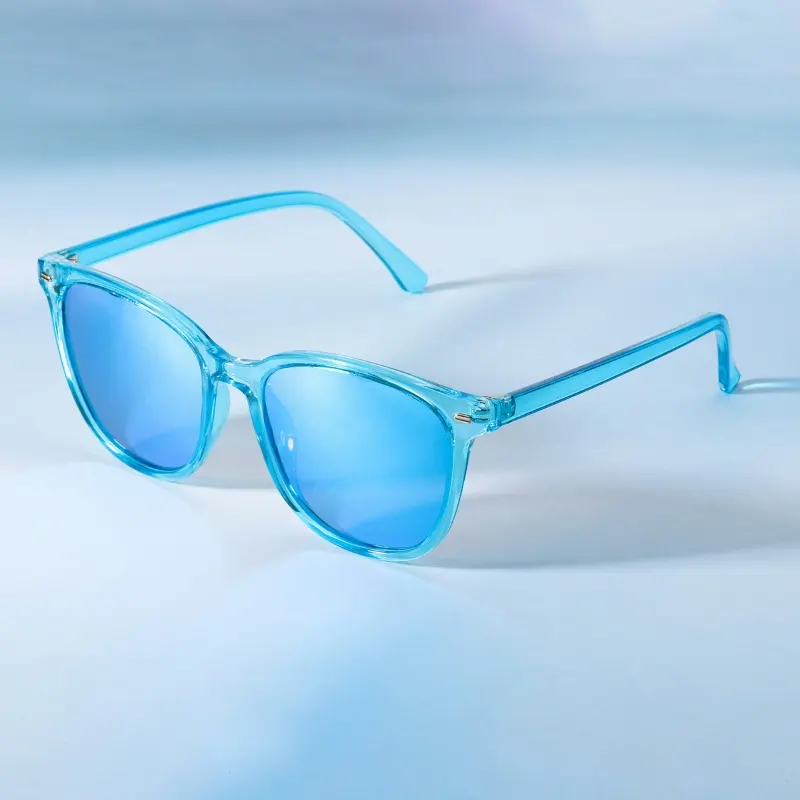
Children’s eyewear faces both failure modes at once — frames get bent, sat on, and dropped, and impact resistance matters for safety. TR90 is commonly used for kids’ frames because of its flex tolerance and lighter weight, which also improves comfort for smaller faces. PC remains the standard for kids’ lenses specifically, where impact resistance is the priority and any safety-related marketing claim depends on it.
Fashion and Promotional Lines
For fashion-forward or promotional sunglasses where cost control and production speed matter more than mechanical performance under stress, PC is often the more practical choice. PC tooling and processing are generally faster to scale, and the material is well suited to high-volume, frequently-changing colorway programs where cost per unit is a primary driver. This is consistent with PC’s broader role in eyewear: it is a strong, cost-efficient choice when the product’s performance demands are moderate rather than extreme.
TR90 can also serve fashion lines, particularly where the brand wants to emphasize comfort and lightness as part of the product story, but the per-unit cost is typically higher than PC at comparable volumes.
Safety-Certified Eyewear
For any product line carrying or pursuing a genuine impact-resistance certification — ANSI Z87.1, EN 166, or equivalent regional standards — PC is the standard material for the lens, and frequently for the frame as well. PC’s raw impact strength in lab testing is generally higher than TR90’s, even though TR90’s flex tolerance performs well under the kind of moderate, repeated stress that everyday use involves. For certification-driven product lines, lens material is rarely optional — PC remains the practical default.
Climate and Market Considerations
Material choice interacts with the climate of the target market in ways that are easy to overlook at the design stage.
Humid or coastal markets: TR90’s lower water absorption rate gives it a dimensional stability advantage in consistently humid conditions. PC absorbs slightly more moisture over time, which can affect long-term fit and surface stability in markets with sustained high humidity.
Cold or alpine markets: TR90 retains flexibility at low temperatures more reliably than PC, which can become brittle below roughly −20°C. For winter sports or alpine-market product lines, this is a meaningful durability consideration, not just a marketing point.
Hot or high-UV markets: Both materials require attention to color stability under prolonged sun exposure, but the difference shows up in finish: PC’s typical sprayed or coated color application can fade with extended UV exposure, while TR90’s injection-molded color tends to hold longer because the color is integrated into the material itself rather than applied as a surface layer.
For brands selling into a single dominant climate, these factors can tip the decision meaningfully. For brands selling across multiple climates within one collection, this is part of the case for using different materials across different SKUs within the same line, addressed below.
Production and Cost Differences
Beyond the finished product’s performance, PC and TR90 differ in how they behave during manufacturing — a factor that affects lead time, mold investment, and quality control requirements.
Tooling and mold cost: Both materials use standard injection mold tooling, and mold cost is comparable between the two for a given design complexity. Material choice itself does not significantly change mold cost; design complexity and cavity count are the primary cost drivers, covered in detail in Metal Sunglasses MOQ and Pricing, where the same tooling cost logic applies across materials.
Processing speed: PC generally processes with fewer adjustments once parameters are set, supporting fast, consistent runs at scale. TR90 requires more careful process control — melt temperature, injection speed, and cooling time all affect the material’s final flex characteristics — but a manufacturer experienced with TR90 production manages this as standard practice rather than as added complexity.
Quality control focus: PC parts require attention to stress-whitening and micro-cracking at thin sections, particularly around hinge mounts. TR90 parts require attention to consistent flex behavior across a production run, since variation in processing parameters can produce frames with inconsistent bend-and-return performance even when they look identical.
Color and finish: TR90 supports a broader range of frame thicknesses and surface textures with consistent injection-molded color, including matte, gloss, and gradient effects achieved in the molding process itself. PC commonly relies on surface spray or coating for non-standard colors, which adds a processing step and a long-term fade consideration not present with TR90’s integrated color.
Can You Use Both in the Same Collection?
Yes, and this is common practice rather than an edge case. Many sunglasses brands run both PC and TR90 within the same collection, assigning each material to the product lines where its specific properties matter most.
A typical structure: TR90 for the core sport and active-lifestyle SKUs where flex tolerance and lightweight comfort are the priority, PC for entry-level fashion or promotional SKUs where cost efficiency matters more, and PC lenses paired with either frame material where impact-resistance claims are part of the product positioning.
This is not a compromise — it reflects that PC and TR90 solve different problems, and a multi-material collection lets a brand match material to use case rather than forcing one material to serve every product line equally well.
What to Specify When Briefing Your Manufacturer
A brief that simply names “PC” or “TR90” without further detail leaves the manufacturer to apply standard defaults, which may not match the brand’s actual performance priorities. The following specifications produce a more accurate quote and sample.
For PC:
- Frame, lens, or both — see What Is PC (Polycarbonate)? for the distinction
- Color application method (injection vs surface coating)
- Impact testing requirement, if applicable (ANSI Z87.1, FDA drop-ball, or equivalent)
For TR90:
- Confirm genuine Grilamid TR90 vs a generic nylon-based equivalent
- Wall thickness target, since this affects both flex behavior and weight
- Surface finish (gloss, matte, textured) and whether color is injection-molded or coated
For both:
- Target climate or market, if humidity or cold-temperature performance is a priority
- Whether the collection will use a single material throughout or assign materials by SKU
FAQ
Is TR90 better than PC for sunglasses? Neither material is universally better — they solve different problems. TR90’s flexibility makes it better suited to frames that need to tolerate bending, twisting, and repeated stress, common in sports and active-use eyewear. PC’s rigidity gives it higher raw impact resistance, making it the standard choice for lenses and safety-certified product lines. The right choice depends on which kind of stress the finished product is most likely to encounter.
Can the same sunglasses collection use both PC and TR90? Yes, and many brands do this deliberately. A common structure pairs a TR90 frame with a PC lens, combining the frame’s flex tolerance with the lens’s impact resistance. Brands selling across multiple product categories — sport, fashion, kids’ — often assign different materials to different SKUs based on which properties matter most for each category.
Which material is lighter, PC or TR90? TR90 is generally lighter, with a density of approximately 1.14–1.15 g/cm³ compared to PC’s approximately 1.20 g/cm³. This difference, while modest in raw numbers, contributes to the comfort TR90 is known for in extended-wear and active-use eyewear.
Does climate affect which material is better? Yes. TR90 has a lower water absorption rate, giving it a dimensional stability advantage in humid or coastal markets. TR90 also retains flexibility at low temperatures more reliably than PC, which can become brittle below roughly −20°C, making it a stronger choice for cold-climate or alpine product lines. PC’s typical color application is more prone to fading under prolonged UV exposure compared to TR90’s injection-molded color.
Why do some brands use PC even though TR90 is more flexible? PC remains the standard choice wherever raw impact resistance is the priority — particularly for lenses and for any frame carrying a genuine safety certification. PC is also generally more cost-efficient at scale for fashion or promotional product lines where mechanical performance under repeated stress is less critical than cost control and production speed.
How do I confirm I’m getting genuine TR90 and not a generic substitute? Specify “Grilamid TR90” explicitly in your brief rather than just “TR90,” and ask your manufacturer to confirm the material source. Generic nylon-based resins are sometimes marketed under similar terminology but may not match Grilamid TR90’s specific performance characteristics. This is a standard verification step worth taking the same way confirming genuine material content matters for any branded material specification.
Summary
PC and TR90 are not competing for the same role — they address different mechanical demands, and the right choice depends on what kind of stress the finished product needs to survive. TR90’s flexibility suits frames that need to bend and recover under repeated use; PC’s rigidity suits lenses and safety-rated applications where raw impact resistance is the priority. Climate, product category, and cost structure all factor into the decision, and many collections use both materials deliberately rather than choosing one universally.
Specifying the material clearly — including genuine formulation, wall thickness, color application method, and any testing requirements — at the brief stage is what produces an accurate quote and a sample that matches the brand’s actual performance needs.
For Sailook’s full range of PC sunglasses materials, construction, and customization options, visit our PC sunglasses page. For TR90-specific material data and construction details, see our TR90 sunglasses page.
Let's get started!
Get in touch with a custom eyewear specialist now for a free consultation and instant price quote.
WHATSAPP ME GO!
📱 Scan with your phone to start chatting