Golf and Tennis Sunglasses: Why Contrast-Enhancing Lenses Matter for This Niche
Golf and tennis share a visual problem that most other sports don’t face in quite the same way: tracking a small, fast-moving object against a bright, often green or sky-colored background, without much reflective glare to worry about. That combination is exactly why contrast-enhancing lenses — not polarized ones — are usually the right starting point for this niche.

Why Polarized Isn’t the Default Here
Polarized lenses are built to cut glare from flat, reflective surfaces — water, wet pavement, snow. Golf courses and tennis courts aren’t dominated by that kind of surface, which means the core benefit of polarization doesn’t apply as directly as it does in fishing or driving.
More importantly, polarization can work against the specific visual tasks these sports demand. Multiple sports eyewear specialists note that polarized lenses can interfere with depth perception — making it harder to read subtle breaks and contours on a putting green, or to judge a tennis ball’s speed and spin accurately as it approaches. Golfers and tennis players are making fine-grained visual judgments about surface and object detail, and reduced depth perception works against exactly that.
That’s not to say polarized lenses have no place — a golfer playing a course with several water hazards may still want the glare reduction near those areas. But as a default lens choice for the sport generally, non-polarized contrast-enhancing lenses tend to serve the core task better.

Lens Tint Guide for Golf
Golf’s visual challenge has two parts: tracking the ball against the sky during a shot, and reading fine grass and terrain detail on the green. Different tints handle this differently.
Copper and cinnamon tones suppress the excess green light that dominates a golf course’s visual field, while amplifying red and yellow. This makes fairway contours easier to read, helps the ball stand out against the sky, and sharpens the distinction between different grass textures.
Rose and red tones boost contrast between an object and its background more broadly, and tend to perform well across variable lighting — useful for golfers playing through changing cloud cover during a round.
Brown and dark amber offer broader, more general contrast enhancement. They’re a reasonable single-tint option for golfers who want one lens to cover most conditions, though they don’t filter specific wavelengths as precisely as a copper-based tint.
Tints generally worth avoiding for golf: plain gray lenses are too neutral to create strong contrast against grass and sky, and green-based tints tend to have lower light transmission, which can leave the course looking flatter and less detailed than a warmer tint would.
VLT (visible light transmission) matters too. Many golf-specific lenses sit around 30% VLT — a relatively light tint by sunglasses standards — because golf is often played through overcast stretches, morning haze, and mixed light within a single round, and a heavier tint can leave a player under-lit in those conditions.
Lens Tint Guide for Tennis
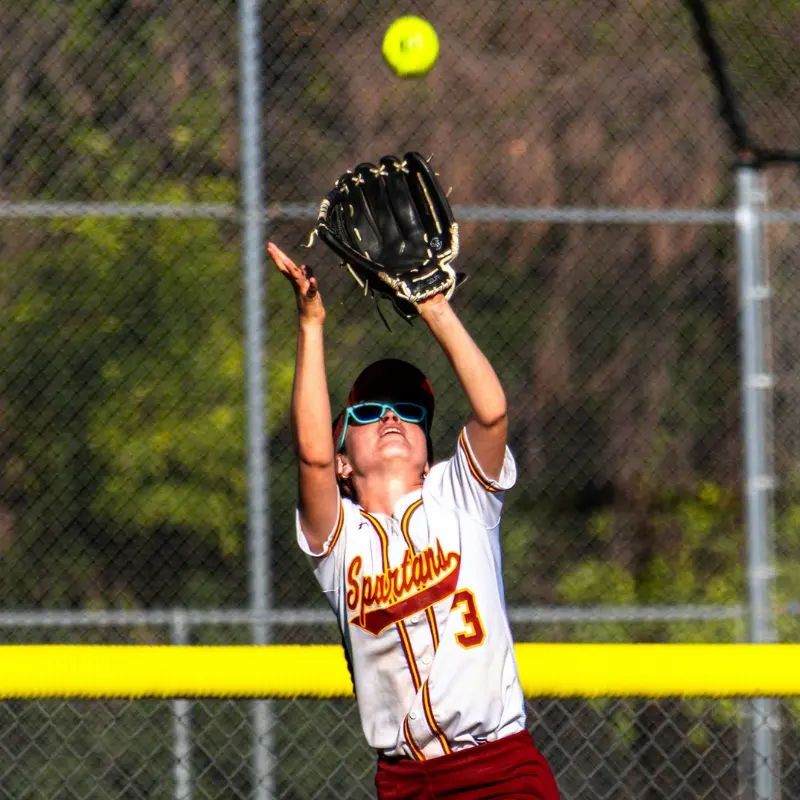
Tennis presents a narrower version of the same challenge: tracking a small, fast, often bright-colored ball against a court and background that don’t change much within a match.
Brown-amber base tints are the common choice, tuned to make the ball pop against the court surface while keeping natural depth perception intact — important for judging ball speed and spin in real time.
VLT tends to run lower for tennis than for golf — commonly in the 12–17% range, compared to golf’s lighter tints around 30%. This reflects the difference in playing environment: tennis is typically played on brighter, more consistently lit courts (especially hard courts), while golf covers a wider range of light conditions across 18 holes.
Non-polarized is the standard here too, for the same depth-perception reasons that apply to golf — a tennis player needs to judge exactly how fast and where a ball is moving, and polarization’s glare-cutting benefit doesn’t outweigh that trade-off in most match conditions.
A Design Detail Worth Knowing: Dual-Zone Lenses
One notable development in golf-specific lens design addresses a problem neither a single tint nor a single VLT fully solves: golfers spend a round switching between looking up (tracking a ball against the sky) and looking down (reading a green or lining up a putt) — two visual tasks that benefit from different treatment.
Some golf lens programs address this with a dual-zone tint — a neutral gray upper zone for sky visibility and glare comfort, paired with an amber lower zone for closer green-reading detail. It’s a more complex lens to produce than a single flat tint, but it directly addresses the up-and-down visual pattern that’s specific to golf.
This pairs naturally with frame shape decisions, too. We’ve covered how half-frame designs improve upward visibility for exactly this reason — a half-frame removes the upper rim that would otherwise interrupt the sightline when tracking a ball in flight, which complements a dual-zone or contrast-enhancing lens rather than working against it.
What This Means for a Private Label Golf or Tennis Collection
A few practical takeaways worth carrying into a lens program brief:
- Default to non-polarized, contrast-enhancing lenses for both golf and tennis, unless a specific customer segment (golfers on water-heavy courses, for example) justifies a polarized option as a secondary SKU.
- Match VLT to the sport’s typical lighting range — lighter tints (around 30%) for golf’s variable, all-day light conditions; somewhat darker tints (12–17% VLT) for tennis’s brighter, more consistent court environment.
- Consider tint by use case within golf specifically — a copper-based tint for fairway and ball-tracking emphasis, rose for variable light, brown as a versatile single-lens default.
- Frame shape and lens tint should be planned together. A half-frame with an upward-clear sightline pairs well with a lens tuned for both sky and ground visibility, rather than treating frame and lens as separate decisions.
For the underlying mechanics of how contrast-enhancing lenses work — and how they compare to photochromic and polarized technology more broadly — see our lens technology guide and sport-by-sport lens comparison.

Frequently Asked Questions
Are polarized lenses ever a good choice for golf?
They can be, particularly for golfers playing courses with significant water hazards where glare is a real issue. But as a default across the sport, non-polarized contrast-enhancing lenses generally serve ball-tracking and green-reading better.
What’s the best single lens tint for a golf brand that only wants to offer one option?
Brown or dark amber is the most versatile single-tint choice, offering broad contrast enhancement across most lighting conditions, even though it’s less precisely tuned than a copper or rose tint for specific scenarios.
Why does tennis use a lower VLT than golf?
Tennis is typically played on brighter, more consistently lit courts, especially hard courts, so a somewhat darker lens (12–17% VLT) is usually more comfortable than the lighter tints golf uses to handle its wider range of light conditions across a round.
Is a dual-zone lens worth the added production complexity?
It depends on brand positioning. A dual-zone lens directly addresses golf’s up-and-down visual pattern and can be a meaningful differentiator for a premium golf line, but it’s a more complex product than a single-tint lens and worth evaluating against the target price point.
Getting lens tint and VLT right for golf and tennis is really about matching the lens to how the eyes actually move during the sport, which is worth planning alongside the frame and material decisions that shape the rest of a sports sunglasses collection
Let's get started!
Get in touch with a custom eyewear specialist now for a free consultation and instant price quote.
WHATSAPP ME GO!
📱 Scan with your phone to start chatting