How Blue Light Filtering Lens Coatings Actually Work: The Optics Explained
The phrase “blue light coating” is used to describe products that work through fundamentally different technologies, and the difference matters for how a brand specifies a product, how it performs in use, and what claims can honestly be made about it. Most content available on this topic either explains the science for consumers — “these lenses protect your eyes” — or lists product options without explaining how they actually work. Neither helps a brand specify correctly.
This guide covers the actual optics behind blue light blocking glasses — the two core technologies, what the visible lens tint signals and does not signal, how to read filtering performance numbers accurately, and what each approach means for a product line development decision. If you are still evaluating whether blue light glasses belong in your collection at all, start with Blue Light Blocking Glasses: What Brands Need to Know Before Adding Them to Your Line — this article picks up from the lens technology section of that overview.
Two Fundamentally Different Technologies, One Product Name
Blue light filtering eyewear is produced through two distinct optical mechanisms that achieve a similar end result — reducing the amount of blue light that reaches the wearer’s eye — through completely different physical processes.
Surface Coating: Reflection-Based Filtering
The first approach applies a thin-film optical coating to the surface of a finished lens using vacuum deposition — the same general process used for anti-reflective (AR) coatings. Multiple layers of dielectric materials are deposited on the lens surface at precise thicknesses, engineered so that light waves at specific wavelengths interfere destructively as they reflect off the coating layers.
The physics of this is thin-film interference: when light hits a stack of thin layers, some reflects off each layer boundary, and those reflected waves interact with each other. By controlling layer thickness and refractive index, the coating can be designed so that reflections at certain wavelengths cancel each other out — reducing transmission of those wavelengths through the lens.
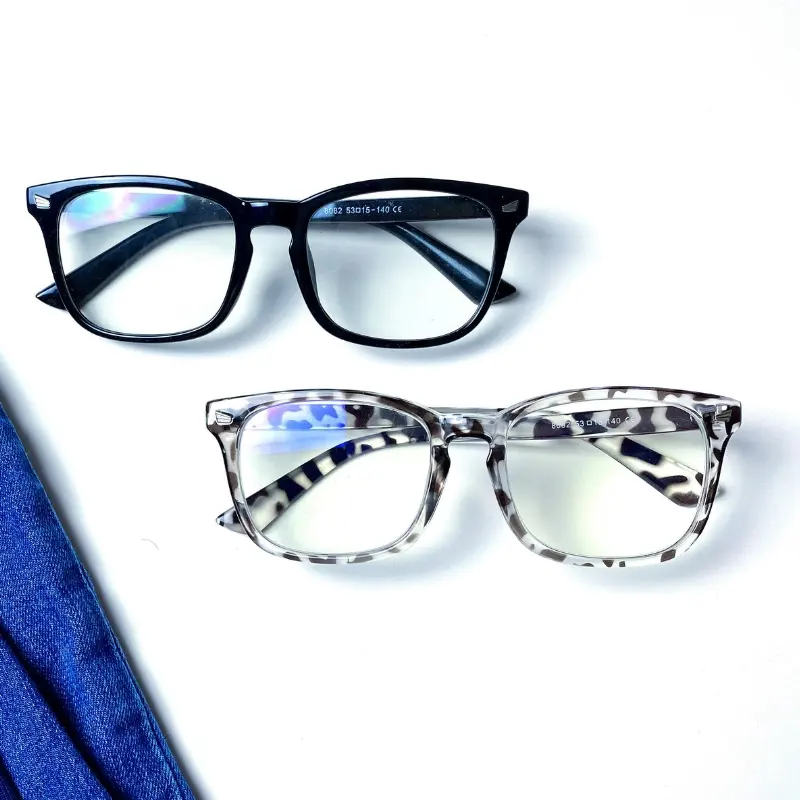
For blue light coatings, this means the coating preferentially reflects light in the 400–455nm range — the short-wavelength portion of the visible spectrum associated with high-energy visible (HEV) light from screens and LED sources. The result is that less blue light passes through to the eye, and the reflected blue light is visible as the characteristic blue or purple sheen on the front surface of the lens.
What this means in production: Surface coating is applied after the base lens is manufactured, making it adaptable to any lens substrate — CR-39, polycarbonate, or others. It can be combined with standard AR coating, scratch-resistant hard coat, and hydrophobic top layers in a single coating stack. This makes it the more flexible and cost-efficient approach for commercial eyewear production.
In-Mass Substrate: Absorption-Based Filtering
The second approach embeds blue light filtering material directly into the lens substrate during manufacturing — before the lens takes its final shape. Rather than reflecting specific wavelengths at the surface, the filtering compounds within the material absorb them as light passes through.
This is achieved by incorporating absorbing dye compounds — often porphyrin-based molecular structures — into the lens resin formulation. As light travels through the lens material, these compounds selectively absorb photons in the target wavelength range. The absorbed energy is converted to heat rather than transmitted to the eye.
Because absorption happens throughout the material rather than at the surface, the filtering effect does not depend on a surface layer that can be scratched, delaminated, or worn over time. In-mass lenses maintain their filtering performance as long as the lens substrate itself is intact.
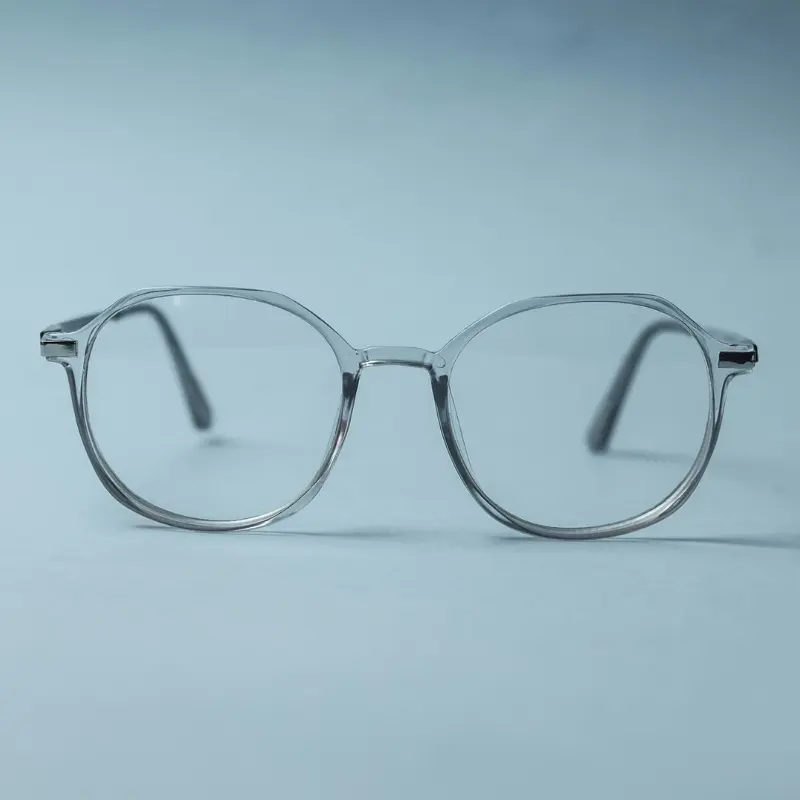
What this means for lens appearance: Since in-mass filtering works by absorption rather than reflection, there is no inherent blue-sheen effect on the lens surface. Lenses can appear visually clear or with only slight color tint depending on the absorbing compound concentration. This is why clear-appearing lenses can still provide meaningful blue light filtering — the mechanism does not produce the visible reflective signature that surface coatings do.

Hybrid Approaches
Some lenses combine both mechanisms: the substrate material absorbs a portion of the target wavelength range, and a surface coating reflects an additional portion. This can produce higher total filtering percentages while maintaining lens clarity at levels that pure coating approaches cannot reach. The tradeoff is increased complexity in specification and production. Hybrid lenses are more common at the premium end of the blue light eyewear market and require coordination between lens substrate specification and coating specification.
What the Blue Tint on the Lens Actually Means
The blue or purple reflective sheen visible on many blue light glasses is one of the most frequently misunderstood visual cues in this product category — both by consumers and by brands developing product lines.
The blue reflection is a byproduct of the coating mechanism, not a performance indicator. A lens with a strong blue sheen is not necessarily providing better protection than one without it. The sheen indicates that a reflective coating is present and is rejecting blue light at the surface — but the intensity of the visual sheen and the amount of light actually filtered are not proportional.
In fact, a high-quality in-mass lens with no visible sheen can outperform a surface-coated lens with a strong blue reflection, because the in-mass approach is not limited to surface reflection alone.
For brands, this matters because consumer expectations have been shaped by the visible sheen — many buyers associate it with the product “working.” A brand developing clear in-mass lenses that perform better but lack the visible cue needs to communicate its performance through test data rather than through the visual shorthand that the sheen provides. Conversely, a brand using surface coating should not let the visible reflection substitute for actual performance documentation.
How to Read Filtering Performance Numbers
Filtering performance claims for blue light glasses are frequently reported in ways that make direct comparison difficult or misleading. Two products claiming “50% blue light filtering” may perform completely differently — the number means nothing without knowing what wavelength range was measured.
The Wavelength Range Problem
Blue light in the context of eyewear is generally defined as the 380–500nm portion of the visible spectrum, but different manufacturers, brands, and test laboratories measure filtering across different portions of this range.
A lens that blocks 80% of light at 410nm may block far less at 450nm — the range most commonly associated with the LED screen emissions that prompted the blue light eyewear market. A filtering percentage reported without a specific wavelength range is not a meaningful specification. The same lens can be described as “80% filtering” or “15% filtering” depending on which part of the range is being measured, both accurately.
When evaluating or specifying a blue light lens:
- Ask for a transmission spectrum, not just a blocking percentage
- Confirm which wavelength range the percentage refers to
- Understand that 415nm filtering (short-wave blue-violet) and 455nm filtering (longer-wave digital blue) address different aspects of the blue light concern
Transmission vs. Blockage Percentage
These terms describe the same measurement from different directions: a lens with 85% transmission at a given wavelength is blocking 15% at that wavelength, and vice versa. Both are used in product marketing, sometimes without consistent labeling. When comparing products, confirm whether numbers refer to transmission or blockage, and confirm the wavelength reference.
A transmission spectrum graph — showing transmission percentage across the full visible wavelength range — is the clearest format for evaluating and comparing lens performance. For any blue light product line where the brand intends to make specific filtering claims, the transmission spectrum of the approved sample should be part of the production documentation package.
What Each Technology Means for Your Product Line
The technology choice is not purely a technical decision — it has direct implications for positioning, pricing, MOQ, and what the brand can truthfully claim.
| Factor | Surface Coating | In-Mass Substrate |
|---|---|---|
| Filtering mechanism | Reflection at lens surface | Absorption through lens material |
| Visible indicator | Blue/purple sheen on lens | Little to no surface sheen |
| Durability | Dependent on coating integrity | Inherent to lens material |
| MOQ flexibility | More flexible — applied to standard lens blanks | Higher MOQ — requires dedicated substrate production |
| Cost | Lower per unit at commercial volumes | Higher per unit |
| Claim support | Performance varies; test report needed | More consistent; easier to document |
| Best suited for | Fashion and lifestyle blue light eyewear, promotional | Premium positioning, extended wear claims |
Surface coating is the right specification for most commercial blue light glasses programs — fashion lifestyle, promotional wellness, and mid-range branded collections where cost efficiency and production flexibility matter and the filtering level is modest (15–50% in the key wavelength range).
In-mass substrate is appropriate for brands positioning at the premium end, making specific performance claims, targeting professional or extended-wear use cases, or where the brand story explicitly centers on filtering effectiveness rather than visual styling.
How to Specify the Right Technology in Your Brief
A brief that says “blue light glasses with blue light coating” leaves every meaningful technical decision to the manufacturer’s defaults. A complete blue light lens specification covers:
Technology type: State surface coating, in-mass substrate, or hybrid. If you have a preference based on the product positioning described above, state it. If you do not have a preference, describe the positioning and let the manufacturer recommend.
Target wavelength range and filtering level: State the wavelength range that matters for your use case — typically 400–455nm for screen-use products — and the minimum blocking percentage in that range. “30% blocking at 420–455nm” is a specification. “Blue light blocking” is not.
Lens appearance: State whether visible blue sheen is acceptable, preferred, or should be minimized. For clear-lens blue light glasses positioned for professional wear, minimizing the sheen may be part of the brief. For gaming or wellness positioning where the visible cue supports consumer confidence, it may be preferred.
Base lens material: Surface coating can typically be applied to most lens substrates. In-mass filtering requires specifying the substrate itself, since the filtering is part of the material. State whether CR-39, polycarbonate, or another base material is required.
Test documentation required: State that a transmission spectrum of the approved lens is required as part of sample approval, and that any filtering claim made at retail must be supported by this documentation. This prevents the common situation of approving a lens based on visual appearance alone and discovering at a later stage that the filtering level does not support the product’s marketing claims.
At Sailook, when clients develop a blue light eyewear line, we confirm the technology type and filtering specification before sampling begins — not at the end of the process. The lens specification, coating type, and test documentation requirements are part of the initial product brief, because these decisions affect everything from mold specification and lens sourcing to production timeline and final claim validation.

FAQ
What is the difference between a blue light coating and an in-mass blue light lens? A blue light coating is a surface treatment applied to a finished lens that reflects blue light wavelengths at the lens surface. An in-mass blue light lens has filtering compounds embedded in the lens material itself, which absorb blue light as it passes through. Surface coatings produce the characteristic blue sheen; in-mass lenses typically do not. In-mass lenses are generally more durable and consistent but cost more and have higher MOQ.
Does the blue sheen on a lens mean it is filtering more blue light? No. The blue or purple reflective sheen is a visual byproduct of the surface coating mechanism — it indicates that blue light is being reflected at the surface, but its intensity is not proportional to filtering effectiveness. A clear in-mass lens with no visible sheen can provide equal or superior filtering performance compared to a surface-coated lens with a strong sheen.
How should filtering performance be stated in a product specification? Filtering performance should be stated as a blockage or transmission percentage at a specific wavelength range — for example, “blocks 40% of light at 415–455nm.” A percentage without a wavelength reference is not a meaningful specification, as the same lens can show very different percentages depending on which portion of the blue light spectrum is measured.
Can blue light filtering be combined with other lens coatings? Yes. Surface coating-based blue light filtering is typically part of a multi-layer coating stack that also includes anti-reflective layers, a scratch-resistant hard coat, and a hydrophobic top layer. In-mass filtering can also receive surface coatings for additional AR performance. The two mechanisms are not mutually exclusive and are often combined in hybrid lenses targeting higher filtering levels.
Which technology is better for a fashion or lifestyle blue light glasses brand? For most fashion and lifestyle blue light programs — where the product is styled eyewear with a wellness feature rather than a clinical or high-performance product — surface coating is the more practical choice. It offers more production flexibility, lower per-unit cost, and can be applied across a range of frame and lens combinations without the MOQ constraints of in-mass substrate production.
What documentation should accompany a blue light lens specification? A transmission spectrum of the approved lens sample — showing light transmission across the full visible wavelength range — is the most useful documentation for validating a filtering claim. Point measurements at specific wavelengths can also be used. Any filtering percentage claimed at retail should be traceable to documented test data from the approved lens, not inferred from the technology category or visual appearance.
Summary
Blue light filtering eyewear works through two distinct mechanisms — surface reflection via thin-film coatings, or absorption via compounds embedded in the lens material — and these mechanisms produce different visual appearances, different durability profiles, different cost structures, and different appropriate use cases. The blue sheen visible on surface-coated lenses is a byproduct of the coating mechanism, not a performance indicator. Filtering performance numbers require a wavelength range to be meaningful. Specifying a blue light lens correctly means stating the technology type, target wavelength range and filtering level, desired appearance, and required test documentation — not just “blue light coating.”
For Sailook’s full range of blue light glasses options and lens specifications, visit our blue light blocking glasses page.
Let's get started!
Get in touch with a custom eyewear specialist now for a free consultation and instant price quote.
WHATSAPP ME GO!
📱 Scan with your phone to start chatting