Kids' Sunglasses Materials Compared: TR90 vs TPEE vs Silicone vs Acetate vs Titanium
Most sourcing briefs for a kids’ sunglasses line start with a single material name, as if one material could serve every age from six months to twelve years. It can’t. A toddler who chews on temples, a six-year-old doing cartwheels, and a twelve-year-old who wants frames that look like her mom’s are putting three different sets of demands on a frame — and matching the wrong material to the wrong age bracket is one of the most common (and avoidable) mistakes in a first kids’ collection brief.
This guide compares the five materials that actually show up across children’s sunglasses lines — TPEE, silicone, TR90, acetate, and titanium — and maps each one to the age bracket, price tier, and development reality it actually fits, rather than treating them as interchangeable options on a spec sheet.

Why Material Is the First Decision, Not a Detail
For adult sunglasses, material is largely a style and price decision. For kids’ eyewear, it’s a functional decision first — the material has to survive being chewed, stepped on, sat on, and pulled off dozens of times a day, on a face that’s still growing and often more sensitive to certain materials than an adult’s. Getting material selection right before sampling starts saves a brand from the more expensive fix later: reworking tooling after a first batch turns out to be too heavy, too rigid, or triggering skin reactions in the youngest end of a collection.
The Five Materials at a Glance
| Material | Typical Age Range | Core Advantage | Main Tradeoff |
|---|---|---|---|
| TPEE | Infant–toddler (0–3 years) | Soft, chew-safe, gentle on delicate skin | Less structural rigidity for high-activity play |
| Silicone (true silicone) | Infant–toddler (0–3 years) | Very soft, non-slip grip, easy to clean | Higher processing cost, less common in molded frames than the name suggests |
| TR90 | Roughly 3 years through early teens | Lightweight, impact-resistant, holds shape under stress | Narrower color palette than acetate |
| Acetate | Roughly 8 years and up | Rich color and pattern depth, adult-style aesthetics | Heavier, can warp under heat, less forgiving on drops |
| Titanium / beta-titanium | Roughly 8 years and up, or any age with a skin-sensitivity requirement | Extremely light, genuinely hypoallergenic when properly specified | Higher cost, narrower color range |
These are starting points, not fixed rules — a brand building a multi-age line typically ends up specifying two or three of these across its collection rather than picking one for everything.
TPEE and “Silicone” for Infants and Toddlers (0–3 Years)
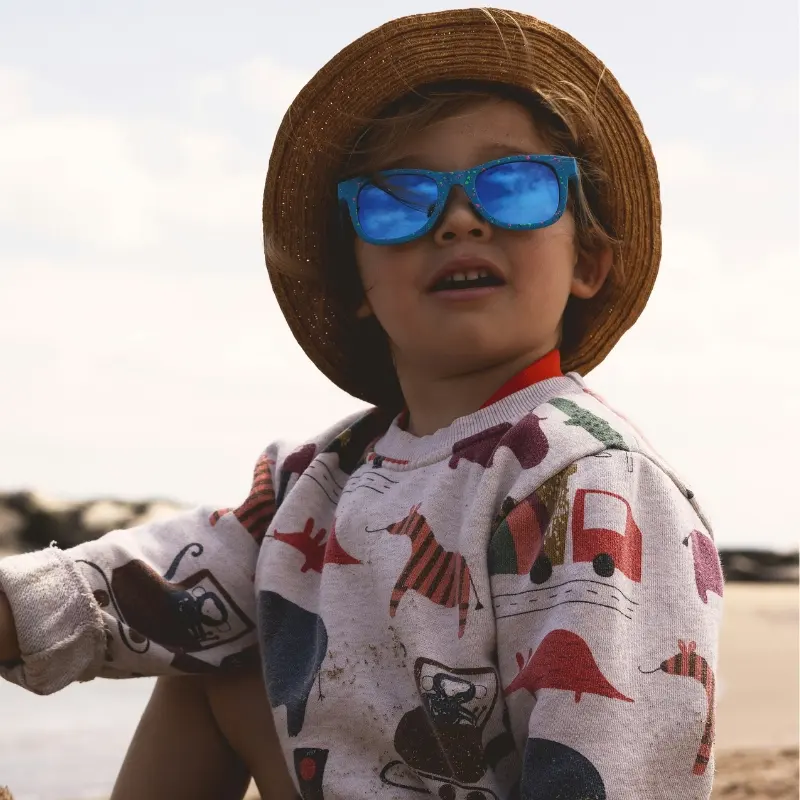
For the youngest age bracket, softness matters more than anything else. TPEE (thermoplastic elastomer) is the material most commonly used here: it’s soft and pliable enough to be safe when a baby puts the temples in their mouth, and dense enough that it doesn’t break into sharp pieces under that kind of handling. We cover TPEE’s properties in more detail, alongside how it compares to TR90 for the next age bracket, in our guide to TR90 sunglasses for kids.
Why the “Silicone” Label Doesn’t Always Mean Silicone
Buyers sourcing infant sunglasses will see the word “silicone” on a large share of the products in this category — nose pads, temple tips, and sometimes entire frame fronts. In practice, a lot of what’s marketed as “silicone” in kids’ eyewear is actually TPE or TPEE, not true silicone rubber. The two materials are chemically different and processed differently, but casual product copy across the industry treats them as interchangeable.
This matters at the spec stage for the same reason it matters with titanium-family materials, which we cover in our guide to titanium sunglasses for sensitive skin: a label is a starting point, not proof. If a hypoallergenic or “safe for chewing” claim is part of your product’s value proposition, it’s worth asking your manufacturer to confirm the exact material composition — TPE, TPEE, or genuine silicone — rather than relying on the word printed on the packaging.
TR90 for Active Kids (Roughly 3 Years Through Early Teens)

Once children are past the toddler stage and into an age where they’re running, climbing, and generally handling their own eyewear on and off dozens of times a day, TR90 becomes the more common material choice. It’s meaningfully lighter than acetate and standard plastic, flexes under pressure and returns to shape rather than cracking, and is inherently hypoallergenic — all properties that matter more, proportionally, on a smaller and still-developing face.
TR90 is also easier to mold into vibrant colors and dual-tone designs than acetate, which is part of why it dominates the mid-market kids’ sunglasses segment. A full technical breakdown of TR90’s properties, flex tolerance benchmarks, and design considerations is available in our dedicated TR90 sunglasses for kids guide.
Titanium and Beta-Titanium for Sensitive Skin and Older Kids
Titanium shows up in kids’ collections in two situations: when a brand is building toward an older, more mature-looking style for pre-teens, and when hypoallergenic positioning is genuinely part of the product’s value proposition for a child with a known metal sensitivity.
The important nuance here — one that gets blurred in a lot of casual product marketing — is that not every material labeled “titanium” is nickel-free. Pure titanium and properly specified beta-titanium are genuinely hypoallergenic; memory titanium (sometimes labeled Ti-Ni) is a different alloy that typically contains substantial nickel despite sometimes being marketed similarly. For a kids’ or sensitive-skin line specifically, this distinction is worth confirming explicitly with your manufacturer, component by component — not just for the frame front, but for hinge screws and spring mechanisms too. This is covered in full detail in our titanium sunglasses for kids and sensitive skin guide.
Where Acetate Fits — and Where It Doesn’t

Acetate is worth addressing directly because it’s a premium, popular material in adult eyewear, but it’s a smaller and more specific fit in children’s collections than TR90 or TPEE. Two of acetate’s core traits work against it at the younger end of the age range: it’s heavier than TR90, and it can warp or lose shape under sustained heat — a real concern for a product that regularly gets left in a car or a beach bag.
Where acetate does fit well is at the older end of a kids’ line — roughly age eight and up — where children are starting to want eyewear that looks like an adult accessory rather than a “kids’ product.” Acetate’s color depth and pattern layering give a brand real design range for this segment, and it’s the material most likely to satisfy a pre-teen or teen customer who’s choosing frames the same way they’d choose a fashion accessory. If your collection targets this older bracket specifically, acetate is worth specifying alongside TR90 rather than skipping it in favor of a single do-everything material.
Matching Material to MOQ, Cost Tier, and Development Timeline
Material choice also affects what a development plan actually looks like — MOQ, sampling time, and cost tier all shift depending on which material a style is built around. This is the part most consumer-facing material guides skip entirely, but it’s the part that actually shapes a sourcing decision.
| Material | Typical MOQ | Sampling Time | Cost Positioning |
|---|---|---|---|
| TPEE / Silicone | Grouped with injection-molded lines, typically from 1,200 pcs/style | Similar to TR90 | Entry to mid-tier |
| TR90 | From 1,200 pcs/style | 2–3 weeks | Mid-tier |
| Acetate | From 300 pcs/style, 100 pcs/colorway | 2–4 weeks | Mid to premium |
| Titanium / beta-titanium | Lower volume runs possible depending on component sourcing | 2–4 weeks sampling, 60–90 days bulk | Premium |
New mold investment also varies significantly by material and frame complexity, so it’s worth requesting a cost breakdown by style before finalizing which materials go into a first collection — a mixed-material line (TPEE for the infant tier, TR90 for the mid-range, acetate or titanium for the top of the range) is common, but it changes the total tooling investment compared to a single-material line.
Building a Multi-Age Collection: How the Materials Work Together
A brand launching across multiple age brackets — infant, toddler, school-age, and pre-teen — rarely does better with a single material stretched across all four. The more common and more defensible approach is a tiered material strategy: TPEE or silicone for the 0–3 bracket, TR90 as the backbone of the 3-to-early-teen range, and acetate or titanium introduced at the older end where design and positioning start to matter as much as durability.
This also gives a collection a natural upsell structure — a customer can start their child in a $6–$10 TR90 pair and graduate to a $15–$25 acetate or titanium pair as the child gets older, all under the same brand.

Frequently Asked Questions
What’s the best material for kids’ sunglasses overall?
There isn’t a single best material across every age — it depends on the age bracket. TPEE or silicone suits infants and toddlers who mouth their eyewear; TR90 suits active children roughly three years and up; acetate and titanium suit older kids and pre-teens who want a more mature look or need a hypoallergenic option.
Is silicone actually used in kids’ sunglasses frames, or is it usually something else?
A large share of what’s marketed as “silicone” in kids’ eyewear is actually TPE or TPEE, which behaves similarly but is chemically different from true silicone rubber. It’s worth confirming the exact material with your manufacturer if a hypoallergenic or chew-safe claim matters to your product positioning.
Can one material work across an entire kids’ collection?
It’s possible, but most brands building a full age-range collection get better results specifying two or three materials — one for the youngest bracket and one or two for older children — rather than defaulting to a single material across every age tier.
Why does acetate show up less often in kids’ sunglasses than in adult eyewear?
Acetate is heavier than TR90 and can warp under sustained heat, both of which are bigger drawbacks for younger, more active children. It tends to work better for the older end of a kids’ line, where design and a more adult-like aesthetic matter more than maximum durability.
Does material choice affect MOQ for a kids’ eyewear line?
Yes. Acetate styles typically carry a lower MOQ per colorway than TR90 or injection-molded materials, while titanium sampling and bulk production both take longer. A mixed-material collection changes the total tooling and MOQ picture compared to a single-material line, which is worth mapping out before finalizing a children’s eyewear development brief.
Let's get started!
Get in touch with a custom eyewear specialist now for a free consultation and instant price quote.
WHATSAPP ME GO!
📱 Scan with your phone to start chatting