5 Signs Your Eyewear Brand Is Ready to Switch to Acetate
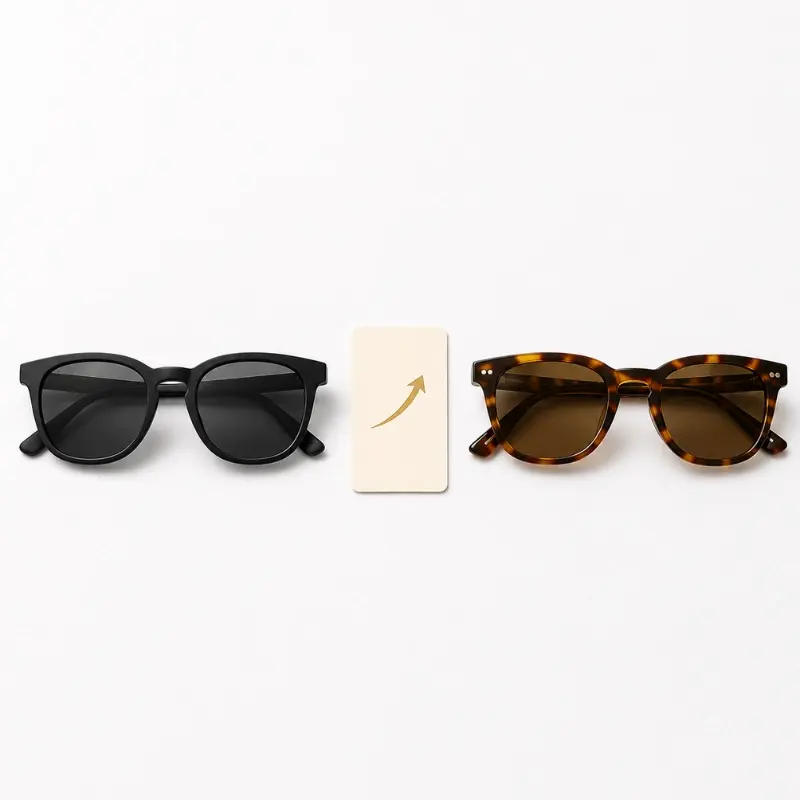
You launched with TR90. Sales are moving. But something isn’t adding up — and you can’t quite name it.
Most eyewear brands don’t decide to switch to acetate. They get pushed there — by customers who don’t feel the price is justified, by boutique buyers who won’t take the meeting, by review language that keeps using the same word: “cheap.” These are signals. And if you know what to look for, they tell you exactly when your brand has outgrown its current material.
This guide covers the five clearest signs that your eyewear brand is ready for acetate — and what to do when you recognize them.
Why Material Switches Happen — and Why Most Brands Wait Too Long
Brands don’t usually switch materials proactively. They switch reactively, after the signals have been accumulating for months.
The reason is simple: switching materials feels risky. It means higher unit cost, new supplier conversations, and the possibility of disrupting something that’s already working. But the real risk is the opposite — staying with a material that’s holding your brand’s ceiling lower than your pricing wants to go. The brands that wait too long to switch lose ground to competitors who moved earlier.
Understanding when to make the switch is a strategic decision, not a production one. Here are the five signs that tell you the time is now.
Sign 1: Your Retail Price Has Crossed $50 — But Your Margins Haven’t Improved
Price point is the clearest indicator of material readiness. And there’s a specific threshold where the mismatch between TR90 and retail expectation becomes commercially damaging.
When your brand is selling above $50 retail and customers are still comparing you to cheaper alternatives, the frame material is often the invisible reason. TR90 at $60 retail doesn’t feel like $60 to most customers. The weight, the surface finish, the color uniformity — none of these communicate premium in the way a $60 price tag requires. The result is a conversion problem that no amount of better photography or stronger copy fully solves.
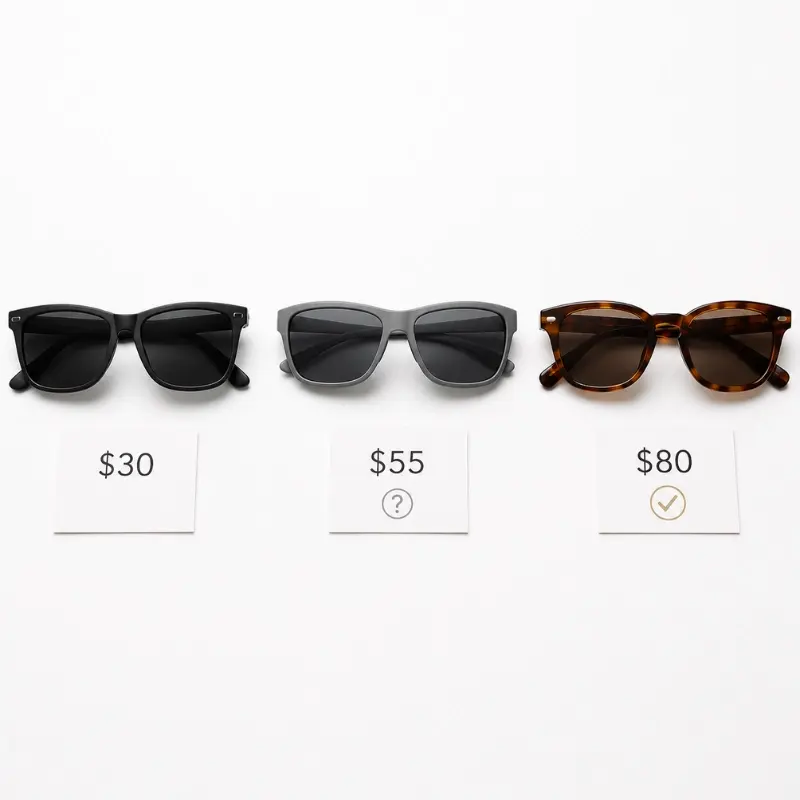
Here’s the price-to-material alignment that works in practice:
| Retail Price Range | Material That Fits | Risk of Mismatch |
|---|---|---|
| $15–$40 | TR90, PC | Low — price and material align |
| $40–$60 | TR90 or acetate | Medium — TR90 starts to feel mismatched |
| $60–$100 | Acetate strongly preferred | High — TR90 creates a credibility gap |
| $100–$200 | Acetate | Very high — TR90 undercuts the brand promise |
| $200+ | Acetate, titanium | Severe — TR90 is not credible at this level |
The $50–$60 zone is the transition threshold. Below it, TR90 works. Above it, customers start to feel the mismatch — even if they can’t articulate why. If your brand has been operating above $60 retail for more than two collections without switching material, the material is very likely your conversion ceiling.
Here’s the deal: the switch to acetate doesn’t require raising your price. It requires matching your material to the price you’re already charging. A domestic acetate frame at $6–$18 EXW can retail at $60–$120 with margins that work. The economics support the switch — the question is timing.
Sign 2: Boutique Retail Buyers Keep Saying No — or Not Responding
Wholesale and boutique sell-in conversations are some of the most direct feedback a brand receives — and most brands misread the signal.
When boutique retail buyers decline your line or go quiet after seeing samples, the most common reason isn’t price, design, or brand recognition. It’s material. Buyers at independent optical shops and premium fashion boutiques handle eyewear every day. They know acetate by touch. A TR90 sample at $65 wholesale tells them the end-customer will feel a mismatch, and that creates return risk they don’t want to take on.
This signal is hard to hear because buyers rarely say it directly. They say:
- “Not the right fit for us right now”
- “We’ll circle back next season”
- “The price works but we need to think about it”
What they’re often really saying: the material doesn’t match what we stock at this price point.
The boutique buyer test
Before your next wholesale pitch, run this check:
- Look at what the boutiques you’re targeting currently stock
- Pick up three frames from their current selection at your target price point
- Compare the surface feel, weight, and color depth to your TR90 sample
If the comparison feels unfavorable, that’s what the buyer feels too. If the comparison feels equal or better, material is not your problem.
If the answer comes back clearly — the boutique frames feel richer, more substantial, more polished — you’re holding a TR90 sample into a room that expects acetate. That conversation will not go well, regardless of your other brand strengths.
Sign 3: Your Customer Reviews Keep Using One Word
Reviews are unfiltered brand feedback. And in eyewear, certain words appear in reviews in patterns that directly track material quality.
TR90 frames, when reviewed positively, produce words like “lightweight,” “comfortable,” “durable,” and “great for the price.” These are real compliments — but they’re not premium compliments. When the same TR90 frame appears in negative reviews at mid-range price points, the language shifts to “feels cheap,” “looks plastic,” “not worth the price,” and “not what I expected.” That last phrase is the most damaging — it means the customer’s expectation at your price point wasn’t met.
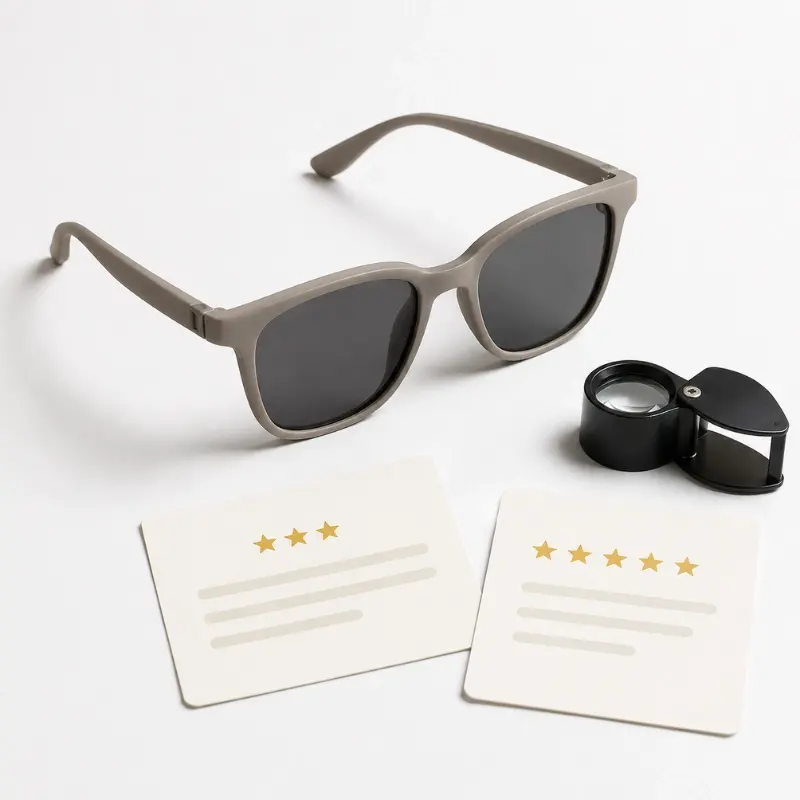
Check your last 50 reviews. Look for these patterns:
TR90 review language that signals material readiness for upgrade:
- “Feels lighter than I expected” (positive, but not premium)
- “Looks good in the photos” (implies it looks different in person)
- “Not sure it’s worth [price]” (price-value mismatch)
- “Feels a bit plasticky” (material perception problem)
- “Great for the price” (damning with faint praise at mid-range)
Acetate review language (what you want to see):
- “Feels substantial and well-made”
- “The color is beautiful — richer than the photos”
- “Worth every penny”
- “Exactly what I expected for the price”
- “The quality is obvious”
If your reviews contain three or more phrases from the first list, your customers are telling you the material isn’t delivering on your price point. That’s a switch signal.
You might be wondering: what if the reviews are mostly positive? Look more carefully at the specific words. “Great for the price” and “worth every penny” feel similar — but one is a ceiling statement and one is a confirmation statement. The first says “given what I paid, this is acceptable.” The second says “I believe this is worth what I paid.” At mid-range price points, you want the second.
Sign 4: Your Return Rate Is Running Above Industry Average
Returns in eyewear track two things: fit and expectations. Material affects both.
The industry average return rate for online eyewear is approximately 10–15%. If your brand is running above this consistently, and fit isn’t the primary complaint, material mismatch is likely contributing. The mechanism is straightforward: a customer pays $70, receives a TR90 frame, holds it, and the weight and surface don’t confirm the $70 decision. The return justification writes itself — “not as described,” “quality not as expected,” “doesn’t look like the photos.”
Acetate reduces this mechanism in two ways. First, the weight and surface richness of acetate frames confirm the purchase price — customers hold an acetate frame and feel that it’s worth what they paid. Second, acetate’s color depth photographs accurately — what the customer sees in your product images is what they get. TR90 under photography lighting often looks richer than it is; the gap between photo and reality triggers returns.
How to diagnose a material-related return pattern
Pull your return data and look for:
- Return reason: “not as expected” or “quality not as described” (not fit-related)
- Return rate by price point: are higher-priced TR90 styles returning more?
- Review correlation: do returned products have the “great for the price” language?
If you’re seeing return rates above 12% with non-fit complaints concentrated in your mid-to-upper price tier, switching the highest-priced styles to acetate is likely to reduce that number meaningfully.
Sign 5: Competitors at Your Price Point Are Using Acetate
This is the most direct competitive signal — and often the clearest.
When a competitor enters your price point with acetate frames and starts taking your customers, they’re not just competing on design. They’re competing on material credibility. A customer comparing your $75 TR90 frame to a competitor’s $75 acetate frame will, all else being equal, choose the one that feels more worth the price. This is not a preference — it’s a physics problem. Acetate wins the hand-feel test at comparable retail prices every time.
Monitor your competitive set actively:
- What material are they using for their $50–$100 products?
- Are they gaining boutique placements you’ve been losing?
- Are their reviews using “quality” and “premium” while yours are using “lightweight” and “great value”?
If the answer is yes to two or more of these, you’re not just seeing a competitor doing well. You’re seeing the acetate advantage playing out in your market.
The response isn’t to panic — it’s to switch your flagship styles to acetate and let the material advantage work for you.
The Price Threshold Explained: Why $50–$60 Is the Natural Transition Point
Understanding why this specific price range is the transition threshold helps you plan the switch with more confidence.
Below $50 retail, customers don’t expect premium material. They’re buying on price, design, and convenience. TR90 delivers all three efficiently. Above $60 retail, customer expectations shift — they’re now evaluating whether the product is worth the price, not just whether it’s acceptable for the price. This is the moment material becomes the deciding factor in customer satisfaction.
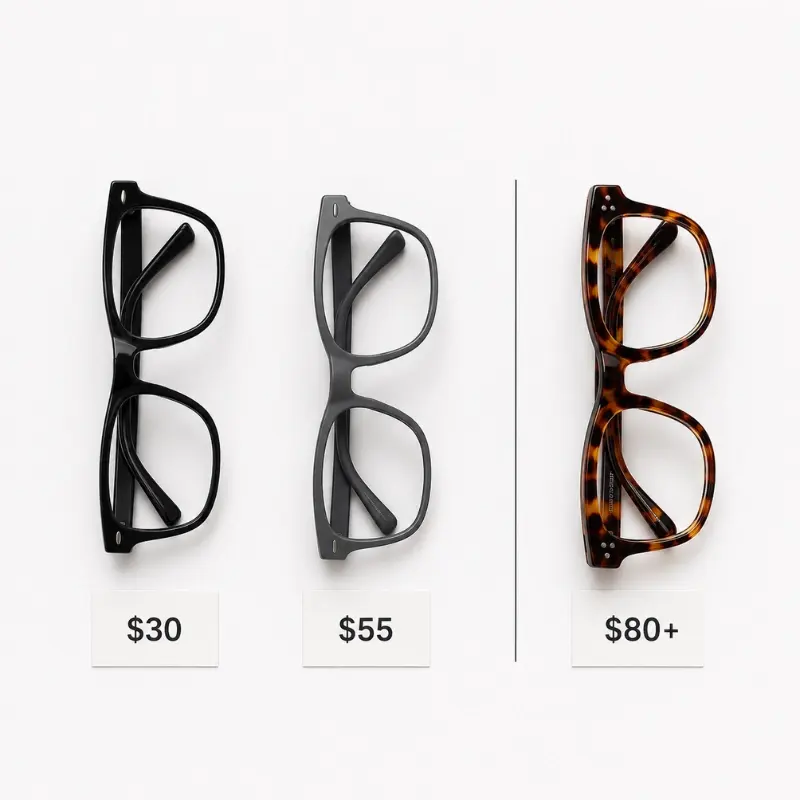
Here’s the psychology at each price point:
$15–$40: Customer is buying a fashion accessory, not an investment. TR90’s lightness and color uniformity are exactly right. Price-material alignment is strong.
$40–$60: Customer is starting to evaluate quality. TR90 can still work, but acetate starts to feel more appropriate. This is the grey zone where the decision depends on your specific product and channel.
$60–$100: Customer expects to feel the quality. TR90 fails this test consistently. Acetate passes it. Brands in this range with TR90 are fighting a structural disadvantage that better marketing can partially offset but never fully eliminate.
$100+: The customer is explicitly paying for premium. TR90 at this price point is almost always a brand credibility problem. Acetate is the baseline expectation.
The switch point for most brands is when they start consistently pushing above $60 retail and want to access boutique channels. That’s the moment acetate stops being a “nice to have” and becomes a “necessary to compete.”
How to Make the Switch Without Breaking What’s Working
Recognizing the signal is one thing. Executing the transition without losing your current customers is another.
The most common mistake brands make when switching to acetate is switching everything at once. This creates production disruption, confuses existing customers, and creates margin pressure before the new positioning has time to work. The smarter approach is a dual-track strategy: introduce acetate for your flagship styles first while maintaining your existing TR90 line for current customers.
Here’s a practical transition framework:
Phase 1: Launch one or two acetate hero styles
Select your one or two best-selling designs or the designs most aligned with where you want the brand to go. Relaunch them in acetate — same design, upgraded material. Position them explicitly as your premium tier. Price them at your target acetate retail ($60–$120 depending on your current positioning).
This does three things: it tests the market’s response to acetate at your brand, it creates a proof point for boutique buyers, and it generates the “quality” review language that starts shifting brand perception.
Phase 2: Evaluate and expand
After two to three months of acetate hero sales, evaluate:
- Are conversion rates higher for acetate styles than equivalent TR90 styles?
- Are reviews using “quality” and “premium” language?
- Are boutique buyers responding differently to your acetate line card?
If yes — expand acetate to more styles in the next collection. Keep TR90 for your entry tier or discontinue it based on your brand direction.
Phase 3: Establish the brand’s new material standard
Once acetate represents your flagship tier, use it as the anchor for all brand communication. Lead with acetate in photography, press, and retail conversations. Let TR90 fade naturally as a legacy tier or position it explicitly as an accessible entry point.
The key rule: never position TR90 and acetate as equal options at similar price points under the same brand. The customer will always choose the wrong one for your brand positioning. Keep them at clearly different tiers — in price, in presentation, and in how they’re described.
This is part of our complete guide to custom acetate sunglasses manufacturing. If you’ve identified your brand is ready to make the switch and want to discuss a first acetate collection — starting with existing molds at 300 units per colorway — we respond within 4 business hours.
Your Brand Readiness Checklist
Run through this before your next supplier conversation:
- [ ] My brand is consistently retailing above $50 per unit
- [ ] I’ve had boutique or premium wholesale conversations that didn’t convert
- [ ] My reviews include “great for the price,” “feels lightweight,” or “not what I expected”
- [ ] My return rate on mid-to-upper priced styles runs above 12%
- [ ] At least one competitor at my price point is using acetate
- [ ] I want to enter boutique, optical, or premium fashion retail channels
- [ ] My brand’s visual identity relies on color complexity, pattern, or surface richness
If you checked three or more: your brand is signaling it’s ready for acetate. The question is no longer whether — it’s when and how.
If you checked one or two: you’re approaching the threshold. Start sampling acetate now so you’re not scrambling when the signal becomes undeniable.
If you checked none: TR90 is still the right call. Focus on building volume and brand recognition before the material upgrade.
Conclusion
Brands don’t outgrow materials overnight. They outgrow them through a series of signals — price creep, boutique friction, review language shifts, return pressure, and competitive displacement. The five signs in this guide are those signals made visible. When you see three or more of them, your brand is telling you it needs a different material to deliver on its positioning. Acetate is that material.
Frequently Asked Questions
When should an eyewear brand switch from TR90 to acetate?
The clearest trigger is retail price. When your brand consistently retails above $60 and customers, buyers, or reviews signal a price-quality mismatch, the material is likely the ceiling. Other clear signals: boutique buyers not converting, review language showing “feels cheap” or “not worth the price,” return rates above 12% on higher-priced styles, and competitors at your price point using acetate.
Does switching to acetate require raising prices?
Not necessarily. Domestic acetate at $6–$18 EXW can support $60–$120 retail — a price point many TR90 brands are already at. The switch is about matching your material to your existing price point, not about raising prices to justify the material. If you’re already at $70 retail with TR90, switching to acetate at that same price point is likely to improve conversion and reduce returns.
Can a brand use both acetate and TR90 at the same time?
Yes — and this is often the best transition strategy. Launch acetate for your flagship styles first, keep TR90 for your entry tier, and let the market response guide how quickly you expand acetate. The key rule: don’t position them at the same price point under the same brand without clear tier differentiation.
Why do boutique buyers care about frame material?
Boutique buyers handle eyewear professionally. They evaluate material by touch and know what their customers expect at different price points. A TR90 frame at $65 wholesale signals to them that the end-customer will feel a mismatch — creating return risk they don’t want. Acetate at the same wholesale price signals material credibility that justifies the retail price.
What MOQ should I expect for a first acetate collection?
For ODM acetate using existing molds, minimum order quantities start at 300 pieces per style per colorway. This is significantly lower than custom TR90 injection molds, which typically require 1,200+ pieces and a one-time mold tooling fee. The lower acetate MOQ makes it more accessible for brands testing the material transition without a large inventory commitment.
How long does it take to see results after switching to acetate? Review and return rate improvements typically show within the first collection cycle — 60 to 90 days after the acetate styles are live and selling. Boutique sell-in improvements can be faster — the response in buyer conversations often changes immediately when acetate samples replace TR90. Brand positioning shifts take longer — one to two collections for the market to register the material upgrade as a deliberate brand move.
Let's get started!
Get in touch with a custom eyewear specialist now for a free consultation and instant price quote.
WHATSAPP ME GO!
📱 Scan with your phone to start chatting