China Eyewear Manufacturer vs Italy Eyewear Manufacturer: Which Is Right for Your Brand?
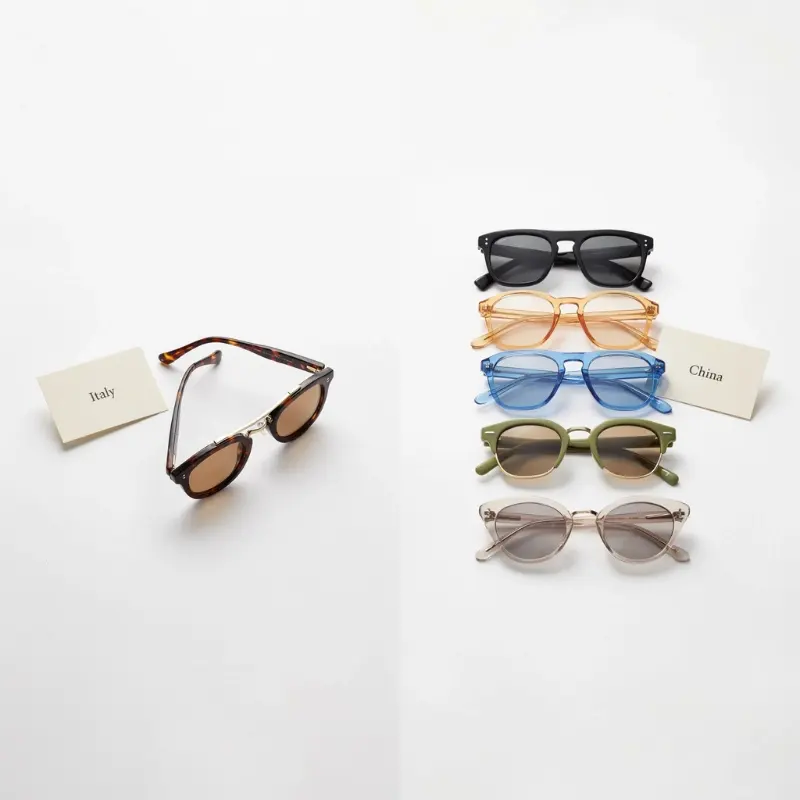
You’re building an eyewear brand. You’ve narrowed sourcing down to two options: China or Italy. Both sound credible — but they couldn’t be more different.
China and Italy both produce world-class eyewear, but they serve completely different brand needs. Italy offers heritage, prestige, and artisan craftsmanship. China offers scale, speed, flexibility, and far lower costs. Choosing the wrong one can slow your growth or blow your budget.
Here’s what most buyers get wrong: they assume “Made in Italy” automatically means better. It doesn’t — it means different. The right choice depends entirely on your brand stage, budget, and target customer.
Let’s break it down.
What Does Each Country Actually Offer?
Italy and China dominate global eyewear production, but from completely opposite ends of the spectrum.
Italy produces prestige. China produces volume — and increasingly, quality too.
Italian eyewear comes from a tight cluster of factories in the Veneto region — towns like Belluno, Cadore, and Longarone. These manufacturers have been handcrafting acetate frames for generations. Names like Safilo and Marcolin are rooted here. The craftsmanship is real. So is the price.
China, on the other hand, makes roughly 70% of all eyewear sold worldwide. Shenzhen, Wenzhou, and Danyang are the main production hubs. Over the last two decades, Chinese factories have invested heavily in technology, materials, and design — closing the quality gap with Europe faster than most buyers realize.
Here’s the kicker: the famous Italian acetate brand Mazzucchelli — the one your premium supplier brags about — runs its largest manufacturing operation in China. German hinge brand OBE has its main hub there too. The supply chain story is more complicated than “Italy = quality, China = cheap.”
How Do They Compare on Price?
Price is usually the first question — and the gap is significant.
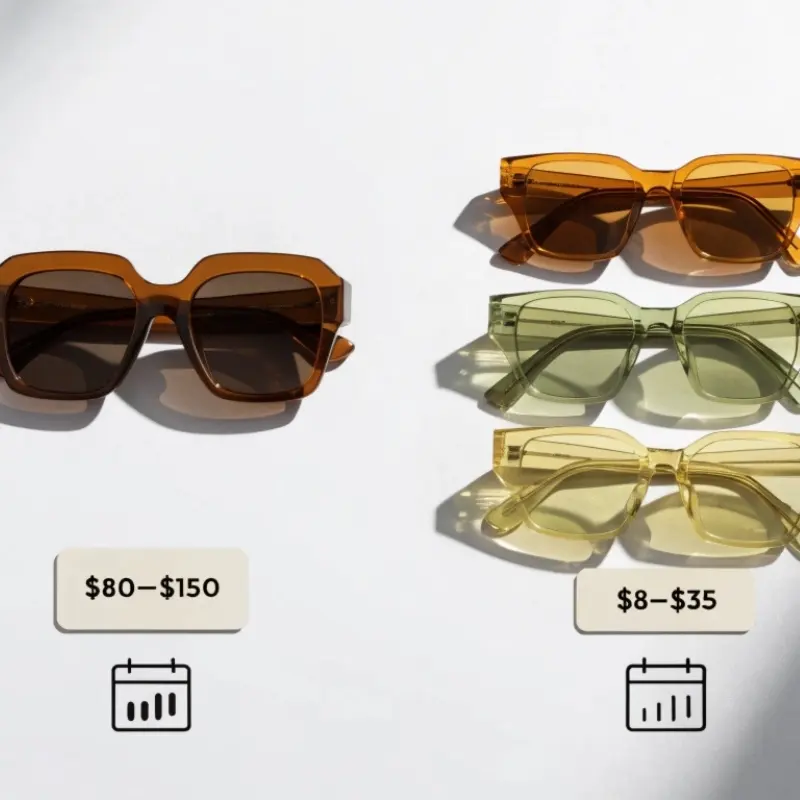
Italian factories typically charge $80–$150+ per unit FOB for custom acetate frames. Chinese manufacturers produce comparable frames for $8–$35, depending on material, complexity, and order volume. That’s a 3–5x cost difference that directly affects your margins.
This isn’t just about labor costs. Italian factories carry higher overheads: strict labor regulations, smaller production volumes, and the premium attached to the “Made in Italy” label itself. You pay for the story as much as the product.
Chinese factories benefit from a fully integrated supply chain. Hinges, acetate sheets, lenses, screws, packaging — everything is sourced within a few hours’ drive. This keeps costs low and turnaround fast.
For a growing brand placing orders of 300–1,000 pieces per style, the math is straightforward. With Chinese manufacturing, you can test more styles, iterate faster, and protect your margins while building market traction.
| China | Italy | |
|---|---|---|
| Price per unit (acetate) | $8–$35 | $80–$150+ |
| MOQ per style | 300–500 pcs | 1,000–3,000 pcs |
| Sample lead time | 10–20 days | 4–8 weeks |
| Bulk lead time | 45–60 days | 90–120 days |
| OEM/ODM flexibility | High | Low–Medium |
| IP protection | Strong (NDA available) | Strong |
What About Quality — Is Italian Eyewear Really Better?
This is where the conversation gets more honest.
Italian eyewear still leads in one area: handcrafted acetate detail. The multi-step polishing process, hand-finishing on hinges, and deep color richness of Italian acetate frames is hard to replicate at volume. But for most mid-range and growing brands, the quality gap is far smaller than the price gap.
Here’s what’s changed in the last decade. Chinese manufacturers — especially those in Shenzhen and Wenzhou — now use the same Italian Mazzucchelli acetate sheets. They run ISO 9001-certified production lines. They provide CE documentation for EU markets and FDA compliance for the US. Many have in-house design teams with international training.
We work with brands across the US, EU, and Australia, and we see this shift firsthand. The buyers who visited our Shenzhen facility expecting to find “cheap” factories leave surprised. Multi-stage QC, CNC machining, barrel polishing, spring hinge testing — the process is thorough.
The truth is: quality in eyewear manufacturing comes down to which factory you choose, not which country you’re in. A poorly run Italian factory produces bad frames. A well-run Chinese factory produces excellent ones.
Which Is Better for Private Label and OEM?
If you’re building a private label brand, China wins on almost every dimension.
Chinese factories are built for OEM and private label from the ground up. Italian manufacturers are built for heritage brands and long-term licensed production. If you need custom logo, custom shape, custom packaging, and a flexible MOQ — China is where you go.
Italian factories are set up for long-term partnerships with established luxury brands. They’re not optimized for a 300-piece trial run with a new brand. Many won’t quote you unless you can commit to 1,000+ pieces per colorway, and sampling alone can take 6–8 weeks.
Chinese manufacturers, by contrast, actively compete for private label business. They’ve built their workflows around it: fast quoting, iterative sampling, technical drawing support, and branded packaging all under one roof. You can start a project with nothing more than a mood board or reference frame.
For your first collection, your fifth collection, or your seasonal launch — the speed-to-market advantage of Chinese OEM is hard to overstate.
What Are the Real Risks With Each Option?
No sourcing decision is risk-free. You need to know what you’re taking on.
The biggest risk with Italian manufacturers is access and cost overrun. The biggest risk with Chinese manufacturers is finding the wrong factory — inconsistent quality, poor communication, or weak IP protection. Both risks are manageable if you know what to look for.
Italian risks:
- High MOQ locks in inventory before you’ve validated the market
- Long lead times (90–120 days) make seasonal agility difficult
- Communication barriers and formal, slow response culture
- If your brand isn’t established, some factories won’t work with you
- Per-unit costs leave thin margins at mid-market retail prices
Chinese risks:
- Quality varies widely between factories — you need to vet carefully
- IP protection requires proper NDA and mold ownership contracts
- Some manufacturers overpromise and underdeliver on sampling
- Language can be a barrier with smaller or less experienced factories
The solution to the Chinese risks isn’t “go to Italy.” It’s to choose the right Chinese manufacturer — one with verifiable export experience, clear NDA policies, and a track record with brands in your target markets.
Which Should You Choose for Your Brand?
The answer depends on where your brand sits right now.
Choose Italy if: You’re an established luxury brand, selling at $400+ retail, with heritage storytelling as a core part of your brand identity, and you can sustain 1,000+ MOQs per style.
Choose China if: You’re building a private label brand, launching a new collection, scaling an independent brand, or need to balance quality with margins at $80–$300 retail price points.
The bottom line? Most growing eyewear brands — including those in the US, EU, and Australia — source from China and sell with confidence. The country of manufacture matters far less to your end customer than the story you build around your product.
Italy makes sense for a luxury brand that needs the “Made in Italy” label as part of its value proposition. For everyone else, China offers better economics, faster timelines, and more than enough quality to build a brand you’re proud of.
Conclusion
China offers the speed, flexibility, and cost structure most growing eyewear brands need. Italy offers prestige — at a price. Choose based on your brand stage, not industry assumptions.
Frequently Asked Questions
Is Chinese eyewear quality good enough for European and US markets?
Yes. Reputable Chinese manufacturers provide CE and FDA compliance documentation. Many use Italian Mazzucchelli acetate and run ISO 9001-certified production lines that meet EU and US standards.
What is the MOQ difference between Chinese and Italian eyewear manufacturers?
Chinese manufacturers typically start from 300–500 pieces per style. Italian manufacturers usually require 1,000–3,000 pieces minimum, making them less suitable for emerging or growing brands.
How much cheaper is manufacturing eyewear in China vs Italy?
Chinese factories typically charge $8–$35 per unit for custom acetate frames. Italian factories charge $80–$150+. The cost difference is 3–5x, which directly impacts your retail margins.
Can I get private label eyewear made in China with my own branding?
Yes. Chinese OEM manufacturers are built for private label production — custom logo, custom shape, custom packaging, and flexible MOQs from 300 pieces. This is standard service, not a premium add-on.
How long does sampling take with Chinese vs Italian manufacturers?
Chinese manufacturers typically deliver samples in 10–20 days. Italian manufacturers often take 4–8 weeks for new clients, which significantly extends your product development timeline.
Does “Made in Italy” eyewear actually mean it’s made in Italy?
Not always. Under Italian law, a product can be labeled “Made in Italy” if only the final assembly happens there, even if all components are manufactured in China. Many brands use this label despite the majority of production happening elsewhere.
What’s the best way to find a reliable eyewear manufacturer in China?
Look for factories with verifiable export records to your target markets (US, EU, Australia), clear NDA and IP protection policies, ISO 9001 certification, and a willingness to do factory visits or video walkthroughs.
Can Chinese eyewear manufacturers use Italian acetate materials?
Yes. Many Chinese manufacturers source acetate directly from Mazzucchelli — the same Italian supplier used by luxury brands. The material origin is Italian; only the manufacturing happens in China.
Let's get started!
Get in touch with a custom eyewear specialist now for a free consultation and instant price quote.
WHATSAPP ME GO!
📱 Scan with your phone to start chatting