Custom Color Acetate Sunglasses: What's Possible and How to Brief Your Manufacturer
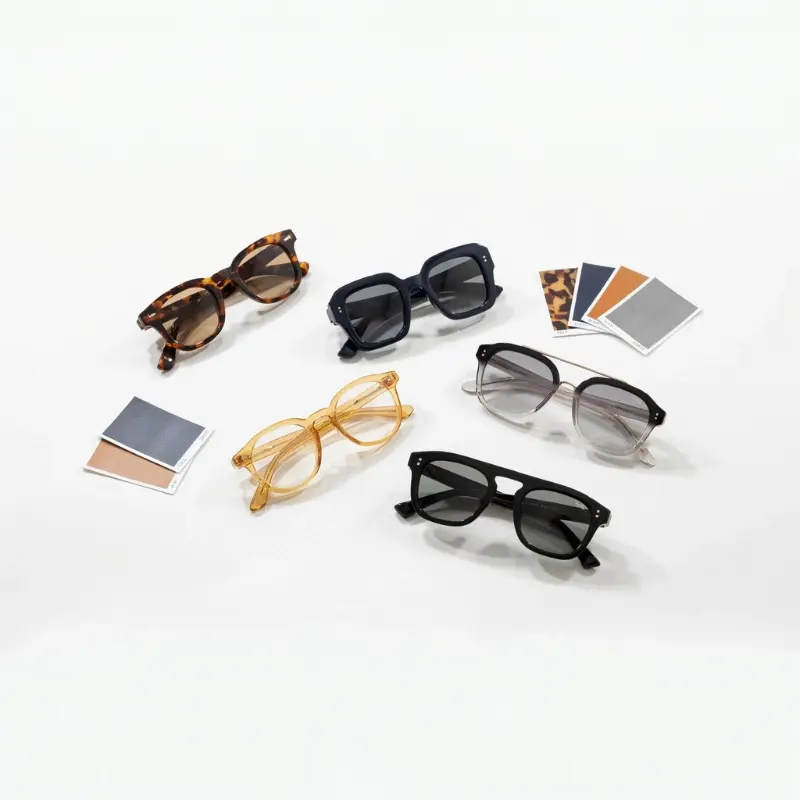
You have a color in your head. Maybe it’s a specific tortoiseshell with more amber than brown. Maybe it’s a gradient that fades from deep navy to clear. Maybe it’s a matte sage green that doesn’t exist in any catalog you’ve seen.
The good news: acetate can probably do it. The challenge: knowing exactly what’s achievable, what the constraints are, and how to communicate your vision so your manufacturer produces the right result the first time.
Most color briefs fail not because the color is impossible — but because the brief is too vague. “Something tortoiseshell but warmer” produces ten different frames from ten different factories. A proper color brief produces one.
This guide covers what custom color acetate sunglasses can and can’t do, and how to write a brief that gets your color right.
What Makes Acetate Uniquely Suited to Color Customization
Before understanding what’s possible, it helps to understand why acetate is the right material for color customization in the first place.
Acetate frames are cut from solid layered sheets. Color and pattern run through the full material thickness — they are structural, not surface-applied. This means a tortoiseshell acetate frame has tortoiseshell throughout the entire frame, not printed on the outside. Sand it, cut it, polish it — the pattern is still there. No other common eyewear material offers this kind of color depth and permanence.
This structural color property is what makes acetate the default material for fashion and premium eyewear brands where color differentiation is part of the brand identity. TR90 and polycarbonate can be dyed or spray-painted, but the color sits on the surface and wears off. Acetate’s color is the material itself.
The acetate color you specify comes from the sheet — which means your color brief is really a sheet specification. Understanding this changes how you approach the briefing process.
Standard Colors vs Custom-Developed Colors: The Key Distinction
This is the most important thing to understand before briefing any manufacturer — and the thing most brands get wrong.
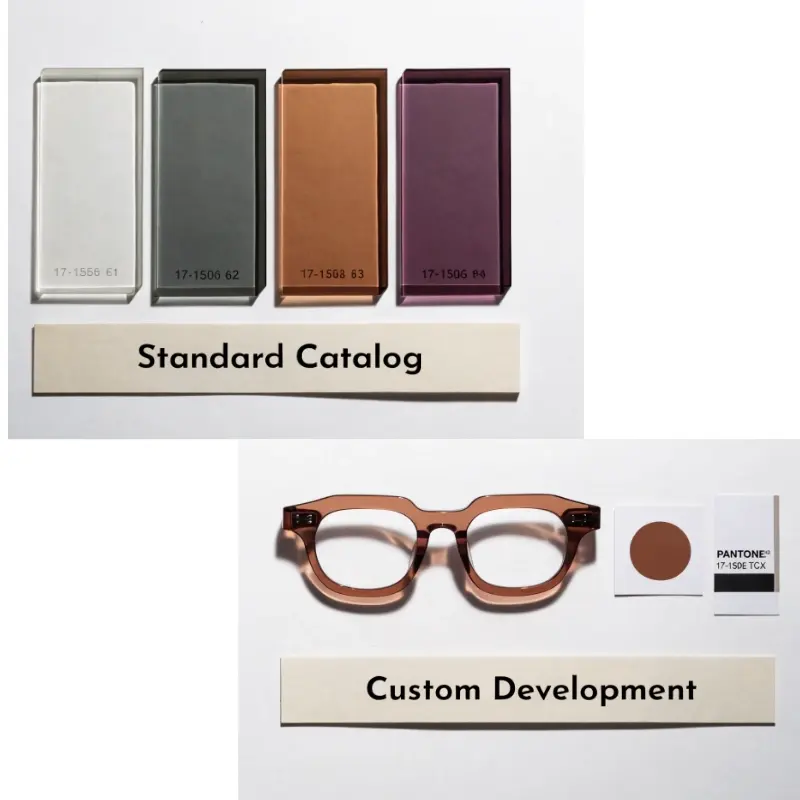
There are two completely different things a brand can mean by “custom color”: selecting from a supplier’s existing catalog, or commissioning a new color to be developed. These are not the same process, do not have the same MOQ, and do not have the same lead time. Confusing them causes most of the timeline and expectation problems in acetate color development.
Standard catalog colors
Acetate sheet suppliers — Mazzucchelli, domestic Chinese suppliers, Japanese suppliers — maintain extensive catalogs of existing colors and patterns. These include hundreds of tortoiseshell variations, solid colors, gradients, transparent effects, and multi-layer patterns. Each has a reference code.
When you select a standard catalog color, your manufacturer orders that specific sheet. The color already exists — it just needs to be ordered, which typically takes 7–45 days depending on the supplier and whether it’s in stock.
Standard catalog colors are not exclusive to your brand. The same color exists in the supplier’s catalog and can be ordered by any factory for any client at any time. If color exclusivity matters to your brand, you either need to develop a custom color, or negotiate a specific exclusivity arrangement — though this is generally not enforceable for colors that exist independently in the supplier’s standard range.
Regarding sheet MOQ for standard catalog colors: it depends on the supplier and the specific color. Some standard colors have no minimum sheet quantity and can be ordered as needed. Others do require a minimum purchase. Confirm with your manufacturer before finalizing your color selection — they will check the current sheet availability and MOQ requirement with the supplier directly.
Frame production MOQ: typically 300 pieces per style, with a minimum of 100 pieces per colorway within that style. This is determined by mold economics and CNC machining efficiency — not by sheet quantity.
Custom-developed colors are different. The supplier needs a minimum development quantity to justify formulating a new color — typically enough material to produce 500+ frames. This sheet-level MOQ is the real constraint for custom color development, and it’s why the minimum frame quantity for custom colors is higher than for standard catalog colors.
Custom-developed colors
A custom-developed color is one that doesn’t exist in any supplier’s standard catalog — a color created specifically for your brand. This involves working with the acetate supplier’s color development team to formulate a new sheet: specific pigment ratios, pattern structures, layering sequences, or finishes that produce your target color.
Custom color development is expensive, slow, and has high minimum quantities at the sheet level. Mazzucchelli custom color development typically takes 60–90 days for the sheet alone, before any frame production begins. Minimum sheet quantities are high — often requiring 500+ frames worth of material just to justify the color development run.
Most brands don’t need custom-developed colors. The existing catalog from premium suppliers contains thousands of options. If you can find a catalog color that achieves your target — or close enough — you save significant time, cost, and complexity.
The right question to ask your manufacturer: “Does this color exist in your supplier’s standard catalog, or would we need to develop it?”
| Standard Catalog Color | Custom Developed Color | |
|---|---|---|
| Lead time (sheets) | 7–45 days | 60–90 days |
| MOQ per colorway | Varies — some colors have no sheet MOQ, others do. Confirm with supplier. Frame MOQ: 300 pcs/style, 100 pcs/colorway | 300–500+ pcs (varies by supplier) |
| Cost premium | None | Significant |
| Exclusivity | Not available | Negotiable (your brand) |
| Color reference | Supplier code | Custom specification |
| Recommended for | Most brands | Established brands with flagship colorway |
What Acetate Color Can Actually Do: Possibilities and Limits
Understanding the full range of what acetate color can achieve — and where the structural limits are — helps you brief confidently without over-specifying or asking for things that aren’t possible.
What acetate can do
Solid colors. Any solid color achievable in acetate sheet production — from deep matte black to vivid translucent red to pale blush. Solid colors are the most reliable to produce consistently across batches.
Tortoiseshell and havana patterns. The classic warm-amber-and-brown pattern that defines premium acetate eyewear. Tortoiseshell exists in hundreds of catalog variations — lighter, darker, more amber, more brown, tighter pattern, looser pattern, more transparent, more opaque. Finding the right tortoiseshell is a matter of narrowing down from catalog options.
Gradient effects. Color that transitions from one shade to another across the frame — typically darker at the top, lighter at the bottom. Gradients in acetate are structural: the sheet is layered differently across its width, producing a genuine material gradient rather than a surface treatment.
Transparent and crystal effects. Frames with significant transparency — crystal clear, lightly tinted transparent, colored transparent. Transparency depth varies by sheet formulation.
Multi-layer patterns. Complex patterns involving multiple acetate layers — swirls, two-tone blocks, marble effects, abstract patterns. These require specialty sheets and are more expensive than standard options.
Matte finishes. A matte surface finish is achieved through the tumbling and polishing process, not the sheet itself. Any acetate color can be produced in matte finish by adjusting the polishing stage.
What acetate cannot do
Photo-realistic imagery. Acetate cannot reproduce photographic detail or complex multi-color illustrations. The patterns achievable are geometric and organic — not representational.
Precise color matching to a non-acetate reference. If your reference is a fabric swatch, a Pantone C chip, or a paint color, there will be variation. Acetate has its own color language. You can get close — sometimes very close — but a direct 1:1 match to a non-acetate material is rarely achievable.
Gradients in multiple directions simultaneously. Acetate gradient runs in one direction (top-to-bottom in standard production). Multi-directional color transitions are not achievable in standard production.
Colors that change in UV light or temperature. Photochromic effects are lens treatments, not frame treatments. The acetate frame itself does not change color.
How to Read an Acetate Supplier Color Catalog
Most brands approach color selection by describing what they want in words. A better approach is to work directly from supplier catalogs — the reference system used by the industry.
The three primary acetate sheet suppliers used in premium eyewear production are Mazzucchelli (Italy), Takiron and Toray (Japan), and Chinese domestic suppliers. Each publishes color catalogs with reference codes. Your manufacturer can show you physical swatches or digital catalog references for any code. When you select by code, there is no ambiguity about what color you’re getting.
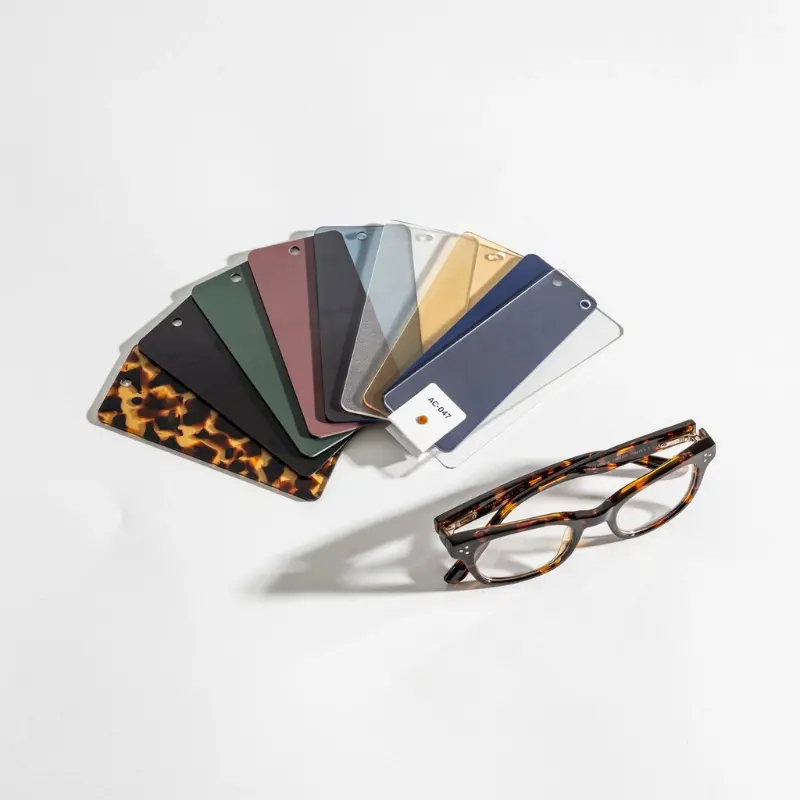
How to work with supplier catalogs:
Step 1: Ask your manufacturer which acetate suppliers they work with and request access to their color catalog — physical swatches, supplier website, or digital catalog PDF are all fine.
Step 2: Browse by color family (tortoiseshell, solid, gradient, transparent) and narrow to options that match your general direction.
Step 3: Request physical swatches of your shortlisted options. Digital catalog colors are indicative — physical swatches show actual color depth, transparency, and pattern behavior in different light conditions.
Step 4: Select your final color by reference code. Confirm the code with your manufacturer in writing before production begins.
Step 5: Note that acetate colors deepen slightly after polishing. Ask your manufacturer for a polished swatch or a reference frame in that color if possible — polished color is closer to the finished product than raw sheet.
The reference code is your protection. “The warm tortoiseshell we chose” is ambiguous. “Mazzucchelli MT09” is not.
How to Write a Color Brief That Works
A color brief is the document or communication that tells your manufacturer exactly what color result you’re targeting. Most brands under-brief on color, which leads to sampling rounds that could have been avoided.
A complete color brief answers five questions: What is the reference? What family does it belong to? What is the acceptable variation? What is the finish? And does this color need to be exclusive to your brand?
Here’s what a complete color brief looks like in practice:
Element 1: Primary color reference
The strongest color reference is a supplier catalog code — it’s unambiguous. If you don’t have a catalog code yet, provide the next best reference:
- Supplier catalog code: The most precise reference — no ambiguity, directly actionable
- Reference image: A photo showing the color you’re targeting — annotate clearly which area to match (“match the frame color in this photo, not the background”). High-resolution images with accurate color reproduction work best. Your manufacturer will use this to search the supplier catalog for the closest match, or as a basis for custom color development
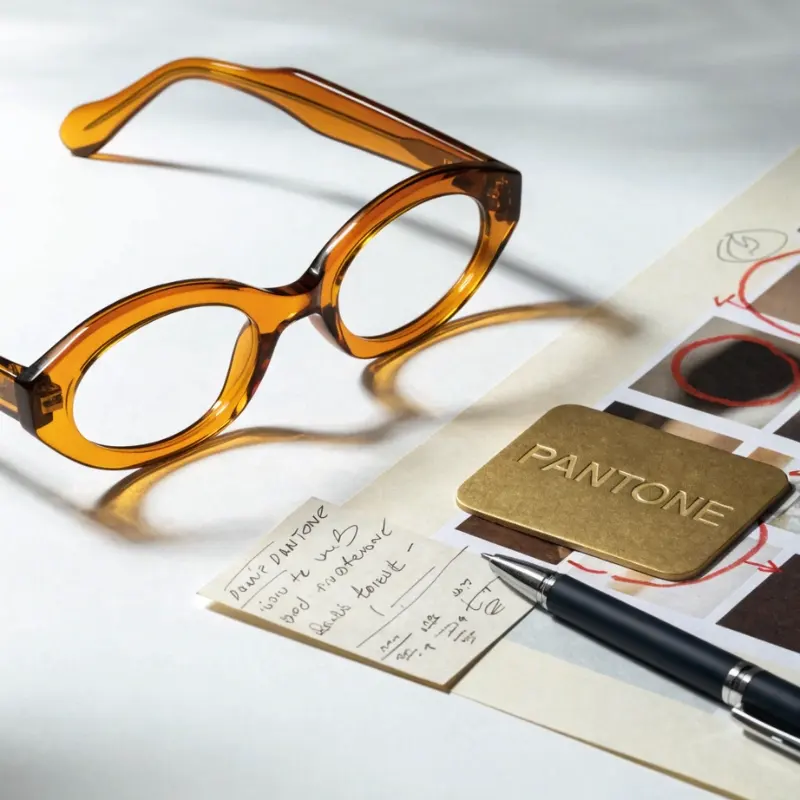
- Pantone code: Use Pantone TCX (textile) for warm colors, Pantone C (coated) for surface colors. Note that Pantone-to-acetate matching is approximate — use as a direction, not an exact target
- Physical swatch: A physical material sample (fabric, paint chip, existing product) shipped to your manufacturer
- Reference frame: An existing acetate frame that matches your target color — the most useful reference for acetate-to-acetate matching
A note on image references: Photos are the most common starting point for custom color development — most brands begin with an image rather than a catalog code. The limitation is that screen color reproduction varies, and what looks like a specific shade on your monitor may appear differently on your manufacturer’s screen. For best results, send the highest resolution image available, describe the color in words alongside the image (“warm amber with brown undertones, semi-transparent”), and confirm the color direction with a physical swatch before committing to bulk production.
Element 2: Color family description
One sentence describing what kind of color this is: “warm amber tortoiseshell, medium density, more amber than brown” or “transparent navy blue, high clarity, similar to deep water” or “matte sage green solid, no pattern.”
This description gives your manufacturer context for catalog selection and helps catch misunderstandings before samples are cut.
Element 3: Acceptable variation
Color reproduction in acetate is not perfectly precise across production batches. Specify your tolerance:
- Tight: “Match must be within one shade of reference — reject if noticeably different”
- Medium: “General color family is correct — minor variation in depth or saturation acceptable”
- Open: “Inspired by this reference — some interpretation acceptable”
Element 4: Finish specification
- High gloss (default for most fashion acetate)
- Matte (specify matte if required — it affects the polishing process)
- Satin (between gloss and matte — less common but achievable)
Element 5: Exclusivity requirement
If you are selecting a standard catalog color: “This color is not required to be exclusive — standard production run commitment only.”
If you are developing a custom color or selecting a distinctive pattern: “We require a written exclusivity commitment that this specific colorway will not be produced for other clients during our business relationship.”
Note: exclusivity applies to genuinely distinctive combinations. Standard catalog solid colors — black, clear, standard tortoiseshell — cannot be made exclusive because they exist independently of your brand.
Color Brief Template
Use this as a starting point for any acetate color brief:
ACETATE COLOR BRIEF
Brand: [Your brand name] Style: [Frame style name or code] Date: [Brief date]
Primary color reference: ☐ Supplier catalog code: _______________ ☐ Reference image: ☐ Attached (annotated — area to match clearly marked) ☐ Pantone reference: _______________ (TCX / C / U) ☐ Physical swatch enclosed: ☐ Yes ☐ No ☐ Reference frame: ☐ Enclosed ☐ Photo attached
Color family description: [One sentence: e.g. “Warm tortoiseshell, medium density, more amber than brown, semi-transparent”]
Finish: ☐ High gloss ☐ Matte ☐ Satin
Acceptable variation: ☐ Tight (close match required) ☐ Medium (general family correct, minor variation acceptable) ☐ Open (direction only, interpretation acceptable)
Exclusivity required: ☐ No (standard catalog color) ☐ Yes — please confirm in writing
Additional notes: [Any specific requirements: “Avoid green undertones,” “Pattern should be tighter than reference,” “Must photograph well on white background,” etc.]
Send this brief with your sampling request. A manufacturer that reviews it and comes back with questions is a good sign — it means they’re reading it carefully. A manufacturer that accepts a vague brief without questions is a risk.
Lead Times and MOQ by Color Type
Understanding the timeline implications of your color choice is essential for collection planning.
The single biggest timeline variable in acetate production is not the frame manufacturing — it’s the sheet procurement. Standard catalog colors from domestic suppliers can be ready in 7–20 days. Mazzucchelli standard colors take 15–45 days. Custom-developed colors take 60–90 days. If your launch date is fixed, your color choice determines whether your timeline is achievable.
| Color Type | Sheet Lead Time | MOQ per Colorway | Notes |
|---|---|---|---|
| Domestic standard catalog | 7–20 days | Varies — some colors have no sheet MOQ, others do. Confirm with supplier | Most common choice for mid-range brands |
| Mazzucchelli standard catalog | 15–45 days | Varies — confirm with supplier | Premium positioning, Italian provenance |
| Mazzucchelli custom development | 60–90 days | 300–500+ pcs | New color formulation required |
| Japanese acetate standard | 15–30 days | Varies — confirm with supplier | Known for transparency and clarity |
Note: these are sheet procurement times only. Total production time (50–60 working days for domestic acetate) runs after sheet procurement is complete. For project planning, add sheet procurement time to total production time, then add sampling rounds (10–20 days each) and shipping.
This is part of our complete guide to custom acetate sunglasses manufacturing. If you want to discuss color options for your next collection — including physical swatch review and catalog access — we respond within 4 business hours.
Conclusion
Custom color acetate sunglasses are one of the most powerful brand differentiation tools available to eyewear brands. The acetate color system — structured around supplier catalog codes, physical swatches, and clearly defined brief elements — is designed to get your color right with minimal sampling loops. The brands that get color right consistently are the ones that invest in the brief, not the ones that describe color in words and hope for the best.
Frequently Asked Questions
Can I get a completely custom color made for my acetate sunglasses?
Yes, but custom color development is different from selecting a standard catalog color. True custom development — a new color formulated specifically for your brand — requires 60–90 days for sheet development and higher minimums. Most brands achieve their color goals by selecting from existing supplier catalogs, which contain thousands of options. Ask your manufacturer whether your target color exists in their supplier’s catalog before committing to custom development.
How do I communicate my color to a manufacturer?
The most effective reference is a supplier catalog code — it’s unambiguous and directly actionable. If you don’t have a code, use a Pantone reference (approximate), a physical swatch, or an existing acetate frame as a reference. Always follow up with a written color brief that specifies the color family, finish, acceptable variation, and any exclusivity requirements.
What is the MOQ for custom color acetate sunglasses?
Frame production MOQ is typically 300 pieces per style, with a minimum of 100 pieces per colorway within that style — driven by mold economics and CNC machining efficiency. For sheet MOQ: standard catalog colors vary by supplier and color — some have no minimum sheet quantity, others do. Confirm directly with your manufacturer before finalizing your color selection. For custom-developed colors, minimum quantities are higher — typically 300–500+ pieces — to justify the color development run at the supplier level. Packaging MOQ is separate and typically 500–1,000 pieces.
Can acetate match a Pantone color exactly?
Not exactly. Pantone-to-acetate matching is approximate — acetate has its own color language and behavior. Pantone is a useful direction reference, but you should expect some variation between the Pantone chip and the finished acetate frame. Physical swatch review against your reference, and a pre-production color approval step, are the practical safeguards.
How long does it take to develop a new acetate colorway?
For standard catalog colors: sheet procurement is 7–45 days depending on supplier, then 50–60 working days total production. For custom-developed colors: 60–90 days for sheet development alone, plus production time. Total project timeline from color decision to finished bulk shipment typically runs 3–5 months for standard colors, 5–7 months for custom-developed colors.
Can I make my acetate color exclusive to my brand?
Yes, with important limits. Colors or patterns that were developed specifically for your brand can be made exclusive through a written exclusivity agreement. Standard catalog colors — particularly common colors like black, clear, or standard tortoiseshell that exist independently of your brand — cannot be made exclusively yours, as they are available to any buyer from the same supplier. Genuinely distinctive catalog colors can carry an exclusivity commitment for the duration of your business relationship.
What’s the difference between a matte and gloss acetate finish?
The finish is determined by the polishing process, not the sheet color. Any acetate color can be produced in gloss (high shine, standard finish) or matte (no shine, achieved by adjusting the tumbling and polishing stages). Specify your finish in your color brief — matte finish takes slightly longer in production and may affect the perceived depth of the color.
Why does acetate color look different after polishing?
Raw acetate sheets appear slightly different from polished finished frames — colors typically appear richer and deeper after the polishing process, and transparency can increase. When reviewing color swatches, ask your manufacturer for a polished reference if possible, as this gives a more accurate preview of the finished product. Always do a pre-production color approval on a polished sample before bulk production begins.
Let's get started!
Get in touch with a custom eyewear specialist now for a free consultation and instant price quote.
WHATSAPP ME GO!
📱 Scan with your phone to start chatting