Acetate vs Plastic Sunglasses: Which Material Is Right for Your Brand?
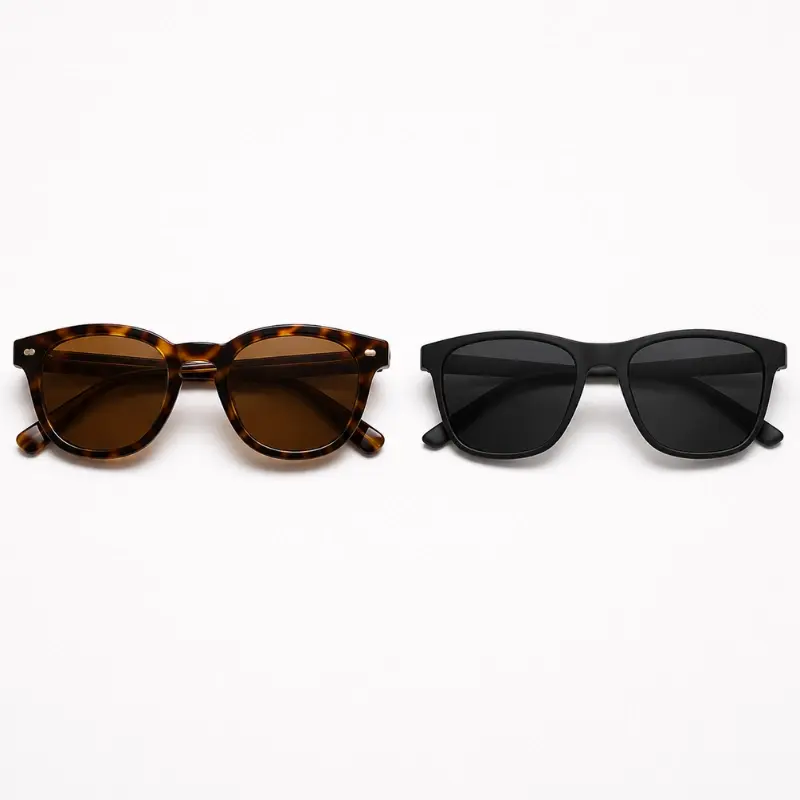
Your manufacturer gives you a quote for acetate. It’s higher than TR90. You wonder if the difference is worth it.
The answer isn’t about the material itself — it’s about what material your brand needs to say. Acetate and plastic sunglasses aren’t competing on quality alone. They’re competing on brand signal, sales channel fit, customer expectations, and margin structure. Choosing the wrong material doesn’t just affect your product — it affects how your entire brand is perceived.
We produce both acetate and injection-molded frames across a wide range of brand projects. Here’s the comparison that actually helps you decide.
The Materials on the Table: What You’re Actually Choosing Between
“Plastic” in eyewear isn’t one thing. Before comparing, it’s worth being precise.
When brands say “plastic sunglasses,” they typically mean one of three injection-molded materials: polycarbonate (PC), TR90 (a flexible nylon-based thermoplastic), or standard nylon. Each has different properties. Acetate is in a separate category — it’s technically a plastic, but its manufacturing process (cut from layered sheets rather than injection molded) gives it fundamentally different visual and tactile properties.
Here’s a quick orientation across all four materials:
| Material | Type | Production Method | Key Characteristic |
|---|---|---|---|
| Acetate | Sheet-cut bioplastic | CNC cut from layered sheets | Color depth, surface richness, adjustability |
| Polycarbonate (PC) | Injection plastic | Molded from liquid plastic | Impact resistance, optical clarity for lenses |
| TR90 | Injection thermoplastic | Injection molded | Lightweight, flexible, impact resistant |
| Nylon | Injection thermoplastic | Injection molded | Flexible, durable, good for sports |
The rest of this guide compares acetate against injection-molded plastics as a group — with specific notes on PC and TR90 where the differences are meaningful for brand decisions.
Material as Brand Signal: What Your Frame Says Before Anyone Reads the Label
This is the comparison most guides skip — and it’s the one that matters most for brand strategy.
Every frame material communicates something to the customer who picks it up. Acetate communicates craft, premium positioning, and considered design. TR90 communicates performance, lightness, and value efficiency. Polycarbonate communicates functional durability. None of these signals is wrong — but each one either reinforces or contradicts your brand’s price point and positioning. Mismatching material signal and brand positioning is one of the most common and costly mistakes in eyewear brand development.
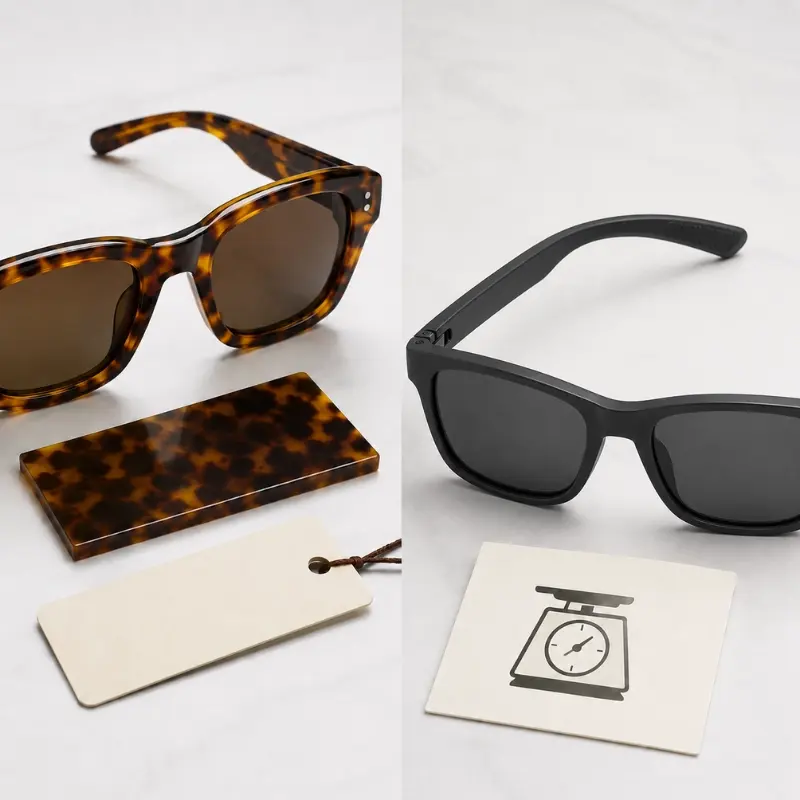
Here’s what each material communicates in practice:
Acetate: “This was made with intention”
When a customer picks up an acetate frame, they notice:
- The weight — slightly heavier than TR90, which reads as substantial, not cheap
- The surface — high-gloss polished, warm to the touch, visually deep
- The color — pattern runs through the material, not printed on it
- The hinge movement — smooth, precise, with a quality feel
These cues, together, communicate a product that was made carefully. They create the sensory conditions for the customer to believe the price is justified.
For brands selling at $50+ retail, in fashion boutiques, optical stores, or premium e-commerce with photography that showcases the frame’s texture and color — acetate’s sensory signals directly support conversion and reduce returns.
TR90 and Nylon: “This was engineered to perform”
TR90 and nylon communicate a different set of values:
- Lightness — frames that weigh almost nothing signal functionality and all-day comfort
- Flexibility — frames that bend without breaking signal durability and practical intelligence
- Color uniformity — clean, consistent color reads as modern and precise
These signals are exactly right for sports, outdoor, kids, and active lifestyle categories. They’re also appropriate for high-volume fashion brands who compete on value rather than perceived craft.
The mismatch problem: a brand positioning at $80–$120 retail with TR90 frames faces an uphill battle. The product doesn’t feel worth $80. The visual depth isn’t there. The sensory experience on unboxing doesn’t confirm the price. This creates return pressure and negative reviews that erode the brand positioning over time.
Polycarbonate: “This is functional and accessible”
PC frames communicate the clearest price signal: entry-level. PC’s surface sheen reads as mass-produced to most buyers. At the right price point ($15–$40 retail), this is appropriate and honest. At mid-range price points, it creates a credibility gap.
The bottom line on material signal: before you choose a material, ask: “What does this frame feel like in the hand, and does that feeling match what my brand is asking customers to pay?”
Acetate vs Polycarbonate: The Direct Comparison
Polycarbonate is the most common entry-level frame material. Understanding exactly where it falls short helps brands know when to step up.
Polycarbonate is an impact-resistant, optically clear, injection-molded plastic used widely in entry-level sunglasses and safety eyewear. It’s lightweight, inexpensive to produce, and dimensionally stable. What it cannot do is deliver the color richness, surface quality, or tactile premium of acetate — and at mid-range price points, this gap is exactly what customers notice.
| Factor | Acetate | Polycarbonate |
|---|---|---|
| Color depth | Pattern through full thickness | Uniform surface color only |
| Surface finish | High-gloss through polishing | Moderate gloss, injection finish |
| Tactile quality | Warm, substantial, premium feel | Lighter, harder, functional feel |
| Adjustability | Heat-adjustable | Not adjustable |
| Hypoallergenic | Yes | Generally yes |
| Weight | Moderate | Light |
| Impact resistance | Good | Excellent |
| EXW unit cost | $6–$18 (domestic acetate) | $2–$8 |
| MOQ | 300 pcs/style/color | 1,200+ pcs/style |
| Best positioning | $40–$150+ retail | $15–$45 retail |
The MOQ difference is significant for first-time brand buyers. Acetate’s lower entry quantity (300 vs 1,200+) means brands can test new styles without committing to large inventory. PC’s economics only improve at high volume — and for custom PC designs, a mold tooling fee applies on top of per-unit cost.
Acetate vs TR90: The Most Common Brand Decision
TR90 is where most mid-range brands face their real choice — because TR90 is genuinely good, and the price gap with acetate is real.
TR90 is a flexible thermoplastic nylon known for its extremely light weight, rubber-like flexibility, and impact resistance. It’s the material of choice for sports eyewear, kids’ frames, and outdoor brands. It’s also increasingly used by fashion brands looking to reduce per-unit cost. The question for brand builders is not whether TR90 is a good material — it clearly is. The question is whether TR90’s sensory properties support the brand experience you’re trying to build.
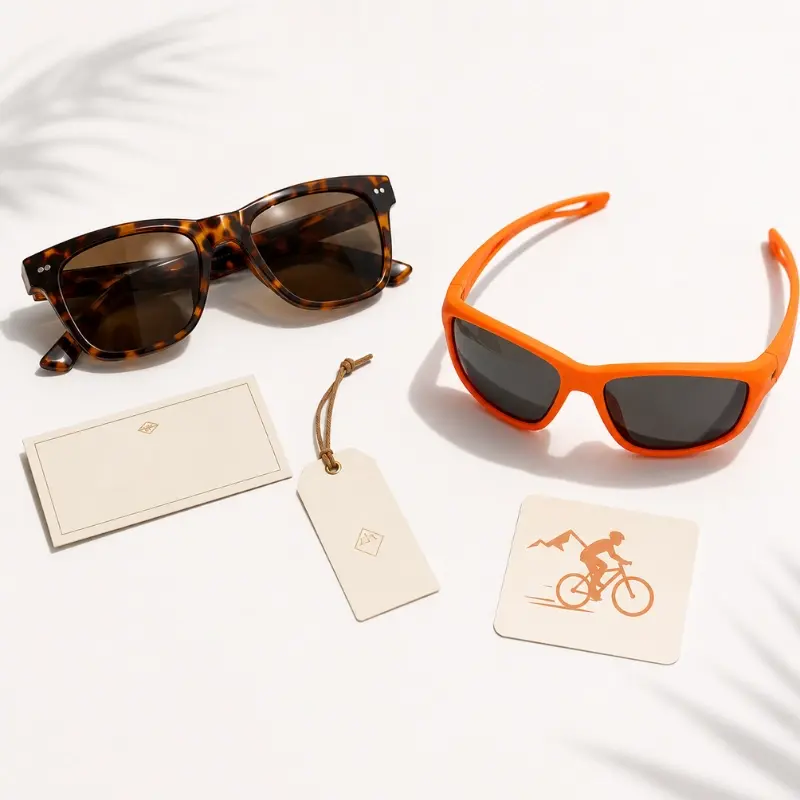
Where TR90 wins:
- Weight: TR90 frames can be 30–40% lighter than comparable acetate frames. For brands where all-day comfort is a primary selling point, this is a real advantage.
- Flexibility: TR90 bends without breaking. For kids’ eyewear, sports frames, and active lifestyle brands, this durability advantage is directly meaningful.
- Cost efficiency: TR90’s lower EXW cost ($2–$12) allows brands to deliver a visually acceptable product at lower retail price points.
- Color uniformity: For brands that want clean, consistent single colors rather than patterned effects, TR90 delivers precise, repeatable color.
Where acetate wins:
- Color complexity: Tortoiseshell, gradient, transparent, multi-layer patterns — these are structurally impossible in injection-molded TR90. If your brand identity depends on color and pattern differentiation, TR90 cannot deliver it.
- Surface quality: TR90’s injection finish, even when polished, reads differently from acetate’s tumble-polished surface. Side by side at the same retail price, the acetate frame will consistently be perceived as higher quality.
- Brand positioning ceiling: TR90 has a practical retail price ceiling of around $60–$80 before the material-price mismatch becomes a customer perception problem. Acetate can credibly support $150+ retail.
- Boutique retail: Buyers and store managers in premium optical and fashion boutiques know the difference between acetate and injection plastic by touch. A TR90 frame presented to a premium boutique buyer will face harder sell-in conversations than an acetate frame at the same price point.
The honest summary: if your brand is building at $50+ retail, in fashion or optical channels, with color and pattern as part of your visual identity — acetate is the right material. If your brand is building for active use, kids, sports, or high-volume fashion at $20–$50 retail — TR90 is appropriate and economically superior.
Acetate vs Nylon: When Flexibility Is the Priority
Nylon as a frame material sits close to TR90 but has some distinct use cases worth understanding.
Nylon eyewear frames offer a combination of flexibility, lightness, and chemical resistance that makes them particularly suited to sports and outdoor applications. Nylon frames can withstand perspiration, temperature extremes, and physical stress better than most other materials. For brands building in the active outdoor, cycling, running, or water sports space, nylon is a serious material choice.
The comparison with acetate is straightforward: nylon wins on performance and durability in high-stress environments; acetate wins on aesthetics, color complexity, and premium positioning in fashion and lifestyle contexts.
Where nylon makes sense over acetate:
- Sports eyewear brands where frame survival under physical stress is a core product promise
- Outdoor and adventure brands where chemical resistance (sunscreen, perspiration, salt water) matters
- Kids’ eyewear lines where bending and dropping are expected
Where acetate is clearly superior:
- Any fashion, lifestyle, or optical brand where the frame’s visual and tactile quality is part of the value proposition
- Brands selling through boutique, optical, or premium retail channels
How Your Sales Channel Should Drive Your Material Choice
The same frame in two different materials can succeed or fail based entirely on where it’s sold. Channel matters as much as category.
The fundamental difference between retail channels is whether your customer touches the product before buying. In physical retail, the frame’s tactile and visual properties are experienced directly. In e-commerce, they’re filtered through photography, copy, and reviews. This distinction drives different material requirements for the same brand.
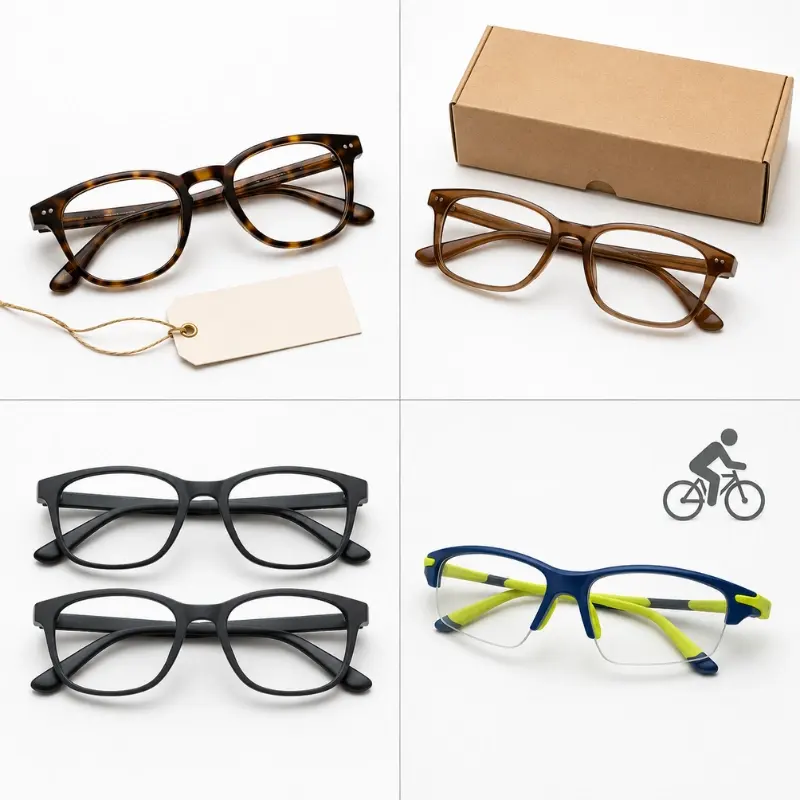
Boutique and premium retail: acetate is almost always right
In boutique optical shops, independent eyewear retailers, and premium fashion stores, buyers and end customers touch every frame. Acetate’s weight, surface quality, and color depth are experienced directly and compared against competing frames on the same shelf. A TR90 frame in this environment, even at the same price, will be perceived as lower quality by buyers who handle eyewear professionally.
For boutique sell-in conversations, acetate frames carry significantly more credibility. Buyers at independent optical stores know the material difference by touch and by reputation. Presenting acetate is presenting a product that fits the context.
E-commerce: acetate still wins, but TR90 is more competitive
In e-commerce, customers can’t touch the product. They judge on photography and reviews. Acetate’s visual advantages photograph well — color depth, surface reflection, pattern richness all translate to screen. But TR90’s weight and flexibility advantages show up in reviews (“incredibly lightweight,” “survived dropping it twice”) in ways that drive positive ratings.
For e-commerce brands competing at $30–$60 retail, TR90 can be the right call — especially if weight and durability are prominent selling points. For e-commerce brands at $60+ retail where photography quality and brand story are the primary conversion drivers, acetate’s visual superiority in photos is a real asset.
Wholesale and mass retail: cost efficiency drives the decision
In wholesale accounts or mass retail placements where price point is the primary selection criterion, injection plastic wins on economics. TR90 or PC at 1,200-unit MOQ and $2–$12 EXW allows the margin structure that wholesale channels typically require.
The exception: specialty wholesale into premium optical chains, where acetate’s material credibility is again a sell-in advantage.
Sports and active lifestyle: injection materials are the standard
For sports-specific collections — cycling, running, water sports, outdoor adventure — TR90 and nylon are the appropriate materials. Acetate’s advantages (color depth, polished surface) are irrelevant in contexts where impact resistance, weight, and chemical durability are what customers care about. Sports buyers know this, and a beautifully made acetate frame in a sports context reads as impractical rather than premium.
The Multi-Material Brand Strategy: Using Both Deliberately
Most guides treat this as an either/or decision. For growing brands, it shouldn’t be.
Many successful eyewear brands use both acetate and injection plastic deliberately — with acetate anchoring the core collection at premium pricing and TR90 or PC extending the line into accessible price points. This strategy lets a single brand serve multiple customer segments without diluting the core brand positioning. The key is sequencing: establish the brand’s identity at acetate level first, then extend down.
Here’s how a multi-material brand strategy typically works:
Phase 1: Establish with acetate
Launch your core collection in acetate. This sets the brand’s quality standard, its visual identity, and its credibility in premium retail channels. Acetate frames in two to three colorways, at 300-unit MOQ per colorway, is a manageable first collection that positions the brand correctly.
At this stage, every customer who touches your product, every retail buyer who considers stocking it, and every reviewer who writes about it is evaluating your brand at acetate quality. This builds brand equity.
Phase 2: Extend with TR90 or PC strategically
Once the brand’s premium identity is established, introduce TR90 or PC styles at a lower price point — framed explicitly as a different tier within the brand. This can be a “sport” or “essential” or “everyday” sub-line that trades on the core brand’s equity while serving price-sensitive customers.
The rules for this to work:
- The extension must be clearly positioned as a different tier — not the same tier at lower quality
- The acetate collection must remain the hero — visually dominant in brand communication
- The injection plastic frames should not compete directly with the acetate frames in the same retail environment
Why this works commercially
A brand with both acetate and TR90 collections can serve boutique retail accounts (acetate only), mass market or online accounts (TR90), and sports specialty accounts (TR90 or nylon) — covering a wider distribution footprint without compromising any single channel’s quality expectations.
The risk to avoid: launching TR90 first and trying to “trade up” to acetate later. It’s very hard to upgrade the market’s perception of a brand’s quality level once it’s been established at injection plastic. The sequence matters — establish premium first, extend accessible second.
This is part of our complete guide to custom acetate sunglasses manufacturing. If you want to discuss which material — or which combination — fits your brand’s price point, channel strategy, and collection plan, we respond within 4 business hours.
Quick Decision Guide: Which Material for Your Brand?
Use this reference before briefing any manufacturer:
| Your situation | Recommended material |
|---|---|
| Fashion brand, $50–$150 retail, boutique or optical channel | Acetate |
| Lifestyle brand, $40–$100 retail, e-commerce primary | Acetate (photography advantage) |
| Sports or outdoor brand, any price point | TR90 or nylon |
| Kids’ eyewear line | TR90 (flexibility and durability) |
| Entry-level or volume brand, $15–$40 retail | PC or TR90 |
| Wholesale or mass retail, cost-driven | PC or TR90 |
| Premium brand extending to accessible tier | Acetate core + TR90 extension |
| First collection, testing the market | Acetate at 300 MOQ (lower entry risk) |
Conclusion
Acetate and plastic sunglasses are not competing on quality in a vacuum — they’re competing for fit with your brand’s positioning, channel, and customer. Acetate signals craft and supports premium pricing in fashion and optical retail. TR90 signals performance and supports cost efficiency in sports, kids, and value-driven channels. PC serves entry-level volume. The strongest eyewear brands choose their primary material deliberately — and many use both, with acetate anchoring brand identity and injection plastic extending accessible reach.
Frequently Asked Questions
Is acetate better than plastic for sunglasses?
For brands positioning at $50+ retail in fashion, optical, or lifestyle channels, acetate delivers better brand signal, higher retail pricing support, and stronger customer perception than injection plastic. For sports, kids, or value-focused brands at $15–$50 retail, TR90 or PC injection frames are more appropriate — both materially and economically.
What is the difference between acetate and TR90 sunglasses frames?
Acetate is cut from layered cellulose sheets, giving it color depth, pattern complexity, and a premium surface feel. TR90 is injection-molded from a flexible nylon material, making it lighter, more flexible, and more impact-resistant. Acetate suits fashion, optical, and premium lifestyle positioning. TR90 suits sports, kids, outdoor, and value-focused channels.
What is the difference between acetate and polycarbonate sunglasses?
Polycarbonate is an entry-level injection plastic used in mass-market and functional eyewear. It has good impact resistance but limited color depth and a functional surface feel. Acetate has significantly richer color, better surface quality, and supports higher retail pricing. MOQ for custom PC frames (1,200+ pieces) is also higher than acetate (300 pieces per style per colorway).
Which sunglasses material is best for boutique retail?
Acetate. Boutique retail buyers and their customers evaluate frames by touch. Acetate’s weight, surface quality, and color depth are directly experienced and compared with competing products on the same shelf. A TR90 frame at the same price will consistently be perceived as lower quality in a boutique context.
Can a brand use both acetate and plastic sunglasses?
Yes — and many successful eyewear brands do. The recommended approach is to establish the core brand identity with acetate first, then extend into TR90 or PC for accessible price tiers once the brand’s premium positioning is established. Launching injection plastic first and trying to move upmarket later is significantly harder.
What is the MOQ difference between acetate and injection plastic frames?
Acetate sunglasses typically start at 300 pieces per style per colorway — lower than injection-molded frames, which typically require 1,200+ pieces per style. For custom injection designs, a one-time mold tooling fee also applies. For first-time brand buyers, acetate’s lower MOQ entry point is an advantage for testing new styles without large inventory commitment.
Which sunglasses material is best for e-commerce brands?
At $60+ retail, acetate’s visual depth and surface quality photograph well and support strong brand storytelling. At $30–$60 retail, TR90 can compete effectively, especially if weight and durability are key selling points that generate positive reviews. The choice depends on your price point and how much your brand differentiation depends on visual product quality.
What sunglasses material is right for a sports brand?
TR90 or nylon. Sports applications require light weight, flexibility, impact resistance, and chemical durability (perspiration, sunscreen, temperature). Acetate’s advantages — color depth, polished surface — are not relevant purchasing criteria for sports buyers. TR90 and nylon are the industry standard for sports eyewear for good reason.
Let's get started!
Get in touch with a custom eyewear specialist now for a free consultation and instant price quote.
WHATSAPP ME GO!
📱 Scan with your phone to start chatting