What Is Acetate? Why Top Eyewear Brands Choose It Over Plastic
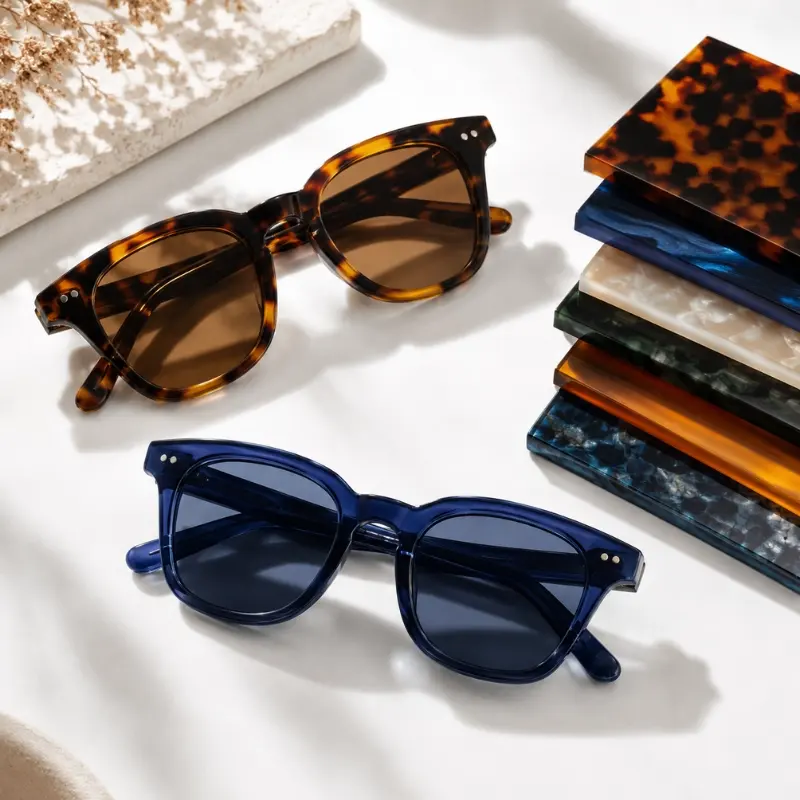
You’re sourcing frames for your brand. Every supplier says “acetate.” But what exactly is it — and why does it cost more than plastic?
Acetate is the material that separates premium eyewear from commodity product. It’s a plant-based bioplastic with properties that injection-molded plastic simply cannot replicate: color depth, surface richness, adjustability, and a tactile quality that customers feel the moment they pick up the frame. For brands selling above $40 retail, acetate is not a luxury — it’s a business decision.
This guide explains what acetate is, how it’s made, what makes it different from standard plastic, and — most importantly — why the brands that know eyewear choose it for the majority of their product line.
What Is Cellulose Acetate? The Material Explained
Cellulose acetate is not a synthetic petroleum plastic. That distinction matters.
Cellulose acetate is a semi-synthetic bioplastic derived from natural plant fibers — primarily cotton linters and wood pulp. The cellulose is chemically treated with acetic acid to produce acetate flakes, which are then dissolved, extruded, and cast into sheets. Those sheets are the raw material for every acetate eyewear frame. Unlike injection-molded plastic, acetate frames are cut from solid sheets — not poured into a mold.
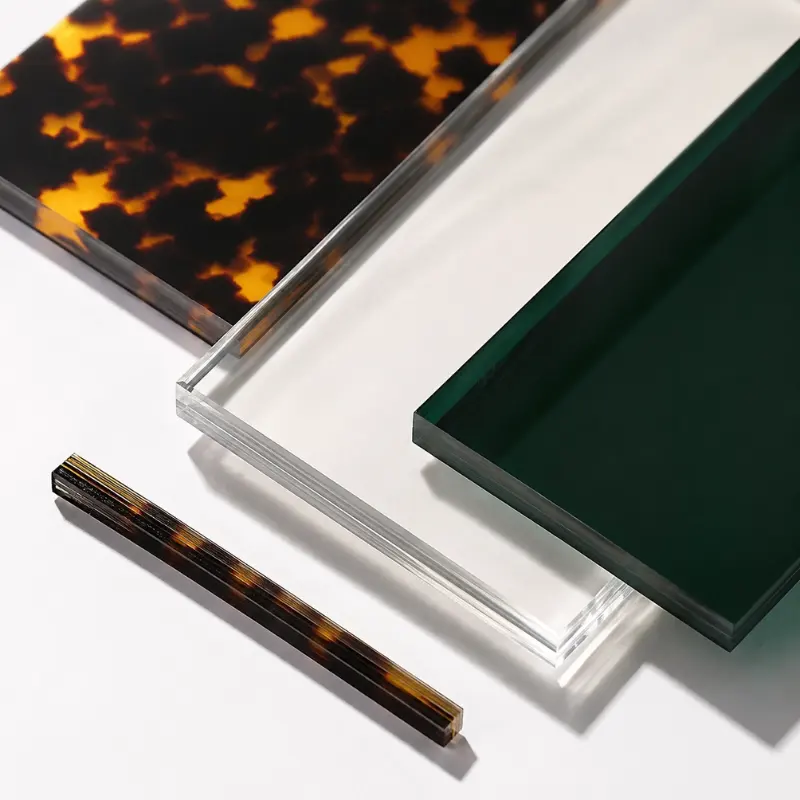
This sheet-cutting process is the foundation of acetate’s key advantages. Because the frame is cut from a solid, layered sheet rather than molded from liquid material, acetate can carry color, pattern, and transparency in three dimensions — through the depth of the material, not just on the surface.
Here’s what that means in practice:
A tortoiseshell acetate frame doesn’t have tortoiseshell printed on it. The pattern runs through the entire thickness of the material. Cut the frame any way, and the pattern is there. Sand the surface, and the pattern is still there. This is structurally impossible with standard injection-molded plastic, where color is applied to the surface or mixed uniformly through a single-color material.
The same principle applies to gradient colors, transparent layers, and multi-tone patterns. All of these are properties of the sheet itself — which means they’re permanent, not surface-applied, and don’t fade or peel.
Key material properties of cellulose acetate
| Property | What It Means for Eyewear |
|---|---|
| Plant-based origin | Cotton and wood pulp, not petroleum — positions as eco-friendlier than standard plastic |
| Sheet construction | Color and pattern run through full material depth — not surface-applied |
| Thermoplastic | Can be heat-adjusted by opticians and manufacturers for a precise fit |
| Hypoallergenic | No nickel or petroleum compounds — suitable for sensitive skin |
| Polishable | High-gloss finish achievable through tumbling and hand-polishing |
| Adjustable | Temples can be bent and re-bent without cracking under professional heat application |
| Durable | More impact-resistant than standard injection plastic at comparable thickness |
How Is Acetate Made Into Eyewear Frames?
The production process for acetate frames is fundamentally different from plastic injection molding — and that difference is why acetate costs more.
Acetate frame production is a multi-stage, largely manual process. Sheets are cut into blanks, shaped by CNC machines, tumbled for days in polishing barrels, hand-finished by workers, and assembled with metal hinges. From raw sheet to finished frame, a quality acetate production run takes significantly longer than injection molding. The labor and time cost is real — and it shows in the product.
Here’s the full process:
Stage 1: Sheet selection
Acetate sheets arrive at the factory in the chosen color, pattern, and thickness (typically 6–8mm for sunglasses fronts, 3–5mm for temples). Sheet selection is a quality decision — the pattern consistency, color saturation, and transparency level of the sheet determines the visual quality of the finished frame.
Stage 2: CNC cutting and shaping
Frame blanks are precision-cut from the sheet using CNC machines programmed to the frame’s technical specifications. The front and temples are cut separately.
Stage 3: Rough tumbling
Cut blanks are loaded into rotating tumbling barrels with abrasive media. This stage removes sharp edges, begins to smooth the surface, and starts developing the acetate’s characteristic sheen. Tumbling runs for hours to days depending on the finish target.
Stage 4: Hinge fitting
Metal hinges — typically stainless steel barrel hinges or spring hinges — are fitted and pressed into the acetate frame front and temple ends. Hinge fitting is a precision step: too loose and the hinge plays; too deep and the frame structure is compromised.
Stage 5: Fine tumbling and polishing
After hinge fitting, frames go back through finer tumbling stages. Final hand-polishing achieves the high-gloss surface finish that distinguishes quality acetate from frames that have been under-processed.
Stage 6: Logo application and assembly
Logo is applied — by laser engraving, hot stamping, or metal inlay — before final assembly. Lenses are cut and fitted. Frame undergoes final QC inspection.
The total production time for a quality acetate frame, from sheet selection to finished product, is typically 3–5 weeks for a production run. This is longer than injection molding, but the output is a product that justifies a premium price point.
Acetate vs Plastic: What’s Actually Different?
This is the question brands ask most often — and the answer matters for your pricing and positioning decisions.
The key difference between acetate and injection-molded plastic is not just material composition — it’s the manufacturing process and what that process makes possible. Acetate frames are cut from layered sheets. Plastic frames are poured into molds. That difference determines everything: color depth, pattern capability, surface finish, adjustability, and how the product communicates quality at the point of sale.
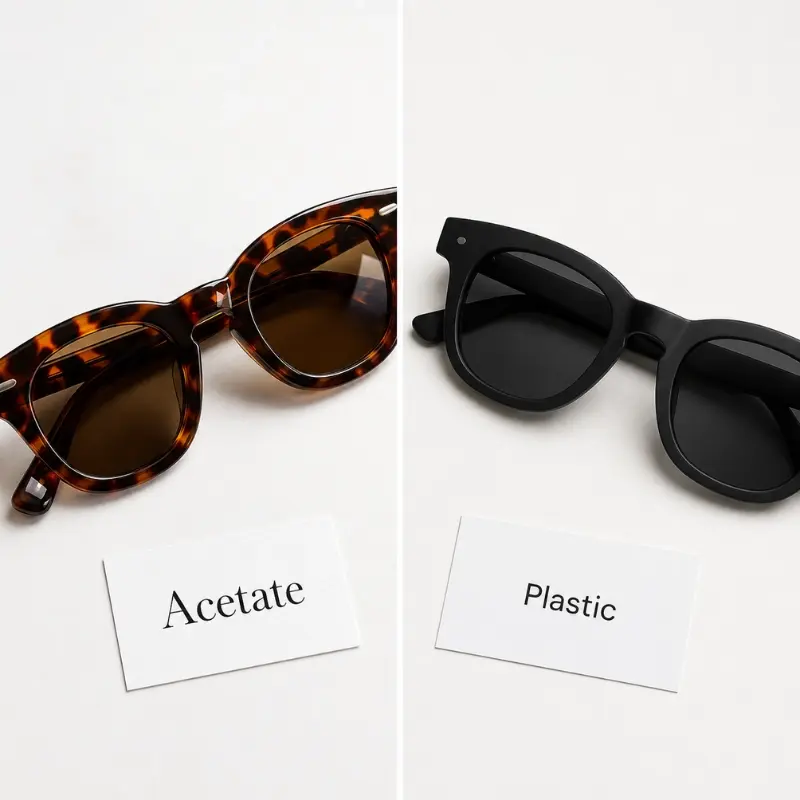
Here’s a direct comparison across the dimensions that matter for brand decisions:
| Factor | Acetate | Injection-Molded Plastic (PC / TR90 / Nylon) |
|---|---|---|
| Color depth | Pattern runs through full material thickness | Color uniform or surface-applied only |
| Pattern capability | Tortoiseshell, gradient, multi-layer, transparent | Single-color or simple two-tone |
| Surface finish | High-gloss through polishing — feels premium | Typically matte or uniform gloss — feels mass-produced |
| Adjustability | Heat-adjustable for custom fit | Mostly non-adjustable once molded |
| Hypoallergenic | Yes — plant-based, no petroleum compounds | Varies — some TR90 is hypoallergenic, most PC is not |
| Weight | Slightly heavier than TR90 / nylon | TR90 and nylon lighter; PC comparable |
| Durability | High impact resistance, stable over time | Good for TR90; standard PC can become brittle |
| Production process | Cut from sheet — longer, more labor | Injection-molded — faster, lower labor cost |
| Per-unit cost | Higher | Lower |
| Retail positioning | Premium to luxury ($50–$300+) | Entry to mid-range ($15–$80) |
| Brand signal | “This is a crafted product” | “This is a manufactured product” |
Here’s the deal: the difference is not just material chemistry. It’s how the product communicates its value to the end customer. An acetate frame, held in the hand, signals quality through its weight, its surface, and the depth of its color in a way that injection plastic cannot replicate. For brands selling to customers who compare products before buying — in boutique retail, in premium e-commerce, at optical chains — this signal translates directly into conversion rate and repeat purchase.
Why Top Eyewear Brands Choose Acetate: The Business Case
This is the part most material guides skip. Acetate isn’t just a material preference — it’s a brand economics decision.
Brands that use acetate for their primary product line consistently report three commercial advantages over brands using injection plastic at similar price points: higher retail margins, lower return rates, and stronger customer reviews. These aren’t soft claims — they’re logical outcomes of what acetate delivers and what customers perceive.
Advantage 1: Higher retail margin per unit
Acetate frames carry a material cost premium over injection plastic — but retail price scales faster than production cost as you move up the quality ladder. A domestic acetate frame produced at $6–$18 EXW per unit (depending on design complexity, hinge type, and color) can retail at $40–$120, achieving a strong markup. An injection plastic frame produced at $2–$12 EXW per unit typically retails at $15–$60. Note that EXW is factory gate price only — freight, duties, warehousing, and operating costs all affect your actual landed margin. Exact pricing depends on the specific project.
Advantage 2: Lower return rates
Returns in eyewear are predominantly driven by two factors: the product didn’t look the way it did in the photo, and the product didn’t feel like it was worth the price when it arrived. Acetate addresses both. The depth and richness of acetate color photographs accurately and delivers what the customer expected. The weight and surface quality of a polished acetate frame confirms the purchase decision when the customer opens the box.
Injection plastic fails more often on the second point. At mid-price points, a plastic frame that cost $12 to make but retails at $60 often doesn’t feel worth $60. The return justification writes itself.
Advantage 3: Stronger customer reviews and repeat purchase
Review language for acetate eyewear consistently includes words like “quality,” “premium,” “well-made,” and “worth it.” Review language for injection plastic at the same price point more often includes “lightweight” — which is a positive — but also “cheap-feeling,” “fragile,” and “not what I expected.”
Customer review quality directly affects conversion rate for online brands and reorder behavior for wholesale buyers. Acetate’s tactile advantages generate better reviews, which compound into better conversion over time.
The bottom line: if you’re building a brand at $50+ retail, acetate is not an added cost — it’s a margin investment that pays back through pricing power, lower returns, and better reviews.
Acetate Sheet Suppliers: Why It Matters Which One Your Manufacturer Uses
Not all acetate is the same. The sheet supplier your manufacturer uses affects your finished product’s color quality, durability, and — in some markets — brand perception.
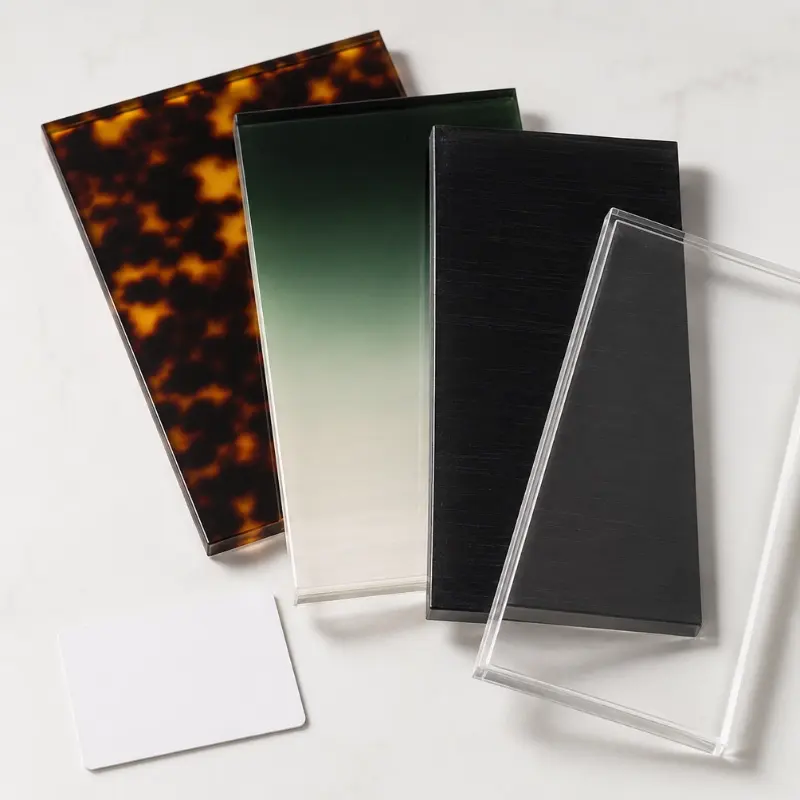
The three primary sources for quality acetate sheets used in premium eyewear are Italian (Mazzucchelli), Japanese (Toray, Takiron), and Chinese domestic manufacturers. Each has different quality characteristics and cost profiles. For B2B brands, understanding the difference helps you make an informed procurement decision — not just accept whatever the factory uses by default.
Mazzucchelli (Italy) — the benchmark for color richness
Mazzucchelli is the most recognized name in premium acetate sheet production. Founded in 1849, they produce acetate sheets using a block casting process that achieves exceptional color depth — particularly in their tortoiseshell and havana patterns, which have a richness and three-dimensionality that is hard to replicate with other materials.
Mazzucchelli acetate is the standard material for high-end European and American eyewear brands. Brands like Cutler & Gross, Oliver Peoples, and Moscot use or have used Mazzucchelli sheets. The brand recognition of the material itself is a selling point in premium optical retail.
When to specify Mazzucchelli: when you’re positioning at $120+ retail and selling into optical boutiques or premium fashion retail where material provenance matters to buyers. The premium over domestic acetate runs approximately 30–50% on material cost per frame — meaningful at lower price points, manageable at premium positioning.
Japanese acetate (Toray, Takiron) — known for transparency and clarity
Japanese acetate suppliers are recognized for their color consistency and exceptional transparency in clear and light-tinted frames. The manufacturing precision of Japanese sheet production results in fewer visual inclusions and more consistent optical clarity across a production run.
When to specify Japanese acetate: when your product line emphasizes transparent, crystal-clear, or light-tinted frames where visual purity of the material is a priority. Also strong for optical frame applications where prescription lens fitting requires precise, stable material.
Chinese domestic acetate — the practical choice for most brands
Chinese domestic acetate suppliers have improved significantly over the past decade. For most brand color selections — solid colors, standard tortoiseshell, gradient effects — domestic acetate delivers visually indistinguishable results from Italian material at 30–50% lower sheet cost.
When domestic acetate is the right call: for brands positioning at $40–$100 retail, for production runs where the cost differential is meaningful to your margin structure, and for color profiles that don’t rely on the specific richness characteristics of Mazzucchelli block acetate. The majority of successfully selling mid-range acetate brands globally use domestic Chinese acetate sheets — and their customers don’t know, and don’t need to know.
The honest answer for most brands: specify Mazzucchelli or Japanese acetate if you’re entering optical boutiques or premium fashion retail above $120, or if material provenance is a legitimate brand story you want to tell. Use domestic acetate for everything else — and invest the cost saving in better lens quality, packaging, or marketing.
Acetate Is Not Always Expensive: Correcting a Common Misconception
Many brands avoid acetate because they assume it’s out of their budget. This assumption is worth challenging directly.
Acetate is more expensive than injection plastic — but it is not inherently out of reach for mid-range brands. The actual cost difference between a domestic acetate frame and a TR90 or PC injection frame at comparable quality levels is often $5–$10 per unit. At mid-range retail prices ($50–$100), that cost difference translates into a retail price premium of $15–$30 that acetate consistently supports. The economics work in acetate’s favor at almost any price point above $40 retail.
Here’s a reference for EXW unit cost by material type. Note that EXW cost is the factory gate price only — landed cost will be higher after freight, duties, and logistics. Retail margin calculations should be based on your full landed cost, not EXW alone. MOQ also varies significantly by material: acetate typically starts at 300 pieces per style per colorway, while injection-molded frames (PC, TR90) typically require 1,200 pieces or more per style. For custom injection designs, a one-time mold tooling fee applies on top of the per-unit cost.
| Frame Type | Typical EXW Unit Cost | Typical MOQ | Suggested Retail Range |
|---|---|---|---|
| Domestic acetate, standard color | $6–$18 | 300 pcs/style/color | $40–$120 |
| TR90 injection, standard color | $2–$12 | 1,200+ pcs/style | $15–$60 |
| PC injection, basic | $2–$8 | 1,200+ pcs/style | $15–$45 |
| Mazzucchelli acetate | $13–$40 | 300 pcs/style/color | $80–$250 |
The key point is not the margin percentage — it’s that acetate supports a meaningfully higher retail price relative to its EXW cost. The dollar spread between production cost and retail price is wider for acetate than for injection plastic, which is why brands building at mid-to-premium price points consistently choose it.
The margin percentages are similar across materials — but acetate supports a higher retail price per unit, which means more room to absorb landed costs (freight, duties, warehousing, returns) while still maintaining a healthy margin. That’s the economic case for acetate at mid-to-premium price points.
You might be wondering: what’s the right entry point for acetate? For a brand new to the category, domestic acetate at 300 units per style is achievable with a first order investment that varies by project — frame complexity, color, hinge type, and packaging all affect the total. Contact us with your brief and we’ll give you a specific number within 4 business hours. What we can say: the margin structure of acetate supports the investment at almost any mid-range retail price point.
This is part of our complete guide to custom acetate sunglasses manufacturing. If you want to discuss which acetate specification fits your brand’s price point and aesthetic direction, we respond within 4 business hours.
Conclusion
Acetate is a plant-based, sheet-cut bioplastic that delivers color depth, surface richness, and tactile quality that injection-molded plastic cannot replicate. For B2B brands, it’s a material choice that supports higher retail margins, lower return rates, and stronger customer perception. Domestic acetate makes it accessible at mid-range price points. Italian or Japanese acetate makes sense at premium positioning. The question is not whether your brand can afford acetate — it’s whether your brand can afford to position without it.
Frequently Asked Questions
What is acetate in eyewear?
Acetate in eyewear refers to cellulose acetate — a semi-synthetic bioplastic made from plant fibers (cotton and wood pulp). Unlike injection-molded plastic, acetate frames are cut from solid sheets, which allows color and pattern to run through the full depth of the material. This gives acetate its characteristic color richness, surface quality, and adjustability.
What is the difference between acetate and plastic eyewear frames?
The key difference is the manufacturing process. Acetate frames are cut from layered, patterned sheets — so color and pattern are structural, not surface-applied. Injection plastic frames are poured into molds in a single uniform color. Acetate also has a higher-quality surface finish through polishing, is heat-adjustable for fit, and is hypoallergenic. These differences support a premium price point and better customer perception.
Is acetate better than plastic for sunglasses?
For brands positioning above $40 retail, yes. Acetate delivers color depth, surface quality, and tactile richness that injection plastic cannot replicate at comparable price points. For brands positioning at entry-level price points where weight and cost efficiency are the priority, TR90 or PC injection frames may be more appropriate.
What is Mazzucchelli acetate?
Mazzucchelli is an Italian acetate sheet manufacturer founded in 1849. Their block casting process produces acetate sheets with exceptional color depth — particularly in tortoiseshell and havana patterns. Mazzucchelli acetate is the standard material for many premium European and American eyewear brands and commands a material cost premium of approximately 30–50% over domestic Chinese acetate sheets.
Is acetate eyewear eco-friendly?
Relative to petroleum-based plastics, yes. Cellulose acetate is made from natural plant fibers (cotton and wood pulp) rather than petroleum derivatives, making it more renewable and biodegradable than standard plastics. Bio-acetate variants use even more sustainable production processes. For brands selling into markets where sustainability is a procurement criterion, acetate’s plant-based origin is a legitimate positioning advantage.
How much does acetate cost compared to plastic for eyewear production?
EXW unit cost varies by material, design complexity, and order quantity. As a general reference: domestic acetate frames typically run $6–$18 EXW; TR90 injection frames $2–$12; PC frames $2–$8; Mazzucchelli acetate $13–$40. Note that injection-molded frames (PC, TR90) typically require 1,200+ pieces MOQ per style, while acetate starts at 300 pieces per style per colorway. Custom injection designs also require a one-time mold tooling fee. All prices are EXW only — landed cost will be higher after freight, duties, and logistics.
Can acetate sunglasses be adjusted?
Yes — this is one of acetate’s key functional advantages. Because acetate is thermoplastic, it becomes pliable when heated and can be reshaped. Opticians routinely adjust acetate temples and nose bridges for a precise fit. Injection-molded plastic frames typically cannot be adjusted once molded. This adjustability makes acetate frames more suitable for optical and prescription applications as well as sunglass use.
What’s the minimum order for custom acetate sunglasses?
For most private label acetate sunglasses using existing frame molds (ODM), minimum order quantities start at 300 pieces per style per colorway. For fully custom OEM mold development, MOQ is typically 300–500 pieces with an additional one-time tooling fee. Domestic acetate at this volume produces a market-ready product competitive with frames retailing at $60–$120.
Let's get started!
Get in touch with a custom eyewear specialist now for a free consultation and instant price quote.
WHATSAPP ME GO!
📱 Scan with your phone to start chatting