Fashion Brand vs Eyewear Startup: Two Different Paths to Private Label Eyewear

Two brands walk into the same conversation with an eyewear manufacturer. One is a fashion label with 50,000 Instagram followers, an established aesthetic, and a customer base that already buys from them. The other is a founder building an eyewear brand from zero — no existing product, no customer list, no brand recognition yet.
Both want to launch private label eyewear. But what they need from a manufacturer, how they should approach the process, and what success looks like in year one are fundamentally different. Treating these as the same path is one of the most common mistakes brands make when entering eyewear.
We work with both types of brand regularly. Here’s how the paths actually differ — and how to know which one you’re on.
Why the Starting Point Changes Everything
Most private label eyewear guides treat all buyers the same. They don’t differentiate between a brand that already has a customer relationship and one that’s building from zero. That’s a problem.
The single biggest difference between a fashion brand adding eyewear and an eyewear startup isn’t budget, manufacturing model, or product category. It’s brand equity. A fashion brand entering eyewear has something to extend. An eyewear startup has something to build. These are opposite challenges — and they require opposite strategies.
A fashion brand extending into eyewear is asking: “How do I bring my existing identity into a new product category without losing what makes my brand coherent?”
An eyewear startup is asking: “How do I build a brand identity and product simultaneously, from nothing, in a crowded category?”
The manufacturing process is nearly identical. The strategic context is completely different.
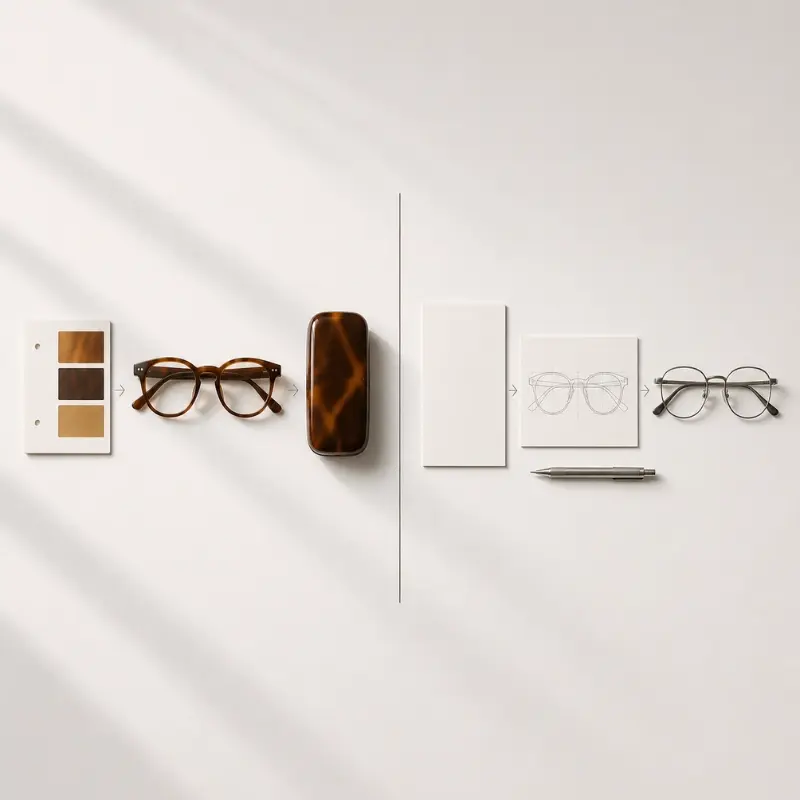
Path One: The Fashion Brand Adding Eyewear
Your advantages — and they’re real
If you already run a fashion, lifestyle, or accessories brand and you’re adding eyewear, you’re starting from a stronger position than you probably realize.
A fashion brand entering eyewear carries four structural advantages that no eyewear startup can replicate: an existing customer base that already trusts the brand, a defined aesthetic that translates directly into a product brief, a pricing architecture that anchors customer expectations, and packaging infrastructure that can be extended to a new category.
Here’s what each of these actually means in practice:
Existing customer base: Your customers already buy from you. They don’t need to be convinced that your brand is worth their money — that work is done. When you launch eyewear, you’re selling a new product to a warm audience, not selling a new brand to strangers. The conversion economics are completely different.
Defined aesthetic: When you brief a manufacturer on a new eyewear collection, your brand’s visual identity is the brief. Your colorways, your material preferences, your price point sensibility — all of this translates directly into frame shape, acetate color, surface finish, and packaging direction. A fashion brand’s brief is half-written before they sit down to write it.
Pricing architecture: Your customers have a reference point for what your brand costs. If you sell accessories at $60–$120 retail, your eyewear at $80–$100 slots in naturally. There’s no need to establish price-value perception from scratch — it’s inherited from your existing product line.
Packaging infrastructure: You already have relationships with packaging suppliers, branded assets, and possibly retail distribution. Your eyewear packaging can extend the same unboxing experience your customers already recognize. This is a significant operational advantage over a brand building these relationships from zero.
Your disadvantages — and they matter
The same brand equity that gives fashion brands their advantage also creates constraints that eyewear startups don’t face.
The biggest risk for a fashion brand entering eyewear is brand dilution. Every new category you add carries the question: does this belong here? A luggage brand adding sunglasses makes intuitive sense. A streetwear brand adding reading glasses might not. When eyewear doesn’t fit the brand’s core identity, it doesn’t just underperform — it creates noise that confuses your existing customers about what your brand stands for.
Other real disadvantages:
Zero eyewear category knowledge: Most fashion brands entering eyewear don’t know what CE marking means, what UV400 compliance requires, what the difference between acetate and TR90 actually is in terms of production cost and lead time, or why a 300-piece MOQ per colorway is structured the way it is. This isn’t a permanent problem — it’s a learning curve — but it’s a real one that slows down first projects.
Risk of diluting brand focus: Every category you add is a category you have to support — with inventory, with marketing, with customer service. Eyewear done well becomes a meaningful revenue line. Eyewear done half-heartedly becomes a distraction that diverts resources from your core business without generating proportional return.
Higher perceived risk for the wrong reasons: Fashion brand buyers sometimes over-invest in eyewear packaging and under-invest in frame quality because packaging is familiar and frame quality assessment isn’t. A beautiful box around a frame that doesn’t hold up to wear damages the brand more than it helps.
When is the right time for a fashion brand to add eyewear?
Add eyewear when your brand has a clear visual identity, a customer base that buys accessories, a retail price point that fits the eyewear category, and the operational bandwidth to support a new product line without compromising your core business. Don’t add eyewear because it seems like a natural extension in theory — add it because your customers are already asking for it, or because you can see a clear adjacency in how they already shop.
The brands that do this well typically start with one hero style in two colorways. Not a full collection. One frame that is unmistakably their brand, executed at the quality level their customers expect. That single frame — if it works — builds the case for a collection. That collection doesn’t need to be launched on day one.
The fashion brand manufacturing path
For a fashion brand entering eyewear, the ODM model is almost always the right starting point. Your brand identity is already defined — the manufacturer’s design team helps you translate it into a manufacturable frame shape, not build an identity from scratch.
Your brief arrives almost pre-written: color palette (from your existing brand guide), aesthetic direction (from your existing product line), target customer (already defined), price point (already established), packaging direction (already aligned with your brand identity).
What you need from a manufacturer is design translation capability — the technical ability to take your brand’s visual language and turn it into a frame that fits your spec. Not creative direction. Translation.
First-order recommendation for fashion brands: Two to three styles maximum. One or two colorways per style. Packaging aligned with your existing product line. Budget $8,000–$15,000 for a properly executed first launch.
Path Two: The Eyewear Startup
Your advantages — and they’re different from what you think
An eyewear startup has a different set of structural advantages. They’re less obvious, but they’re real.
An eyewear startup’s primary advantage is focus. You’re not balancing eyewear against an existing product line, protecting an existing brand identity, or managing customer expectations that were set in a different category. You can build your brand entirely around eyewear — which means every decision, from frame shape to packaging to price point, is in service of a single coherent brand story.
This matters more than it sounds. Some of the strongest independent eyewear brands — brands that command $200+ retail prices and have genuine cult followings — are eyewear-first brands built from scratch. They didn’t have to worry about whether eyewear fit their identity. Eyewear was their identity from day one.
Other startup advantages:
No legacy constraints: You can position at any price point, choose any aesthetic direction, and target any customer segment without worrying whether it fits an existing brand. A startup can build a $250 premium titanium optical brand just as credibly as it can build a $40 entry-level sunglasses brand. The positioning is chosen, not inherited.
Can build category expertise: Because eyewear is the core business, a startup founder typically learns the category deeply — materials, compliance, manufacturing mechanics, lens technology. This expertise builds over time into a genuine competitive advantage. Fashion brands often remain generalists in eyewear even after several collections.
Flexibility in manufacturing relationships: Without the constraint of matching an existing product line, a startup can choose a manufacturer specifically for eyewear expertise — optimizing for category knowledge, design capability, and communication quality rather than continuity with a prior supplier relationship.
Your disadvantages — and they’re significant
The eyewear startup’s core challenge is brand recognition from zero. You’re not selling a new product to warm customers — you’re simultaneously building a brand and selling a product to strangers. Every conversion requires both a product decision and a brand trust decision. This is structurally harder and more expensive than extending an established brand.
Other real disadvantages:
No pricing anchor: Without an existing brand context, customers evaluate your eyewear price point in isolation — comparing it directly to competitors rather than contextualizing it within a trusted brand relationship. Establishing price-value perception from zero takes time, content, and often a longer sales cycle.
Marketing spend starts from zero: A fashion brand launching eyewear gets coverage from existing channels — email list, social following, retail partnerships. An eyewear startup has to build all of these from scratch while simultaneously managing product development. The capital and time requirements are higher.
Higher first-order risk: Without an existing customer base to validate demand, the eyewear startup’s first order is a genuine market test — not a launch to a warm audience. The risk of over-ordering styles that don’t move, or under-ordering styles that sell out and can’t be restocked fast enough, is higher when you don’t have historical customer data.
What an eyewear startup needs from a manufacturer
An eyewear startup often needs more from a manufacturer than a fashion brand does — not because the startup is less capable, but because the manufacturing partner plays a different role.
For an eyewear startup, the manufacturer is not just a production partner — they’re a category education resource. A startup founder entering eyewear without prior category experience needs a manufacturer who can explain why certain materials cost more, what compliance documentation is required for their target market, how to evaluate sample quality, and what a realistic production timeline looks like. This manufacturer-as-advisor relationship is one of the most undervalued parts of a successful startup launch.
The ODM model works well for startups too — but for a different reason than it does for fashion brands. For fashion brands, ODM works because the brief is pre-built. For startups, ODM works because it allows the brand to develop a custom, exclusive product without requiring design capability that the startup may not yet have.
First-order recommendation for eyewear startups: One to two styles. One colorway per style to start. Keep packaging simple — semi-custom case, branded cloth, printed hang tag. Validate the market before investing in full custom packaging. Budget $5,000–$12,000 for a first market test that generates real data.
The Honest Comparison: Advantages and Disadvantages Side by Side
| Fashion Brand Adding Eyewear | Eyewear Startup | |
|---|---|---|
| Brand equity | Existing — can be extended | None — must be built |
| Customer base | Warm — already trusts the brand | Zero — must be acquired |
| Brief writing | Half-done — aesthetic already defined | Starts blank — requires full development |
| Pricing architecture | Inherited from existing brand | Must be established independently |
| Packaging | Can extend existing system | Must be built from scratch |
| Category knowledge | Usually zero | Can be built as core competency |
| Brand dilution risk | Real — every new category carries risk | None — eyewear is the brand |
| Positioning flexibility | Constrained by existing brand identity | Complete freedom |
| First-order risk | Lower — selling to existing customers | Higher — selling to strangers |
| Long-term ceiling | Eyewear as one of many categories | Eyewear can be the entire brand |
| Recommended first order | 2–3 styles, 1–2 colorways | 1–2 styles, 1 colorway |
| Recommended first budget | $8,000–$15,000 | $5,000–$12,000 |
| Manufacturing model | ODM (brief already defined) | ODM (design development support needed) |
Private Label Eyewear for Fashion Brands: The Three Rules That Matter
Based on what works and what doesn’t for fashion brands entering eyewear, three rules stand out consistently.
Rule 1: The eyewear must feel like it could only be from your brand.
This sounds obvious. It isn’t. Most fashion brands entering eyewear produce frames that could have come from any manufacturer’s catalog — generic shapes, safe colorways, packaging that doesn’t match the brand’s existing look. The only thing connecting them to the parent brand is the logo.
That’s not a brand extension. That’s a logo application exercise. It doesn’t build category credibility, and it doesn’t give customers a reason to buy your eyewear over the alternatives.
A successful fashion brand eyewear launch produces a frame that — even without the logo — looks and feels like it belongs to your brand. The color, the shape, the weight, the packaging aesthetic. Every detail should be recognizable as yours.
Rule 2: Align your eyewear price point with your brand’s existing positioning.
A $200 fashion brand launching $30 sunglasses creates price confusion. Customers don’t know whether the sunglasses are a diffusion line, a promotional item, or a sign that the brand is trading down. Any of those readings damages the brand.
A $200 brand should launch eyewear at $120–$200. A $60 accessories brand should launch eyewear at $40–$80. The price points don’t need to be identical — but they need to be in the same conversation.
Rule 3: Launch with one frame, not a collection.
The temptation is to launch with six styles and demonstrate category seriousness. The discipline is to launch with one frame — the most unmistakably on-brand frame you can make — and let it prove the category before you expand.
One frame done perfectly builds more brand credibility than six frames done generically. And one frame significantly reduces the inventory and cash flow risk of your first eyewear launch.
When Should a Fashion Brand Add Eyewear? A Practical Decision Framework
Not every fashion brand should add eyewear — and not every fashion brand that should add eyewear should add it right now.
Add eyewear to your fashion brand when all five of these are true: your brand has a clear visual identity, your customers buy accessories (not just apparel), your retail price point maps naturally to eyewear, you have operational bandwidth to support a new category, and eyewear fits the lifestyle your brand represents. If any one of these is absent, the launch will underperform — not because of the product, but because of the strategic misfit.
Use this checklist to assess your readiness:
Is your visual identity clear enough to brief a manufacturer?
Can you describe your brand’s aesthetic in five words or fewer? Can you point to a color palette, a texture preference, a silhouette sensibility? If yes, you can translate that into a frame brief. If not, define your identity first — then add eyewear.
Do your customers buy accessories?
If your customers already buy bags, jewelry, scarves, or sunglasses from other brands, they’re in the habit of accessory purchasing. Eyewear fits naturally. If your brand is purely apparel with no accessory purchases, eyewear is a bigger behavioral jump.
Does your price point map to eyewear?
There are successful eyewear brands at every price point. The question is whether your existing price point maps coherently to the eyewear category. A $500 fashion brand can credibly launch $300 eyewear. A $25 fashion brand launching $150 eyewear creates friction.
Do you have bandwidth to support a new category?
Eyewear requires: supplier management, inventory planning, compliance documentation, product photography, customer service for a new SKU type, and potentially new retail negotiations. If your team is already at capacity, adding eyewear will strain execution quality in both your core business and the new category.
Does eyewear fit your brand’s lifestyle territory?
Sunglasses belong in every outdoor, travel, sports, and fashion context. Optical frames belong in every lifestyle context period. The question is whether your brand’s world naturally includes eyewear — or whether adding it feels like a reach.
Which Path Are You On? A Self-Diagnosis
Before you brief a manufacturer, answer these five questions honestly.
1. Do you already have customers who buy from you regularly? Yes → Fashion brand path. Your first-order strategy centers on selling to that existing base. No → Startup path. Your first-order strategy must include customer acquisition.
2. Is your brand’s visual identity defined well enough to write a product brief today? Yes → Fashion brand path. Start with ODM and translate your existing identity into frames. No → Startup path. Work with a manufacturer’s design team to develop your identity alongside your product.
3. Will your eyewear need to match an existing product line aesthetically and in price? Yes → Fashion brand path. Alignment with your existing product line is the primary design constraint. No → Startup path. You have freedom to set the price point and aesthetic independently.
4. Do you have an existing audience to launch to? Yes → Fashion brand path. Launch to your existing audience as a category extension announcement. No → Startup path. Build your launch strategy around acquiring the first customers, not just making the product.
5. Is eyewear your primary product, or one of several? One of several → Fashion brand path. Treat eyewear as a category addition, not a brand-defining launch. Primary product → Startup path. Everything — brand identity, customer acquisition, packaging, pricing — is built around eyewear from the beginning.
If you answered mostly “Yes,” you’re on the fashion brand path. Focus on brand alignment, price point coherence, and launching with a single well-executed hero style.
If you answered mostly “No,” you’re on the startup path. Focus on finding a manufacturer who can support your category learning, keep your first order small and market-test oriented, and build your brand identity alongside your first product.
This is part of our complete guide to private label eyewear manufacturing. Whether you’re a fashion brand extending into eyewear or building an eyewear brand from scratch, the manufacturing process is the same — what changes is how you approach the brief, the budget, and the launch strategy. We work with both. We respond within 4 business hours.
Conclusion
A fashion brand adding eyewear and an eyewear startup are not the same buyer. They have different starting points, different advantages, different risks, and different definitions of a successful first launch. The manufacturing path is the same — ODM, sample approval, golden sample, bulk production. The strategic context is opposite. Know which path you’re on before you start, and everything downstream — the brief, the first order, the launch strategy — becomes clearer.
Frequently Asked Questions
Should a fashion brand add eyewear to its product line?
Yes, if the brand has a clear visual identity, an existing customer base that buys accessories, a retail price point that maps naturally to eyewear, and operational bandwidth to support a new category. Eyewear is one of the most margin-friendly accessories categories and works well as a brand extension for fashion, lifestyle, outdoor, and travel brands. The key is alignment — the eyewear must feel like it belongs to the brand, not like a logo application exercise.
What is the difference between a fashion brand launching eyewear and an eyewear startup?
The core difference is brand equity. A fashion brand enters eyewear with existing customer trust, a defined aesthetic, and an established price point. An eyewear startup builds all of these from scratch. Both can produce excellent private label eyewear through the same manufacturing process. The strategic challenge is opposite — extension vs. construction.
How many styles should a fashion brand launch in its first eyewear collection?
One to three styles maximum. One is ideal for a first launch — the most on-brand frame you can produce, executed well, launched to your existing audience. Two or three styles is reasonable if you have strong customer data suggesting demand across multiple silhouettes. More than three styles in a first launch spreads budget and attention too thin.
When is the right time for a lifestyle brand to add sunglasses?
When the brand’s lifestyle territory naturally includes eyewear — travel, outdoor, fashion, sports — and when customers are already asking for it or clearly buying sunglasses from other brands. The right time is also when you have the operational bandwidth to support the new category without compromising execution quality in your core business.
What manufacturing model do fashion brands typically use for eyewear?
ODM is the most practical starting point for fashion brands. The brand’s visual identity, price point, and aesthetic direction are already defined — the manufacturer’s design team translates these into a manufacturable frame. The brand doesn’t need to provide technical drawings; it provides a design brief and the manufacturer develops the product from there.
How much does it cost for a fashion brand to launch its first eyewear line?
A properly executed first launch — two styles, ODM model, branded packaging aligned with the existing brand, compliance documentation for the target market — typically costs $8,000 to $15,000. This includes sampling, frame production at standard MOQ, packaging, and shipping. Using existing molds rather than custom tooling keeps costs at the lower end.
What is the biggest mistake fashion brands make when entering eyewear?
Producing frames that could have come from any manufacturer — generic shapes, safe colorways, packaging that doesn’t match the brand aesthetic — connected to the parent brand only by the logo. This isn’t a brand extension; it’s a product with a logo. The frame should feel like it could only come from your brand, even without the logo.
Can an eyewear startup compete with established brands?
Yes — through focus. The strongest independent eyewear brands compete not by outsizing established brands on marketing spend, but by having a more defined point of view and a more specific customer. A startup that builds a genuinely distinctive brand around a specific aesthetic or functional positioning can command premium prices and build a loyal customer base that large brands struggle to replicate.
Let's get started!
Get in touch with a custom eyewear specialist now for a free consultation and instant price quote.
WHATSAPP ME GO!
📱 Scan with your phone to start chatting