From Sample to Bulk: How the Private Label Eyewear Production Process Actually Works
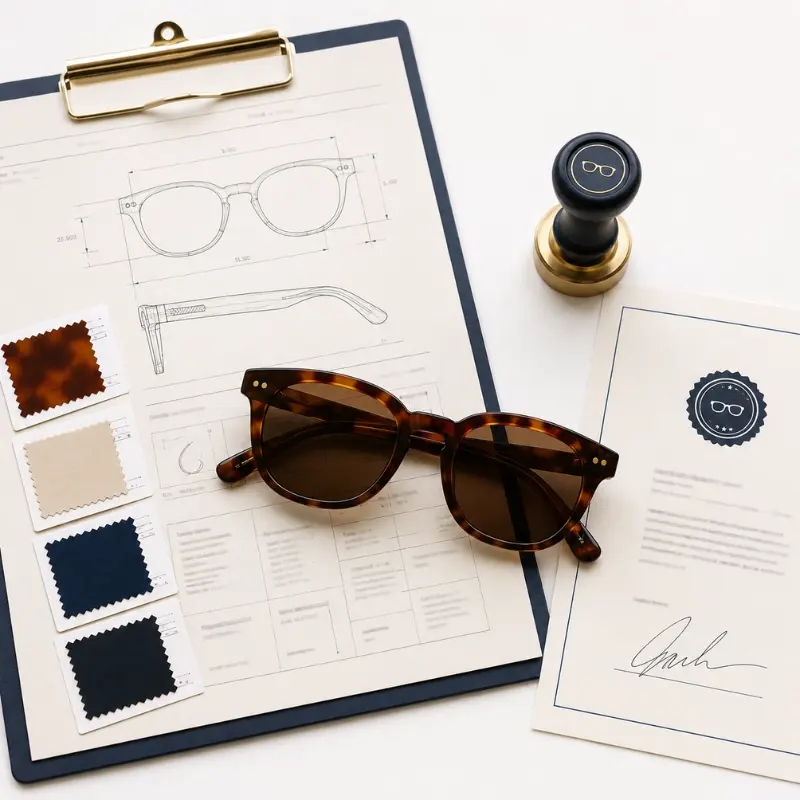
You’ve approved the design. You’ve confirmed the manufacturer. Now comes the part most brands don’t fully understand until they’re in the middle of it.
The private label eyewear production process is not a single event — it’s a sequence of stages, each with its own timeline, decision points, and potential failure modes. Brands that understand the full sequence move through it faster, make better decisions at each stage, and receive bulk orders that match what they approved. Brands that don’t often experience delays, quality surprises, and expensive revision rounds.
We’ve run this process hundreds of times across acetate, metal, titanium, and TR90 frames. Here’s how it actually works — and what you need to do at each stage to keep it on track.
The Full Production Sequence: An Overview
Before diving into each stage, it helps to see the complete picture.
The private label eyewear production process runs across six stages: design confirmation, sampling, sample review and revision, golden sample sign-off, bulk production, and pre-shipment inspection. Each stage has a defined output that must be confirmed before the next stage begins. Skipping confirmation steps is the single most common cause of bulk quality issues.
Here’s the full sequence with typical timelines:
| Stage | What Happens | Typical Duration | Output |
|---|---|---|---|
| 1. Design & spec confirmation | Brief reviewed, materials confirmed, design drawings produced | 5–10 days | Approved design spec sheet |
| 2. Sample production | First physical sample produced to spec | 10–20 days | First sample |
| 3. Sample review & revision | Brand reviews sample, provides feedback, revisions made | 10–20 days per round | Revised sample(s) |
| 4. Golden sample sign-off | Final approved sample locked as production standard | 2–5 days | Signed golden sample |
| 5. Bulk production | Full order produced to golden sample standard | 45–60 days | Bulk production |
| 6. Pre-shipment inspection | Finished goods inspected against golden sample | 3–5 days | Inspection report + shipment approval |
| Total | First enquiry to shipment | 90–150 days | Product ready to ship |
The most variable parts of this timeline are stages 3 and 5. Stage 3 varies based on how many revision rounds are needed and how quickly the brand provides feedback. Stage 5 varies based on material, order complexity, and factory capacity. Everything else is relatively predictable once production begins.
Stage 1: Design Confirmation and Spec Sheet
Production cannot begin without a confirmed specification. This stage is often rushed — and that rushing causes problems in every stage that follows.
The design confirmation stage produces a spec sheet: a single document that defines every detail of the frame — shape, dimensions, material, color (with Pantone references), hinge type, logo placement, logo method, lens specification, and packaging. This document becomes the legal reference for every quality decision in the production process. If it isn’t complete and accurate, nothing downstream will be either.
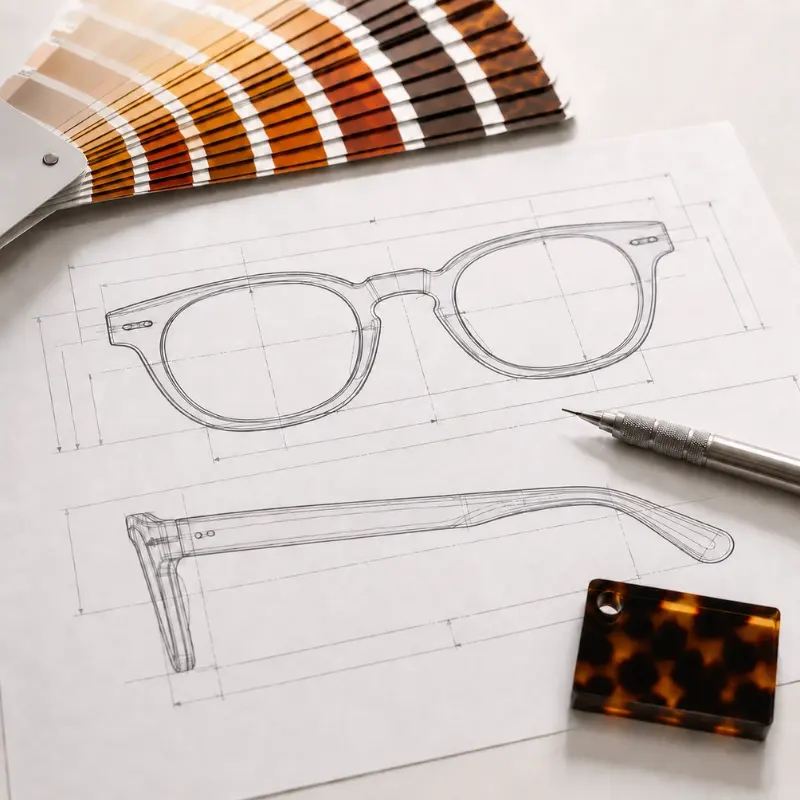
Here’s what a complete eyewear spec sheet covers:
Frame specification
- Frame shape and dimensions (front width, lens width, bridge width, temple length)
- Material and grade (e.g., “Italian acetate, 6mm sheet, matte finish”)
- Color specification (Pantone code or physical color chip reference)
- Hinge type (barrel hinge, spring hinge, flex hinge — specify number of barrels)
- Nose pad type and material (if applicable)
- Temple tip material and finish
Branding specification
- Logo file (vector AI or EPS, confirmed version)
- Logo placement (right temple outer, specific position from hinge end)
- Logo application method (laser engraving, hot stamp, metal inlay — with depth or foil spec)
- Logo color (Pantone code for epoxy fill or foil color)
Lens specification
- Lens material (CR-39, polycarbonate, nylon)
- Lens color and tint level (for sunglasses)
- Lens treatment (UV400, polarized, anti-reflective, photochromic)
- Base curve
Packaging specification
- Case type and material
- Case color and logo method
- Cleaning cloth (size, color, logo)
- Hang tag (dimensions, print spec)
- Retail box (if applicable)
Here’s what most people miss: the spec sheet is not just a design document — it’s a quality control reference. Every QC inspector at every stage will compare the product against this document. Vague specs (“navy blue,” “standard hinge”) produce inconsistent results. Specific specs (“Pantone 289C,” “7-barrel spring hinge, 14mm barrel length”) produce predictable results.
Your action items at this stage
- Review the spec sheet line by line before approving — don’t assume the manufacturer interpreted your brief correctly
- Confirm every Pantone code against a physical Pantone fan, not a screen
- Confirm logo file is the correct final version — not a work-in-progress file
- Sign and date the spec sheet — this becomes the production reference document
Stage 2: Sample Production
With a confirmed spec sheet, sample production begins. This is the stage where the product becomes physically real for the first time.
Sample production for private label eyewear takes 10 to 20 days depending on material and complexity. Acetate frames with custom color mixing take longer than metal or TR90 frames. Samples should be produced using the same materials and tooling that will be used in bulk production — not handcrafted prototypes. Ask your manufacturer to confirm this explicitly before sampling begins.
What happens during sample production depends on the frame material:
Acetate frame sampling
Acetate sheets in your confirmed color are sourced from the acetate supplier. Sheets are cut into frame blanks using CNC or laser cutting. Blanks are tumbled to remove sharp edges and begin the polishing process. Hinges are fitted and pressed. Logo is applied. Frame is finished and inspected against the spec sheet.
Metal frame sampling
Metal rods or sheets are cut and formed into frame components. Components are soldered or screwed together. Surface treatment (plating, PVD, painting) is applied. Hinges and nose pads are assembled. Logo is applied. Finished sample is inspected.
TR90 / injection frame sampling
If using an existing mold, frames are injection-molded in your confirmed color. If a new mold is required, tooling must be produced first (add 20–30 days and tooling fee). Logo is applied after molding. Sample is inspected against spec.
Your action items at this stage
- Confirm with the manufacturer that the sample will use production materials and tooling — not a substitute
- Ask for the sample production lead time in writing before work begins
- Prepare your sample review checklist in advance (covered in Stage 3) so you’re ready to evaluate systematically the moment the sample arrives
- Confirm whether sample cost is credited against the bulk order — get this in writing
Stage 3: Sample Review — What to Check Before Approving Bulk
This is the stage where most production problems are prevented — or locked in.
A thorough sample review is the most valuable quality control action a brand can take. Once you approve a sample and move to bulk production, the approved sample becomes the standard. Anything not caught at this stage becomes a bulk defect. Review systematically, document everything, and never approve a sample under time pressure.

Here is a complete checklist for evaluating an eyewear sample:
Frame dimensions and fit
- Compare front width, lens width, bridge width, and temple length against the spec sheet (±1mm tolerance is standard)
- Place the frame on a flat surface — does it sit level without rocking?
- Is the frame symmetrical left-to-right? Hold it at arm’s length and look down the temples
- Is the bridge height and angle consistent with the design reference?
Material and finish
- Is the acetate color and pattern accurate to the Pantone or color chip reference?
- Is the surface finish (matte, glossy, satin) consistent across the entire frame?
- Are there any surface defects — scratches, pits, uneven polish, color variation?
- Does the material weight feel consistent with the price point and spec?
Hinge and construction
- Open and close the hinge 20 times — is the movement smooth and consistent on both sides?
- Is there any side-to-side play in the hinge when the temple is fully open?
- Are all screws flush and fully seated?
- Are the temples parallel when the frame is open on a flat surface?
Logo and branding
- Is the logo position exactly as specified (measure from the hinge end)?
- Is the logo depth correct (for laser engraving) or the foil transfer complete (for hot stamp)?
- Is the epoxy fill color accurate to the Pantone reference (if applicable)?
- Are the logo edges clean with no bleeding, inconsistency, or incomplete transfer?
Lens
- Is the lens color and tint level accurate to spec?
- Hold the lens up to a light source — is the optical surface free of distortion, bubbles, or inclusions?
- For polarized lenses: test against a reflective surface to confirm polarization is present
- Is the lens fit flush in the frame with no gaps or pressure points?
Packaging
- Is the case size appropriate for the frame — not too loose, not too tight?
- Is the case logo method and placement accurate?
- Is the cleaning cloth quality (thickness, weave) consistent with the spec?
Your action items at this stage
- Document all feedback with annotated photos — not written descriptions alone
- Send a single consolidated feedback document covering all points — not multiple emails over several days
- Specify each revision as a clear instruction: “Move logo 3mm toward the lens end” not “Logo position doesn’t look right”
- Set a maximum of two revision rounds in your agreement with the manufacturer — additional rounds should trigger a formal change order
- Never approve a sample under timeline pressure — a bulk order of 500 units with a defect costs more to fix than a delayed launch
Stage 4: The Golden Sample — Why It Matters More Than You Think
The golden sample is the most underused quality control tool in private label eyewear manufacturing — and the one that most directly prevents bulk quality surprises.
A golden sample is the final approved sample, physically retained and stored at both the manufacturer’s facility and the brand’s premises, used as the standard reference throughout bulk production. Every QC inspector — in-process and pre-shipment — compares bulk output against the golden sample. Production should never begin without a signed, physically retained golden sample.
Here’s how the golden sample mechanism works in practice:
What makes a sample “golden”
The golden sample is the last sample approved in the revision process — the one both parties agree represents exactly what the bulk order should deliver. It is labeled, dated, and signed by both the brand and the manufacturer. Multiple copies are retained:
- One copy retained by the manufacturer for QC reference during production
- One copy retained by the brand as the shipment acceptance standard
- One copy held as a neutral reference (some brands ship this to a third-party QC agency)
How it’s used during production
During bulk production, QC inspectors at the factory compare frames coming off the production line against the golden sample at regular intervals. Dimensions, finish, hinge quality, logo placement, and packaging are all checked against this physical standard. The golden sample prevents quality drift — the gradual deterioration of standards that can occur when workers rely on memory rather than a physical reference.
What happens without a golden sample
Without a retained physical sample as the production standard, quality is defined by the spec sheet alone. Spec sheets are precise, but they can’t capture every tactile and visual quality of a finished frame — the exact surface sheen of a polished acetate, the precise feel of a hinge under tension. The golden sample fills the gap between written specification and physical reality.
The bottom line: before you approve bulk production, confirm that both you and the manufacturer have a physically retained signed golden sample. This is the single most effective quality control mechanism available to a brand buyer.
Your action items at this stage
- Request that the manufacturer sends you the golden sample via express courier — keep it in your possession
- Label it clearly: “Golden Sample — [Style Name] — [Date Approved] — Do Not Use”
- Photograph the golden sample comprehensively from all angles (for remote QC reference)
- Confirm in writing that bulk production will not begin until the golden sample is signed and retained
Stage 5: Bulk Production — What’s Happening and How to Stay Informed
Once the golden sample is signed, bulk production begins. For most B2B buyers, this is the stage where communication goes quiet — and that silence is where problems develop.
Bulk production for private label eyewear takes 45 to 60 days from production start to completion, depending on material, order volume, and factory capacity. During this period, your job is not to wait passively — it’s to maintain visibility into production progress through agreed communication checkpoints.
Here’s what’s happening at the factory during bulk production:
Material procurement
The factory confirms material availability and places orders for acetate sheets, metal rods, lens blanks, hinge components, and packaging materials. Material lead time is often the first hidden delay in production. Raw material shortages or color matching issues at the material supplier level can add 1–2 weeks before production even begins.
Frame production stages (acetate example)
- Sheet selection and cutting: Acetate sheets in the confirmed color are cut into frame blanks
- CNC shaping: Blanks are precision-cut to frame shape dimensions from the spec sheet
- Tumbling and polishing: Frames run through tumbling barrels with polishing compounds — this stage takes several days
- Hinge fitting: Hinges are pressed and fitted, screws installed
- Logo application: Laser engraving, hot stamping, or metal inlay applied
- Final inspection and polishing: Individual frame inspection, final polish
- Lens fitting: Lenses cut and fitted to frame
- Packaging assembly: Frame, case, cloth, hang tag packed into retail box
Production milestones to request from your manufacturer
Ask your manufacturer to send a status update at these milestones:
- Material procurement confirmed (Week 1–2)
- Frame production started (Week 2–3)
- In-process QC check completed (Week 4–5)
- Production completed, pre-shipment inspection scheduled (Week 7–8)
Your action items at this stage
- Agree on communication checkpoints in writing before production begins
- Request production line photos at the mid-production milestone — this is standard practice for professional manufacturers
- If a milestone update is missed by more than 3 days, follow up immediately — silence during production is an early warning sign
- Confirm your balance payment timeline against the production completion date — most manufacturers require balance payment before shipment
Stage 6: Pre-Shipment Inspection — Your Final Quality Gate
Pre-shipment inspection is the last opportunity to catch quality issues before your product leaves the factory. It’s not optional.
Pre-shipment inspection (PSI) compares a statistically representative sample of finished goods against the golden sample and spec sheet before packing and shipment. A proper PSI follows AQL (Acceptable Quality Level) standards — typically AQL 2.5 for major defects and AQL 4.0 for minor defects in eyewear. The inspection report becomes your acceptance or rejection document.
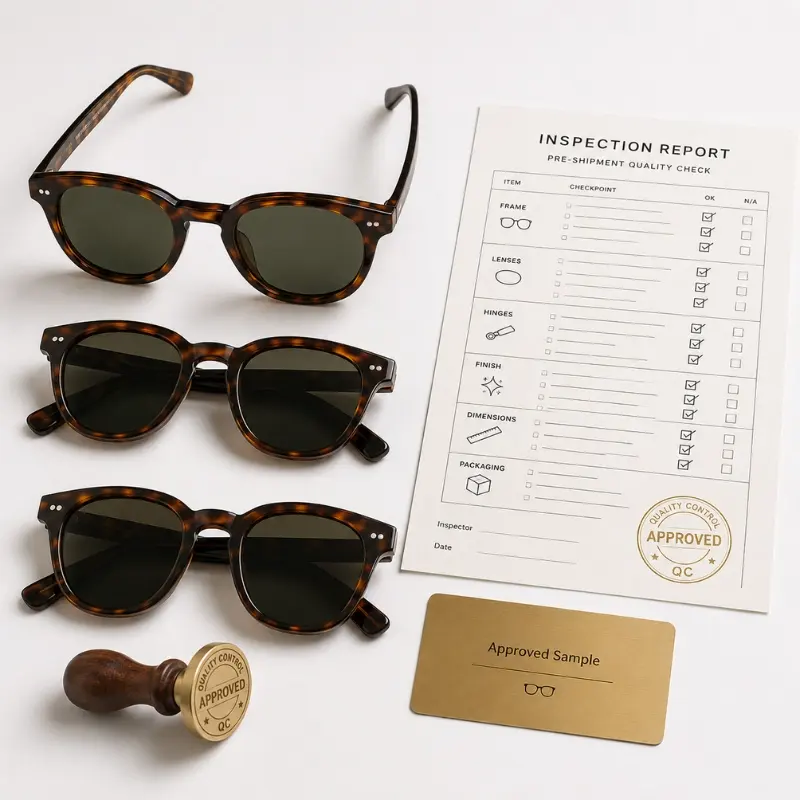
What PSI covers
Quantity verification: Confirm the total quantity produced matches the purchase order. Check carton count and units per carton.
Visual inspection: Compare finished frames against the golden sample for color, finish, logo, and packaging accuracy.
Dimensional check: Measure a sample of frames against the spec sheet tolerances.
Function test: Open and close hinges on inspected frames. Check for loose screws, misaligned temples, and lens fit.
Packaging check: Confirm packaging matches spec — correct case, cloth, hang tag, and retail box where applicable.
Barcode and labeling check: Confirm barcodes scan correctly, labels are accurate, and any required compliance markings (CE, UV400) are present.
AQL sampling standards for eyewear
| Order Quantity | Sample Size (AQL 2.5) | Max Defects Allowed |
|---|---|---|
| 151–280 pcs | 32 pcs | 2 |
| 281–500 pcs | 50 pcs | 3 |
| 501–1,200 pcs | 80 pcs | 5 |
| 1,201–3,200 pcs | 125 pcs | 7 |
Who conducts the PSI
Option 1: Manufacturer’s internal QC team Standard for most orders. The factory QC team conducts the inspection and provides a report with photos. Cost is typically included in the production agreement.
Option 2: Third-party inspection agency SGS, Bureau Veritas, QIMA, or similar agencies send an independent inspector to the factory. More expensive ($200–$400 per inspection day) but provides independent verification. Recommended for first orders with a new manufacturer, or for orders above $15,000.
Your action items at this stage
- Request the PSI report with photos before approving shipment — never approve shipment without reviewing it
- Compare PSI photos directly against your golden sample photos
- If defects exceed AQL limits, you have three options: reject the shipment, request rework (adds 5–10 days), or negotiate a price adjustment for acceptable minor defects
- Confirm that your golden sample is included in the shipment for future reorder reference
Why Production Gets Delayed — And What You Can Control
Most production delays in private label eyewear are predictable and preventable. Understanding which delays come from the manufacturer’s side and which come from the buyer’s side is the key to controlling your timeline.
The most common cause of production delays is slow decision-making on the buyer side — not factory problems. Sample feedback that takes two weeks to arrive, unclear revision instructions that require re-explanation, late deposit payments that delay production scheduling — these are buyer-side delays that the factory cannot resolve.
Here’s an honest breakdown of delay causes and who controls them:
| Delay Cause | Controlled By | Typical Time Lost | Prevention |
|---|---|---|---|
| Slow sample feedback from buyer | Buyer | 1–3 weeks | Commit to 5-day feedback turnaround |
| Unclear revision instructions | Buyer | 1–2 weeks (re-explanation rounds) | Use annotated photos, not written descriptions |
| Late deposit payment | Buyer | 1–2 weeks (production scheduling delayed) | Pay deposit within 3 days of purchase order |
| Material sourcing delay (acetate color) | Manufacturer | 1–2 weeks | Ask manufacturer to confirm material availability before sampling |
| Mold tooling delay (new mold) | Manufacturer | 2–4 weeks | Confirm tooling lead time upfront; start tooling before sample approval |
| Factory capacity overload | Manufacturer | 1–3 weeks | Confirm production slot availability at order placement |
| Revision rounds exceeding agreed limit | Both | 1–4 weeks | Set maximum revision rounds in the agreement |
| Packaging production delay | Both | 1–3 weeks | Brief packaging supplier at same time as frame manufacturer |
| Holiday shutdowns (Chinese New Year, Golden Week) | Manufacturer | 1–4 weeks | Check factory calendar before setting timelines |
Here’s the deal: the delays you control are the most impactful ones. Most buyer-side delays compound — a slow sample review delays revision production, which delays golden sample sign-off, which delays the production slot booking, which pushes the bulk completion date by more than the original review delay. A 10-day delay in sample feedback can translate to a 3-week delay in delivery.
How to speed up eyewear production without compromising quality
- Choose existing molds over custom tooling for your first order — this removes 20–30 days of tooling lead time
- Pre-confirm material availability — ask your manufacturer to confirm acetate color and hinge availability before sampling begins
- Limit revision rounds — agree on a maximum of two in the contract; the first round covers design, the second locks the final spec
- Pay the deposit immediately after purchase order confirmation — every day of payment delay is a day of production scheduling delay
- Brief your packaging supplier in parallel with your frame manufacturer — packaging lead times can match or exceed frame production lead times
- Use air freight or express courier for the sample — 3–5 days delivery compared to 7–14 days for standard shipping; worth it for a $150–$300 sample
- Avoid briefing manufacturers around Chinese holidays — Chinese New Year (Jan–Feb) and Golden Week (Oct) affect factory capacity for 2–4 weeks before and after the holiday
This is part of our complete guide to private label eyewear manufacturing. If you’re ready to start a production project and want to understand the timeline for your specific brief, we respond within 4 business hours.
Production Confirmation Checklist: Before You Approve Bulk
Before transferring your bulk production deposit, confirm every item on this list. A “yes” on every line means your production is set up for success. A “no” on any line is a risk that will surface later.
Design and specification
- [ ] Spec sheet is complete, accurate, and signed by both parties
- [ ] All Pantone codes confirmed against physical reference (not screen)
- [ ] Logo file is final version in vector format
- [ ] Packaging spec confirmed and aligned with frame spec
Sampling
- [ ] Sample produced using production materials and tooling (confirmed in writing)
- [ ] All revision points addressed and confirmed in revised sample
- [ ] Golden sample signed, dated, and retained by both parties
- [ ] Golden sample photographed comprehensively for remote QC reference
Production parameters
- [ ] Quantity per style per colorway confirmed in writing
- [ ] Production lead time confirmed with specific completion date
- [ ] Material availability confirmed (acetate color, hinge type, lens spec)
- [ ] Factory capacity confirmed for your production slot
- [ ] Payment schedule confirmed (deposit amount, balance trigger, payment method)
Quality control
- [ ] QC checkpoints agreed (mid-production update, pre-shipment inspection)
- [ ] AQL standard for PSI confirmed
- [ ] Third-party inspection arranged (if applicable)
- [ ] Defect resolution process agreed (rework, price adjustment, rejection terms)
Packaging and shipment
- [ ] Packaging production timeline confirmed (running parallel to frame production)
- [ ] Shipping method confirmed (sea freight or express courier) and booking initiated
- [ ] Export documentation requirements confirmed (commercial invoice, packing list, CE certificate if required)
- [ ] Delivery address and incoterms confirmed
Conclusion
The private label eyewear production process runs from design confirmation through six defined stages to shipment. The brands that move through it successfully share three habits: they confirm specifications completely before sampling begins, they review samples systematically and provide clear feedback, and they maintain active communication throughout bulk production rather than going silent and hoping for the best. The golden sample mechanism and the pre-shipment inspection are your two most powerful quality control tools — use both, every time.
Frequently Asked Questions
How long does private label eyewear production take from sample to bulk shipment? From golden sample sign-off to bulk shipment, budget 50 to 65 days — 45 to 60 days for bulk production plus 3 to 5 days for pre-shipment inspection. Including the design confirmation and sampling stages, the full process from first enquiry to product in hand typically runs 90 to 150 days.
How many sample revision rounds should I expect for private label eyewear? Two revision rounds is the standard for a well-briefed ODM project. The first round addresses design direction, fit, and material accuracy. The second round confirms all revision points are resolved and locks the golden sample. More than two rounds usually indicates an unclear original brief — not a factory quality problem.
What is a golden sample in eyewear production? A golden sample is the final approved sample, physically signed and retained by both the brand and the manufacturer, used as the production standard throughout bulk manufacturing. QC inspectors compare bulk output against the golden sample at regular intervals. Production should never begin without a signed, physically retained golden sample on both sides.
What is pre-shipment inspection for eyewear, and do I need it? Pre-shipment inspection (PSI) checks a statistically representative sample of finished goods against the golden sample and spec sheet before packing and shipment, following AQL quality standards. Yes — you need it on every order. PSI is your final quality gate and your acceptance document. Approving shipment without a PSI report is accepting unknown quality risk.
What are the most common causes of eyewear production delays? The most common cause is slow buyer-side decision-making — delayed sample feedback, unclear revision instructions, and late deposit payments. Manufacturer-side delays include material sourcing issues, mold tooling for new frame shapes, and factory capacity constraints. Chinese holiday periods (Chinese New Year and Golden Week) affect production capacity for 2–4 weeks.
What should I check when reviewing an eyewear sample? Check frame dimensions against the spec sheet, material and finish quality, hinge smoothness and consistency, logo placement accuracy and finish quality, lens optical clarity and fit, and packaging accuracy. Document all feedback with annotated photos — not written descriptions. Never approve under time pressure.
Can I use a third party for eyewear pre-shipment inspection? Yes. SGS, Bureau Veritas, and QIMA all offer eyewear pre-shipment inspection services. Third-party inspection is recommended for first orders with a new manufacturer and for orders above $15,000. Cost is typically $200–$400 per inspection day and is the brand’s responsibility to arrange.
How do I make sure bulk production matches my approved sample? The golden sample mechanism is your primary tool — retain a signed physical sample and confirm the factory retains one for QC reference. Agree on mid-production QC checkpoints and request production photos. Conduct a thorough pre-shipment inspection against the golden sample before approving shipment. Never start bulk production without a signed golden sample on both sides.
Let's get started!
Get in touch with a custom eyewear specialist now for a free consultation and instant price quote.
WHATSAPP ME GO!
📱 Scan with your phone to start chatting