Blue Light Glasses Care and Maintenance: What Brands Need to Tell Customers
Blue light glasses are a functional product — the coating or substrate that provides the filtering is the reason the customer bought it. Unlike fashion sunglasses, where care affects appearance and longevity but not the product’s core purpose, damaged blue light lens coatings directly reduce the filtering performance the product is sold on. A customer who cleans their lenses with window cleaner for three months is not just scratching their glasses — they are degrading the filtering layer that determines how well the product works.
This distinction is why care and maintenance communication matters more for blue light blocking glasses than for most eyewear categories, and why a generic care card that says “clean with a soft cloth, store in a case” leaves out the information that actually prevents the most common forms of damage. This guide covers what is specific to blue light glasses care, from the perspective of a manufacturer that produces blue light eyewear for brands across multiple markets.
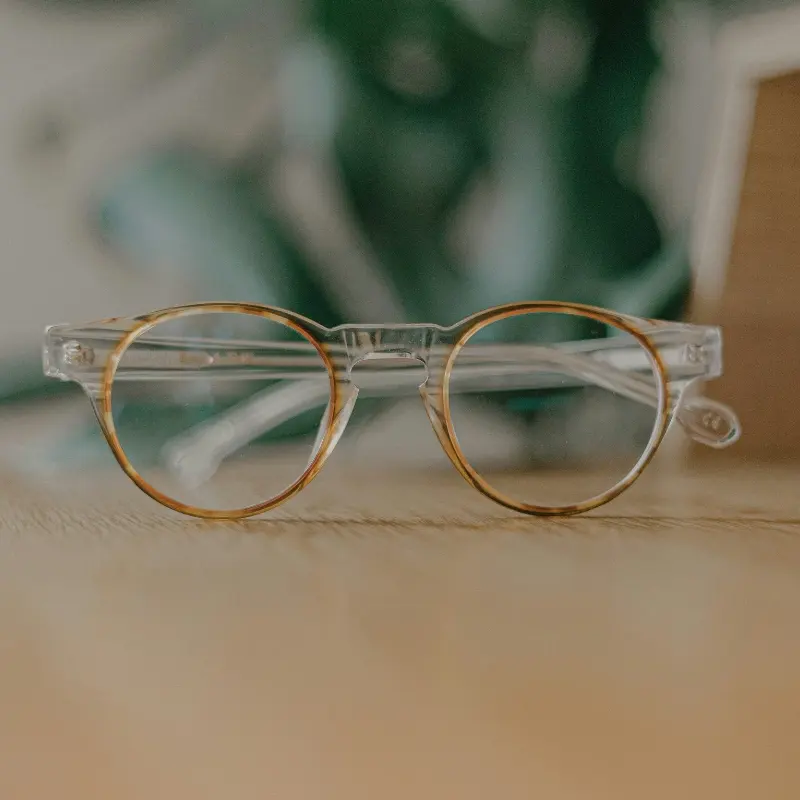
Why Blue Light Glasses Need More Careful Handling Than Standard Eyewear
The lens in a blue light glasses product has a more complex coating stack than a standard uncoated fashion lens. As explained in detail in How Blue Light Filtering Lens Coatings Actually Work, surface-coating-based blue light filtering works through thin-film interference — multiple dielectric layers deposited at precise thicknesses on the lens surface. These layers are engineered to selectively reflect blue light wavelengths, and they are also the part of the lens most vulnerable to chemical and mechanical damage.
The practical consequence: if the blue light coating layer is compromised — through repeated exposure to solvents, abrasive contact, or physical degradation — the filtering performance of the lens declines. This is not a defect in the original manufacturing; it is the result of how the coating is maintained in the hands of the end user.
For a brand, this creates a specific post-sale responsibility. Customers who are not told what damages their blue light coating will use whatever cleaning products they have on hand, many of which will degrade the coating over time. The resulting experience — progressively reduced lens performance without a visible explanation — is attributed to poor product quality rather than to maintenance. A care communication that names the specific risks prevents this outcome.
Daily Cleaning: The Right Sequence for Coated Lenses
The cleaning sequence for blue light glasses follows the same logic as for any coated lens — the priority is removing particulates before any contact occurs with the lens surface. The difference is that the chemical sensitivity of blue light coatings is higher than standard AR coatings, making the choice of cleaning agent more consequential.
The correct cleaning sequence:
- Rinse under lukewarm water first. Any dust, grit, or debris on the lens surface becomes an abrasive when dragged across it with a cloth. Rinsing removes these particles before contact. This step is the single most effective habit for preventing micro-scratches on the coating. Avoid very hot water — water hot enough to be uncomfortable to the touch can stress lens coatings over time with repeated exposure, and for injection-molded plastic frames (TR90 or PC), sustained heat accelerates material fatigue. Lukewarm is the right temperature: warm enough to dissolve oils, cool enough not to risk the coating.
- Apply a small amount of mild dish soap — without moisturizers or heavy additives — to clean fingertips. Work gently across both lens surfaces and the frame.
- Rinse thoroughly. Soap residue left on the lens attracts dust and can leave a film that interferes with the coating’s optical performance over time.
- Dry with a clean microfiber cloth. Pat gently rather than rubbing. The cloth must be clean — a microfiber cloth that has picked up grit from a bag or pocket carries the same abrasive risk as any contact material.
What not to use:
- Paper towels, tissues, or clothing — fibrous materials that scratch coated lens surfaces
- Hot water — damages coatings and can deform plastic frames
- Breath fogging before wiping — saliva compounds degrade coatings over repeated exposure
- Any dry wiping before rinsing — always wet the lens first
What Damages Blue Light Coatings: Chemicals to Name Specifically
This is the section that most generic care guides omit and that most customers need most. Blue light lens coatings are more chemically sensitive than standard lenses for a specific reason: the thin-film interference layers that create the filtering effect have a different chemical resistance profile than a simple hard coat. Several commonly available cleaning products will degrade these layers in ways that are not immediately visible but accumulate over weeks of regular exposure.
The chemicals to name specifically in customer-facing care documentation:
| Chemical Category | Common Sources | Effect on Blue Light Coating |
|---|---|---|
| Alcohol | Hand sanitizer, isopropyl alcohol, alcohol wipes | Degrades coating layers; reduces filtering performance over time |
| Ammonia-based cleaners | Window cleaners (Windex and similar) | Strips coating; causes cloudiness or coating delamination |
| Acidic cleaners | Vinegar, citrus-based sprays | Etches coating surface; degrades optical performance |
| Ketone solvents | Nail polish remover (acetone), MEK | Severe: directly dissolves lens substrate and coating |
| Hydrophobic-stripping agents | Some multi-surface sprays | Removes hydrophobic top layer; increases smudge retention |
The most important to name explicitly are the ones customers are most likely to reach for: hand sanitizer, window cleaner, and household multi-surface spray. Most customers do not know these are harmful to lens coatings without being told.
A specific note on alcohol: hand sanitizer has become a near-universal cleaning tool, and many customers will apply it to their glasses without thinking. For surface-coated blue light lenses, repeated alcohol exposure degrades the coating layers that provide the filtering effect. This is worth naming as a single dedicated line in any care communication.
Surface Coating vs In-Mass Lenses: Does Care Differ?
Yes, but less than most brands assume.
Surface-coated blue light lenses depend on an intact coating layer for their filtering function. Chemical damage to the coating does reduce filtering performance. These lenses require the most careful chemical avoidance — the restriction on solvents and harsh cleaners directly protects the filtering layer.
In-mass substrate lenses have the filtering compounds embedded within the lens material itself, not in a surface layer. This means chemical damage to the surface does not directly degrade the blue light filtering function. However, in-mass lenses still have a hard coat and AR coating stack on the surface, and damage to those layers degrades optical clarity, anti-glare performance, and scratch resistance — all of which affect the product experience. The same care practices apply.
The care card language for both types can be identical — the reasoning is slightly different, but the recommended practices are the same. What changes is the risk explanation: for surface-coated lenses, the stakes of chemical exposure include degraded filtering performance; for in-mass lenses, the stakes are limited to surface optical quality.
Frame Care for TR90 and Acetate Blue Light Frames
The two most common frame materials for blue light glasses each have specific care considerations.
TR90 Frames
TR90 is the dominant frame material for blue light glasses — lightweight, flexible, and comfortable for the extended screen-use sessions this product is designed for. TR90 frames are generally durable, but they have two specific vulnerabilities worth communicating to customers.
Heat sensitivity: TR90 frames will deform under sustained high heat. Leaving glasses on a car dashboard in direct sun, where interior temperatures routinely exceed 70°C / 160°F, is the most common source of frame warping in this material. For customers who wear their blue light glasses for work or gaming and then leave them in a car or near a heat source, this is the most likely cause of frame distortion. State this explicitly.
Solvent sensitivity: The same solvents that damage lens coatings — acetone, certain alcohol-based sprays — can also affect the surface finish of TR90 frames. For branded spray-coated frames, this extends to the frame color layer, which can be stripped by aggressive solvents.
Acetate Frames
Acetate blue light frames are less common but appear in premium-tier products where the richer feel and color depth of acetate is part of the brand story. Acetate has a higher heat tolerance than TR90 but shares the solvent sensitivity at the lens-frame junction — where adhesives or coatings at the lens mounting point may be affected by aggressive cleaning agents reaching that area.
Acetate frames can also be polished professionally if surface scratches develop over time — this is an advantage over TR90 for brands building a premium positioning around product longevity.
Storage and Handling
Use the hard case. A hard case protects against the two most common forms of non-wear damage: impact and contact abrasion from other objects in a bag or pocket. A soft pouch is better than nothing but does not protect against compression. Blue light glasses in particular are worn by customers who are actively working — going between their desk, bag, and commute — and the storage habit during those transitions determines a significant portion of the lens surface condition over time.
Store lens-side up. Placing glasses lens-down on a desk or table is the most common cause of lens surface abrasion outside of cleaning. Even an apparently clean surface carries particles at the lens contact points.
Avoid temperature extremes. Beyond the car dashboard scenario: sustained cold below approximately -20°C increases brittleness in PC lens materials; sustained heat above 60-70°C deforms TR90 frames. Neither is common in daily indoor use, but both apply in extreme seasonal or travel situations.
Screen cleaning products near your glasses. Customers who use screen wipes or spray cleaners on their monitors may inadvertently expose their glasses to those products. This is worth a single line in care documentation for brands whose customer base includes office professionals who clean their screens regularly.
What to Put on Your Care Card
A care card that comes with a blue light glasses product has one job: reduce the rate of coating damage from customer behavior. The content should be specific enough to change behavior, concise enough to be read, and accurate enough to represent the product honestly.
Minimum care card content for blue light glasses:
- Rinse before wiping — one line, unambiguous. This prevents the most common cause of physical coating damage.
- Cleaning method — lukewarm water + mild dish soap + microfiber cloth. State specifically: not hot water, not paper towels, not clothing.
- Chemicals to avoid — list by common name, not chemical category: “Do not use hand sanitizer, window cleaner, vinegar, or nail polish remover on your lenses.” The more specific the naming, the more likely the customer follows it.
- Why it matters — one sentence: “These products can damage the blue light filtering coating and reduce your lens performance over time.” Giving customers the reason improves compliance significantly.
- Heat warning — “Do not leave in a hot car or on a dashboard.”
- Storage — “Store in the hard case with lenses facing up when not in use.”
- Brand contact — for claims, questions, or warranty.
Optional additions worth considering:
- QR code linking to a care video — increasingly effective for a screen-use customer base that will actually scan it
- A note on the lens technology: “Your lenses use [surface coating / in-mass filtering] to block blue light — keeping the coating intact preserves the filtering performance.” This positions the care instruction as a performance issue, not just a cosmetic one, and helps customers understand why standard eyeglass cleaning advice may not fully apply.
- Replacement guidance: “If lenses become heavily scratched or cloudy, the filtering performance may be reduced. Contact us for a lens replacement assessment.” This gives customers a clear action instead of guessing whether damaged lenses are still effective.
At Sailook, when clients finalize a blue light glasses collection, we provide the specific lens coating type and its chemical sensitivities as part of the product handover documentation, so that care card copy can be written to match the actual product rather than generic eyewear advice.
FAQ
Why do blue light glasses need different care than regular sunglasses? Blue light glasses have a more complex coating stack than standard fashion lenses — the thin-film layers that create the filtering effect are more chemically sensitive than a standard hard coat or tint. Chemical damage to these layers degrades filtering performance, not just lens appearance. Care instructions for blue light glasses need to specifically address the chemicals that damage filtering coatings — hand sanitizer, window cleaner, and vinegar are the most common household products that cause this damage.
What is the most common cause of blue light coating damage? Chemical exposure, not physical scratching, is the primary cause of filtering coating degradation. Alcohol-based products (hand sanitizer, isopropyl alcohol) and ammonia-based cleaners (window cleaner) are the most frequently used household products that degrade blue light lens coatings. Many customers apply these without knowing they are harmful, because they look like effective lens cleaners. Naming them specifically on a care card is the most effective single intervention a brand can make.
Can I use lens wipes on blue light glasses? Depends on the wipe. Pre-moistened lens wipes formulated for coated optics and labeled as safe for AR coatings are generally acceptable. Wipes containing alcohol, ammonia, or strong solvents are not. Alcohol wipes — including those used for phone and screen cleaning — should not be used on blue light lenses with surface coatings.
Does care differ between surface-coated and in-mass blue light lenses? Slightly. For surface-coated lenses, chemical damage to the surface directly affects the filtering layer — solvents reduce filtering performance, not just optical clarity. For in-mass lenses, the filtering compounds are embedded in the material, so surface chemical damage does not degrade filtering performance directly. However, both types have AR and hard coat layers on the surface that require the same careful cleaning practices to maintain optical clarity and scratch resistance.
What should a blue light glasses care card actually say? At minimum: rinse before wiping (the most important single instruction), cleaning method (lukewarm water, mild dish soap, microfiber cloth), specific chemicals to avoid by common name (hand sanitizer, window cleaner, vinegar, nail polish remover), a one-sentence explanation of why these chemicals matter (they damage the filtering coating), a heat warning (no car dashboards), and storage guidance (hard case, lens side up). Adding the reason behind each instruction significantly improves compliance versus a list of rules alone.
How long do blue light glasses coatings last with proper care? With correct cleaning habits and chemical avoidance, a quality surface-coated blue light lens maintains its filtering performance for 1–2 years of daily use. The primary variables are cleaning frequency, cleaning products used, and physical handling (abrasion during storage). In-mass lenses have no degradation limit tied to surface care — their filtering performance is stable as long as the lens substrate itself is intact.
Summary
Blue light glasses care matters more than standard eyewear care because coating damage reduces filtering performance — not just product appearance. The most important customer behavior to change is chemical exposure: hand sanitizer, window cleaner, vinegar, and acetone degrade blue light lens coatings and, for surface-coated products, reduce filtering effectiveness over time. A care card that names these products by common name, explains why they are harmful, and provides a specific alternative (lukewarm water, mild dish soap, microfiber cloth) changes customer behavior in a way that generic “avoid harsh chemicals” language does not. For TR90 frames — the most common frame material in this category — the additional heat warning (no car dashboards) addresses the most common source of frame distortion during active daily use.
For Sailook’s full range of blue light glasses lens options, coating types, and product specifications, visit our blue light blocking glasses page.
Let's get started!
Get in touch with a custom eyewear specialist now for a free consultation and instant price quote.
WHATSAPP ME GO!
📱 Scan with your phone to start chatting