Clear vs Yellow vs Amber Lens Blue Light Glasses: Filtering Strength Compared
Lens color is the most visible differentiator in the blue light glasses category, and it is also the decision that most directly determines what a product can honestly claim to do. Clear lenses, yellow lenses, and amber lenses are not simply aesthetic choices — they represent fundamentally different filtering profiles, use case fits, and tradeoffs between protection level and visual experience.
For brands developing a blue light blocking glasses line, the lens color decision shapes everything downstream: what the product can truthfully claim, which customer segment it serves, what the product experience is like in use, and how it needs to be communicated at retail. This guide works through each option with actual filtering data rather than marketing generalizations.
The Tradeoff at the Core of Every Lens Choice
Before comparing the three lens colors, one principle applies to all of them: filtering more blue light requires blocking more of the visible spectrum, and blocking more of the visible spectrum produces more color distortion. This is not a manufacturing quality issue — it is a physical consequence of how selective wavelength filtering works.
Blue light occupies the 380–500nm range of the visible spectrum. The same wavelengths that carry the blue light brands want to filter are also the wavelengths that give blue and blue-adjacent colors their appearance. A lens that blocks 90% of light in that range will show the wearer a world with most blue removed — which means colors shift toward yellow, orange, and red.
Clear lenses choose minimal color distortion at the cost of limited filtering. Amber lenses choose maximum filtering at the cost of significant color distortion. Yellow lenses occupy the middle. None of these is objectively better — the right choice depends on the use case the product is designed for and the experience the brand wants its customers to have.
Clear Lenses: What They Filter and What They Don’t
Clear blue light lenses — lenses that appear visually transparent with no perceptible tint — are the dominant lens type in the blue light glasses market, accounting for approximately 61% of market volume. Their appeal is straightforward: they look like ordinary glasses, require no adjustment period, and work in any setting without drawing attention.
The filtering mechanism for most clear blue light lenses is a surface coating that selectively reflects a portion of the blue-violet range. The technical profile of what they actually filter is more specific than most consumer or brand communications acknowledge.
Most clear blue light lenses provide meaningful filtering in the 380–430nm range — the short-wave violet-blue portion of the spectrum. In this range, filtering percentages of 50–95% are achievable without visible tint, because the wavelengths being blocked are at the edge of visible light where blocking them does not significantly shift the color appearance of the lens.
The 455nm Problem with Most Clear Lenses
The limitation of clear lenses becomes apparent at 455nm — the peak emission wavelength of LED screens, the light source most directly relevant to screen-use blue light concerns. Filtering at 455nm requires blocking wavelengths that are squarely in the visible blue range, and doing so produces a visible tint. Most clear lenses on the market provide relatively weak filtering at 455nm — often 10–30% at this wavelength — precisely because achieving higher filtering there would compromise the clear appearance that is the product’s primary feature.
This creates a specific communication challenge for brands: a clear lens marketed as “blocks 20% of blue light” may be blocking 80–95% of light below 420nm, while providing 10–20% filtering at the 455nm wavelength most relevant to screen use. Both the overall percentage and the 455nm-specific performance are accurate — they are simply measuring different things. For a brand developing a clear lens product, understanding this distinction is essential for making claims that are both true and meaningful to the actual use case.
Clear lenses are best suited for:
- Daytime office and screen use where color accuracy matters — for designers, editors, or any professional work where true color perception is part of the job
- Fashion and lifestyle blue light glasses where the visual unobtrusiveness of the lens is a primary purchase driver
- All-day wear scenarios where the glasses need to function in both screen and non-screen environments without affecting the wearer’s visual experience
- Entry-level and mid-range blue light programs where cost efficiency and broad market appeal matter
Yellow Lenses: The Middle Ground

Yellow-tinted lenses produce filtering across a broader portion of the blue light spectrum than clear lenses, typically providing 30–60% filtering across the full 380–500nm range. The filtering is stronger at 455nm than clear lenses can achieve while maintaining visual clarity, making yellow lenses a meaningfully more protective option for screen-use scenarios.
The mechanism is typically a combination of absorbing pigment in the lens material and surface coating — the pigment handles the broader wavelength attenuation, and the coating adds optical refinement. The result is a lens that appears yellow-tinted to observers and gives the wearer a slightly warm-toned visual experience, but without the significant color shift that amber lenses produce.
For brands, yellow lenses occupy a positioning sweet spot that clear lenses cannot reach: they provide demonstrably stronger filtering than clear lenses (which can be communicated and documented through transmission spectrum data), while the color shift is mild enough that most wearers adapt quickly and find them comfortable for extended screen sessions.
The visual experience through a yellow lens has a well-documented secondary effect beyond blue light filtering: yellow tints increase contrast perception in many lighting conditions, which contributes to the subjective sense of reduced eye strain that many users report. This is not primarily a blue light filtering effect — it is a consequence of the contrast-enhancing properties of the yellow tint itself. For brands communicating about yellow-tinted products, the distinction between filtering effect and contrast enhancement effect is worth understanding.
Yellow lenses are best suited for:
- Screen-use blue light glasses where the brand wants to communicate meaningful filtering performance with supporting data
- Gaming eyewear, where yellow tints are associated with the category and where the contrast enhancement effect has practical value for extended gaming sessions
- Evening and low-light screen use, where the warm tone of the lens is less visually disruptive than it might be in a bright daytime environment
- Brands positioning at the mid-to-upper range of the blue light category where specific performance claims are part of the product story
Amber Lenses: Maximum Filtering, Real Tradeoffs
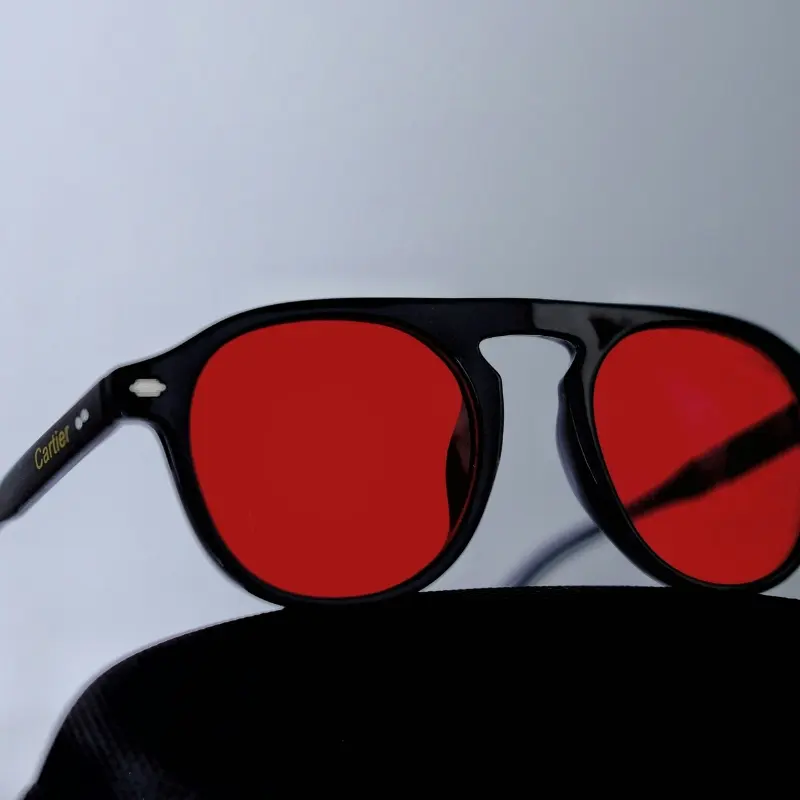
Amber-tinted lenses provide the strongest blue light filtering of the three options — typically 70–95% across the 380–500nm range, with filtering at 455nm often reaching 90% or above. Amber lenses achieve this by blocking not just the short-wave blue-violet range but a substantial portion of the longer-wave blue range as well, often extending filtering into the blue-green portion of the spectrum (up to approximately 520–550nm for the deepest amber tints).
The tradeoff is significant and should be communicated honestly to customers: amber lenses produce substantial color distortion. The world viewed through an amber lens has most blue removed — colors shift toward yellow, orange, and red; blue objects appear gray or dark; and screen color calibration becomes meaningless for any work requiring color accuracy. This is not a quality defect — it is the physical consequence of the level of filtering the lens is providing.
For the use cases where amber lenses are genuinely appropriate, this tradeoff is accepted willingly. The melatonin-suppression research most frequently cited in support of blue light glasses specifically focuses on wavelengths in the 450–500nm range, the portion of the spectrum most associated with circadian rhythm effects. Amber lenses, by filtering this range substantially, have stronger scientific standing than clear or yellow lenses for sleep-focused blue light applications — they are the lens type closest to what the relevant research has actually used.
Amber lenses are best suited for:
- Evening use and sleep-focused applications, where the goal is suppressing circadian-disrupting light in the 2–3 hours before sleep
- Gaming brands positioning at the performance end of the market, where maximum filtering and high contrast are valued over color accuracy
- Any product making a specific, substantiated claim about melatonin support or sleep preparation — amber lenses provide the filtering level that can most directly support this positioning
- Markets and customer segments that prioritize functional performance over aesthetics and are willing to accept the visual experience amber lenses provide
What Lens Color Means for Your Product Line
The lens color decision is ultimately a product positioning decision, and it should be made deliberately rather than defaulting to whichever option feels most “safe.”
Daytime, Office, and Fashion Positioning
Clear lenses are the right choice for products positioned for daytime, professional, or fashion use where visual normality is a priority. The key communication challenge is being honest about filtering levels — not overstating what the lens provides at the wavelengths that matter most for screen use, and focusing messaging on the comfort and color-accuracy benefits rather than maximum protection claims.
For brands developing a clear lens product, the transmission spectrum at 455nm is worth knowing and being specific about. A claim like “filters 25% of blue light at 450–455nm” is honest, specific, and does not overreach. A general claim like “blocks harmful blue light” without wavelength specificity is harder to defend.
Gaming and Evening Use Positioning
Yellow and amber lenses are the right choice for products positioned for intensive screen use, gaming, or evening blue light management. Both require communicating the color tint experience accurately at point of sale — a customer who does not understand that yellow-tinted lenses will change the appearance of their screen is a customer who will return the product.
The stronger filtering performance of yellow and amber lenses can be documented and communicated with specific numbers in a way that clear lenses cannot. For brands in this category, the transmission spectrum is a marketing asset, not just a technical document — it allows a brand to say “our lenses filter 50% of blue light at 455nm” with supporting data.
Multi-SKU Collections
For brands building a collection rather than a single product, the three lens colors map naturally to a good/better/best structure: clear for the entry/fashion positioning, yellow for the mid-range/performance positioning, amber for the premium/sleep-focused positioning. Each tier has a distinct use case, a distinct filtering level that can be documented, and a distinct price point. This structure allows a brand to address multiple customer segments without the products competing against each other.

How to Specify Filtering Performance in Your Brief
When working with a manufacturer on a blue light glasses line, the lens color choice needs to be accompanied by specific filtering requirements rather than treated as a purely visual decision.
For each lens color, the brief should specify:
- Target filtering percentage at 455nm specifically — this is the most meaningful single-wavelength reference for screen-use products
- Target filtering percentage across the full blue light range (380–500nm) — the broader measure
- Whether the filtering mechanism is surface coating, in-mass substrate, or hybrid — this affects both the filtering profile and the cost structure, as covered in How Blue Light Filtering Lens Coatings Actually Work
- Required test documentation — a transmission spectrum of the approved lens should be part of sample approval, as covered in Blue Light Glasses Testing Standards: What Certifications Matter for B2B
- Acceptable color distortion range — for clear lenses, this is minimal; for amber lenses, the brand should understand and accept the color experience before committing to production
At Sailook, lens color and filtering specification are confirmed together as part of the initial product brief, because the lens affects the transmission spectrum documentation, the product claims the brand can make, and the customer experience the product delivers. These are not separable decisions.
FAQ
Do clear blue light lenses actually work? Yes, but with important qualification on what “work” means. Clear blue light lenses typically provide 10–30% filtering across the full 380–500nm blue light range, with stronger filtering (50–95%) in the shorter blue-violet range below 430nm. Their limitation is at 455nm — the peak LED screen emission wavelength — where most clear lenses provide relatively weak filtering (often 10–20%) to preserve the clear appearance. For daytime comfort and color-accuracy applications, clear lenses serve their purpose. For maximum blue light reduction at screen-relevant wavelengths, yellow or amber lenses are more effective.
Why do amber lenses distort colors so significantly? Amber lenses block a substantial portion of the blue and blue-green wavelengths (roughly 380–500nm and sometimes beyond). Since these wavelengths are what gives blue objects their blue appearance, removing them causes colors to shift toward warm tones — yellows, oranges, and reds appear more intense while blues appear muted or gray. This is a physical consequence of the filtering mechanism, not a manufacturing defect. For evening and sleep-focused use, the tradeoff is appropriate because the circadian-disrupting wavelengths targeted by amber lenses (around 450–500nm) are the same ones that affect melatonin suppression.
Which lens color is best for gaming? Yellow-tinted lenses are the most common choice for gaming blue light glasses, for two reasons: they provide stronger filtering than clear lenses at screen-relevant wavelengths, and the contrast-enhancing effect of the yellow tint has practical value for extended gaming sessions. Amber lenses provide even stronger filtering but are better suited to evening use or players who prioritize maximum protection over screen color accuracy. Most gaming eyewear brands use yellow or light amber lenses as their standard lens.
Can the same frame style use different lens color options? Yes. The same frame mold can typically be fitted with different lens colors — clear, yellow, or amber — as separate SKUs within the same collection. This is how many brands structure a product line: one frame style with multiple lens color options, each positioned for a different use case. From a production standpoint, the frame and hinge are the same across the SKUs; the lens specification differs. Confirm with your manufacturer that the frame’s lens retention system works with the lens thickness and material specification for each tint option.
How should I communicate the color distortion from amber lenses to customers? Directly and specifically, at point of sale. The most effective approach is to show the lens tint clearly in product images, state the expected visual experience explicitly (“lenses produce a warm amber tint that shifts screen colors toward yellow”), and position the color shift as a feature of the filtering level rather than a downside. Customers who understand the experience in advance adapt to it readily; customers who are surprised by it return the product. For amber lenses, the visual experience is part of the product’s value proposition — filtering at this level is what sleep-focused blue light glasses require, and the color shift is the evidence that the filtering is real.
What is the 455nm wavelength and why does it matter? 455nm is approximately the peak emission wavelength of the LED backlights used in most modern screens — smartphones, laptops, monitors, and televisions. It is the specific wavelength most commonly associated with blue light from digital screens, making it the most relevant single reference point for evaluating how well a lens performs for screen use. A lens that filters 80% below 420nm but only 10% at 455nm provides little protection at the wavelength actually emitted by screens. When evaluating or specifying a blue light lens, the 455nm performance is the most meaningful single data point to request.

Summary
Clear, yellow, and amber blue light lenses represent three distinct points on a spectrum between color accuracy and filtering strength — and all three have legitimate product applications when matched to the right use case. Clear lenses prioritize visual normality at the cost of limited filtering at screen-relevant wavelengths. Amber lenses prioritize maximum filtering at the cost of significant color distortion. Yellow lenses occupy the middle with meaningful filtering and moderate color impact. For brands, the lens color decision is a positioning decision that determines what the product can truthfully claim, which customer segment it serves, and how the product experience needs to be communicated. Specifying filtering performance at 455nm — not just across the full blue light range — is the most useful single technical reference for any screen-use blue light product.
For Sailook’s full range of blue light glasses lens options, visit our blue light blocking glasses page.
Let's get started!
Get in touch with a custom eyewear specialist now for a free consultation and instant price quote.
WHATSAPP ME GO!
📱 Scan with your phone to start chatting