Pet Sunglasses Sizing & Fit Guide: How to Fit Different Dog Breeds and Head Shapes
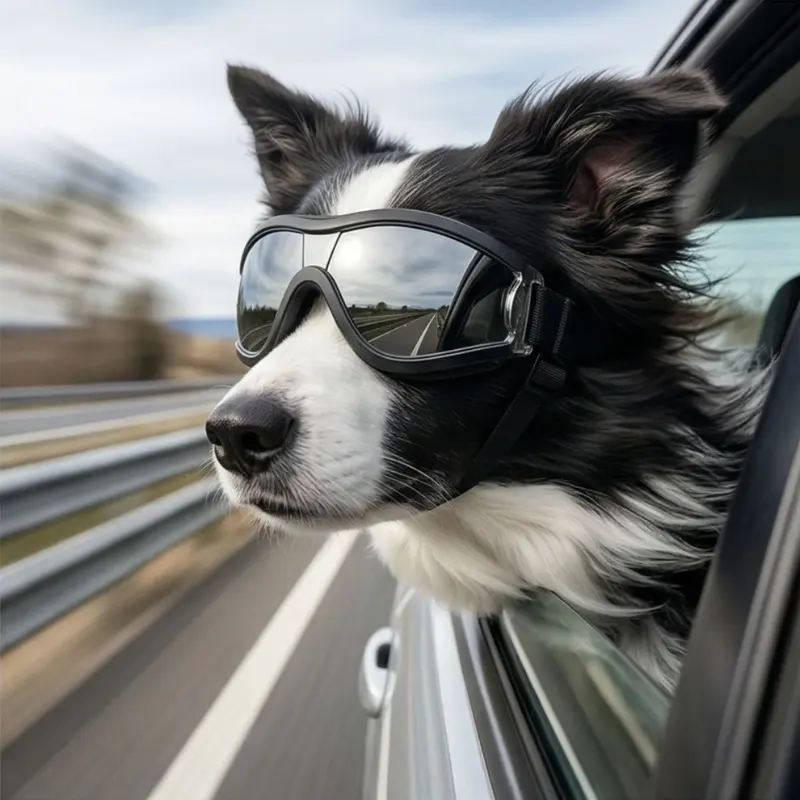
Order pet eyewear by breed or weight alone and you’ll get returns. A Bulldog and a Boxer can weigh the same and still need two completely different frames.
Pet eyewear fit comes down to three measurements: head circumference, muzzle circumference, and the eye-to-eye width across the face. Breed and weight are useful starting points, but two dogs of the same breed can still need different sizes, since head shape varies more than most buyers expect.
The bottom line? A size chart built around real measurements will always outperform one built around breed names. Here’s how to measure, read a chart correctly, and — if you’re building a product line — decide how many sizes you actually need.
The Three Measurements That Actually Determine Fit
Most sizing problems trace back to skipping a measurement, not measuring wrong.
The three measurements that determine pet eyewear fit are head circumference (about an inch behind the eyes), muzzle circumference (behind the mouth, measured with the jaw closed), and eye-to-eye width (outer corner of one eye to the outer corner of the other). Frame width should match the eye-to-eye number; strap length should match the head circumference.
Head circumference sets the strap sizing. This measurement is taken roughly an inch behind the eyes, where a goggle strap naturally sits on the forehead. It’s the number most brands recommend prioritizing if a dog falls between two sizes, since a strap that’s too tight around the head causes more discomfort than a slightly loose muzzle strap.
Muzzle circumference sets the lower strap or chin strap, and it’s measured with the dog’s mouth closed, around the back of the mouth rather than close to the nose. Dogs with a narrow skull and a wide muzzle, or the reverse, are exactly why this measurement can’t be skipped even when head circumference is already known.
Eye-to-eye width decides frame width specifically, separate from either strap measurement. This is measured from the outer corner of one eye across the bridge of the nose to the outer corner of the other eye. A frame with the right strap sizing but the wrong eye-to-eye width will still sit crooked or press against one side of the face.
How to Measure Your Dog for Pet Eyewear (Step-by-Step)
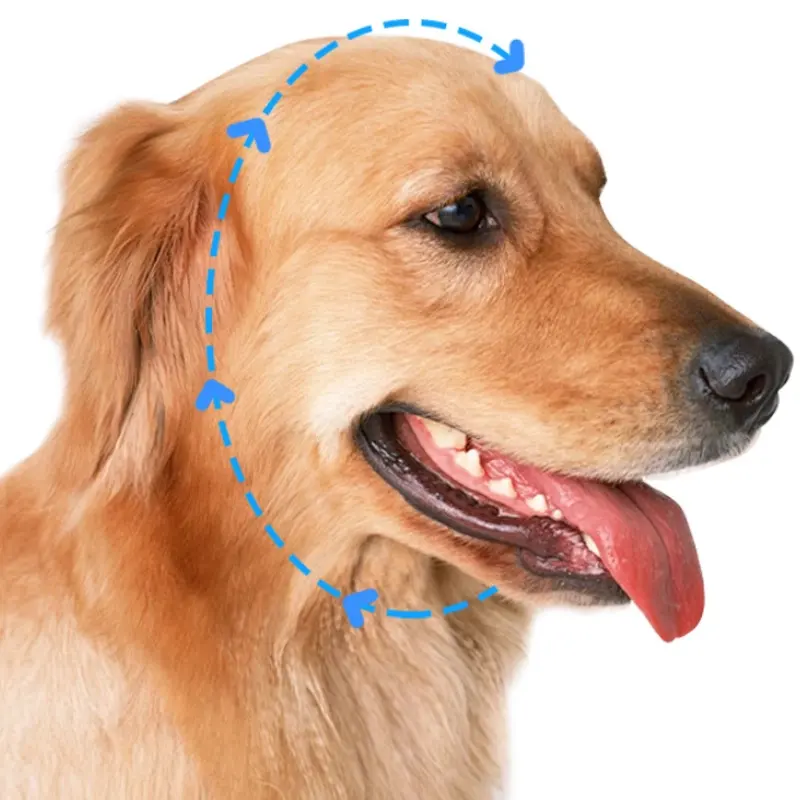
A flexible tape measure gives the cleanest numbers, but a piece of string and a ruler work almost as well.
To measure a dog for pet eyewear: wrap a flexible tape around the head about an inch behind the eyes for head circumference, around the muzzle behind the mouth (jaw closed) for muzzle circumference, and across the face from outer eye corner to outer eye corner for frame width. Take all three before checking a size chart.
Start with the dog standing or sitting calmly, since a hunched or stretched posture can shift the numbers slightly. Wrap the tape snugly around the head, without slack, but not so tight that it compresses fur or skin. If a flexible tape isn’t available, a piece of string works the same way: wrap it around the head, mark where the ends meet, then lay it flat against a ruler.
Muzzle circumference should always be taken with the mouth closed, since an open-mouth measurement runs larger and leads to an oversized fit around the nose bridge. This measurement sits toward the back of the mouth rather than close to the nostrils, roughly where a chin strap would naturally rest.
Eye-to-eye width is the trickiest of the three to get consistently, since it involves keeping the tape flat across a curved surface. Measuring in front of a mirror, or with a second person holding the dog steady, tends to produce a more reliable number than measuring solo.
Write all three measurements down before opening a size chart. A dog whose head circumference lands in one size and whose eye-to-eye width lands in another isn’t unusual, and knowing both numbers up front avoids a return-and-reorder cycle.
Why Brachycephalic Breeds Need a Different Size Category
A general size chart built around an average head shape will consistently under-fit flat-faced breeds, and it’s worth understanding exactly why.
Brachycephalic breeds like French Bulldogs, Pugs, and Boston Terriers have wider, flatter heads relative to their muzzle length, along with eyes that sit closer to the surface of the face. Standard size charts built for longer-snouted breeds don’t map onto this head shape, which is why several eyewear brands offer a dedicated “wide” or brachycephalic-specific size.
The core mismatch is proportional, not just a matter of overall size. A brachycephalic dog often has a head circumference similar to a medium-sized standard breed, but a much shorter, wider muzzle and eyes positioned further apart and closer to the surface. A standard-proportion frame sized to that head circumference will typically pinch the muzzle strap and sit too close to the eyes, which is exactly the lens cup depth problem covered in pet eyewear construction.
Some established goggle brands solve this with a specific “wide” size line, sized separately from their standard S–XL range and explicitly excluded from it — a standard Small won’t fit a Pug correctly no matter how the strap is adjusted, and a brachycephalic-specific size won’t fit a Greyhound. For a brand or factory planning a size range, this isn’t an edge case to fold into an existing chart; it’s effectively a second, parallel sizing system built around a different head-to-muzzle ratio.
Reading a Size Chart: What Head Circumference Ranges Actually Mean
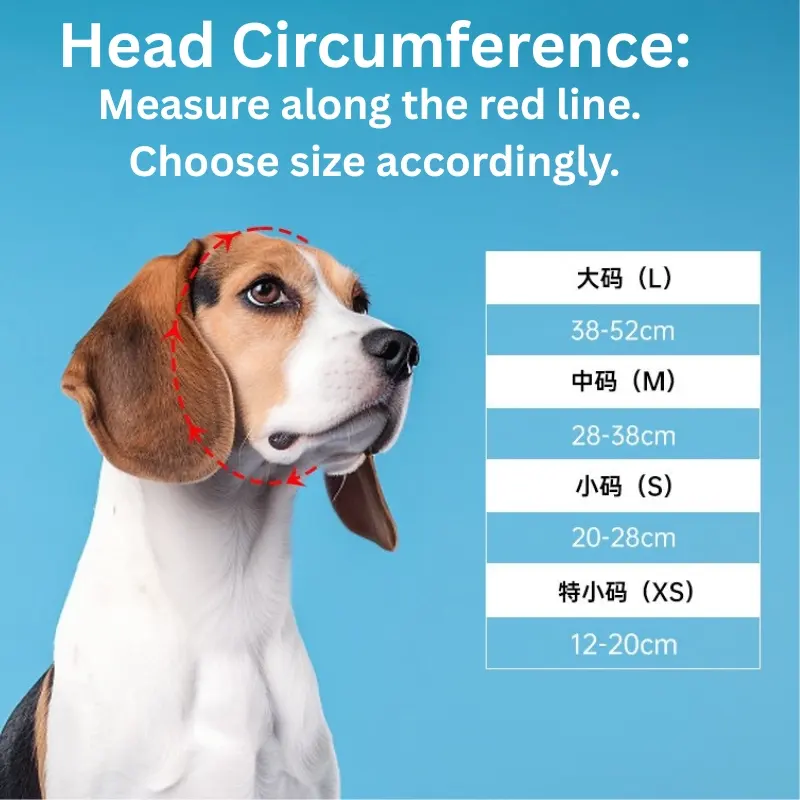
A size chart with four columns and cryptic labels like “S,” “M,” “L” doesn’t tell a buyer much on its own.
A usable pet eyewear size chart lists a head circumference range and a muzzle circumference range for each size, in both inches and centimeters, along with clear breed examples for reference — not breed names as the primary sizing method. Overlap between adjacent sizes should favor sizing up when a dog’s measurements fall on a boundary.
Head circumference ranges typically span 4–6 cm per size step in most goggle sizing systems on the market, moving from a small size around 20–27 cm up through extra-large sizes in the mid-40s. Muzzle circumference ranges follow a similar step pattern, usually a slightly narrower band per size than the head measurement. What a well-built chart adds beyond the raw ranges is a labeled brachycephalic or “wide” option that sits outside this standard progression, plus a note on which measurement to prioritize when a dog’s numbers span two sizes.
Breed examples on a size chart work best as a sanity check, not a shortcut. A chart that lists “fits: Beagle, Cocker Spaniel” next to a Medium size is useful for a buyer trying to get a rough sense of scale, but the actual purchase decision should still come from the tape measure, since individual dogs within any breed can vary by a size or more.
How Many Size Tiers Should a Pet Eyewear Product Line Actually Have?
For a brand or factory planning a new pet eyewear line, sizing isn’t just a customer-facing chart — it’s one of the decisions worth locking down when specifying a custom order, made months before the chart gets published.
Most working pet eyewear lines land on three to four standard size tiers covering small, medium, and large (sometimes split into large/XL), plus a separate brachycephalic-specific size. Fewer tiers simplify tooling and inventory but increase returns from poor fit; more tiers improve fit but add mold cost and lead time.
Three to four standard tiers tend to cover the bulk of the market without requiring a mold for every possible head size, since most standard-proportion breeds fall along a fairly predictable curve from small to large. Going beyond four or five standard tiers usually produces diminishing returns — the fit improvement per added size gets smaller, while the tooling and inventory cost per size stays roughly constant.
The brachycephalic tier is the one size range worth treating as non-negotiable rather than optional, given how consistently flat-faced breeds appear across pet ownership data and how poorly they fit standard-proportion frames. A brand skipping this size isn’t simplifying its lineup; it’s excluding a meaningful share of potential buyers who will bounce off the product after one bad fit experience.
Getting this sizing grid locked before development starts, rather than adjusting it after a first mold is cut, is where the real cost savings sit — a size range built around actual measurement data from multiple breed groups avoids the far more expensive path of remolding a size that turns out not to fit its intended breed group.
Conclusion
Fit comes from measurements, not breed names — get the sizing grid right before a single mold gets cut, and returns stay low from day one.
Frequently Asked Questions
What’s the most accurate way to measure a dog for pet eyewear?
Take three measurements: head circumference about an inch behind the eyes, muzzle circumference behind the mouth with the jaw closed, and eye-to-eye width across the bridge of the nose. All three matter — one alone isn’t enough.
Can I choose a size based on breed or weight alone?
Not reliably. Dogs within the same breed can vary by a full size or more due to individual head shape differences. Breed and weight are useful starting points, but actual measurements should decide the final size.
Why do brachycephalic breeds need a different size category?
Flat-faced breeds like Pugs and French Bulldogs have wider, shorter heads with eyes positioned closer to the surface of the face. Standard size charts built for longer-snouted breeds don’t fit this proportion, which is why a separate “wide” or brachycephalic size exists.
What should I do if my dog’s measurements fall between two sizes?
Prioritize head circumference over muzzle circumference when in doubt, and size up rather than down. A slightly loose muzzle strap is usually more comfortable than a head strap that’s too tight.
How many sizes should a pet eyewear product line offer?
Most established lines use three to four standard sizes plus a dedicated brachycephalic size. Fewer sizes simplify production but raise fit-related returns; more sizes improve fit but add tooling cost and lead time.
Let's get started!
Get in touch with a custom eyewear specialist now for a free consultation and instant price quote.
WHATSAPP ME GO!
📱 Scan with your phone to start chatting