Acetate Optical Frames vs Acetate Sunglasses: What Actually Changes in Frame Construction
If you already source acetate sunglasses, it’s tempting to assume optical frames are just “the same thing, minus the tint.” Same sheet acetate, same cutting and polishing line, same factory. On paper, that’s true. In practice, one single variable changes almost everything about how the frame has to be engineered: what happens to the lens after the frame leaves our factory.
A sunglasses lens is finished the day it ships. An optical frame ships with a demo lens in the groove too — but that demo lens isn’t the final product. It’s a flat, thin placeholder whose real job is holding the frame’s shape during transit and on the shelf, so the rim doesn’t warp before it ever reaches an optician. The demo lens gets popped out and replaced with a real prescription lens months later, in a country you’ll probably never visit, by an optician who has never seen your frame before. That one difference — what’s really happening to the groove after it leaves the factory — cascades into at least four real construction decisions. Here’s what actually changes.
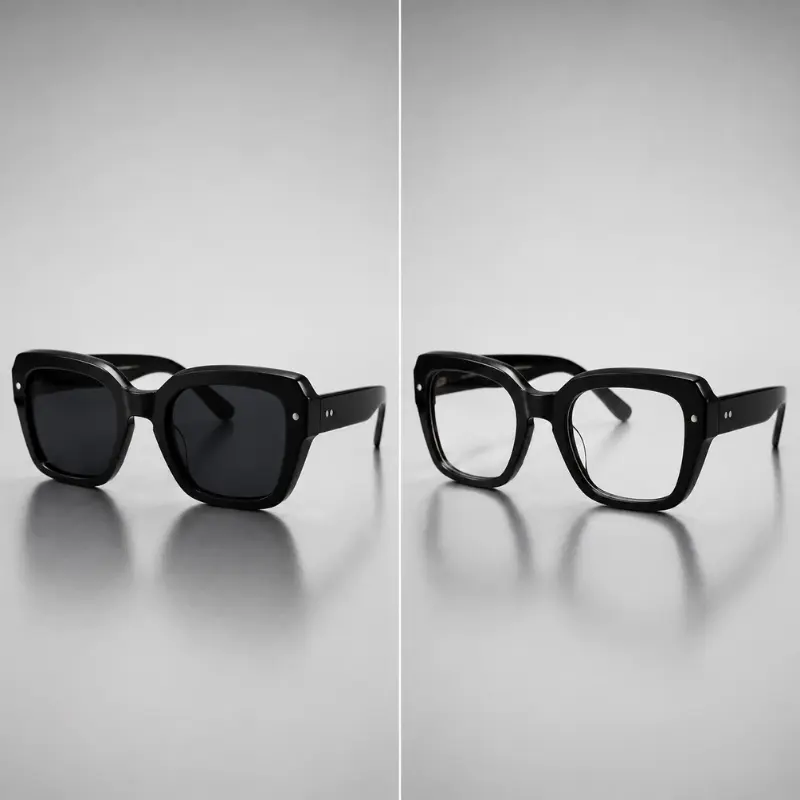
The Same Material, Two Different Jobs
Both product lines start from the same cellulose acetate sheet, cut, filed, and polished through the same production stages. The frame front, temples, and hinge assembly all follow a similar workflow whether the end product is a sunglass or an optical frame. Where they split is downstream: a sunglasses lens is shaped, tinted, and mounted at the factory as a finished functional part. An optical frame ships with only a thin, flat placeholder — a demo lens — and the rim is really being built for a lens that doesn’t exist yet.
That single fact is why an optical frame mold can’t simply be “a sunglasses mold without the color.”
1. The Lens Groove: A Finished Seat vs. a Waiting Socket
On a sunglasses frame, the lens groove holds a lens that was cut to its final shape and curve at the point of manufacture. Once it’s snapped in, it’s done — no further adjustment happens after it leaves the factory.
On an optical frame, that same groove is cut to a standard angle and depth — commonly close to a 120° bevel around 1.5mm deep — sized to receive a prescription lens edged later by an independent lens lab through a process called glazing. The frame isn’t holding a finished part; it’s holding a socket that has to be dimensionally consistent enough for an optician on the other side of the world to fit an unknown lens into it, weeks or months after the frame ships.
This is also why an optical frame’s groove tolerance matters more than people expect. Too tight, and local labs struggle to seat lenses cleanly. Too loose, and the lens rattles. Getting that groove spec right — and holding it consistently across a production run — is one of the quieter quality markers that separates a frame factory from a lens factory pretending to make frames.

2. Base Curve: Why Optical Frames Stay Flatter
This is the difference most buyers never think about until a customer complaint lands on their desk.
Base curve is how much a frame front wraps around the face. Sunglasses can push toward a higher wrap — 6 to 8 base curve or more — because the lens inside is either plano or a simple tint, and a stronger wrap just means a sportier look and more coverage. Optical frames, by contrast, are almost always built on a flatter curve, typically close to a 4 base. The reason isn’t style — it’s optics. The higher the base curve, the more a prescription lens distorts at the edges, especially at stronger powers, producing the “fishbowl” effect and prismatic errors that opticians have to correct for with digital surfacing.
At Sailook, our acetate optical frame molds are kept in a low-to-moderate base curve range specifically so they stay compatible with the widest possible span of prescriptions your local lens labs will need to glaze — instead of designing a frame that looks great empty and then quietly limits what powers a customer can actually wear in it.
If your product team is used to briefing sunglasses molds, this is the one spec worth double-checking before you approve an optical frame design: a base curve that photographs well on a sunglasses sample can become a real fitting problem once a customer tries to put a -6.00 lens into it.
3. Rim Thickness: Building in Room for a Lens You Haven’t Seen Yet
A sunglasses rim can be engineered around a known, fixed lens thickness — the factory controls both sides of that equation. An optical frame rim has to leave enough visual and structural margin to accommodate lenses that could range from a thin single-vision lens to a much thicker high-power lens edged at a local lab. That’s part of why optical acetate rims are rarely cut razor-thin in the same way some fashion-forward sunglasses styles are — a rim with almost no margin looks fine with the thin, flat demo lens the frame ships with, and becomes a problem the moment a real prescription lens is edged into it.
This connects directly to frame shape choice for higher prescriptions, which is worth its own conversation if you’re sourcing frames for a market with a lot of stronger-power wearers.
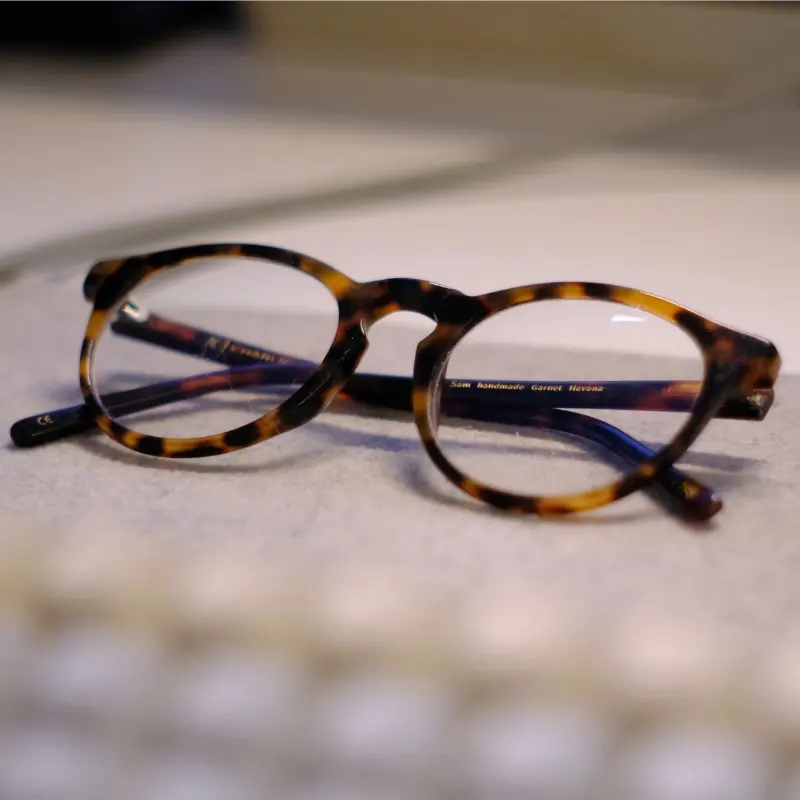
4. Rimless and Semi-Rimless: Finished Assembly vs. Field Assembly
Rimless and semi-rimless construction is where the “same material, different job” idea shows up most visibly.
On rimless sunglasses, the lenses are mounted to the bridge and end-pieces during manufacturing — the frame arrives as a complete, closed system. On rimless optical frames, the lenses are drilled and screwed into the bridge and end-pieces by the lens lab, after the prescription lens has been edged — the frame you receive is really a mounting kit, not a finished eyewear. Semi-rimless follows the same logic: a sunglasses semi-rim usually has its nylon “supra” cord fitted at the factory, while an optical semi-rim’s supra channel is prepared but installed later, once the local lab has your customer’s lens in hand.
If you’re planning a rimless or semi-rimless optical style, it’s worth confirming with your supplier how the mounting points are engineered for field assembly — it’s a different set of tolerances than a rimless sunglasses mold.
Where Construction Actually Stays the Same
To be fair to the “it’s basically the same frame” instinct — some things really don’t change. Hinge selection (barrel, spring, or hidden), nose pad or bridge design, and general temple engineering follow largely the same logic across sunglasses and optical frames, because none of those components care what’s happening inside the lens groove. If you’ve already worked through hinge specs for a sunglasses program, most of that thinking carries over directly to your optical frame briefs.
What This Means When You’re Briefing Your Manufacturer
If you’re moving from an acetate sunglasses line into optical frames for the first time, the questions worth asking your factory shift slightly:
- What lens groove depth and bevel angle do you cut to, and how consistent is it across a production run?
- What base curve range do your optical molds sit in, and has it been checked against a realistic prescription range?
- How much rim margin is built in around the groove for higher-power lenses?
- For rimless or semi-rimless styles, are the mounting points designed for lab assembly rather than factory assembly?
None of these show up in a product photo. They only surface once a real prescription lens meets the frame — which, for most factories, happens after the sale is already made. It’s also worth being clear with your own customers about what’s actually included in the box: an optical frame from an OEM factory typically ships with a demo lens in place, not a finished prescription lens, and getting that expectation right upfront avoids a lot of after-sales confusion.
Frequently Asked Questions
Can the same acetate mold be used for both sunglasses and optical frames?
Not usually without modification. Even when a style shares the same silhouette, the base curve and groove depth typically need to be adjusted for an optical version, since the groove has to accommodate a range of future prescription lenses rather than one finished lens shaped at the factory.
Why do optical frames look flatter than sunglasses?
It comes down to base curve. Optical frames are generally built on a flatter curve — often close to 4 base — because a flatter frame front minimizes distortion for prescription lenses, especially at stronger powers. Sunglasses can use a higher, more wrapped curve since the lens inside doesn’t need to accommodate a prescription.
Can you put a prescription lens into a sunglasses frame?
In some cases, yes, but it depends on the frame’s base curve and groove design. High-wrap sunglasses frames often require specialized digital surfacing to compensate for distortion, and not every sunglasses mold is designed with prescription glazing in mind the way an optical frame is.
What’s the difference between a demo lens and a prescription lens?
A demo lens is the flat, thin placeholder that ships inside an optical frame to hold its shape during transit and display. It isn’t meant to be worn for vision correction — a local optician removes it and replaces it with a lens ground to the customer’s prescription.
Do optical frames and sunglasses use the same hinges?
Largely, yes. Hinge selection — barrel, spring, or hidden — follows similar logic across both product types, since hinge components don’t interact with whatever is happening inside the lens groove.
Same acetate, same factory floor, genuinely different frame — and it’s worth briefing it that way rather than treating your acetate optical frames program as a tinted copy of your sunglasses line.
Let's get started!
Get in touch with a custom eyewear specialist now for a free consultation and instant price quote.
WHATSAPP ME GO!
📱 Scan with your phone to start chatting