MOQ and Sourcing for Optical Frame Programs: What Actually Changes From a Sunglasses Order
If you’ve already sourced acetate sunglasses, the MOQ conversation for an optical frame program can feel oddly familiar. The numbers your supplier quotes — a per-style minimum, a per-colorway minimum — often land in the same range you’ve seen before. But the number being the same doesn’t mean the strategy around it should be. What you do with that minimum order quantity, how you split it across colors, and how you plan the order after the first one is where an optical frame program and a sunglasses program genuinely part ways.
Where the MOQ Number Actually Comes From
Before getting into what’s different, it’s worth being clear on why an MOQ exists at all — because this part is the same for both product lines. A frame factory isn’t setting a minimum order quantity arbitrarily. It’s passing along a constraint that comes from further up its own supply chain. Acetate sheet is purchased in bulk rolls, not custom-cut per order. Hinges, screws, and other hardware come from subcontractors who have their own minimum production runs. A new mold or die has a fixed cost that only makes sense to amortize across a certain volume. Your factory’s MOQ is really the sum of everyone else’s MOQ, several layers upstream.
At Sailook, our acetate MOQ sits at 300 pieces per style, with a 100-piece minimum per colorway — and that’s true whether the frame in question ends up as a sunglass or an optical frame. The number doesn’t change based on what’s going in the lens groove. What changes is everything downstream of that number.
Color Strategy: Sunglasses Chase Trends, Optical Frames Build a Core
This is where the two product lines start to diverge in a way that actually matters for how you brief your first order.
Sunglasses are a trend-driven, seasonal category. Buyers sourcing acetate sunglasses are often comfortable spreading a style across five or six colorways — a gradient tortoise, a translucent pastel, a bold seasonal color — because the category rewards variety and a new drop every season justifies the risk of a slower-moving shade. If one colorway underperforms, it’s a smaller loss inside a larger seasonal bet.
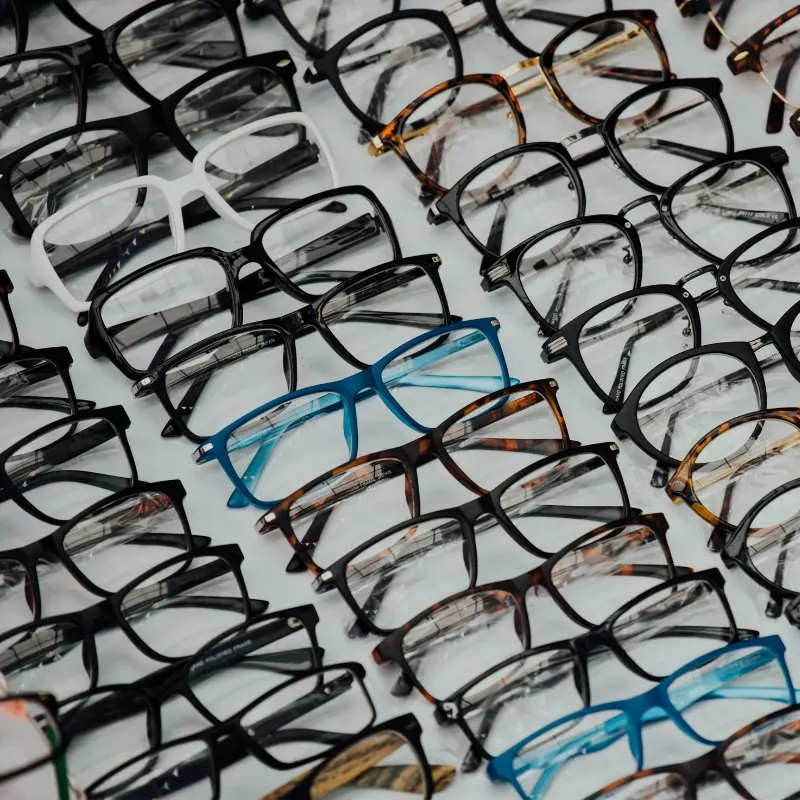
Optical frames don’t behave the same way in the market. A pair of prescription glasses is worn daily, for years in many cases, and the buying decision leans conservative. Frame colorists and opticians consistently point to the same handful of shades doing the heavy lifting across most collections — black, classic tortoise, crystal or translucent, and a handful of muted neutrals — with brighter or trend-driven colors playing a much smaller supporting role. The retail pattern backs this up: most people settle on two or three frame colors they rotate between, not a rack full of seasonal statement pieces.
That has a direct, practical consequence for how you spend a 100-piece colorway minimum. Spreading it thin across five trend colors on an optical style usually means four of them sell slowly while the fifth — almost always the black or the tortoise — needs a reorder within weeks. It’s usually a better sourcing decision to concentrate your first order in two or three core, evergreen colorways and treat anything more fashion-forward as a smaller test addition once the core colors have proven demand, rather than splitting the same minimum order quantity the way a sunglasses buyer would.
Order Rhythm: Sunglasses Bet on a Season, Optical Frames Run on Reorders
The second real difference is timing, not quantity.
A sunglasses order is usually planned around a season — spring/summer or a specific sales window — with one larger order meant to carry the collection through that period. Demand is compressed into a few months, so the sourcing plan compresses with it.
Optical frames sell at a steadier pace year-round. There’s no equivalent to sunglasses weather; someone needs a new pair of glasses whenever their prescription changes or their old pair breaks, which happens on its own schedule, not a seasonal one. That steadier demand curve makes a “smaller first order, planned reorder cadence” approach a more natural fit than the single seasonal bet common in sunglasses sourcing. It’s worth discussing reorder lead times with your supplier upfront — how long a repeat order takes once a mold and colorway are already established — so a reorder can be placed before existing stock actually runs out, rather than after.

Buyer Profile: Independent Opticians Show Up More in Optical Programs
The last difference is about who’s actually placing the order, and it shapes both of the points above.
Sunglasses buyers sourcing from an OEM factory are more often brand teams planning a seasonal collection launch — larger, less frequent orders tied to a marketing calendar. Optical frame programs bring in a noticeably higher share of independent opticians and small optical retailers alongside brand buyers: businesses building a private label collection to sit alongside branded frames on their own shop floor, often starting cautiously with a narrower style and color range before expanding.
For this buyer type, the color and reorder logic above isn’t just a nice-to-have — it’s usually the deciding factor in whether a first order feels manageable. An independent optician weighing a private label collection is typically less interested in matching a sunglasses brand’s five-colorway seasonal drop, and more interested in a smaller, well-chosen core range they can display confidently and reorder predictably. If you’re sourcing for this kind of program, it’s worth asking your supplier directly whether they’re set up to support a narrower first order with a clear reorder path, rather than assuming the sunglasses playbook will transfer over.
Planning Your First Order
Put together, the practical takeaway looks less like a sunglasses order and more like this: confirm the same MOQ numbers you’d expect from any acetate program, but plan to concentrate your colorway minimums in two or three core shades rather than spreading them thin, budget for a steady reorder cadence instead of one seasonal bet, and be upfront with your supplier about whether you’re sourcing for a brand launch or a smaller retail program — because that context should shape the plan, even when the MOQ on the quote sheet looks identical either way.

Frequently Asked Questions
What is a typical MOQ for acetate optical frames?
MOQs vary by supplier, but a common structure is a per-style minimum alongside a smaller per-colorway minimum — for example, 300 pieces per style with a 100-piece minimum per colorway. This is usually the same whether the frame is being built as a sunglass or an optical frame.
Can I reduce my MOQ by ordering fewer colors?
Usually not below the per-style minimum, since that number is tied to mold and cutting costs rather than color count. What you can control is how you split that minimum across colorways — concentrating on two or three core colors rather than spreading it across many.
Is optical frame MOQ different from sunglasses MOQ?
The number itself is often the same, since both draw on the same acetate sheet, hardware, and mold costs. The difference is in strategy: how you allocate colorway minimums and plan reorders tends to follow a different logic for optical frames than for sunglasses.
How often should I reorder optical frames?
Because optical frames sell at a steadier, less seasonal pace than sunglasses, a planned reorder cadence usually works better than a single large seasonal order. It’s worth confirming reorder lead times with your supplier in advance so a repeat order can go in before stock actually runs out.
Can independent opticians order lower quantities than brand buyers?
The factory MOQ itself typically doesn’t change based on buyer type, but independent opticians often benefit most from concentrating that MOQ in a narrow, well-chosen core color range rather than trying to match a brand’s broader seasonal color spread.
None of this changes the number your supplier quotes you. It changes what you do with it — and that’s usually the difference between a first order that sells through cleanly and one that leaves you with slow-moving stock in colors nobody was asking for. If you’re mapping out a program for your acetate optical frames collection, it’s worth having this conversation with your supplier before the purchase order, not after the first batch arrives.
Let's get started!
Get in touch with a custom eyewear specialist now for a free consultation and instant price quote.
WHATSAPP ME GO!
📱 Scan with your phone to start chatting