Rimless and Semi-Rimless Optical Frames: Hinge and Lens-Edge Considerations
“Rimless” and “semi-rimless” get grouped together constantly, as if they’re two sizes of the same minimalist idea. They’re not. Once you look at what’s actually holding the lens in place, the two constructions pull from different materials, put stress on different parts, and — for a frame supplier working primarily in acetate — call for two very different conversations with a buyer. This article separates the two, because sourcing one correctly depends on not confusing it with the other.

Two Different Constructions Wearing the Same Label
Semi-rimless is a genuine acetate product. The top half of the frame is a molded acetate rim, cut and polished the same way a full-rim frame is, and the lower half of the lens is held by a thin nylon cord — the “supra” — seated in a groove cut into the lens edge itself. Acetate is doing real structural work here.
Full rimless is a different story, and it’s worth being direct about it: genuinely all-acetate rimless frames are rare for a reason. In a true drill-mount rimless design, the bridge and end-pieces are screwed or bonded directly into holes drilled through the lens, and that mounting point carries real, ongoing mechanical stress every time the frame is put on, taken off, or flexed. Acetate is a thermoplastic — it’s dimensionally stable enough for a groove or a hinge barrel, but it isn’t the material anyone reaches for at a load-bearing drill point. That’s why the rimless frames on the market almost always pair metal hardware — usually titanium or stainless steel — for the bridge and end-pieces with acetate reserved for the temples, where it’s doing what it does best: adding color, pattern, and a comfortable, lightweight feel, without being asked to hold a lens in place under tension.
If you’re sourcing rimless as an acetate buyer, it’s worth going in with that expectation already set: you’re buying a hybrid construction, not a pure acetate one, and that’s not a compromise — it’s how the category is built industry-wide.
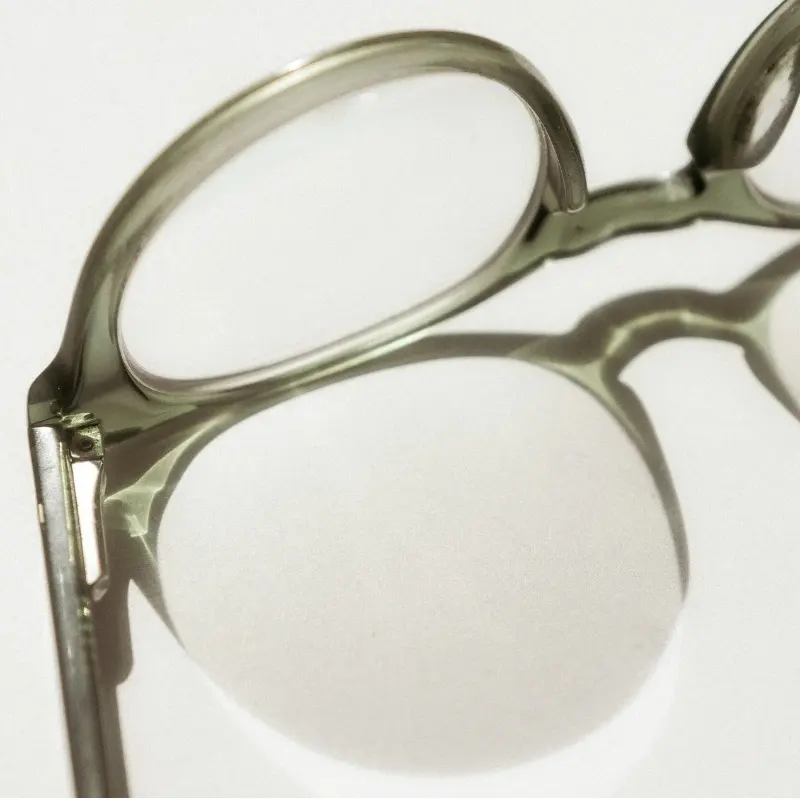
Full Rimless: Why the Load-Bearing Parts Are Metal, Not Acetate
The mounting hardware on a drill-mount frame typically comes in one of two styles: a screw-on system, where the bridge and temple ends pass through the drilled lens holes and are secured with nuts, washers, and screws; or a push-on system, where a compression sleeve is seated into the hole instead. Both put the lens itself under constant, low-level mechanical load, which is exactly why the metal components need to be dimensionally stable — they can’t creep or soften the way a thermoplastic under sustained pressure eventually might.
The hinge on a full rimless frame lives inside this same metal hardware. There’s no acetate end-piece housing a barrel hinge here the way there is on a full-rim frame — the hinge is built into the small metal end-piece fitting that’s already doing the job of gripping the lens. It’s a smaller, more integrated component than the hinge hardware buyers may be used to specifying on a full-rim acetate program, and it’s worth asking your supplier directly what hinge type and metal grade ships with a rimless style, since this is a part your factory is sourcing, not manufacturing from your acetate stock.
Semi-Rimless: Where Acetate Still Does the Structural Work
Semi-rimless keeps acetate in a genuinely load-bearing role, just a smaller one than full-rim. The upper rim holds the top of the lens the same way a full-rim groove does, while the supra cord anchors into the frame’s end-pieces to secure the lower edge. That anchor point is where quality actually shows up: if the end-piece doesn’t hold the cord’s tension consistently, the lens can shift or drop out of the lower channel over time. This is the same logic covered in our guide to acetate optical frame rim depth — groove and anchor-point consistency across a full production run matters more than any single sample looking right.

The Lens Material Requirement Both Styles Share
Regardless of which construction you’re sourcing, the lens going into it isn’t optional in terms of material. Standard CR-39 plastic and glass lack the tensile strength to survive a drilled mounting point — the stress concentrates right at the hole and can crack or chip the lens, particularly along the line running from the drill point out to the lens edge. Polycarbonate and Trivex are the two materials accepted industry-wide for drill-mount and nylor-groove designs, precisely because they flex under load instead of fracturing. Between the two, Trivex has the higher tensile strength and lower density, making it somewhat more resistant to stress fractures around mounting points over years of handling and temperature cycling; polycarbonate is the more budget-friendly option and remains a reliable standard choice.
There’s a useful rule of thumb worth knowing even though it’s your customer’s lens lab that applies it, not your factory: CR-39 shouldn’t be used in a drill-mount frame if the lens is going to be thinner than 2.0mm at its thinnest point, which becomes a real risk with astigmatism corrections that create uneven lens thickness across the surface. Passing this kind of detail along to a buyer building their first rimless or semi-rimless program is a small thing that heads off a support ticket later.
A Compatibility Detail Full-Rim Buyers Already Know — And Rimless Buyers Should Too
Acetate frame factories that also produce full-rim optical styles are usually already aware of a separate issue: polycarbonate lenses are generally avoided in full-rim acetate grooves. Cellulose acetate sheet is processed with plasticizers and residual solvents from manufacturing, and polycarbonate is a material that’s known to be sensitive to prolonged contact with certain solvent classes — the kind of contact that happens continuously when a lens bevel sits locked inside an acetate groove for years. This is why CR-39 or other lens materials are typically favored over polycarbonate for full-rim acetate builds.
That risk doesn’t carry over the same way to rimless and semi-rimless. On a full rimless frame, the lens never touches acetate at all — it’s held entirely by metal hardware — so there’s no equivalent contact point for this concern. On a semi-rimless frame, the exposure is smaller and more localized: only the upper portion of the lens sits against the acetate rim, while the lower portion held by the nylon cord has no acetate contact. Since polycarbonate and Trivex are already the required materials for the drilled and grooved sections of these styles, this generally isn’t the conflict it would be in a full-rim design — but it’s worth confirming with your own production team whether your factory’s acetate formulation shows the same behavior at that smaller upper-rim contact point, since this is exactly the kind of detail that’s easy to overlook until a customer reports it.
A Naming Mix-Up Worth Avoiding: “Nylon Lens” Doesn’t Mean What Most Buyers Think
One more detail worth clarifying before it causes confusion in a sourcing conversation. True nylon, or polyamide, is a real and well-established lens material — but it’s almost exclusively used for plano and tinted sun lenses, marketed specifically for its light weight and ease of drilling in rimless sunglass designs. It isn’t a material local optical labs typically use to grind prescription power. Separately, some opticians and lens suppliers use the word “nylon” casually to refer to Trivex, which is chemically a different, urethane-based material entirely. If a buyer asks for a “nylon lens” on a prescription rimless or semi-rimless order, it’s worth clarifying which of the two they actually mean, since the answer determines whether their local lab can even fill that request for an optical (rather than plano) build.

Frequently Asked Questions
Can acetate be used for the bridge and end-pieces on a rimless frame?
It’s uncommon. The bridge and end-pieces on a drill-mount rimless frame carry ongoing mechanical stress at the point where they attach to the lens, and metal — typically titanium or stainless steel — holds up to that load more reliably than a thermoplastic like acetate. Acetate is generally reserved for the temples on rimless styles.
What lens material is required for rimless or semi-rimless frames?
Polycarbonate or Trivex. Standard CR-39 plastic and glass lack the tensile strength to withstand a drilled mounting point or a tightly cut nylor groove, and are prone to cracking or chipping at those stress points.
Is Trivex the same thing as nylon?
No, though the two get confused often. True nylon (polyamide) is a separate material mostly used for plano sun lenses. Trivex is a urethane-based material sometimes called “nylon” colloquially by opticians, but the two are chemically distinct.
Why do full-rim acetate frames avoid polycarbonate lenses?
Cellulose acetate retains plasticizers and solvent residue from manufacturing, and polycarbonate can be sensitive to prolonged contact with certain solvent classes — a real factor when a lens bevel sits locked inside an acetate groove for years. This concern is much smaller on rimless and semi-rimless styles, where the lens either doesn’t touch acetate at all or only touches it along a small upper section.
Does a semi-rimless frame need the same hinge as a full-rim frame?
Largely, yes. Since the upper rim and end-pieces on a semi-rimless frame are molded acetate components similar to a full-rim frame, standard hinge types apply in the same way. It’s the lower, cord-secured portion of the lens — not the hinge — that follows different rules.
Rimless and semi-rimless might sit next to each other on a style sheet, but they’re sourced, engineered, and specified differently enough that treating them as interchangeable is where most of the after-sales surprises come from. If you’re adding either style to your acetate optical frames program, it’s worth having this conversation with your supplier before the design is locked, not after the first sample comes back from the lens lab.
Let's get started!
Get in touch with a custom eyewear specialist now for a free consultation and instant price quote.
WHATSAPP ME GO!
📱 Scan with your phone to start chatting