Bio-Acetate Sunglasses: Is Sustainable Eyewear Worth It for Your Brand?

Your retailer asks if your frames are sustainable. Your EU buyer mentions upcoming packaging regulations. Your Instagram audience is increasingly vocal about materials.
Bio-acetate is getting attention. But for a B2B brand buyer, the question isn’t whether sustainability is a good idea — it’s whether bio-acetate specifically is worth the cost premium, the production complexity, and the brand commitment it requires. The honest answer depends on your target market, your retail channel, and what you’re actually willing to claim.
This guide gives you the commercial reality of bio-acetate sunglasses — what the material actually is, what it costs, which markets genuinely respond to it, and where the risks are.
What Is Bio-Acetate? The Material Explained
Bio-acetate is not a completely different material from standard acetate. Understanding what actually changes — and what doesn’t — is essential before making any sourcing or brand claims.
Standard cellulose acetate is made from cellulose (from cotton linters or wood pulp) combined with petroleum-derived plasticizers — typically phthalate plasticizers. Bio-acetate uses the same cellulose base but replaces the petroleum-derived plasticizers with plant-based alternatives, typically derived from plant oils. The cellulose component was already plant-based in standard acetate. The change in bio-acetate is in the plasticizer, not the structural material.
The result is a material that is approximately 60–70% plant-based by content, compared to standard acetate which is typically 40–50% plant-based. The look, feel, color capability, and production process of bio-acetate is essentially identical to standard acetate — the difference is in the material’s end-of-life profile and its sourcing footprint.
Key bio-acetate suppliers — Italian, and domestic Chinese options
The two most commercially established bio-acetate sheet suppliers for eyewear are:
Mazzucchelli (Italy) — M49 bio-acetate: Mazzucchelli’s M49 is the benchmark bio-acetate product in premium eyewear. It uses plant-based plasticizers and is certified biodegradable under controlled composting conditions. M49 is the material referenced when premium brands market their frames as bio-acetate.
Eastman Acetate (US/Global): Eastman produces bio-based acetate using a chemical recycling process that incorporates bio-based content. Used by several major eyewear brands for sustainability claims.
Both products are significantly more expensive than standard acetate — the cost premium is real and meaningful at the brand economics level.
Chinese domestic bio-acetate suppliers — Jingyu, Jimei and others
Chinese domestic acetate sheet suppliers including Jingyu and Jimei have also developed bio-based and biodegradable acetate sheet options. These domestic bio-acetate products use plant-based plasticizers similar in concept to Mazzucchelli M49, but at a significantly lower cost premium over standard domestic acetate — typically 10–25% rather than the 20–40% premium associated with Mazzucchelli M49.
For brands targeting sustainability positioning at mid-range price points ($60–$120 retail), or for brands where the EU boutique buyer recognition of Mazzucchelli specifically is not a requirement, domestic bio-acetate is worth evaluating. The trade-off is certification recognition — Mazzucchelli M49 carries internationally recognized TÜV certification that premium EU buyers know by name. Domestic bio-acetate products may carry certifications, but the brand recognition of those certifications with international retail buyers is lower. Confirm specific certification details and recognition with your manufacturer before making sustainability claims based on domestic bio-acetate.
Bio-Acetate vs Standard Acetate: What Actually Differs
For brand buyers, the practical comparison matters more than the chemistry.
The visual and functional properties of bio-acetate are essentially identical to standard acetate. Color capability, pattern options, surface quality, polishing behavior, hinge fitting, and production process are the same. The differences that matter for brand decisions are cost, certifications, end-of-life claims, and what you can credibly say about the material to your customers.

| Factor | Standard Acetate | Bio-Acetate (e.g. M49) |
|---|---|---|
| Plant-based content | ~40–50% (cellulose only) | ~60–70% (cellulose + plant plasticizers) |
| Visual/aesthetic properties | Full color and pattern range | Full color and pattern range — identical |
| Surface quality | High gloss, polishable | High gloss, polishable — identical |
| Production process | Standard acetate process | Standard acetate process — identical |
| Biodegradability | No (standard landfill conditions) | Yes, under industrial composting conditions |
| EXW cost premium | Baseline | 20–40% higher than standard acetate |
| Certifications available | ISO 9001 | OK Biobased, TÜV biodegradable, others |
| Sustainability claim strength | Limited | Moderate — with important caveats |
| MOQ per colorway | 300 pcs | 300 pcs |
The cost premium of 20–40% over standard acetate is the most significant commercial variable. On a $12 EXW domestic acetate frame, bio-acetate adds approximately $2.50–$5.00 per unit. On a $18 EXW frame, the premium is $3.50–$7.00 per unit. Whether your retail price can absorb this depends on your market and customer.
The Honest Truth About “Biodegradable” Claims
This is the section most guides skip — and the one that matters most for brand risk management.
Bio-acetate is certified biodegradable — but the conditions required for that biodegradation are specific and not what most consumers imagine. Bio-acetate biodegrades under industrial composting conditions: sustained temperatures of 55–60°C, specific humidity levels, and active microbial environments. In a standard landfill — where the vast majority of discarded eyewear ends up — bio-acetate degrades only marginally faster than standard acetate. The difference is meaningful in the right conditions. It is not the consumer-facing “disappears naturally” story that some brands imply.
This matters because of greenwashing risk. Regulators in the EU and increasingly in the US are scrutinizing sustainability claims on consumer products. Vague claims like “eco-friendly frames” or “sustainable materials” without specific evidence are being challenged. A brand that claims bio-acetate frames are “biodegradable” without specifying that industrial composting is required is potentially making a misleading claim.
What you can credibly claim about bio-acetate
Credible claims:
- “Made with plant-based plasticizers”
- “60–70% plant-based content”
- “Certified biodegradable under industrial composting conditions”
- “Uses Mazzucchelli M49 bio-acetate” (if using M49 — the material name has brand recognition)
- “Reduced petroleum content versus standard acetate”
Claims to avoid:
- “Biodegradable” without qualification
- “Eco-friendly” as a standalone claim without specific material evidence
- “Sustainable” without context
- “Zero waste” or “plastic-free” (bio-acetate is still a plastic-family material)
The brands that navigate this well lead with specificity — naming the material, citing the certification, and being clear about what the certification means. The brands that get into trouble lead with vague environmental language that overpromises.
Which Markets Actually Respond to Bio-Acetate
Not all markets respond equally to sustainable material claims. Knowing where bio-acetate genuinely drives purchasing decisions helps you assess whether the cost premium is recoverable in your specific market.
The commercial response to bio-acetate is highly uneven by geography and retail channel. The EU market — particularly Germany, the Netherlands, Scandinavia, and the UK — shows the strongest documented purchasing response to sustainable materials in eyewear. The US market shows growing interest, primarily concentrated in premium independent retail and sustainability-focused e-commerce. The Australian market is intermediate. Wholesale and mass-market channels in all geographies show minimal pricing response to bio-acetate.
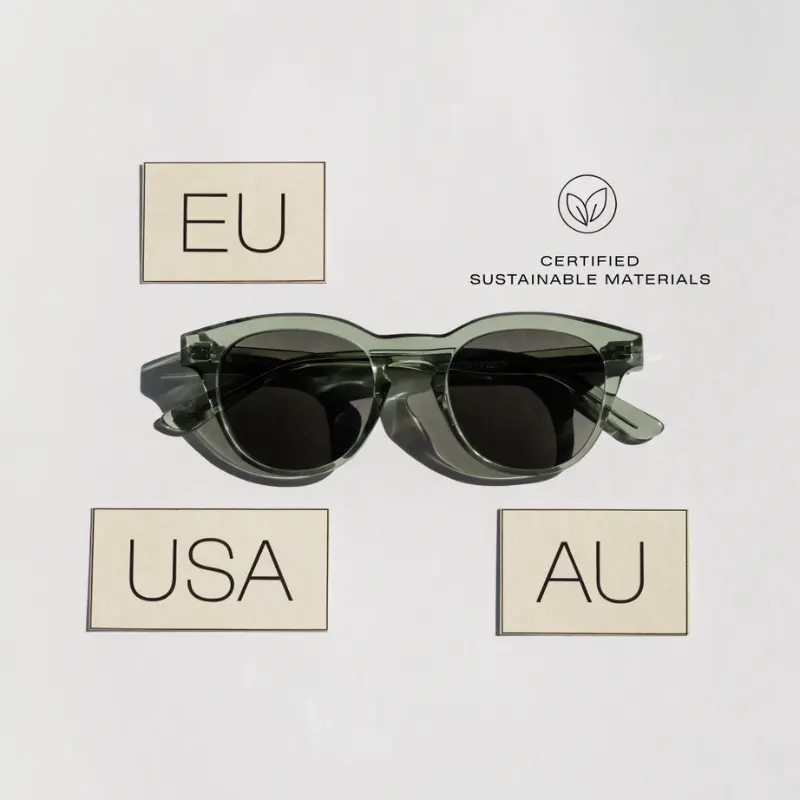
Here’s a practical breakdown by market and channel:
EU market — strongest commercial case
The EU is the strongest market for bio-acetate positioning for three reasons: consumer sustainability awareness is highest, regulatory pressure on materials and end-of-life is increasing, and premium independent retailers actively use sustainable material credentials in their buying decisions.
EU boutique buyers increasingly ask about material credentials as part of their product selection process. A brand that can present Mazzucchelli M49 certification or TÜV biodegradable certification has a genuine sell-in advantage over brands that cannot. The price premium is more recoverable because EU consumers at boutique price points ($80–$200+ retail) are more willing to pay for verified sustainability claims.
US market — selective response
In the US, the response to bio-acetate is concentrated in:
- Independent sustainable lifestyle retailers
- Sustainability-focused e-commerce brands with an existing eco positioning
- Premium optical chains with sustainability initiatives
The mass market and conventional wholesale channels in the US show little pricing response to bio-acetate. A $75 retail bio-acetate frame does not outperform a standard acetate frame in most US wholesale contexts. The premium is most recoverable at $100+ retail in channels where the brand’s sustainability story is already part of the value proposition.
Australia — emerging market
Australia shows growing consumer interest in sustainable materials, particularly in the premium and boutique segments. The market is earlier stage than the EU but accelerating. For brands with existing Australian distribution in premium channels, bio-acetate is worth considering as a collection extension.
Wholesale and mass retail — minimal response
In wholesale accounts, department stores, and mass retail across all geographies, bio-acetate generates essentially no pricing premium. Wholesale buyers in these channels select on price, design, and volume — not material certifications. The cost premium of bio-acetate is a pure margin cost in these channels with no recoverable upside.
The Real Cost Premium: What Bio-Acetate Actually Adds to Your Economics
Most discussions of bio-acetate cost stop at “it’s more expensive.” The full picture requires looking at the per-unit premium, the retail price support, and whether the margin math works at your specific price point.
The EXW cost premium for bio-acetate over standard domestic acetate is approximately 20–40% on the sheet cost — which translates to a per-frame premium of roughly $2.50–$7.00 depending on the frame’s total material cost. Whether this premium is recoverable at retail depends entirely on whether your market will pay a higher retail price for the sustainability positioning, and by how much.

Here’s the economics at three different price points:
| Retail Price Tier | Standard Acetate EXW | Bio-Acetate EXW | Cost Premium | Retail Premium Needed | Verdict |
|---|---|---|---|---|---|
| $50–$80 retail | $6–$10 | $8.50–$14 | $2.50–$4.00 | $8–$12 retail | Difficult — margin pressure significant |
| $80–$150 retail | $10–$18 | $14–$25 | $4–$7 | $12–$20 retail | Viable in EU boutique, harder in US mass |
| $150–$300 retail | $18–$30 | $25–$42 | $7–$12 | $20–$35 retail | Strong case in EU and US premium channels |
Note: all costs are EXW only. Landed cost will be higher after freight, duties, and logistics. Margin calculations should be based on full landed cost.
The key insight from this table: bio-acetate makes the strongest commercial case at higher retail price points where the absolute cost premium is a smaller percentage of total landed cost, and where the customer is already paying for premium positioning.
At $50–$80 retail — a common first-collection price point — the math is difficult. The cost premium adds real margin pressure, and the market response at this price point is limited. For brands at this price tier, standard acetate with a strong design is usually the better investment than bio-acetate with weaker economics.
When Bio-Acetate Makes Sense: A Decision Framework
Given everything above, here’s a practical framework for deciding whether bio-acetate is right for your brand right now.
Bio-acetate is worth pursuing when your brand has at least three of the following five conditions:
Condition 1: Your retail price point is $100 or above The cost premium is more manageable and more likely to be recoverable at higher retail price points. Below $100 retail, bio-acetate creates real margin pressure without proportional market response in most channels.
Condition 2: Your primary market is EU, or sustainability-led US/AU retail The commercial response to bio-acetate is strongest in these contexts. If your primary distribution is US wholesale or mass retail, the premium is a pure cost with minimal upside.
Condition 3: Your target retailer actively asks about material credentials If boutique buyers in your target distribution explicitly ask about sustainable materials as part of their buying decision, bio-acetate is a genuine competitive differentiator. If they don’t ask, it’s a feature you’re paying for that isn’t driving sell-in.
Condition 4: Your brand story includes sustainability as a genuine pillar Bio-acetate works best when it’s part of a coherent sustainability narrative — not a single material choice in an otherwise standard production. Brands that combine bio-acetate with sustainable packaging, carbon offset commitments, and transparent sourcing have a more credible and marketable story than brands that just swap the material.
Condition 5: You can specify the certification clearly If you’re going to invest in bio-acetate, be specific about what you have. Mazzucchelli M49 with TÜV biodegradable certification is a specific, verifiable claim. “Eco-friendly materials” is not. The brands that benefit most from bio-acetate are the ones that can name the material, name the certification, and explain what it means.
If you have fewer than three of these conditions: Standard acetate with strong design and color differentiation is likely a better investment than bio-acetate at this stage of your brand’s development.
This is part of our complete guide to custom acetate sunglasses manufacturing. If you want to discuss bio-acetate options for your next collection — including material certification, cost comparison, and available colorways — we respond within 4 business hours.
Bio-Acetate and Packaging: The Coherence Requirement
One aspect of bio-acetate brand strategy that most guides overlook: the material choice creates an expectation that the rest of the product needs to meet.
When a brand markets bio-acetate frames, consumers and retail buyers who care about sustainability will look at the whole product — not just the frame. If the bio-acetate frame ships in a standard PVC case with a plastic-wrapped cloth and a foil-printed hang tag, the sustainability claim loses credibility. Bio-acetate works best as part of a broader packaging and brand coherence story.
Sustainable packaging options that work with bio-acetate positioning:
- FSC-certified cardboard or kraft paper retail boxes
- Recycled or plant-based microfiber cloths
- PU-free or recycled material cases
- Soy-ink or waterless printing on hang tags and inserts
The packaging upgrade adds cost — typically $1.50–$4.00 per unit depending on specification. This needs to be factored into the total cost premium calculation for a bio-acetate collection.
Conclusion
Bio-acetate is a real material improvement over standard acetate in terms of plant-based content and biodegradability under the right conditions. For brands selling above $100 retail into EU boutiques, sustainability-led US retail, or premium Australian channels — and for brands with a genuine sustainability narrative to tell — the cost premium is likely recoverable and the brand benefit is real.
For brands at lower price points, in wholesale or mass retail, or without a coherent sustainability story, bio-acetate adds cost without proportional commercial return. Standard acetate with strong design, color, and quality remains the better investment.
The question isn’t whether bio-acetate is good. It is. The question is whether it’s the right investment for your brand at this stage — and that depends on your market, your channel, and your price point.
Frequently Asked Questions
What is bio-acetate and how is it different from regular acetate? Bio-acetate uses the same cellulose base as standard acetate (from cotton or wood pulp) but replaces petroleum-derived plasticizers with plant-based alternatives. The result is a material that is approximately 60–70% plant-based versus 40–50% for standard acetate. The visual properties, color options, and production process are identical. The differences are in end-of-life biodegradability (under industrial composting conditions) and reduced petroleum content.
Is bio-acetate actually biodegradable? Yes, but under specific conditions. Bio-acetate certified as biodegradable (such as Mazzucchelli M49 with TÜV certification) biodegrades under industrial composting conditions — sustained temperatures of 55–60°C, specific humidity, and active microbial environments. In standard landfill conditions, it degrades only marginally faster than regular acetate. Brands should specify these conditions when making biodegradability claims to avoid greenwashing risk.
How much more does bio-acetate cost than standard acetate? Bio-acetate carries an EXW cost premium of approximately 20–40% over standard domestic acetate. In per-frame terms, this typically adds $2.50–$7.00 per unit depending on the frame’s total material cost. The premium is more manageable — and more likely to be recoverable at retail — at higher price points ($100+ retail) and in markets with strong consumer response to sustainability claims (EU boutique, premium US independent retail).
Which markets respond best to bio-acetate sunglasses? The EU market — particularly Germany, the Netherlands, Scandinavia, and the UK — shows the strongest commercial response to bio-acetate and sustainable material credentials. Premium independent retail and sustainability-focused e-commerce in the US are also strong contexts. Wholesale, mass retail, and standard multi-door distribution in all geographies show minimal pricing response to bio-acetate.
Can I claim my sunglasses are “eco-friendly” if they use bio-acetate? With care. Vague claims like “eco-friendly” or “sustainable” without specific evidence are facing increasing regulatory scrutiny in the EU and US. Credible claims for bio-acetate include: “made with plant-based plasticizers,” “60–70% plant-based content,” “certified biodegradable under industrial composting conditions,” and naming the specific material (e.g. “Mazzucchelli M49 bio-acetate”). Avoid unqualified “biodegradable” claims that imply standard landfill degradation.
What is Mazzucchelli M49 bio-acetate? M49 is Mazzucchelli’s bio-acetate product — the benchmark material for premium sustainable eyewear. It uses plant-based plasticizers and carries TÜV biodegradable certification for industrial composting conditions. M49 is recognized by premium retail buyers and sustainability-conscious consumers as a specific, verifiable material credential. It is significantly more expensive than standard Mazzucchelli acetate.
What MOQ can I expect for bio-acetate sunglasses? Frame production MOQ for bio-acetate is the same as standard acetate — typically 300 pieces per style, with a minimum of 100 pieces per colorway. This is the minimum production run your manufacturer will accept, not a sheet-level restriction. Sheet MOQ for bio-acetate varies by supplier and specific color — some colors have no minimum sheet quantity, others do. Confirm sheet availability and any sheet-level MOQ with your manufacturer before committing to a bio-acetate collection timeline, as bio-acetate sheet lead times may be slightly longer than standard acetate due to lower production volumes.
Should I launch my first collection in bio-acetate? Generally, no — unless sustainability is a core pillar of your brand from day one and your target market is clearly EU boutique or sustainability-led premium retail. For most brands launching their first collection, the additional cost premium and production complexity of bio-acetate adds risk without proportional return. Establish your brand with standard acetate first, then introduce bio-acetate as a premium extension once your positioning and distribution are clear.
Let's get started!
Get in touch with a custom eyewear specialist now for a free consultation and instant price quote.
WHATSAPP ME GO!
📱 Scan with your phone to start chatting