What Is a Golden Sample in Eyewear Manufacturing — and Why It Matters for Your Brand
You’ve approved the design. The factory has confirmed the specs. Production is about to start — and then something goes wrong. The bulk order arrives with hinges that don’t feel right, a color that’s slightly off, or a surface finish that doesn’t match what you approved.
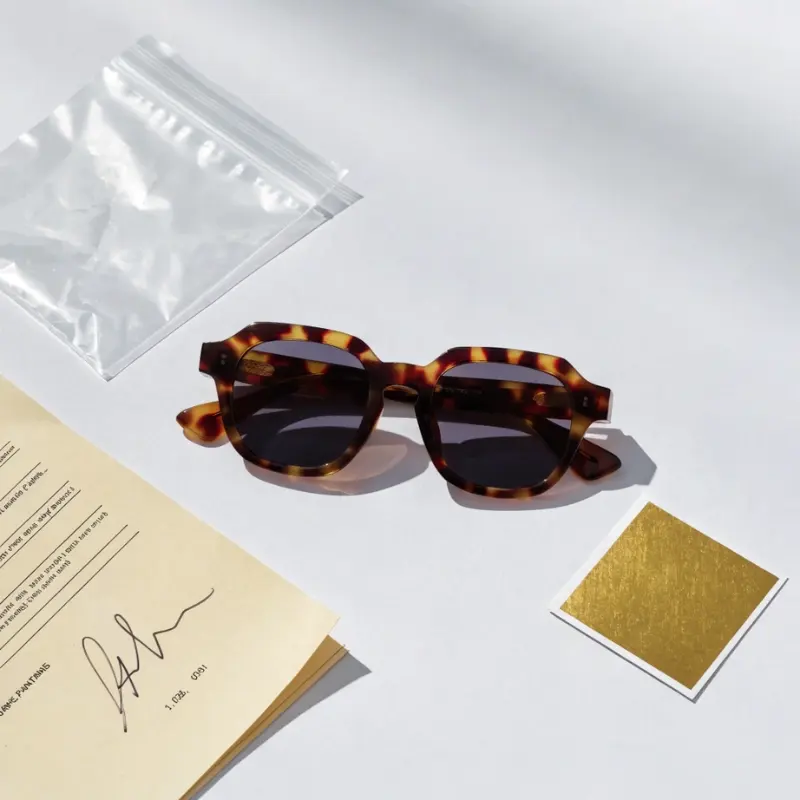
This is exactly the problem the golden sample is designed to prevent. A golden sample is the single approved reference unit that defines what every frame in your bulk order should look, feel, and function like. It’s the standard your factory produces against — and the standard your QC inspector compares bulk goods to before shipment. Without a signed golden sample, quality disputes become a matter of opinion. With one, they become a matter of measurable fact.
We produce acetate sunglasses and optical frames for brands worldwide. The golden sample stage is one of the most consequential steps in any production run. Here’s what it is, how it works, and what to check before you sign off.
What Is a Golden Sample?
The term gets used loosely. It’s worth being precise about what a golden sample actually is — and what it isn’t.
A golden sample (also called an approval sample or master sample) is the final, fully approved physical sample of a product, signed off by both the brand and the manufacturer, that serves as the benchmark for all bulk production. It is not the first sample, not the revised sample, and not a reference photo. It is the physical object that has been reviewed, corrected through however many revision rounds were needed, and formally approved.
Once a golden sample is signed, dated, and sealed, it becomes the legal and operational reference for everything that follows:
- The factory uses it as the standard their production line is expected to match
- Your QC inspector takes it to the factory during pre-shipment inspection and compares finished goods directly against it
- In any quality dispute after delivery, the golden sample is the evidence
The golden sample doesn’t expire with one production run. For brands that reorder the same style in subsequent seasons, the golden sample from the first approved run remains the reference standard — unless a specification change is formally agreed and a new golden sample is signed.
Golden sample vs first sample vs pre-production sample
These three terms are often confused. Here’s the distinction:
| Sample Type | Purpose | Status |
|---|---|---|
| First sample | Initial physical interpretation of the design brief | Not approved — starting point for revision |
| Pre-production sample | Revised sample incorporating feedback, closer to target | May need further revision |
| Golden sample | Fully approved, signed, sealed reference unit | Approved — production begins |
The golden sample is the end of the sampling process, not a stage within it. You may go through one or three or five rounds of pre-production samples before reaching a golden sample. The golden sample is the one you sign.
Why the Golden Sample Matters More in Eyewear Than in Most Categories
Every manufactured product benefits from a golden sample. In eyewear specifically, the stakes are higher — and the failure modes are more numerous.
Eyewear frames involve a combination of material properties, dimensional tolerances, functional components, surface treatments, and branding elements that all need to be correct simultaneously. A frame that passes dimensional checks but has an under-polished surface, or a frame that has the right color but the wrong hinge torque, is still a failure. The golden sample is the only way to define “correct” across all of these variables at once.
Here’s what can go wrong in eyewear bulk production without a signed golden sample:
Color drift. Acetate sheet color can vary between batches. Without a signed color reference, there’s no basis to reject a batch that’s slightly warmer or cooler than the original. With a golden sample, the comparison is direct and physical.
Surface quality compression. Polishing time is one of the first things compressed when a factory is under production pressure. The difference between a fully polished acetate frame and one that’s had two hours cut from its tumbling time is visible to the hand — but only if you have the approved standard to compare it against.
Hinge torque variation. Hinge opening and closing force should be consistent across every unit. Without a golden sample that defines acceptable hinge feel, “the hinges feel loose” is a subjective complaint. With one, it’s an objective deviation from the approved standard.
Logo position drift. Logo placement on acetate frames is applied after polishing and varies slightly between units. A golden sample with the logo in the approved position gives the QC inspector a precise reference to measure against.
Lens fitting variation. Lens gap, lens tint accuracy, and optical clarity should all match what was approved. Without a physical reference, these are difficult to assess consistently across an inspection sample.
The Eyewear Golden Sample Checklist: What to Check Before You Sign
This is the section most guides skip — and the one that determines whether your golden sample actually protects you.
Signing a golden sample that has unresolved issues locks those issues in as the production standard. A surface that looks acceptable in photos but feels wrong in the hand, a hinge that has slight play, a color that’s close but not right — signing a golden sample with these issues means accepting them in the bulk order. The time to resolve them is before you sign, not after.
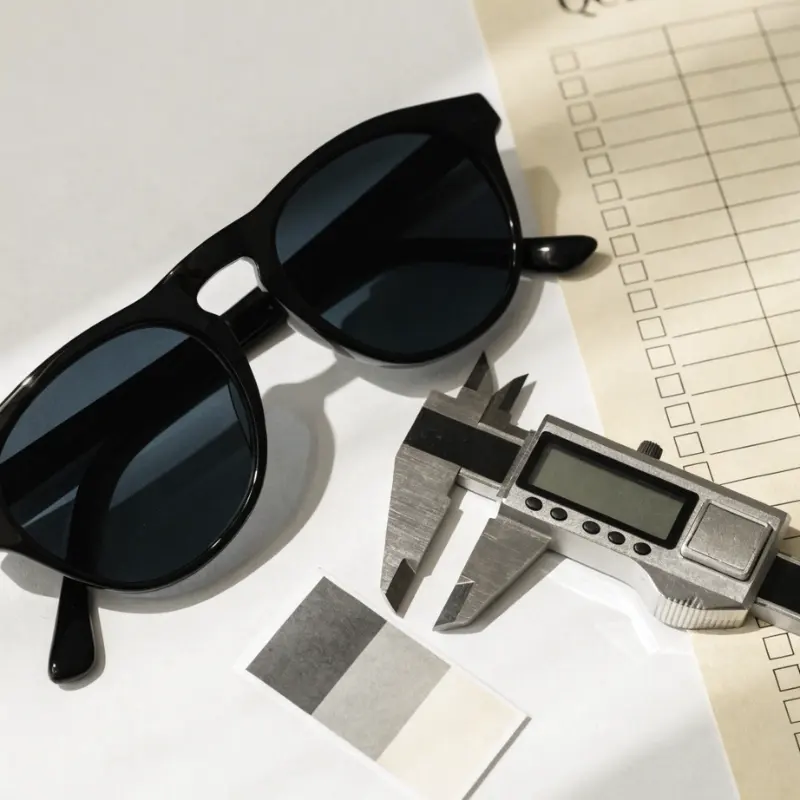
Here’s a complete checklist for approving an eyewear golden sample:
Frame dimensions and symmetry
- [ ] Place the frame face-down on a flat surface — it should sit level with no rocking
- [ ] Hold the frame at arm’s length and sight down the temples — they should be parallel
- [ ] Verify front width, lens aperture dimensions, bridge width, and temple length against the approved spec sheet (tolerance: ±0.5mm)
- [ ] Check that both lens apertures are the same size and shape
Surface quality
- [ ] Run your finger across the front surface — it should feel smooth and warm, not plasticky or cold
- [ ] Tilt the frame under direct light — the surface should reflect clearly, not diffusely (diffuse reflection indicates under-polishing)
- [ ] Check the inner lens rim — run your fingertip along the inside of the lens aperture, it should be smooth with no sharp edges
- [ ] Check the nose bridge underside — should be as evenly polished as the flat front surface
- [ ] No visible scratches, mold marks, or tool marks anywhere on the frame
Color accuracy
- [ ] Compare the frame color directly against your Pantone reference, physical swatch, or reference color chip under consistent lighting (daylight or D65 light box)
- [ ] Check that the color reads correctly from front-on, not just at close range
- [ ] For patterned acetate (tortoiseshell, gradient): confirm the pattern placement reads as intended from the front-facing view
- [ ] Note: acetate colors deepen slightly after polishing — the golden sample should be polished, not raw
Hinge function
For standard barrel hinges and spring hinges:
- [ ] Open and close each hinge 20 times on both sides
- [ ] Hinge movement should be smooth and consistent on both sides
- [ ] Force required to open and close should be equal on both sides — any side-to-side variation indicates inconsistent fitting
- [ ] Temples fully open: both should touch a flat surface simultaneously (indicates alignment)
- [ ] For spring hinges: flex past 90° and release — frame should return to position without stress marks
For integrated / hingeless flexible frames (e.g. TR90 memory flex, screwless designs):
- [ ] Flex each temple inward beyond the normal open position and release — it should return smoothly to the original position with no deformation
- [ ] No audible creak or resistance during flex
- [ ] Repeat 20 times on both sides — the return position should be consistent with no permanent set (permanent deformation)
- [ ] Check the flex point area for any visible stress marks or whitening after repeated flex cycles
Logo accuracy
- [ ] Measure logo position from the hinge end against your specification
- [ ] Check logo depth (for laser engraving) or adhesion (for hot stamp)
- [ ] For engraving with color fill: confirm fill color matches Pantone reference, no gaps or bubbles in the fill
- [ ] Logo should be readable and correctly oriented
Lens fitting
- [ ] Look through the lens at a straight horizontal line — it should appear straight with no wave or distortion
- [ ] Check for lens gap — no visible gap between lens edge and frame groove on any side
- [ ] For polarized lenses: rotate 90° while looking at a reflective surface — glare should disappear at one orientation and return at the other
- [ ] Lens tint matches the specification
Packaging and labeling
- [ ] Confirm case, cloth, hang tag, and retail box match the approved packaging specification
- [ ] Check that all labeling (country of origin, CE mark if applicable, UV400 marking) is correct and in the right position
How to Store, Sign, and Use Your Golden Sample
Having a good golden sample is only half of it. The other half is what you do with it.
A golden sample that is lost, damaged, or poorly stored before bulk inspection is almost useless. The golden sample needs to survive from sign-off to pre-shipment inspection — which could be 50–70 working days later — in the same condition it was approved in. How you store and handle it determines whether it can actually do its job.
How many golden samples do you need?
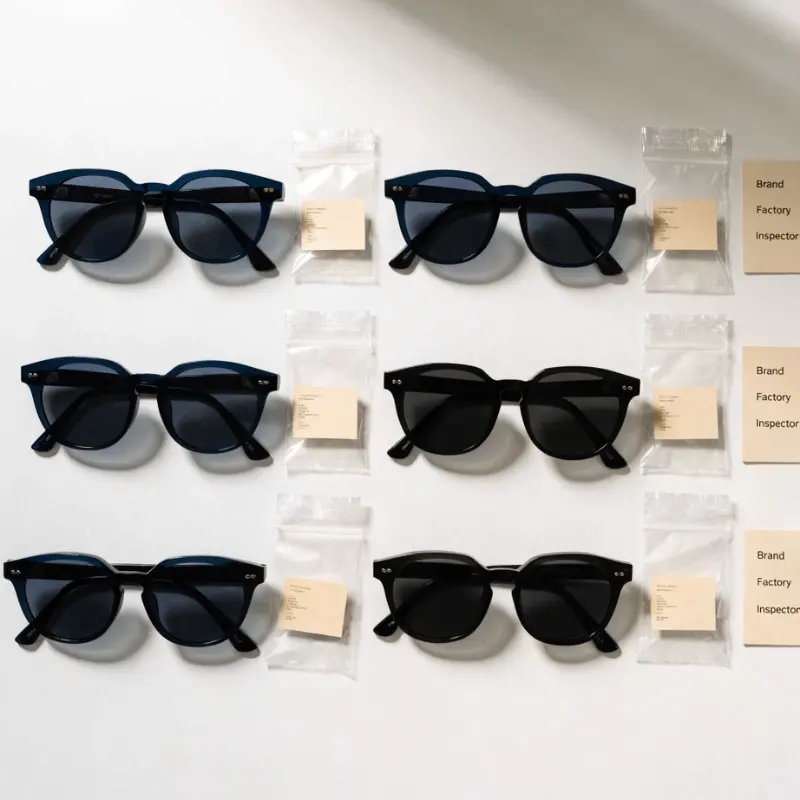
You need at least two — ideally three:
- One for the brand: Kept at your office or with your QC agent. This is your reference copy.
- One for the factory: Kept in the factory’s QC department, used by the production team as the production standard throughout the run.
- One for the QC inspector (optional but recommended): If you’re using a third-party inspection service, they may need their own sealed copy to take to the factory without risk of your copy being damaged.
How to sign and seal a golden sample
- Both parties (brand representative and factory representative) sign across the frame — the signature should partially cover the frame surface so it can’t be removed and reattached
- Note the date and style reference number on the signed area
- Photograph the signed sample against a neutral background in natural light and under a light box
- Place each signed sample in a sealed bag with a label noting the style, colorway, date, and approval reference
- Store in a consistent environment — away from direct sunlight, heat, or humidity that could affect the acetate color over time
How to use the golden sample at pre-shipment inspection
During pre-shipment inspection, the inspector takes the factory’s signed golden sample copy and compares it directly against the bulk production units being inspected. The comparison should cover:
- Surface quality (side-by-side feel and light reflection comparison)
- Color accuracy (direct comparison under consistent lighting)
- Hinge function (both golden sample and bulk units operated with the same hand)
- Logo position (measurement from hinge end)
- Lens clarity and fit
Any bulk unit that deviates from the golden sample on a major criterion (functional defect) should be flagged for rejection. Deviations on minor criteria (cosmetic issues that don’t affect function) are assessed against AQL tolerance.
What Happens When There Is No Golden Sample
This is the most important section for brands that haven’t formalized their sampling process yet.
The absence of a signed golden sample doesn’t mean quality problems become more likely — it means quality disputes become impossible to resolve objectively. Without a physical reference that both parties have agreed represents the standard, every quality conversation becomes an argument about subjective perception. “The color is slightly different” — compared to what? “The hinges feel loose” — looser than what? These disputes are expensive, slow, and damage supplier relationships.
The three most common quality problems we see in eyewear that a golden sample prevents:
Quality fade over a production run. A factory that is under schedule pressure may allow standards to drift — polishing time gets compressed, hinge fitting becomes less careful. With a golden sample actively used in QC, these deviations are caught against a concrete standard. Without one, they accumulate silently until bulk delivery.
Color batch drift between seasons. A brand that reorders the same style in a subsequent season without a retained golden sample has no basis to compare the new batch against the original. The color “looks right” becomes the only standard — which is no standard at all.
Disputed defects at delivery. A brand that discovers quality issues at delivery without a golden sample has very limited recourse. “This is not what we approved” requires evidence of what was approved. The signed golden sample is that evidence.
For context: at our factory, every bulk production run begins with the signed golden sample being physically placed in our QC department. Pre-shipment inspection is conducted with the golden sample present. If anything in the inspection deviates from the sample, it goes back through quality review before shipment is authorized.
The Golden Sample in Practice: Timeline and What to Expect
Understanding where the golden sample fits in your production timeline helps you plan your project correctly.
The golden sample is not produced at the beginning of sampling — it’s the outcome of the sampling process. How long that process takes depends on how many revision rounds are needed, which depends on how complete and accurate your initial brief is.
Here’s a typical sampling and golden sample timeline for a custom acetate frame:
| Stage | Typical Duration | What Happens |
|---|---|---|
| Design brief and spec finalization | 3–7 days | Technical drawings, material spec, color reference confirmed |
| First sample production | 10–20 days | Factory produces initial physical sample |
| Brand review and feedback | 3–7 days | Brand reviews sample, provides revision notes |
| Revision round(s) | 7–14 days each | Factory revises and produces updated sample |
| Golden sample approval | 1–3 days | Final sample reviewed, signed, sealed, photographed |
| Bulk production | 50–60 working days | Production runs against golden sample standard |
| Pre-shipment inspection | 1–3 days | Inspector compares bulk goods against golden sample |

The most common cause of timeline extension at the golden sample stage is an incomplete initial brief — color references that aren’t specific enough, dimensional specifications that are vague, or logo placement that wasn’t defined before sampling began. The more complete your brief, the fewer revision rounds, and the faster you reach a golden sample you can sign.
For more on the complete production process from brief to bulk shipment, see our guide to how acetate sunglasses are made and from sample to bulk production.
If you want to discuss your sampling process — including what to include in your initial brief to minimize revision rounds — we respond within 4 business hours.
Conclusion
The golden sample is the most important quality control tool a brand has before bulk production begins. It converts subjective approval into an objective standard. It protects both the brand and the factory from misunderstanding. It makes pre-shipment inspection meaningful rather than approximate. And it gives you the evidence you need if something goes wrong at delivery.
For eyewear brands specifically, where surface quality, color accuracy, hinge function, and dimensional precision all need to be correct simultaneously, a rigorously checked and properly stored golden sample is not a formality — it’s the foundation of a production relationship that delivers consistent results.
Frequently Asked Questions
What is a golden sample in manufacturing? A golden sample (also called an approval sample or master sample) is the final, fully approved physical sample of a product that serves as the benchmark for all bulk production. It is signed and dated by both the brand and the manufacturer, sealed, and stored for use during pre-shipment quality inspection. Any bulk unit that deviates from the golden sample on agreed criteria can be flagged for rejection.
What is the difference between a golden sample and a pre-production sample?
A pre-production sample is any sample produced during the revision process — it may need further correction. A golden sample is the final sample that has been approved after all revisions are complete. It is the end point of the sampling process, not a stage within it. Production begins only after the golden sample is signed and sealed.
How many golden samples do I need for a production run?
Typically two to three: one for the brand to retain, one for the factory’s QC department to use as the production standard, and optionally one for a third-party inspection agent. Each copy should be independently signed, dated, and sealed so they can function as valid references if separated.
What should I check when approving an eyewear golden sample?
For eyewear frames, check: frame symmetry (sits flat, temples parallel), surface polish quality (smooth and warm, clear light reflection), color accuracy against Pantone or physical reference, hinge function (smooth and consistent both sides, 20 open-close cycles), logo position and finish, lens optical clarity (no distortion), lens tint accuracy, and packaging specification compliance. All of these should be verified before signing.
What happens if bulk production doesn’t match the golden sample?
During pre-shipment inspection, the inspector compares bulk production units directly against the golden sample. Units that deviate on major criteria (functional defects — hinge failure, optical distortion, structural issues) should be flagged for rejection. Units that deviate on minor criteria (cosmetic variation within tolerance) are assessed against AQL acceptance limits. The signed golden sample is the legal and operational basis for any quality dispute.
Can I reuse a golden sample for future production runs of the same style?
Yes. A golden sample from the first approved production run remains the valid reference for subsequent reorders of the same style, as long as no specification changes are made. If any aspect of the specification changes — color, material, hinge type, logo — a new golden sample must be produced and approved before the revised production run begins.
How long does the sampling process take before reaching a golden sample?
For a custom acetate sunglasses style, the sampling process typically takes 15–45 days depending on the complexity of the design and the number of revision rounds needed. The first sample takes 10–20 days to produce. Each revision round adds 7–14 days. The more complete and specific your initial design brief, the fewer revision rounds — and the faster you reach a golden sample you can sign.
What is quality fade and how does a golden sample prevent it?
Quality fade is the gradual decline in production quality that can occur when a factory is under schedule or cost pressure — polishing time gets compressed, hinge fitting becomes less careful, color matching becomes less precise. A golden sample prevents quality fade by giving the factory QC team a concrete physical standard to match, and the brand’s inspection agent a concrete reference to compare bulk goods against. Without a golden sample, quality fade accumulates silently until delivery.
Let's get started!
Get in touch with a custom eyewear specialist now for a free consultation and instant price quote.
WHATSAPP ME GO!
📱 Scan with your phone to start chatting