How to Import Custom Sunglasses from China: Duties, Shipping, and Lead Times Explained

You’ve found a manufacturer. You’ve approved the sample. Now comes the part most first-time buyers underestimate: getting your sunglasses from a factory in Shenzhen to a warehouse in your country — on time, at the right cost, and without customs surprises.
The factory price on your quote is not what you pay. By the time your sunglasses land in your warehouse, you’ve also paid freight, import duties, customs clearance fees, and potentially last-mile delivery costs. For brands planning their first import from China, the gap between the EXW quote and the actual landed cost is almost always larger than expected — and the total timeline is almost always longer.
This guide covers the complete picture: what duties apply in major markets, how shipping methods compare, what volumetric weight does to your freight costs, and how to build a realistic project timeline that accounts for every stage from production to warehouse.
Understanding Your Price: EXW, FOB, CIF, and DDP Explained
Before anything else, understand what your factory quote actually covers — because different Incoterms mean very different total costs.
The most common source of budget shock for first-time importers is misunderstanding what the factory price includes. An EXW (Ex Works) price is the cost of the goods at the factory gate — nothing else. A DDP (Delivered Duty Paid) price includes everything to your door. Most factory quotes are EXW or FOB. The difference between these and your actual landed cost is significant.
Here’s what each Incoterm means in practice:
| Incoterm | What It Covers | Who Arranges Freight | Typical Use |
|---|---|---|---|
| EXW (Ex Works) | Goods at factory gate only | Buyer arranges everything | Common factory quote basis |
| FOB (Free on Board) | Goods loaded onto vessel at origin port | Buyer arranges sea/air freight | Most common for sea freight |
| CIF (Cost, Insurance, Freight) | Goods + freight + insurance to destination port | Seller arranges freight | Less common, seller controls freight |
| DDP (Delivered Duty Paid) | Everything including duties and final delivery | Seller arranges everything | Highest cost, least hassle for buyer |
For most private label brands, FOB is the practical basis for ocean freight orders. The factory handles export clearance and loading; you or your freight forwarder handle the ocean freight booking, import clearance, and final delivery. This gives you control over the freight cost and carrier selection while keeping the factory’s responsibility clearly bounded.
For smaller shipments or samples, DHL/FedEx/UPS express courier under DDP terms is common — the courier handles duties and customs, and you receive a single all-in invoice.
Import Duties: What You’ll Pay by Market
Import duties on sunglasses from China vary significantly by destination market — and in some markets, additional tariffs apply on top of standard rates.
The single most important duty consideration for brands importing from China to the US is the Section 301 tariff, which adds a surcharge on top of standard import duties for most goods of Chinese origin. Any brand importing sunglasses to the US from China should confirm the current applicable rate with a licensed customs broker before finalizing cost calculations — rates have changed through multiple rounds of review.
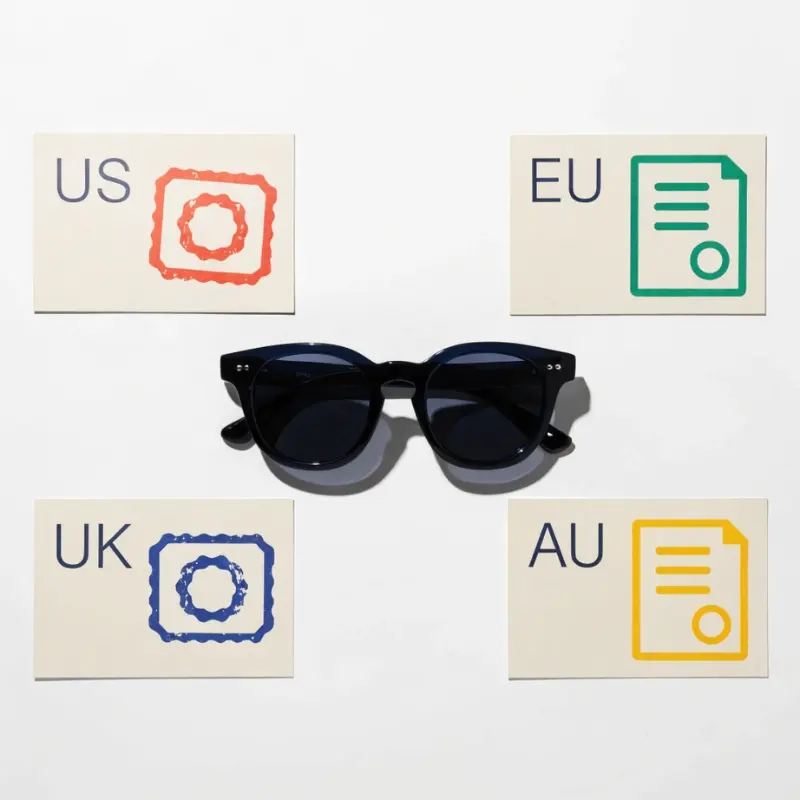
Here’s a market-by-market overview:
United States
- Standard import duty (HTS 9004.10): Approximately 2.9% on sunglasses
- Section 301 tariff: Additional tariff on goods of Chinese origin — confirm current rate with a licensed US customs broker
- FDA requirement: Sunglasses are regulated as radiation-emitting products under 21 CFR Part 1040. Confirm documentation requirements with your customs broker before your first shipment
- De minimis threshold: Shipments valued under $800 may be imported duty-free under Section 321 — relevant for sample shipments
European Union
- Standard import duty: 2.9% on sunglasses (CN code 9004 10)
- CE marking: Mandatory for sunglasses sold in the EU. Your manufacturer should provide EN ISO 12312-1 test reports. The CE mark must be applied before goods enter EU territory — in practice it is typically printed or engraved directly on the inner side of the temple during production. Inform your manufacturer which markets you are selling into before production begins so the correct mark is applied.
- VAT: Import VAT applies at the destination country rate (typically 19–25%) and is usually recoverable for VAT-registered businesses
United Kingdom
- Standard import duty: 2.9% on sunglasses (UK Global Tariff)
- UKCA marking: Replaced CE marking for goods sold in Great Britain. Goods for Northern Ireland may still require CE marking — confirm with your compliance advisor
- Marking on frame: In practice, CE and UKCA marks are typically printed or engraved directly on the inner side of the temple during production — no separate label or sticker is required. Inform your manufacturer which markets you are selling into before production begins so the correct mark is applied.
- VAT: 20% import VAT, recoverable for VAT-registered businesses
Australia
- Standard import duty: 0% on sunglasses
- GST: 10% on customs value plus freight — recoverable for GST-registered businesses
- Key compliance: AS/NZS 1067 applies to sunglasses sold in Australia — your manufacturer should provide test reports on request
Canada
- Standard import duty: Sunglasses from China are subject to MFN (Most Favoured Nation) tariff rates — confirm the current applicable rate for HS 9004 with a Canadian customs broker before budgeting, as rates vary by specific product classification
- GST/HST: Federal and provincial taxes apply on import value
Practical note on all markets
Duty rates are applied to the customs value — typically the CIF value (cost of goods + freight + insurance), not the EXW price. This means freight costs affect your duty calculation, not just your shipping budget. Always calculate duties on CIF value.
Understanding Volumetric Weight: Why Sunglasses Cost More to Ship Than You Expect
This is the most common freight cost surprise for first-time eyewear importers.
Sunglasses are light — a pair of acetate frames weighs 20–35 grams. But sunglasses are bulky relative to their weight, especially when packed in retail cases and retail boxes. Freight carriers charge based on whichever is higher: actual weight or volumetric weight. For eyewear shipments, volumetric weight almost always exceeds actual weight, sometimes by a factor of 3–5x.
How volumetric weight is calculated
Express courier (DHL/FedEx/UPS):
Volumetric weight (kg) = (Length cm × Width cm × Height cm) ÷ 5,000
Air freight (airline cargo):
Volumetric weight (kg) = (Length cm × Width cm × Height cm) ÷ 6,000
The difference matters: the same carton calculates to a higher volumetric weight under express courier than under air freight. Always confirm which divisor your carrier uses when comparing quotes.
For ocean freight:
CBM = Length m × Width m × Height m
Charged per CBM or per ton, whichever is greater
A practical example
A 300-piece order of acetate sunglasses in retail cases:
- Actual weight: ~35 kg (frames + cases)
- 10 cartons, each 60×40×40 cm
- Volumetric weight (air freight): (60×40×40) ÷ 6,000 × 10 = 160 kg
- Volumetric weight (express courier): (60×40×40) ÷ 5,000 × 10 = 192 kg
- Chargeable weight: 160–192 kg depending on method — carrier charges this, not 35 kg
The practical implication: for air or express freight on a 300-piece order with retail packaging, expect to pay for 4–5x the actual weight. More compact packaging directly reduces your freight cost. This is worth discussing with your manufacturer before finalizing packaging specifications.
A note on acetate sunglasses and sea freight packaging
Acetate is sensitive to temperature and humidity changes. Container temperatures on long-haul sea routes can reach 60–70°C in hot climates, and humidity levels inside sealed containers fluctuate significantly over a 3–5 week voyage. Repeated temperature and humidity cycles can cause acetate frames — particularly thinner temples — to warp slightly if packaging is inadequate.
This does not mean acetate cannot be sea-freighted — the vast majority of acetate eyewear exported globally travels by sea. The key is proper packaging: individual frame wrapping (bubble wrap or paper tray), silica gel desiccant inside cartons, moisture-barrier inner bags, and stable stacking to prevent pressure deformation. Before confirming your shipment, verify with your manufacturer that their standard export packing for acetate frames includes these measures.
Shipping Methods Compared: Sea, Air, and Express
| Method | Transit Time | Cost Range | Best For |
|---|---|---|---|
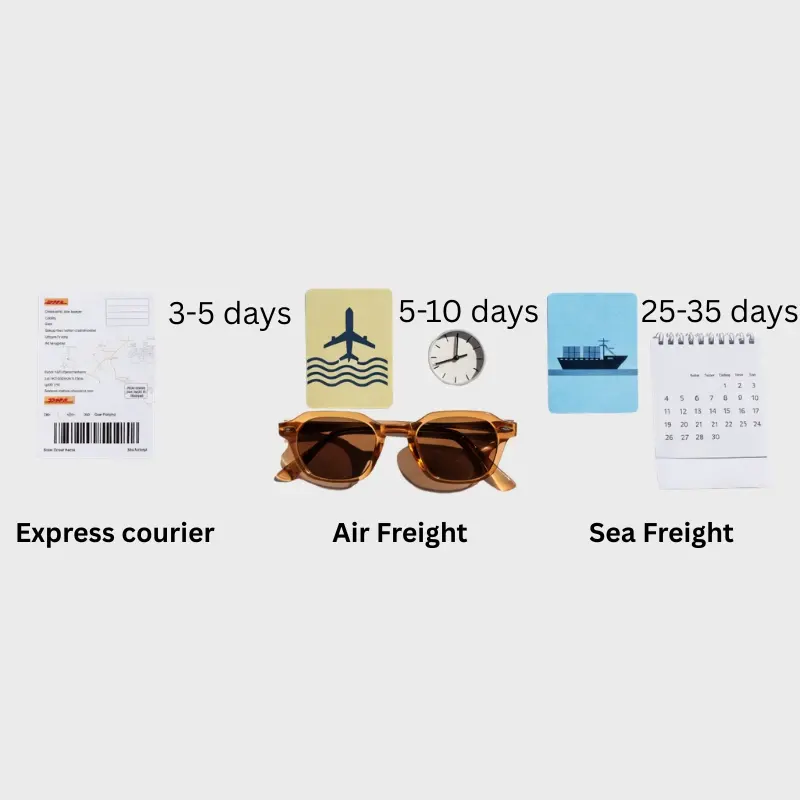
| Express courier (DHL/FedEx/UPS) | 3–5 business days | $8–$20/kg chargeable | Samples, orders under 50 kg |
| Air freight | 5–10 days door-to-door | $4–$8/kg chargeable | Urgent bulk orders, 50–500 kg |
| LCL sea freight | 25–40 days port-to-port | $80–$150/CBM | Orders under 5 CBM |
| FCL sea freight (20ft) | 20–35 days port-to-port | $1,500–$3,500/container | Large orders, 25+ CBM |
Note: add customs clearance time (3–10 business days) and last-mile delivery for total delivery timeline.
Express courier is right for samples and small packages — not bulk orders at scale. However, for fashion and boutique eyewear brands, express courier deserves more consideration than the cost comparison alone suggests. Missing a retail season — a summer launch that arrives in August instead of May, or a holiday collection that clears customs in January — costs far more than the freight premium between express and sea. For first orders, small seasonal restocks, and any shipment where a two-week delay changes your commercial outcome, express courier is often the right call even at 300–500 pieces.
The Complete Landed Cost Calculation
Landed cost is the total cost of getting goods from the factory in China to your warehouse, fully cleared and ready to sell.
Landed Cost = EXW Price
            + Export clearance and origin charges
            + Ocean or air freight
            + Destination port charges
            + Customs clearance fee
            + Import duties and tariffs
            + Import VAT/GST (if not recoverable)
            + Last-mile delivery
            + Cargo insurance
Illustrative example: 300 acetate sunglasses to the EU by LCL sea freight
| Cost Component | Estimated Amount |
|---|---|
| EXW price (300 × $15) | $4,500 |
| Export clearance + origin charges | $150–$250 |
| LCL sea freight (~1.5 CBM) | $200–$350 |
| Destination port charges | $150–$250 |
| Customs clearance fee | $100–$200 |
| Import duty (2.9% on CIF ~$5,100) | ~$148 |
| Import VAT (20%, recoverable) | ~$1,050 |
| Last-mile delivery | $100–$200 |
| Cargo insurance | $50–$100 |
| Total landed cost (ex-VAT) | ~$5,400–$5,950 |
| Per unit landed cost | ~$18–$20 |
A $15 EXW frame lands at approximately $18–$20 per unit — a 20–33% increase over factory price. This is a realistic EU LCL sea freight range. US costs will differ based on applicable tariff rates.
This is an illustrative example only. Freight rates fluctuate, duty classification varies, and broker fees differ. Always obtain actual quotes and confirm duty rates with a customs broker before finalizing your budget.
Building Your Complete Project Timeline
Every stage of an eyewear import runs sequentially. You cannot start production until sampling is approved. You cannot book freight until production is complete. Delays compound. A brand that plans only for production lead time and sea freight transit will consistently miss launch dates.
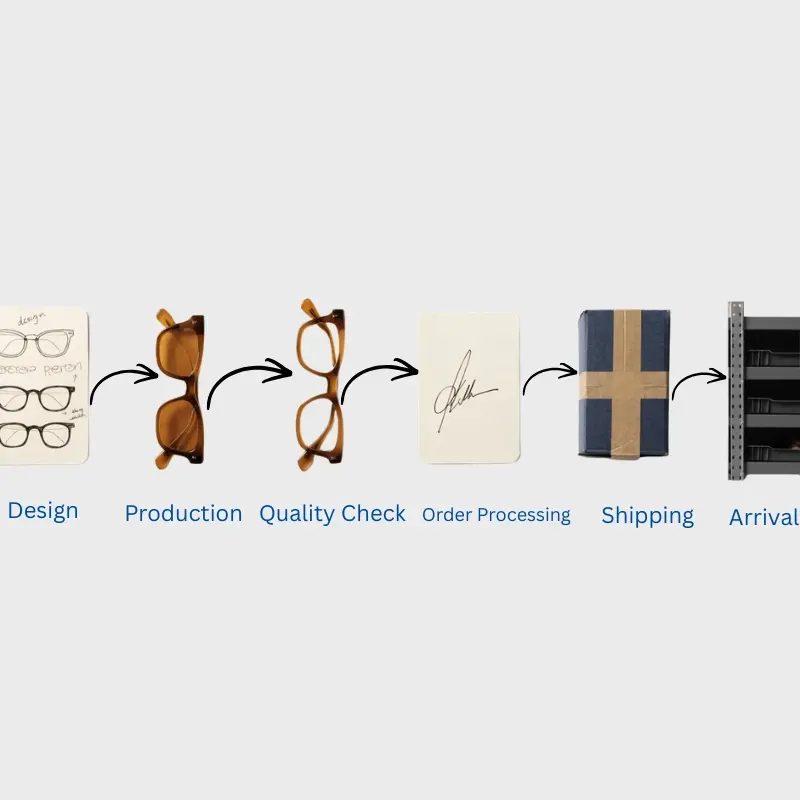
| Stage | Duration | Notes |
|---|---|---|
| Design brief and spec confirmation | 3–7 days | Must complete before sampling begins |
| First sample production | 10–20 days | |
| Sample shipping (express) | 3–5 days | |
| Sample review and approval | 3–14 days | Factor in internal approval process |
| Revision rounds (if needed) | 7–14 days each | Budget at least one round |
| Golden sample sign-off | 1–3 days | |
| Material procurement (domestic acetate) | 7–20 days | Runs after golden sample approval |
| Bulk production | 50–60 working days | |
| Pre-shipment inspection | 2–5 days | |
| Export clearance and loading | 3–5 days | |
| Sea freight transit | 20–35 days | |
| Destination port handling | 3–7 days | |
| Customs clearance | 3–10 business days | Longer if documentation is incomplete |
| Last-mile delivery | 2–5 days | |
| Total: first order | ~4–6 months | From initial brief to warehouse |
| Total: reorder (existing style) | ~3–4 months | Skip sampling |
Most commonly underestimated stages
Sample review time — internal approval with multiple stakeholders can take 10–14 days, not 3.
Material procurement — for Mazzucchelli or specialty acetate, 30–45 days before production even starts.
Customs clearance — incomplete documentation extends clearance significantly. Prepare all documents before goods arrive at port.
Buffer time — always add 2–3 weeks. Vessel delays, port congestion, and customs holds are normal occurrences that experienced importers plan for.
Documentation You Need Before Your Goods Ship
Incomplete documentation is the most common cause of customs delays. Prepare these before goods leave China:
- Commercial invoice: Accurate product description, quantity, unit price, total value, Incoterm, buyer and seller details, country of origin
- Packing list: Detailed breakdown by carton — pieces, weight, dimensions, marks
- Bill of lading (sea) or airway bill (air): Issued by carrier or freight forwarder
- Certificate of origin: May be required for duty treatment
- CE test report (EU/UK): EN ISO 12312-1 compliance for sunglasses
- FDA documentation (US): Confirm with your customs broker
- AS/NZS 1067 test report (Australia): If making UV protection claims
Request all certificates from your manufacturer before production completes. Do not wait until goods are ready to ship.
Working with a Freight Forwarder
For most brands importing from China for the first time, working with a freight forwarder is strongly recommended. A freight forwarder manages logistics between factory and warehouse — freight booking, documentation, customs clearance, and last-mile delivery. The cost is small relative to the risk of a delayed or held shipment.
Choose a forwarder with specific experience in Chinese exports and your destination market. Ask: Have you handled eyewear shipments? Are you familiar with CE/FDA/UKCA documentation requirements? Can you provide a full landed cost estimate?
For more on the production process before your goods are ready to ship, see our guide to how the private label eyewear production process works — from sample to bulk.
If you want to discuss production timelines, documentation requirements, or how to coordinate your first shipment — we respond within 4 business hours.
Conclusion
Importing custom sunglasses from China successfully requires planning across four dimensions simultaneously: production timeline, shipping method, duty costs, and documentation. The brands that navigate their first import without major surprises calculated their landed cost before committing to a retail price, planned their total timeline from brief to warehouse before setting a launch date, and worked with experienced partners — manufacturer, freight forwarder, and customs broker.
The factory price is the beginning of your cost, not the end. The production lead time is the beginning of your timeline, not the end. Plan accordingly.
Frequently Asked Questions
What import duties apply to sunglasses from China?
Standard rates on sunglasses (HS code 9004) are typically 2.9% in the US and EU. The US applies additional Section 301 tariffs on Chinese-origin goods on top of the standard rate — confirm the current rate with a licensed US customs broker. Australia has 0% standard duty. For Canada, MFN tariff rates apply — confirm the current rate for HS 9004 with a Canadian customs broker before budgeting. Import VAT or GST also applies in most markets and is typically recoverable for VAT-registered businesses.
How long does it take to import custom sunglasses from China?
For a first order with custom sampling, total timeline from brief to warehouse is typically 4–6 months: 15–45 days for sampling, 50–60 working days for bulk production, and 25–45 days for shipping and clearance. For reorders of an approved style, approximately 3–4 months. Always add 2–3 weeks buffer.
What is the difference between EXW and landed cost?
EXW is the cost of goods at the factory gate — it excludes all freight, duties, and clearance fees. Landed cost is the total cost to your warehouse including everything. For a typical EU sea freight shipment, landed cost is approximately 20–35% higher than the EXW price.
Why does shipping eyewear from China cost more than expected?
Eyewear is light but bulky — especially with retail cases and packaging. Carriers charge based on the higher of actual weight or volumetric weight. For a typical sunglasses order with retail packaging, volumetric weight is often 3–5x the actual weight.
Do I need CE certification to import sunglasses into the EU?
Yes. Sunglasses sold in the EU must comply with EN ISO 12312-1 and bear the CE mark. Your manufacturer should provide test reports. For the UK (Great Britain), UKCA marking now applies.
What shipping method should I use for sunglasses from China?
For samples under 50 kg, express courier. For bulk orders, LCL sea freight works for 1–4 CBM; FCL sea freight is most efficient for large orders. Air freight is an occasional bridge for time-sensitive bulk shipments where delay costs exceed the freight premium.
What documents do I need to import sunglasses from China?
Standard: commercial invoice, packing list, bill of lading or airway bill, certificate of origin. Market-specific: CE test report (EU/UK), FDA documentation (US), AS/NZS 1067 test report (Australia). Prepare all documentation before goods are ready to ship.
Should I use a freight forwarder for my first import from China?
Yes. A freight forwarder handles logistics, documentation, customs clearance, and delivery. Choose one with specific China export experience and knowledge of your destination market’s requirements for eyewear.
Let's get started!
Get in touch with a custom eyewear specialist now for a free consultation and instant price quote.
WHATSAPP ME GO!
📱 Scan with your phone to start chatting