UV400 vs Polarized Sunglasses: What the Difference Means for Your Product Line
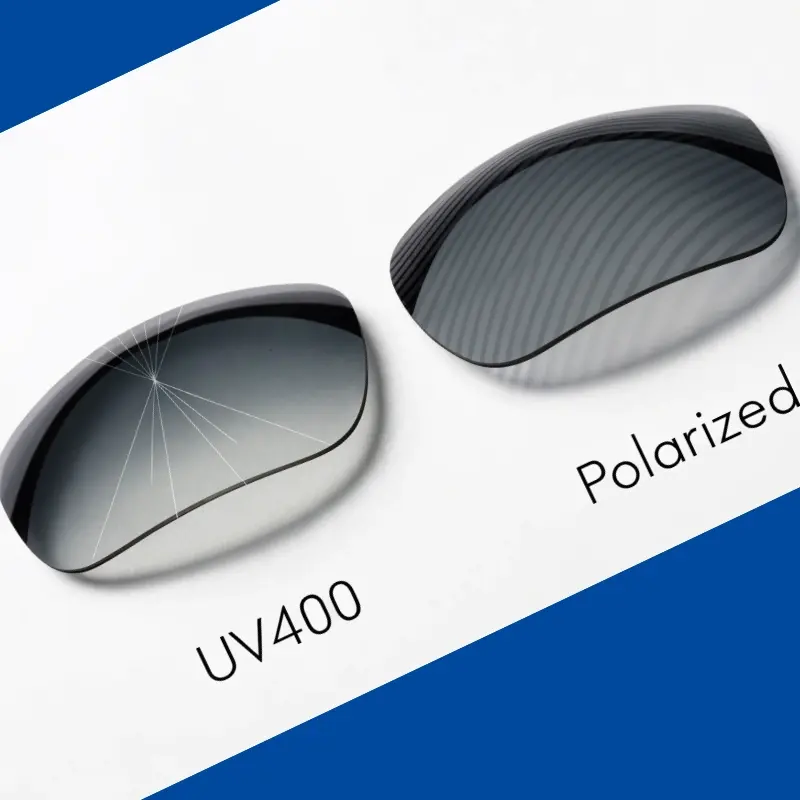
You’re building a sunglasses line. You sit down with your factory contact — or a line sheet from a manufacturer — and you see two boxes to tick: UV400 and Polarized. Maybe both are checked. Maybe only one. You’re not sure if that matters, or how much it should cost, or whether your end customers will even notice the difference.
This is one of the most common sourcing questions we hear from brand owners at every stage — from startups placing their first order to established labels expanding into new categories.
Here’s the short answer: UV400 and polarized are not the same thing. They serve different functions, carry different cost implications, and signal different things to your customers. Getting this wrong means either overpaying for features your market doesn’t need, or under-speccing your product and damaging your brand’s reputation.
This guide breaks down exactly what each lens feature does, how they interact, and — most importantly — how to decide what belongs in your product line.
What Is UV400 Protection? (And Why It’s the Non-Negotiable Baseline)
UV400 is a protection standard, not a lens technology. It simply means the lens blocks all light wavelengths up to 400 nanometers — which covers the full spectrum of UVA and UVB radiation from the sun.
Think of UV400 as the SPF rating of sunglasses. It has nothing to do with how dark or light the lens looks. A clear-tinted lens can be UV400. A very dark lens can fail UV400. Tint and UV protection are completely separate characteristics.
Why UV400 Matters for Your Brand
UV exposure causes progressive, invisible damage to the eyes — cataracts, macular degeneration, and photokeratitis among them. Because of this, UV protection is the standard your end customers assume is there, even if they never check.
More importantly, it is a compliance requirement in most of your key markets:
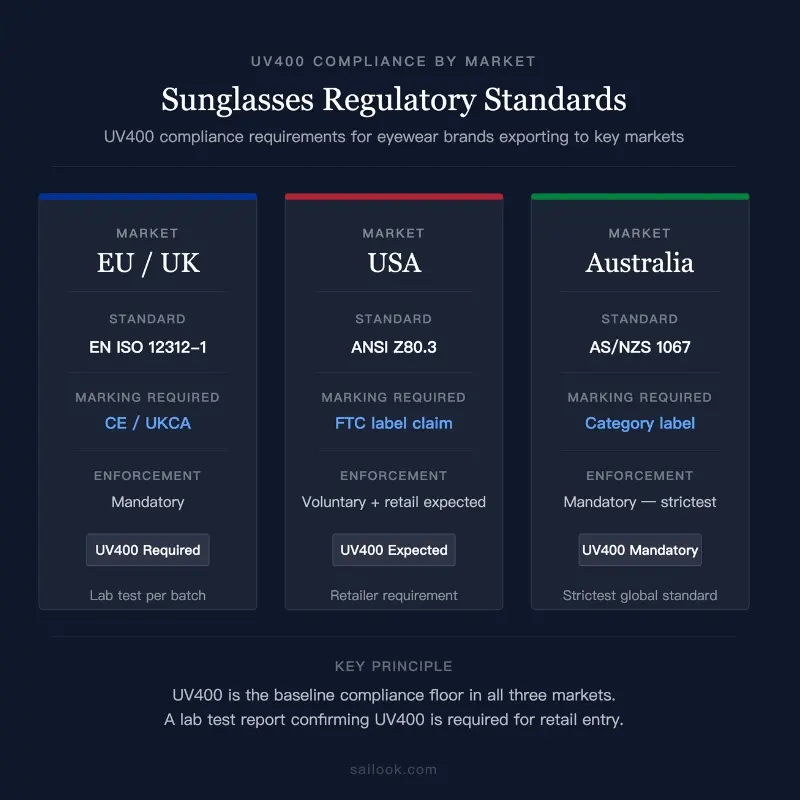
- EU / UK: Requires sunglasses to meet EN ISO 12312-1. UV400 compliance is verified through lab testing and required for CE / UKCA marking.
- USA: ANSI Z80.3 is the voluntary standard, but it is widely expected by US retailers and is required for products sold as “100% UV protection.”
- Australia: AS/NZS 1067 is a mandatory standard with stricter categorization — among the most demanding in the world.
In practice, UV400 is not a premium feature — it is the floor. Any credible sunglasses manufacturer should be offering UV400 as standard. If a factory is quoting you non-UV400 lenses for a fashion sunglass line, that is a red flag, not a cost saving.
The One Thing Brands Get Wrong About UV400
Many buyers assume that if the lens looks dark, it’s protective. It’s not. And conversely, many assume that if the lens is labeled “UV protection,” it’s UV400. Not necessarily — some lower-grade products are labeled “UV protection” while only blocking up to 380nm, leaving a gap in the upper UVA range.
When spec-ing your product, always confirm UV400 specifically — not just “UV protection” — and ask your manufacturer to provide lab test reports. A trustworthy factory will have these ready.
What Are Polarized Lenses? (The Feature That Commands Margin)
Polarization is a lens technology, not a protection standard. A polarized lens contains a thin chemical filter — typically a PVA (polyvinyl alcohol) film — that is embedded or laminated between lens layers. This filter is oriented to block horizontally polarized light: the type of glare that reflects off flat surfaces like water, roads, car hoods, and snow.
The result is dramatically reduced glare, improved contrast, and sharper visual clarity — particularly noticeable when driving, on the water, or in high-sun outdoor environments.
How Polarized Lenses Are Made (What Brands Should Know)
A polarized lens is built around a core polarizing film — the PVA layer — which is then laminated into or onto a base lens material. The base material significantly affects the lens’s weight, optical clarity, impact resistance, and cost. Here are the main options your factory may offer:
TAC (Tri-Acetate Cellulose) polarized lenses — The most common construction for fashion and mid-range sunglasses. The polarizing film is laminated between layers of TAC. Good optical clarity at a reasonable cost, compatible with most tint colors and mirror coatings. This is the standard for the majority of B2B private label orders.
Polycarbonate (PC) polarized lenses — More impact-resistant than TAC, making them well-suited for sports and performance categories. Lightweight and durable. Slightly higher cost than TAC. The preferred choice for active lifestyle brands and outdoor sports markets.
Nylon (Polyamide) polarized lenses — Extremely lightweight and flexible with excellent optical clarity. Commonly used in premium sports and performance eyewear (fishing, cycling, golf). More expensive than TAC and PC, but the weight and clarity difference is noticeable at the consumer level. A good choice for brands targeting serious outdoor athletes.
CR-39 (Allyl Diglycol Carbonate) polarized lenses — A resin-based lens with among the best optical clarity available in plastic lenses. Slightly heavier than PC and nylon, but preferred for fashion and lifestyle brands where optical quality and lens depth are a priority. Common in mid-to-premium fashion sunglasses.
Glass polarized lenses — The highest optical purity of any lens material. Scratch-resistant without additional coating. However, glass is heavier and more fragile than plastic alternatives, which limits its use to heritage and luxury brands where weight is not a concern. Rare in B2B volume production.
The polarizing effect can be verified easily: tilt one polarized lens 90° against another. The lenses will appear to go nearly black where they overlap. This is a quick QC check you or your factory can do during sample inspection.
What Polarized Lenses Cannot Do
This is the most important thing brand owners need to understand: polarization has zero effect on UV protection.
A polarized lens without a UV-blocking compound in the lens material will not protect your customer’s eyes from UV radiation. The polarizing film manages visible light. UV is invisible radiation. They are entirely separate mechanisms.
This means when you order polarized sunglasses, you need to separately confirm UV400 compliance. The two are not automatically bundled. Some factories combine them as standard. Others do not. Always ask — and get the lab report.
UV400 vs Polarized: Side-by-Side Comparison
The table below gives you the clearest view of how these two features differ from a brand sourcing perspective.
| UV400 Protection | Polarized Lenses | |
|---|---|---|
| What it does | Blocks UVA + UVB radiation up to 400nm | Filters horizontally reflected glare |
| What it protects against | Long-term eye damage from UV exposure | Visual discomfort from reflected light |
| Visible effect on the lens | None — invisible to the eye | Slight darkening; anti-glare effect visible |
| Required for compliance | Yes (CE, ANSI, AS/NZS) | No (but adds marketable value) |
| Lens cost impact | Minimal — standard in quality lenses | +$0.50–$2.50 per pair depending on material |
| Retail price impact | Baseline expectation | Premium tier — typically +$10–$30 retail |
| Best for | All sunglass categories | Driving, fishing, beach, skiing, outdoor sport |
| Can exist without the other? | Yes — UV400 without polarization is fine for fashion | Yes — but polarized without UV400 is a product risk |
| Customer perception | Assumed / expected | Perceived as a meaningful upgrade |
| Quality verification | Lab test report (spectrophotometer) | 90° overlap test + lab report |
Why These Two Features Are Often Confused
The confusion is understandable. Most quality sunglasses on the market today combine both — UV400 + polarized — especially in the $30+ retail tier. When customers see both terms on a product, they start to assume they’re related, or that one implies the other.
They don’t.
Here is how to think about it as a brand builder:
UV400 is your license to operate. Without it, you have a fashion accessory, not protective eyewear. In most regulated markets, selling sunglasses without UV400 compliance is either illegal or opens you to significant liability.
Polarization is your margin builder. It’s a functional upgrade with real perceived value that justifies a higher price point and creates a clear product tier in your collection. A polarized frame in acetate that retails at $120 next to a non-polarized acetate frame at $80 is a logical, defensible product architecture that customers understand and respond to.
How to Structure Your Product Line Around These Two Features
This is where most brand guides stop — at the technical explanation. But if you’re building a product line, the real question is: what does this mean for how I architect my collection?
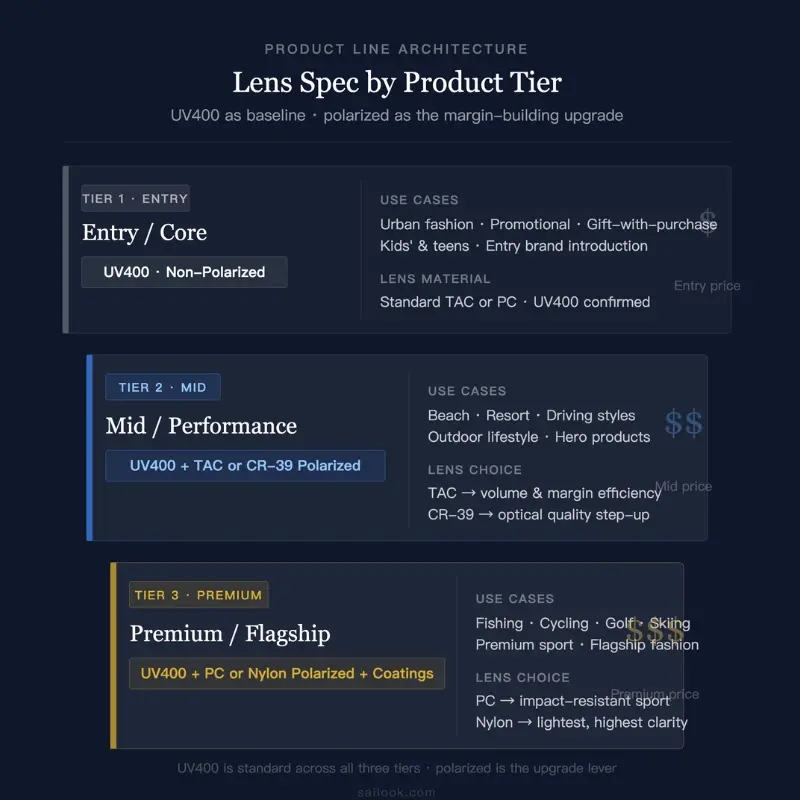
Here is a framework we use with brand clients across lifestyle, outdoor, and fashion categories:
Tier 1 — Entry / Core: UV400, Non-Polarized
Your accessible price point. UV400 is standard and non-negotiable. No polarization. This tier works for:
- Urban lifestyle frames with fashion-forward design
- Gift-with-purchase or promotional bundles
- Entry-level brand introduction styles
- Kids’ or teens’ collections where price sensitivity is high
Tier 2 — Mid / Performance: UV400 + Polarized (TAC or CR-39)
Your volume driver. This is where most fashion and outdoor brands put their bestselling styles. Two lens options work well here depending on your positioning:
- TAC polarized — the efficient choice. Good optical clarity, lower cost, works well for beach, resort, and lifestyle styles where volume and margin efficiency matter.
- CR-39 polarized — the quality step-up within the same tier. Better optical clarity than TAC, slightly heavier but with a more premium lens feel. A good fit for mid-range fashion brands that want to justify a higher retail price without moving to a full performance construction.
This tier is ideal for:
- Beach and resort collections
- Driving-focused styles (aviators, oversized wraps)
- Lifestyle brands with an outdoor or active dimension
- Any style you want to position as a meaningful “hero” product
Tier 3 — Premium: UV400 + Polarized (PC or Nylon) + Enhanced Coatings
Your flagship tier. This is where lens construction shifts from fashion-grade to performance-grade. PC and nylon polarized lenses both offer superior impact resistance and lightweight wear — the right choice depends on your category:
- PC polarized — durable, impact-resistant, cost-effective for a performance lens. Good for sports and active lifestyle brands entering the premium tier.
- Nylon polarized — the lightest and most optically refined option in this tier. Used by leading performance eyewear brands in fishing, cycling, skiing, and golf. Higher cost, but the weight and clarity difference is tangible.
Add anti-scratch coatings, AR (anti-reflective) treatment, and mirror finishes to complete the premium package. Best for:
- Sports brands (fishing, skiing, cycling, golf)
- Performance outdoor categories
- Premium fashion labels where the lens quality supports the price point
What to Ask Your Manufacturer — A Sourcing Checklist
When you’re working with a factory on a new sunglass style, these are the specific questions to ask about lens specification. Don’t assume. Don’t take the word “polarized” on a spec sheet as confirmation of UV400, or vice versa.
On UV400:
- Can you provide a UV transmission test report for this lens?
- Which standard does it comply with — EN ISO 12312-1, ANSI Z80.3, or AS/NZS 1067?
- Is this compliance confirmed per batch, or only at the prototype stage?
On Polarized:
- What is the polarization efficiency? (Industry standard is 99.9%+ for quality lenses)
- What base lens material is used — TAC, CR-39, PC, nylon, or other? What are the optical and weight differences between options for this style?
- Is the UV400 blocking built into the lens substrate, or applied as a separate coating?
- Can you provide a combined UV + polarization test report from a certified lab?
On QC:
- How do you test polarization during bulk production?
- What is your rejection threshold for polarization defects?
- Will you include a polarization test card in the sample package?
A factory that can answer these questions clearly and back them up with documentation is a factory worth working with. One that can’t — or redirects you to vague answers — is one worth being cautious about.
Common Mistakes Eyewear Brands Make with Lens Specs
Over years of working with brand owners at various stages of business, these are the most consistent errors we see in lens specification decisions.
Mistake 1: Treating “Polarized” as a Quality Signal for Everything
Polarization adds real value — but only where the use case calls for it. A fashion brand whose customers wear sunglasses to brunch and weekend errands in a city does not need polarized lenses in every style. Adding polarization across the board increases your COGS without proportional retail upside. Be strategic.
Mistake 2: Assuming Polarized Includes UV400
We said it above and it bears repeating. Polarization ≠ UV protection. Always confirm UV400 separately. Always get the lab report.
Mistake 3: Not Distinguishing Between “UV Protection” and “UV400”
Some manufacturers and product listings use “UV protection” loosely to mean protection to 380nm. UV400 specifically means 400nm — the full UV spectrum. For markets like Australia, this distinction matters for compliance. For your brand’s credibility, it matters everywhere.
Mistake 4: Ignoring Polarization Quality Variation
Not all polarized lenses are equal. A cheap TAC polarized lens may delaminate within months, show uneven color, or have a polarization efficiency of 95% rather than 99.9%. Approve by sample, but also ask your factory about their polarization QC process and what percentage of bulk production they test. If they test 100% at the production line, that’s the right answer.
Mistake 5: Polarized Lenses and Digital Screens
This one trips up brands targeting younger, tech-forward demographics. Polarized lenses can make smartphone screens, GPS displays, and some car dashboards difficult to read at certain angles. For an urban lifestyle brand whose customers are constantly on their phones, a non-polarized UV400 lens may actually deliver a better user experience in their daily context. Know your customer.
How UV400 and Polarized Affect Your Packaging and Marketing Claims
Your lens spec choices have downstream consequences for how you package and market your product. Here’s what to know:
UV400 compliance claims should always be backed by documentation. In the EU and Australia especially, making UV protection claims without being able to demonstrate compliance is a regulatory risk. Your factory should provide test reports that you retain on file.
“100% UV Protection” is a claim that requires UV400-level performance. If your lens is only blocking to 380nm, you cannot legally or ethically use this claim in regulated markets.
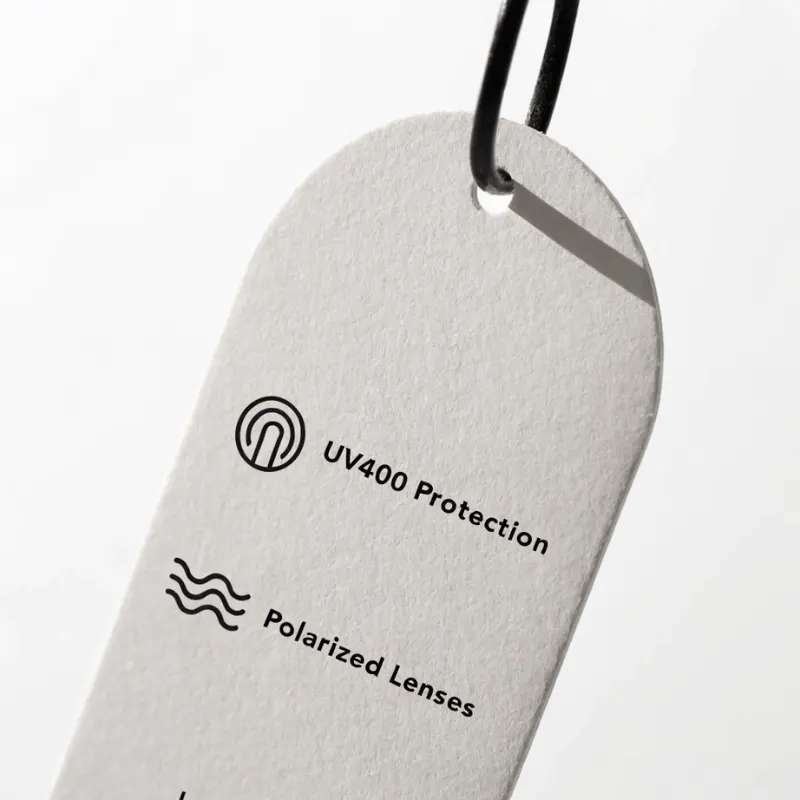
“Polarized” on packaging is purely a function claim — it tells the customer the lens reduces glare. It says nothing about UV protection. For this reason, the best practice is to always show both claims separately when they both apply: “UV400 + Polarized” or “100% UV Protection | Polarized Lenses.”
Retail positioning: In practical terms, polarized lenses are one of the most effective single-line differentiators on a product page or hang tag. A/B tests by eyewear brands consistently show that “polarized” as a feature keyword outperforms “UV400” in conversion — because consumers already assume UV protection, but see polarization as an extra benefit. This makes it a powerful marketing asset when you’ve committed to it in your product architecture.
Which Lens Spec Is Right for Your Brand? (Decision Framework)
Use this to guide your lens specification decisions across your collection.
| Your Brand / Collection Type | Recommended Lens Spec | Rationale |
|---|---|---|
| Fashion / lifestyle, urban market | UV400, non-polarized | Price efficiency, fashion-driven purchase |
| Beach / resort lifestyle brand | UV400 + TAC polarized | High glare environment, customers notice the difference |
| Driving-focused styles | UV400 + TAC or CR-39 polarized | Strong glare reduction; CR-39 adds optical quality for premium positioning |
| Mid-range fashion with quality focus | UV400 + CR-39 polarized | Best optical clarity in the fashion tier; supports higher retail price |
| Sports / outdoor performance | UV400 + PC polarized | Impact resistance + glare control for active use |
| High-performance / professional sport | UV400 + nylon polarized | Lightest weight, highest optical clarity; category expectation at pro level |
| Kids’ / youth collection | UV400, non-polarized | Price sensitivity, compliance-first |
| Entry-level / promotional | UV400, non-polarized | Cost control, compliance minimum |
| Premium / flagship collection | UV400 + polarized + AR/mirror coating | Full feature stack justifies price point |
| Golf / fishing / water sports | UV400 + polarized (nylon or PC, high clarity) | Category expectation — customers actively seek polarized |
A Note on Working with a Manufacturer Who Understands Both
The distinction between UV400 and polarized is one of those areas where the quality of your manufacturing partner really shows. A good factory doesn’t just tick boxes — they help you understand what each specification means for your product category, your customer, and your cost structure, and they back it up with documentation.
If you’re evaluating polarized lens options for an upcoming collection, our polarized sunglasses page covers lens material options (TAC, CR-39, PC, nylon), tint selection by use case, technical specifications, and MOQ guidance — with test report documentation included on every production batch. For project-specific questions, reach out directly and we’ll work through the lens spec together.
Frequently Asked Questions
Is UV400 the same as polarized? No. UV400 is a protection standard that blocks harmful ultraviolet radiation. Polarization is a lens technology that reduces glare from reflected light. They address completely different problems and must be confirmed separately.
Do polarized sunglasses always have UV400? Not automatically. Quality polarized lenses typically include UV400 as part of the lens construction, but this must be confirmed with a lab test report. Never assume polarization includes UV protection without documentation.
Is UV400 required for sunglasses sold in the EU? Yes. Sunglasses sold in the EU must comply with EN ISO 12312-1, which includes UV protection requirements consistent with UV400 standards. This is required for CE marking.
Can I offer a product line with both polarized and non-polarized styles? Absolutely — and this is often the best strategy. It lets you create a clear product tier structure, with polarized styles occupying a premium price point. Both tiers should carry UV400 as a baseline.
How much more does a polarized lens cost in manufacturing?
In OEM/ODM production, TAC polarized lenses typically add $0.50–$2.50 per pair in lens cost compared to standard UV400 lenses, depending on the lens material, construction, and order volume. PC polarized lenses are slightly higher. The retail price premium for polarized is far greater than the cost difference — making it an efficient margin lever.
What’s the best way to verify lens quality when receiving bulk production?
For UV400: request a spectrophotometer test report from the factory, ideally from an accredited lab at the sampling stage. For polarization: conduct a 90° lens overlap test on samples, and request polarization efficiency documentation. For high-volume orders, third-party inspection before shipment is worth considering for overall product QC — covering appearance, dimensions, and packaging — rather than lens-specific lab testing, which is typically confirmed at the sample approval stage.
Let's get started!
Get in touch with a custom eyewear specialist now for a free consultation and instant price quote.
WHATSAPP ME GO!
📱 Scan with your phone to start chatting