How to Work with a Chinese Eyewear Factory: 8 Things First-Time Brand Buyers Need to Know
Finding a Chinese eyewear factory isn’t the hard part. There are thousands of them. The part that trips up first-time brand buyers is what comes next — how to actually work with one.
The gap between “I found a factory” and “I have sellable product in my hands” involves a sequence of decisions most buyers don’t know to prepare for: how to write a brief that gets taken seriously, what the sample process actually looks like, how payment works, why lead times run longer than you expect, and how to communicate across twelve time zones without things falling apart.
We’ve been manufacturing custom sunglasses and optical frames in Shenzhen since 2005, working with brand owners across North America, Europe, Australia, the Middle East, and beyond — at every stage, from first-time founders placing a 300-piece order to established labels expanding into new categories. The same questions come up, almost every time. This guide answers them.
If you’re working with a Chinese eyewear manufacturer for the first time — or you’ve had a previous experience that didn’t go as planned — this is the practical guide we wish more buyers had before they started.
1. Understand What You’re Actually Buying: OEM, ODM, or Stock
Before you contact a factory, you need to know which type of product relationship you’re entering. Most buyers conflate three different models — and getting this wrong costs time and money.
OEM (Original Equipment Manufacturer)
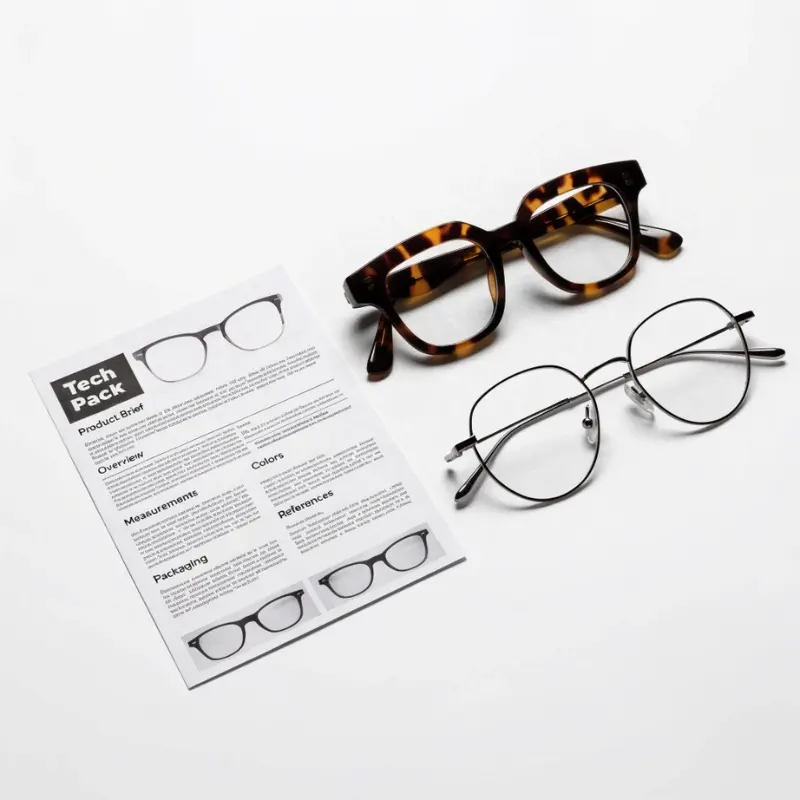
You bring your own design — a tech pack, reference sketch, or detailed brief — and the factory manufactures it to your specifications. Full custom tooling may be required for the frame shape. This is the highest-investment, highest-differentiation path: your product looks like nothing else on the market because it was built from your brief.
Best for: Brands with a clear aesthetic direction, established designers, or founders who’ve done the product development work upfront.
ODM (Original Design Manufacturer)
The factory offers existing frame shapes and molds. You select a base shape, then customize: material, color, temple design, logo, lens, packaging. No new tooling required for the frame. This is faster, lower cost, and lower risk for a first order.
Best for: New brands testing the market, founders without a design background, or labels that want speed-to-market without sacrificing brand identity.
Stock / Ready-to-Ship
The factory has finished or near-finished inventory. You choose styles, add minimal customization (logo, packaging), and ship. Fastest path to product, lowest minimum quantities, least differentiation.
Best for: Promotional runs, gift-with-purchase, market testing before committing to custom production.
Most first-time buyers start with ODM — it lets you build brand identity without the full investment of original tooling. As you understand what sells and how your customers respond, moving to OEM on hero styles makes sense. Learn more about the full range of private label eyewear options.
2. Know Your Numbers Before You Reach Out
The single most common reason a factory doesn’t respond seriously to an inquiry is that the buyer hasn’t defined their parameters. When a factory receives fifty inquiries a day, the ones with clear numbers get answered first.
Before you contact a manufacturer, have these ready:
Minimum Order Quantities — What to Expect
| Frame Material | Typical MOQ | Notes |
|---|---|---|
| Acetate (domestic sheet) | 300 pcs / style | 100 pcs per colorway within that style |
| Acetate (Mazzucchelli import) | 300 pcs / style | Longer lead time; material lead time adds 3–4 weeks |
| TR90 / Injection plastic | 1,200+ pcs / style | Tooling fee required for new molds |
| Metal | 300–500 pcs / style | Varies by complexity |
| Titanium | 300 pcs / style | Higher per-unit cost; lower MOQ acceptable |
These are starting points, not hard limits. Factories with full order books may push MOQs higher; factories with capacity may negotiate lower for the right customer. But going in with no concept of quantity makes the conversation very difficult.
Sample Fees and Tooling Costs
- Pre-production samples: Typically $150–$400 per style depending on complexity. Usually deductible from the bulk order.
- New mold / tooling (injection/TR90): $800–$3,000+ depending on frame complexity. This is a one-time cost that you own.
- Acetate frames: No tooling fee — frames are CNC-cut from sheet. Much lower barrier to custom shapes.
Your Budget and Timeline
Know your target EXW cost range per pair, your intended retail price, and your required delivery date — work backwards to allow for sampling (10–20 days), bulk production (50–120 days depending on material), and shipping.
3. How to Write a Brief That Gets a Real Response
Factories receive dozens of inquiries daily. Many are vague, under-specified, or ask for things that don’t align with the factory’s actual capabilities. A well-structured brief signals that you’re a serious buyer worth investing time in.
What to Include
The essentials — without these, a factory cannot price or plan:
- Reference images or links to comparable styles (this is the single most useful thing you can provide)
- Frame material preference (acetate, metal, TR90, injection)
- Lens type (UV400 standard, polarized, photochromic)
- Approximate quantity and colorways
- Target delivery date or season
- Your target market (US, EU, Australia — compliance requirements vary)
- Whether you need custom logo, packaging, or both
What not to do:
- Don’t lead with “what’s your cheapest price” — this filters you into the lowest-priority category
- Don’t send a generic inquiry to twenty factories simultaneously and wait to see who responds — factories talk, and it damages your credibility
- Don’t withhold your budget expecting to negotiate lower — a factory that knows your ceiling can tell you what’s realistic within it
The First Email — Tone and Format
Short, specific, professional. One paragraph of context (your brand, your market, what you’re building), one paragraph of product specifics (material, quantity, reference), one clear question or call to action. Attach your reference images. WhatsApp or email both work for a first contact — what matters is that your message is clear and specific, not which channel you use.
4. The Sample Stage: What to Expect, What to Approve
Sampling is not a formality. It is the most important quality checkpoint in the entire production process — and the stage where the most mistakes happen, on both sides.
The Sample Sequence
Most factories run a two-stage sample process:
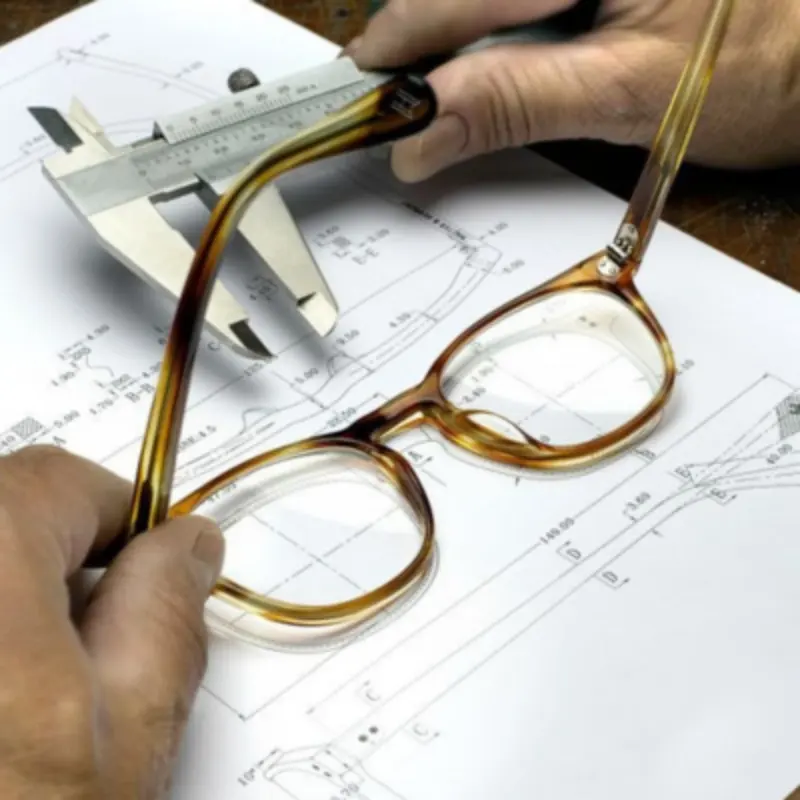
Stage 1 — Development sample (pre-production prototype): The first physical manifestation of your brief. Expect it to be directionally correct but not perfect. Color, finish, and minor proportions may need adjustment. This is normal. Approve the structure; flag everything else.
Stage 2 — Confirmation sample (pre-bulk approval): After revisions, this sample reflects the agreed spec. Once you sign off, this becomes the production standard. Everything you don’t flag here, you accept in bulk.
What to Check on Every Sample
| Check Point | What to Look For |
|---|---|
| Frame dimensions | Temple length, bridge width, lens dimensions — measure against spec |
| Hinge action | Smooth open/close, no wobble, spring hinge function if specified |
| Lens fit | No gaps, no pressure points, correct optical center alignment |
| Lens spec | UV400 confirmed? Polarization test? Request lab report |
| Color / material | Matches Pantone or reference sample? Acetate pattern aligned? |
| Logo placement | Position, depth of engraving, color of printing |
| Finish quality | No scratches, polishing marks, plating inconsistency |
| Fit on face | Have someone wear the sample — does the nose bridge sit correctly? |
One practical rule: If you’re unsure whether to flag something, flag it. The cost of a revision at sample stage is zero. The cost of the same issue in bulk is the whole order.
Sample Fees — Standard Practice
Most reputable factories charge a sample fee ($150–$400 per style) that is refundable against your bulk order. Factories that offer “free samples” often roll the cost into their unit price, or produce samples to a lower standard. Paying for samples is a sign of a real manufacturing relationship.
5. Payment Terms: What’s Standard and What’s Negotiable
Payment is the part of the conversation that many first-time buyers approach with either too much trust or too much suspicion. The reality is straightforward.
Industry Standard Terms
T/T (Bank Transfer) with split payment is the dominant model for OEM/ODM eyewear:
- 30% deposit upon order confirmation and receipt of pro forma invoice
- 70% balance before shipment (against shipping documents or upon bill of lading)
Some factories ask for 50/50 on first orders from new clients — this is reasonable and standard for an unestablished relationship. As trust builds over multiple orders, terms typically relax.
Payment Methods Compared
| Method | Risk for Buyer | Risk for Factory | Notes |
|---|---|---|---|
| T/T (wire transfer) | Medium — limited recourse if factory fails | Low | Standard; fastest processing |
| Letter of Credit (L/C) | Low — bank guarantee | Medium — documentation burden | Common for large orders ($30K+) |
| PayPal / Wise | Low | High | Rarely accepted for production orders; fine for sample fees |
What’s Negotiable
For first orders, the deposit percentage is rarely negotiable below 30%. What is sometimes negotiable: payment timing relative to production milestones, currency (USD vs RMB affects FX exposure), and whether sample fees are deducted from the first bulk order.
One important note: Never pay 100% upfront, regardless of how confident you are in the supplier. And never pay 0% upfront — a factory that accepts zero deposit has no production incentive and is not a serious partner.
6. Production Timeline: How to Read a Lead Time and Plan Around It
The timeline question is where most first-time buyers underestimate — and where most disappointments originate. “Lead time” means different things to different factories, and the gaps add up.
How Production Lead Times Break Down
| Stage | Typical Duration | Notes |
|---|---|---|
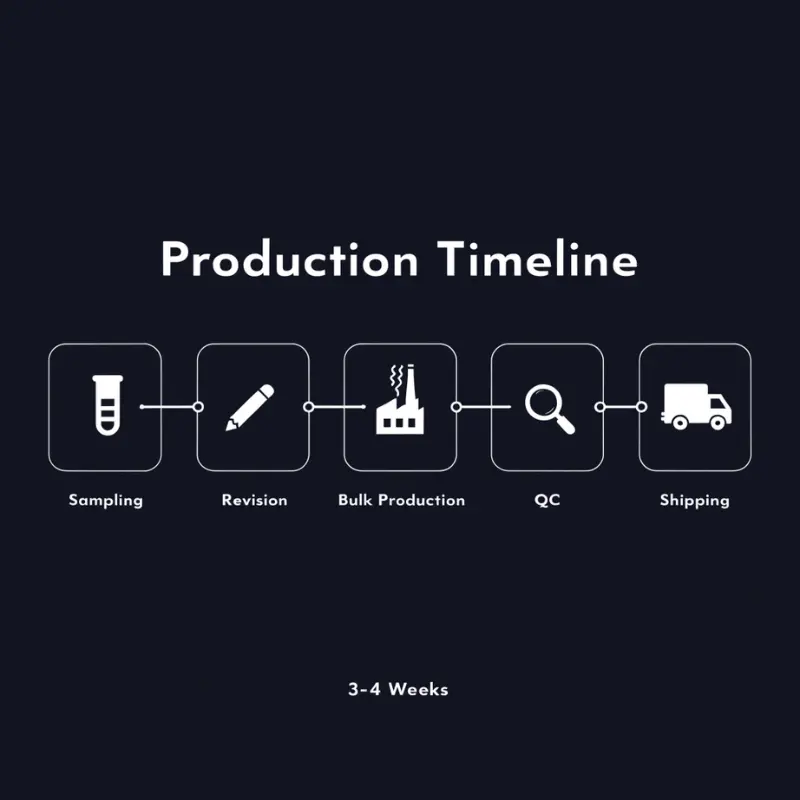
| Brief to first sample | 10–20 working days | New tooling adds 15–25 days |
| Sample revision rounds | 5–10 days per round | Assume 1–2 rounds |
| Bulk production — acetate (domestic) | 50–60 working days | From order confirmation |
| Bulk production — acetate (Mazzucchelli) | 60–120 working days | Material lead time is the variable |
| Bulk production — TR90 / injection | 60–90 working days | After tooling confirmation |
| QC and packing | 5–7 working days | |
| Sea freight (China → US/EU/AU) | 25–35 days | |
| Total realistic timeline | 4–6 months | From first contact to goods in hand |
For a detailed breakdown of shipping options, import duties, and customs clearance, see: How to Import Custom Sunglasses from China: Duties, Shipping, and Lead Times Explained
Three Things Buyers Consistently Get Wrong
1. “Working days” ≠ calendar days. Chinese factories observe national holidays including Golden Week (October) and Chinese New Year (January/February). These can add 2–4 weeks to your timeline if your order spans these periods.
2. The lead time starts from order confirmation, not inquiry. Sampling, revision, and approval happen before the production clock starts. Budget this separately.
3. Factory “delivery” means goods leaving the factory gate (EXW), not arriving at your warehouse. Always clarify whether a quoted date refers to ex-factory or estimated arrival.
Planning Backwards from Your Launch Date
If you need product in US warehouses by October 1 for a holiday season launch:
- Allow 30 days sea freight + customs clearance: ship by September 1
- Allow 60 days production: confirm order by July 1
- Allow 3–4 weeks sampling and approval: submit brief by early June
That means a holiday launch requires a June brief. Most buyers start thinking about it in August.
7. Communication: How to Work Across Time Zones, Language, and Culture
Communication is where long-term supplier relationships are built or broken — and where first-time buyers make the most preventable mistakes.
Channel Discipline
WhatsApp: Best for fast, real-time communication — status updates, sending reference images, quick questions, and confirming details. Not the right channel for decisions that need a paper trail: spec changes, payment instructions, and order confirmations should always be followed up in writing, whether by email or a summary message you can both refer back to.
Email: Use for all binding communications — order confirmations, spec approvals, payment instructions, complaint records. If it matters, put it in an email.
Video call: Use before committing to a factory (a 30-minute call reveals more than twenty emails), and at key milestone points (post-sample review, mid-production check-in for large orders).
How to Confirm Critical Information
Chinese factories are generally responsive and relationship-oriented — but “yes” in communication does not always mean “confirmed and understood.” After any discussion involving a spec change, a timeline, or a payment arrangement, send a written summary:
“Just to confirm what we discussed: the temple color will be matte black (ref: Pantone Black 6 C), logo will be debossed on outer temple, delivery is targeted for [date]. Please confirm.”
This is not distrust — it’s professional practice. Good factories appreciate it because it protects both sides.
Understanding the Communication Layer
In most factories, the person you communicate with (sales or account manager) is not the person making production decisions. Decisions about material sourcing, production scheduling, and QC standards are made by people deeper in the operation. This is normal. What it means for you: your account manager needs clear, unambiguous written instructions to relay accurately. Vague requests get interpreted generously but not always correctly.
Cultural Norms Worth Knowing
- Factories rarely say “no” directly. “We’ll try our best” or “this might be difficult” often means “this is not possible on our current timeline.” Push for clarity.
- Relationship matters more than contract in early-stage partnerships. Factories allocate capacity, prioritize revisions, and go the extra step for clients they like working with. Treating your factory contact as a valued partner — not a vendor to be squeezed — pays back over time.
- Don’t ghost after samples. If you’ve received samples and decided not to proceed, communicate clearly. The factory has invested time and material. Ghosting damages your reputation in an industry where suppliers talk to each other.
8. Quality Control: Your Options Before Bulk Ships
Receiving a bulk order you haven’t verified is a gamble. The question isn’t whether to do QC — it’s how much to do and at what stage.
QC Layers in a Good Factory
A reliable manufacturing partner runs quality checks at multiple stages internally:
- Incoming material inspection: Raw acetate, metal components, hinges, and lenses are checked on arrival
- In-process QC: Frame dimensions, color consistency, and hinge function checked during production
- Pre-shipment inspection: Final batch checked against the approved confirmation sample before packing
Ask your factory what their internal QC process looks like. The answer tells you a great deal about how they operate.
Your External QC Options
| Option | Cost | Best For |
|---|---|---|
| Factory self-inspection report | Included | All orders — request as standard |
| Remote video inspection | Free–$50 | Orders under $5,000 or established relationships |
| Third-party inspection (SGS, QIMA, Bureau Veritas) | $200–$400 | Orders over $10,000–$15,000 or first large bulk order |
Third-party inspection for eyewear covers overall product QC — appearance, dimensions, packaging, labeling, and quantity count. It is not the same as lens-specific lab testing (UV400, polarization), which is confirmed at the sample stage via factory test reports and not typically re-run on bulk.
What to Do If Bulk Doesn’t Match the Sample
First: document everything photographically before unpacking further. Second: contact your factory account manager with specific, numbered defect descriptions (not “this is all wrong”). Third: have a clear understanding upfront of what the factory’s rework and return policy covers.
The best factories handle issues proactively — they’d rather fix a problem than lose a client. The relationship is usually the best insurance policy you have.
The Honest Summary: What First-Time Buyers Should Know Going In
Working with a Chinese eyewear factory is not complicated — but it rewards preparation. The buyers who have smooth first experiences are almost always the ones who came in with a clear brief, realistic timelines, and a willingness to treat the factory as a long-term partner rather than a transactional vendor.
The buyers who struggle are usually trying to move too fast, with too little specification, and too much price pressure. The factory that quotes the lowest price is not always the factory that delivers the best outcome.
If you’re at the stage of evaluating manufacturers for a first collection — or you’re ready to move from concept to sample — we’re happy to talk through your brief and give you a honest picture of what’s realistic for your category, your market, and your timeline.
Frequently Asked Questions
How do I know if a Chinese eyewear factory is legitimate?
Ask for their business license, export license, and references from existing brand clients. A legitimate factory should also be able to provide ISO, CE, or relevant test certificates for their products. Factories that deflect these requests or can’t provide documentation are a risk. Video calls and factory walkthroughs (live or recorded) are also standard — a factory that won’t show you their production floor is one worth questioning.
What’s the difference between a factory and a trading company? A factory manufactures directly. A trading company sources from factories and adds a margin. Trading companies can be useful for buyers who need to consolidate multiple product categories or navigate logistics, but for private label eyewear, working directly with a factory gives you better pricing, more direct communication on spec and quality, and a clearer line of accountability.
Do I need to visit the factory in China?
For a first order, no — most established factories now support full remote development including video calls, live factory walkthroughs, and sample-by-courier. Factory visits become more valuable as order volume grows and the relationship deepens, or when you’re developing a complex OEM product with new tooling. Many clients manage successful multi-year relationships without ever visiting in person.
How do I protect my design from being copied?
Sign an NDA before sharing detailed tech packs or proprietary designs. Register your trademark in China (through CNIPA) if you’re serious about IP protection — Chinese trademark law is territorial. Build into your factory relationship an expectation of exclusivity on custom molds and shapes, confirmed in writing. The reality is that most reputable factories have more to lose from copying a client’s design than they stand to gain.
What happens if my bulk order doesn’t match the approved sample?
This is why the sample approval stage is so important — the confirmation sample you sign off on is the legal production standard. If bulk departs materially from that standard, you have grounds for rework or partial credit. Document everything (photos, measurements) and communicate specifically. Most quality factories will work to resolve genuine production discrepancies. Having a clear written record of your approved spec is your strongest position.
What is EXW and how does it affect my landed cost?
EXW (Ex Works) means the price covers goods at the factory gate only — all freight, export documentation, customs clearance, and import duties are your responsibility. Most China factory quotes are EXW. To understand your true landed cost, add: domestic trucking to port (~$50–$150 per shipment), sea freight (variable by volume and destination), destination port charges, import duty (varies by HS code and country), and final delivery. For buyers new to international freight, working with a freight forwarder who handles China exports is worth the fee.
For the full import guide: How to Import Custom Sunglasses from China: Duties, Shipping, and Lead Times Explained →
Let's get started!
Get in touch with a custom eyewear specialist now for a free consultation and instant price quote.
WHATSAPP ME GO!
📱 Scan with your phone to start chatting