Acetate Sunglasses Hinge Types: What Every Brand Should Know Before Ordering
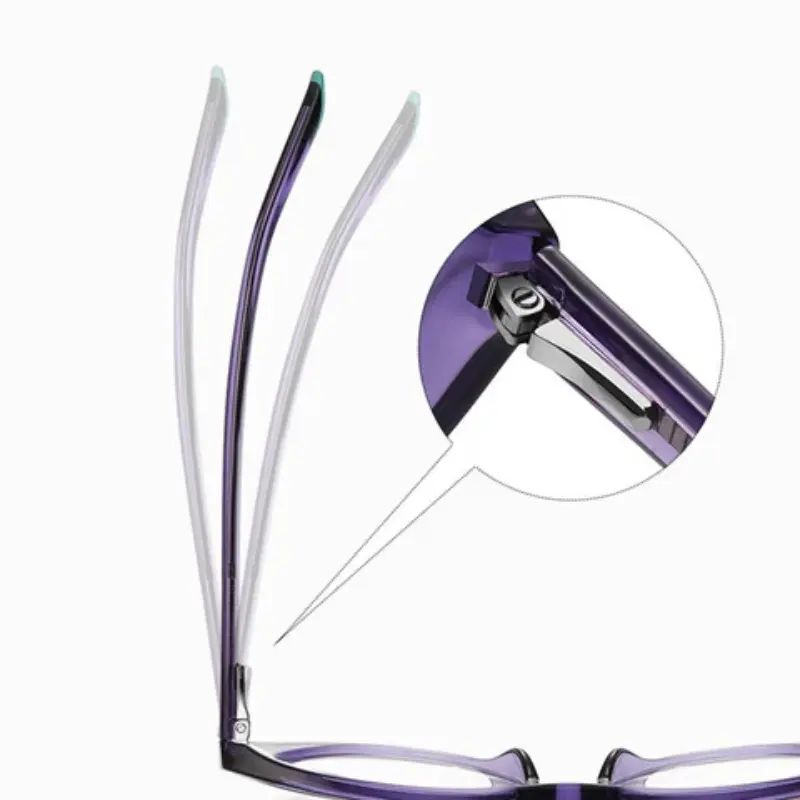
A hinge is one of the smallest parts of a pair of sunglasses, and it’s also one of the most common reasons a customer returns a frame. When a buyer asks us to look into a high return rate on an acetate style, the hinge is one of the first things we check — more often than the acetate itself, more often than the lens.
This guide covers the two hinge types you’ll actually be choosing between for an acetate frame, a third construction worth knowing about even though it’s not a true acetate option, and the specific questions worth asking before you commit to a style.
Why Hinge Choice Matters More Than Most Brands Realize
The hinge connects the temple to the front of the frame, and it’s the part of the eyewear that takes the most mechanical stress — every time a customer puts the glasses on or takes them off, the hinge absorbs that motion. Over the life of the product, that adds up to thousands of open-close cycles.
This is also why hinge failure is disproportionately common compared to other frame defects. A scratch on a lens or a slightly uneven tint is a cosmetic issue. A hinge that loosens after a few months changes how the frame fits on the customer’s face — and that’s the kind of problem that generates a support ticket, a return, or a one-star review, even when the rest of the frame is built well.
For a brand building a private label collection, hinge type is a spec decision with real downstream consequences: return rate, perceived quality, and how the product holds up against a customer’s expectations months after the sale — not just at unboxing.
The Hinge Types You’ll Actually Choose Between for Acetate
Acetate sunglasses are built with one of two hinge constructions in practice. A third type — hingeless — comes up often enough in industry conversation that it’s worth covering, but it’s a metal and titanium construction, not an acetate one.
Standard (Barrel) Hinge
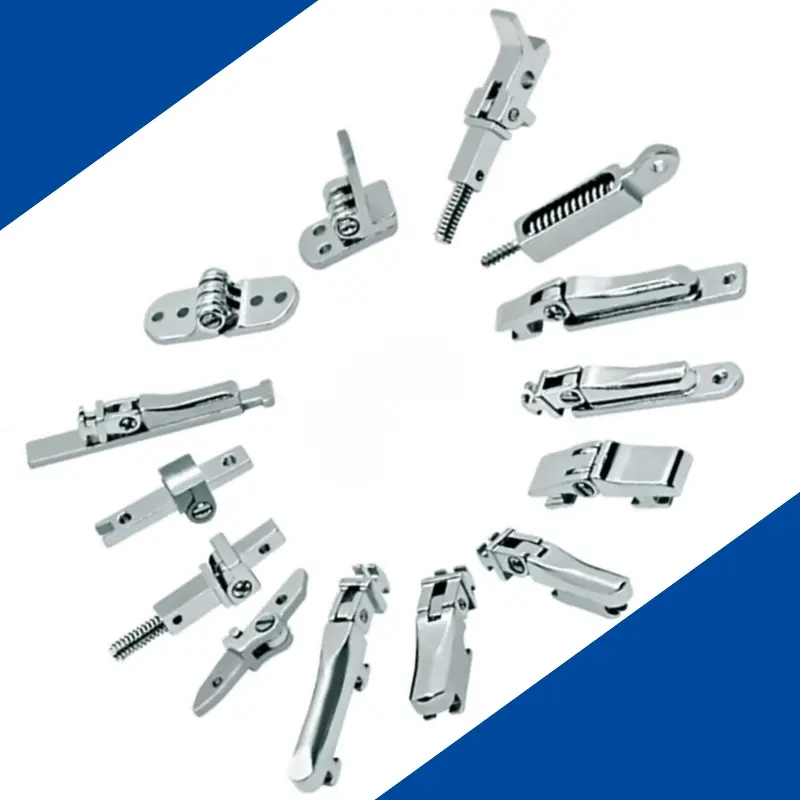
A standard hinge — also called a barrel hinge — is the simplest and most common construction. Small metal cylinders (barrels) are embedded into the temple and the frame front, aligned, and joined with a screw that acts as the pivot point. The temple opens and closes purely on friction between the barrel and the screw.
Barrel hinges are usually described by the number of barrels, or “prongs” — 3-prong, 5-prong, and 7-prong are the most common configurations. More prongs generally means a wider hinge with more surface area distributing the stress of opening and closing, which translates to better long-term stability, particularly on heavier or wider acetate frames.
The known weak point of a standard hinge is straightforward: it holds tension purely through the screw. Over repeated use, screws loosen — that’s mechanical reality, not a quality defect — and once a screw loosens, the temple develops play and the frame stops sitting where it’s supposed to. Industry cycle testing under ISO 12870 typically shows measurable widening at the hinge after around 5,000 open-close cycles on a standard hinge, which for an average wearer translates to roughly six months of daily use.
Best for: entry-tier and promotional lines, fashion-forward styles where lower cost matters more than long-term tension retention, and any program where the retail price point doesn’t support a more complex hinge mechanism.
Spring Hinge
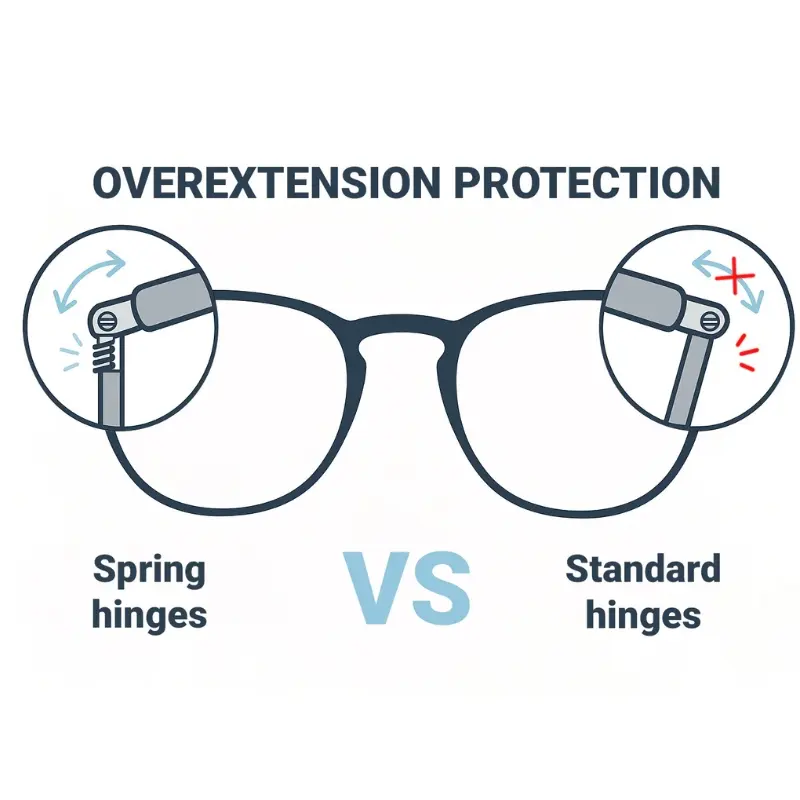
A spring hinge adds a small stainless steel spring — typically 0.3–0.5mm wire diameter — inside the hinge barrel, press-fitted into the temple cavity. Instead of the screw alone holding the temple position, the spring provides continuous outward pressure, allowing the temple to flex an additional 15–20 degrees beyond the resting position before settling back.
This changes the failure mode in a meaningful way. Because the spring — not the screw — is doing the work of maintaining tension, a slightly loosened screw doesn’t immediately translate into a loose-fitting frame the way it does on a standard hinge. Hinge suppliers commonly rate spring hinges for 20,000–30,000 open-close cycles, and some premium constructions are tested well beyond that. At typical usage rates, that’s a multi-year difference in how long the frame holds its original fit compared to a standard hinge.
The internal spring is usually housed in a cartridge made from nickel silver or Monel, materials chosen specifically because they bond securely into acetate or TR90 temple material during assembly. Spring hinges cost more to source and assemble than standard hinges, and they’re harder to repair in the field if something does go wrong — the mechanism is sealed inside the temple, not user-serviceable the way a simple screw tightening is.
Best for: mid-to-premium acetate collections, any style marketed around daily wear or active use, and product lines where return rate and repeat-purchase reputation matter more than shaving a small amount off unit cost.
Hingeless / Flex-Temple Construction — Worth Knowing, Rarely an Acetate Option
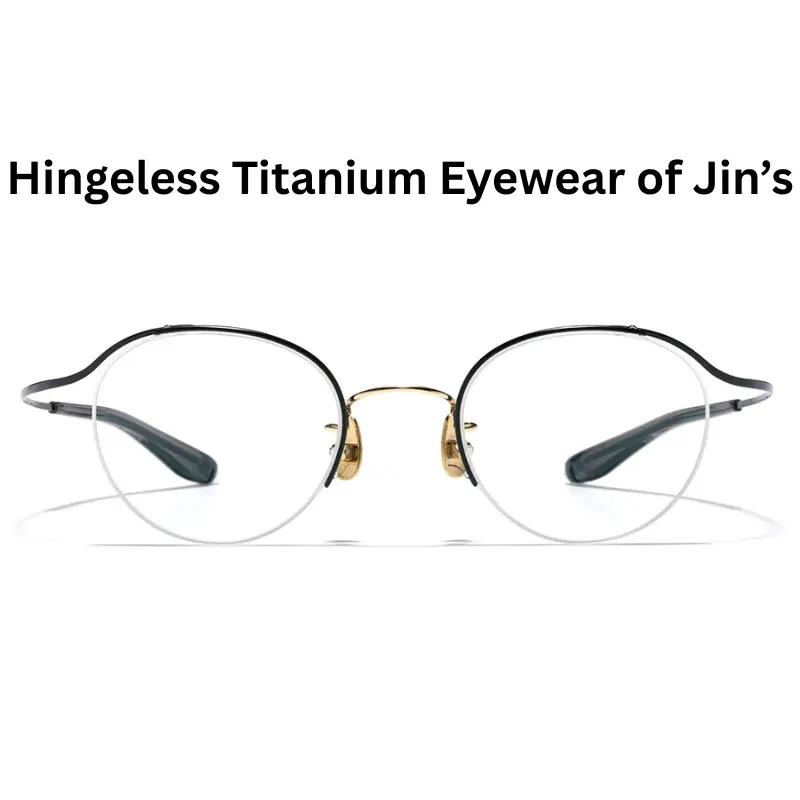
You’ll see “hingeless” or “memory temple” designs marketed in the eyewear industry, and it’s worth understanding what they actually are — mainly so you don’t end up specifying something your manufacturer can’t deliver in acetate.
Hingeless construction relies on a material that can flex significantly and spring back to its original shape, which is a property of memory titanium or certain flexible alloys, not of acetate. Acetate is a rigid, CNC-cut sheet material — it doesn’t have the elastic memory needed to flex repeatedly without cracking. In practice, hingeless and “memory temple” designs are built in titanium or flexible metal, sometimes paired with acetate accents on the frame front, but the flex point itself is almost always metal.
If a hingeless look is something you want for a collection, the realistic path is a titanium or metal build rather than a pure acetate frame — worth flagging at the brief stage rather than discovering during sampling that the construction doesn’t translate to acetate the way it might look in a reference image.
Best for: brands building a metal or titanium line where a seamless, hinge-free silhouette is part of the design language — not a spec to carry over into an acetate program.
| Hinge Type | Typical Cycle Rating | Repair Complexity | Frame Material |
|---|---|---|---|
| Standard (Barrel) | ~5,000 cycles before measurable loosening | Simple — screw tightening | Acetate, metal, combination |
| Spring | 20,000–30,000 cycles | Complex — sealed mechanism | Acetate, metal, combination |
| Hingeless / Flex-Temple | No screw to loosen; impact-dependent | Difficult — frame replacement often needed | Titanium / flexible metal — not acetate |
What’s Actually Inside a Spring Hinge — And Who’s Responsible for What
Hinges are a sourced component, not something an eyewear factory manufactures in-house. They come from dedicated hinge suppliers — names like OBE (Germany), Visottica (France/Italy), and Kanghua (a common domestic Chinese hinge brand) are widely used in the industry — who specialize in nothing but hinge mechanisms. This matters for how you should think about quality control, because the responsibility splits into two distinct stages: what the hinge supplier is responsible for, and what your eyewear manufacturer is responsible for once that hinge arrives.
What the hinge supplier controls: spring material grade, wire gauge, cycle-rated durability, and tension consistency at the point of manufacture. If a hinge supplier publishes cycle test data — typically referenced against ISO 12870 — that data describes the hinge itself, tested independently of any specific frame it ends up in.
What your eyewear manufacturer controls: which hinge supplier and grade gets specified for a given frame, incoming inspection of the hinge components before assembly, and — critically — how well the hinge is embedded into the acetate temple. A well-made hinge installed with an inconsistent heat-set or press-fit process can still underperform, because the bond between hinge and acetate is part of what determines long-term durability, not just the hinge mechanism alone.
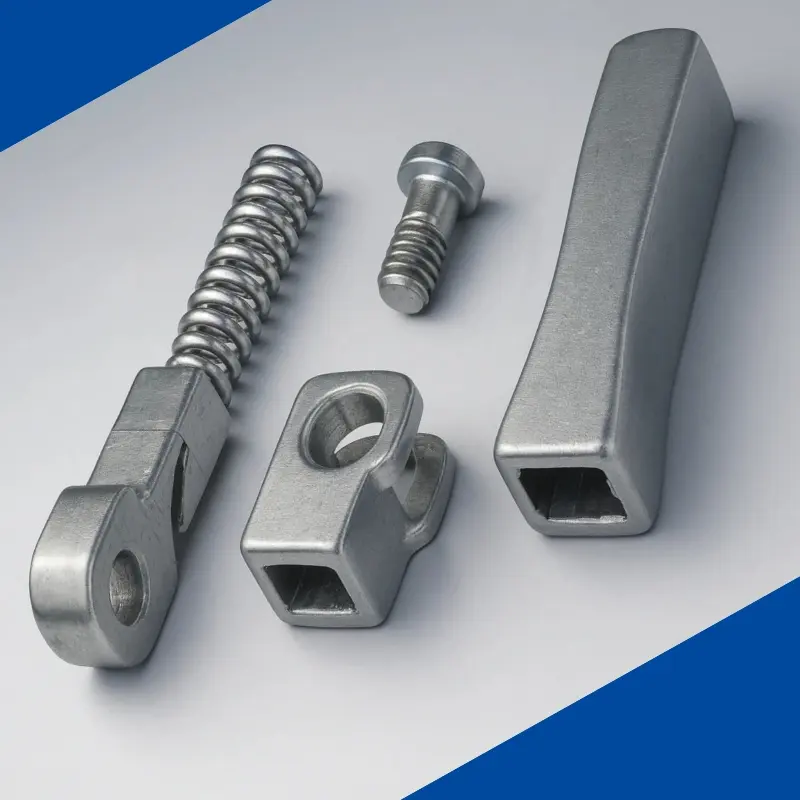
The basic spring hinge assembly has three parts worth understanding, even though you won’t be sourcing them directly:
The spring itself — almost always stainless steel, with wire diameter in the 0.3–0.5mm range. Thinner wire flexes more easily but fatigues faster under repeated cycles.
The cartridge or housing — the metal shell the spring sits inside, typically nickel silver or Monel, chosen because it bonds securely into acetate or TR90 temple material during assembly.
Tension calibration — the “return force” set by the hinge supplier at manufacture, and re-checked by your eyewear factory’s incoming QC before the hinge gets embedded into the frame.
This is also where batch consistency becomes a real variable rather than a theoretical one. A sample hinge that opens and closes smoothly doesn’t guarantee the next 2,000 pieces — sourced from the same hinge supplier, assembled in the same production run — will feel identical. Incoming inspection on a sampling basis, not just a one-time sample check, is the practical safeguard against this.
Questions to Ask About Hinge Sourcing Before Specifying a Style
A few specific questions get you a much clearer picture of what you’re actually ordering than a generic “spring hinge, please” on a tech pack. Some of these are best directed to your eyewear manufacturer, and some are questions worth your manufacturer routing to their hinge supplier on your behalf:
- Which hinge supplier and grade is being specified for this frame? Naming a known supplier (rather than an unspecified “spring hinge”) gives you a traceable starting point if quality issues come up later.
- Can the hinge supplier’s cycle test documentation be provided? This data comes from the hinge manufacturer, not your eyewear factory — a manufacturer that routinely sources from established hinge suppliers should be able to request and pass along this documentation.
- What’s the barrel/prong count for a standard hinge construction? More prongs generally means better long-term stability on wider or heavier frames.
- What does incoming inspection on the hinge components look like before assembly? This is squarely your eyewear manufacturer’s responsibility, and it’s the more practical question to ask than requesting in-house cycle testing, which most acetate frame factories aren’t set up to run themselves.
- Is the hinge mechanism field-repairable, or does a failure mean the whole frame needs replacing? This matters for your after-sales policy and warranty cost planning, regardless of which party is responsible for the original defect.
How Hinge Choice Fits Into Your Overall Frame Spec
Hinge type isn’t a decision made in isolation — it connects to frame weight, target price point, and how the product will actually be used. A heavier acetate frame puts more ongoing stress on a hinge than a lightweight style, which is part of why wider barrel counts or spring hinges tend to show up more often on larger or bolder acetate silhouettes. A style positioned for daily, all-conditions wear has a different durability bar than a fashion piece intended for occasional use.
This is the same logic that applies across other acetate sourcing decisions — material grade, polishing standard, and lens spec all need to match the product’s actual positioning rather than being decided independently. If you’re still working through the broader acetate sunglasses sourcing decisions — material grade, finish, and overall frame construction — hinge type is one piece of a larger spec conversation worth having with your manufacturer before tooling is locked in.
The Practical Takeaway
Hinge type is a small line item on a tech pack that has an outsized effect on how a frame performs months after it ships. Standard barrel hinges are the right call for cost-sensitive or fashion-forward acetate lines where the hinge doesn’t need to survive years of daily flexing. Spring hinges cost more but meaningfully change the failure pattern, which matters for any collection where return rate and repeat-purchase trust are part of the brand’s positioning. If a hingeless look is part of the brief, plan for a titanium or metal build — it’s not a construction acetate can deliver.
None of these are universally “better” — they’re suited to different products and different customer expectations. Getting the spec right starts with being specific about cycle ratings, materials, and QC checkpoints, rather than leaving “spring hinge” as a generic line on a brief.
If you’re working through hinge specification or other construction details for an upcoming acetate collection, start a conversation with our team — we’re happy to walk through what fits your frame weight, price point, and target market.
Frequently Asked Questions
Are spring hinges always better than standard hinges? Not universally — they’re more durable under repeated use, typically rated for 20,000–30,000 cycles versus around 5,000 for standard hinges, but they cost more and are harder to repair if something fails. For low-cost or fashion-forward lines where the product isn’t expected to last years of daily wear, a well-made standard hinge is often the more sensible spec.
What does “5-barrel” or “7-barrel” hinge mean? This refers to the number of metal cylinders (barrels) joined by the hinge screw on a standard barrel hinge. More barrels generally distribute stress across a wider surface area, which improves long-term stability — particularly relevant for wider or heavier acetate frames where a narrow hinge would wear faster.
How long should a quality spring hinge last? Hinge suppliers typically rate spring hinges for 20,000–30,000 open-close cycles under ISO 12870-style testing — this data comes from the hinge manufacturer, not the eyewear factory assembling the frame. Ask your manufacturer to source from an established hinge supplier and provide that documentation; actual lifespan in the finished frame also depends on how well the hinge is embedded into the temple during assembly.
Can a hinge be repaired, or does the whole frame need replacing if it fails? Standard barrel hinges are generally field-repairable — a loose screw can often be tightened or replaced. Spring hinges are sealed mechanisms and are more difficult to service in the field; a failure usually means professional repair or frame replacement. Hingeless or flex-temple constructions typically can’t be repaired if the flex point cracks.
How do I know my factory is actually using the hinge grade they quoted? Since hinges are a sourced component, ask which hinge supplier and grade is specified, and request that documentation be passed through from the hinge manufacturer. Separately, ask what incoming inspection your eyewear factory runs on hinge components before assembly — this is the part within their direct control.
Does hinge type affect how a frame fits different face shapes? Indirectly. Spring hinges allow the temple to flex further outward before settling, which can improve comfort across a wider range of head sizes without needing multiple temple lengths. This is one reason spring hinges are common on unisex or one-size-fits-most acetate styles.
Can I get a hingeless or “memory temple” design in acetate? Not in a true sense — hingeless construction relies on a material that flexes and springs back without cracking, which is a property of titanium or flexible metal alloys, not acetate. If a hingeless silhouette matters to your collection, plan for a titanium or metal build, possibly with acetate accents, rather than specifying it for a pure acetate frame.
Let's get started!
Get in touch with a custom eyewear specialist now for a free consultation and instant price quote.
WHATSAPP ME GO!
📱 Scan with your phone to start chatting