TR90 Sunglasses Hinge and Frame Construction: What to Look For
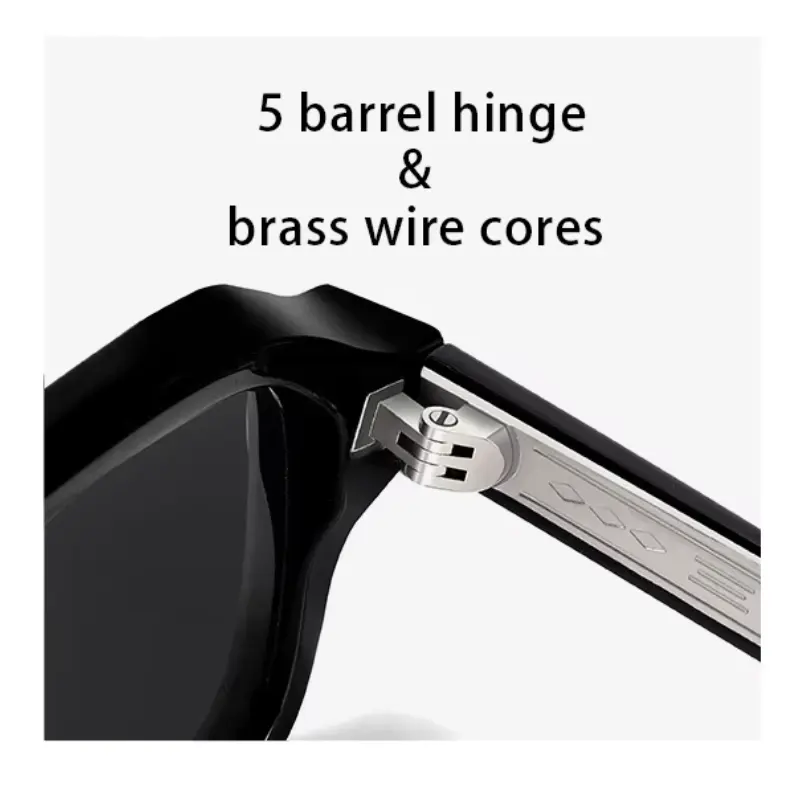
A tech pack that specifies “TR90, standard hinge” or “TR90, spring hinge” without much more detail skips over a decision that affects cost, repairability, and how the frame actually feels on a customer’s face. TR90 frames are built using one of three distinct hinge approaches, and they’re not interchangeable upgrades on a single spectrum — each one trades off cost, comfort, and serviceability differently, and the right choice depends on what your specific product needs to deliver.
This guide covers the three hinge constructions used on TR90 frames, what each one actually involves, and the frame construction details worth checking beyond the hinge itself.
The Three Hinge Approaches on TR90 Frames
Standard (Barrel) Hinges — The Default Choice
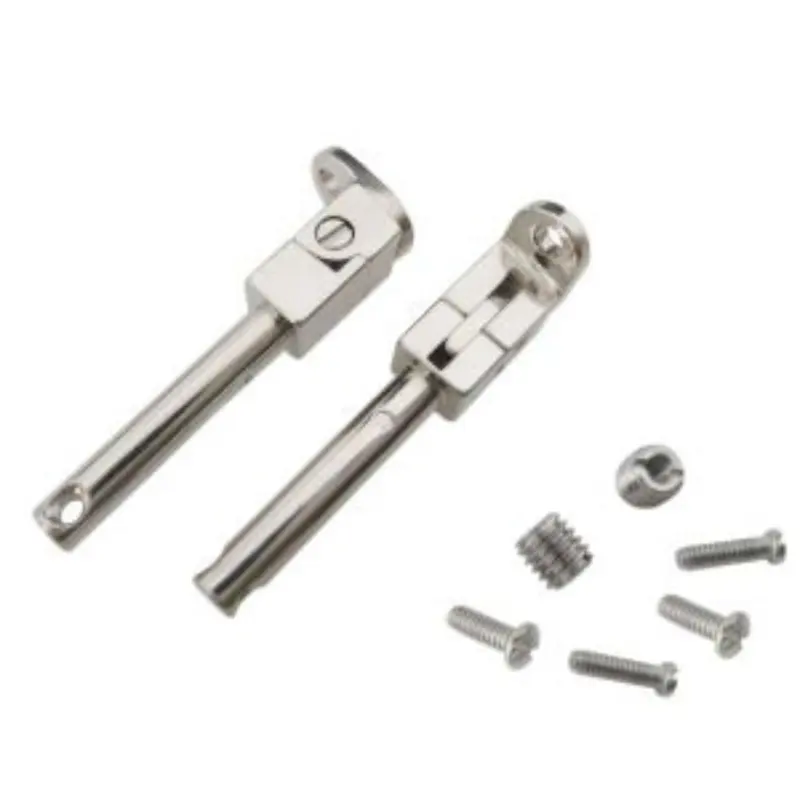
A standard hinge, also called a barrel hinge, uses interlocking metal cylinders held together by a small screw, allowing the temple to open to roughly 90 degrees. This is the most common hinge type across eyewear generally, not just TR90 specifically — it’s the default most factories quote unless a brief specifies otherwise.
The appeal is straightforward: standard hinges are simple to manufacture, which keeps cost down, and they’re genuinely easy to repair — a loose screw can be tightened with a basic precision screwdriver, something most opticians (and many customers) can handle without specialized tools. The tradeoff is limited flex. Because movement stops at a fixed angle, a standard hinge under repeated outward stress — a wider head, frequent one-handed removal — is more prone to loosening over time than a spring hinge would be in the same conditions.
Best for: everyday, budget-to-mid-range TR90 collections where straightforward repairability matters more than extra flex range.
Spring Hinges — The Comfort Upgrade
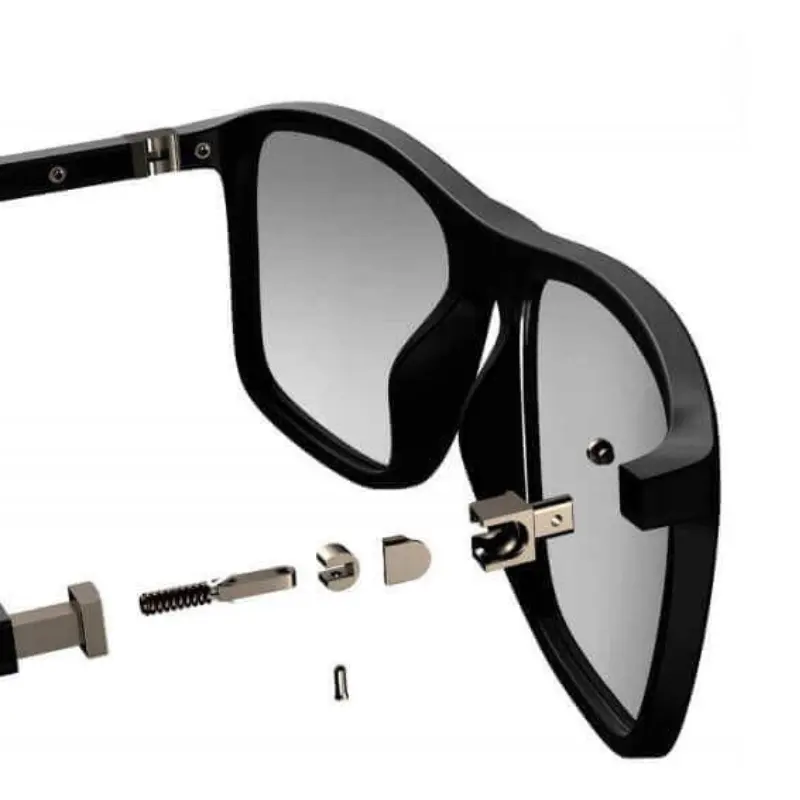
A spring hinge adds an internal spring mechanism that lets the temple flex outward beyond the standard 90-degree limit — typically an additional 15–20 degrees — before returning to its resting position. This is a genuine upgrade over a standard hinge, not just a different style: the spring absorbs stress that would otherwise concentrate at the screw and barrel, which is part of why spring-hinge frames tend to hold their fit longer under repeated daily wear.
This matters most for wider head shapes, where a standard hinge’s fixed angle creates pressure points, and for active or daily-wear products where the temple is opened and closed frequently. The internal spring cartridge is typically housed in a small metal sleeve press-fitted into the temple cavity, and reliable manufacturers test the mechanism against cycle standards — commonly in the range of 20,000–30,000 open-close cycles — before it goes into production.
The tradeoff is repairability and cost. Spring hinges are more complex to manufacture, which adds to per-unit cost, and they’re harder to service — a failed spring mechanism generally requires a professional optician with specialized tools rather than a quick screw tightening.
Best for: active-lifestyle, sports, and daily-wear collections where comfort across a range of head sizes is part of the product’s value proposition, and where the added cost is justified by fewer fit-related complaints.
Molded-In Hinges — The Cost-and-Speed Option
A small number of TR90 styles — generally simpler, more basic designs — skip a discrete hinge mechanism entirely. The hinge function is built directly into the temple during injection molding, using the material’s own flexibility rather than a separate metal mechanism, which eliminates the screw and barrel altogether.
This construction reduces both material cost and assembly time, since there’s no separate hinge component to source, install, and quality-check. The real tradeoff is repairability: a molded-in hinge that fails is far more difficult to service than a standard or spring hinge, since there’s no discrete part to replace — repair options are limited, and a damaged temple often means replacing it rather than fixing it.
Best for: cost-sensitive, fast-turnaround styles where unit price and production speed matter more than long-term repairability — promotional eyewear, simple basic styles, or programs where replacement is cheaper than repair at scale.
| Hinge Type | Flex Range | Repair Difficulty | Relative Cost | Best Fit |
|---|---|---|---|---|
| Standard (barrel) | Fixed, ~90° | Easy — basic screwdriver | Lowest | Everyday, budget-to-mid collections |
| Spring | Extends 15–20° beyond standard | Moderate — professional tools needed | Moderate | Active-lifestyle, daily wear, wider head sizes |
| Molded-in | Limited to material’s natural flex | Difficult — often not repairable | Lowest material/assembly cost | Cost-sensitive, fast-turnaround basics |
Why TR90 Doesn’t Always Pair Well With Metal Hardware
A detail worth understanding before specifying hinge hardware: TR90 is flexible, but the metal components used in standard and spring hinges aren’t. Embedding a fixed metal hinge into a material that’s designed to flex creates a junction point where two very different materials need to move together — and if that junction isn’t engineered correctly, it’s a common source of loosening or cracking around the hinge area over time.
This is part of why hinge installation method matters as much as hinge type. For standard and spring hinges in TR90 temples, the hinge component is generally inserted into a precision cavity and secured using ultrasonic bonding or heat-sealing rather than the rivets or screws-into-pre-drilled-slots method used on acetate — a process suited specifically to TR90’s flexibility, where metal screws driven directly into the material aren’t always reliable. Asking your manufacturer how the hinge is installed, not just what type it is, is a reasonable question — and one a manufacturer with real TR90 experience should answer specifically rather than vaguely.
Frame Construction Details Worth Checking Beyond the Hinge
A few other construction points affect how a TR90 frame performs in practice, beyond the hinge mechanism itself.
Temple thickness and design. TR90’s flexibility comes with a tradeoff: an oversized frame with very thin, slim temples can flex more than intended, which sometimes reads as a design flaw rather than the lightweight aesthetic it was meant to achieve. Confirming temple thickness against the actual frame width and weight — rather than defaulting to the thinnest option for a “lightweight” look — helps avoid this.
Nose pad attachment. Nose pads on TR90 frames are typically glued or heat-fused rather than mechanically fastened, since TR90’s surface chemistry doesn’t always bond reliably with adhesives not formulated for it. This is a smaller detail than hinge construction, but worth confirming with your manufacturer if your design uses a separate nose pad component.
Logo and hardware embedding. TR90’s flexibility complicates embedding fixed, rigid elements like metal logos or accent pieces directly into the frame, for the same reason metal hinges require careful engineering — a rigid insert in a flexible material creates a stress point. This is part of why logo branding on TR90 more commonly uses printing or engraving methods, covered in more detail in our guide to TR90 color and customization options, rather than embedded metal hardware.
Matching Hinge Type to Your Product
A few practical starting points for specifying hinge type:
Everyday, budget-conscious collections — standard hinges, where straightforward repairability and lower cost matter more than extended flex range.
Sports, active-lifestyle, and kids’ collections — spring hinges, where comfort across a range of head sizes and resilience under frequent handling justify the added cost, a consideration covered in more detail in our guide to custom TR90 sunglasses for kids.
Fast-turnaround, cost-sensitive basics — molded-in hinges, where unit cost and production speed outweigh long-term repairability, with the understanding that a damaged frame is more likely to be replaced than fixed.
None of these are fixed rules — a brand might reasonably use spring hinges on a flagship style and standard hinges on an accessible-tier line within the same collection, matching hinge investment to where it earns the most value.
The Practical Takeaway
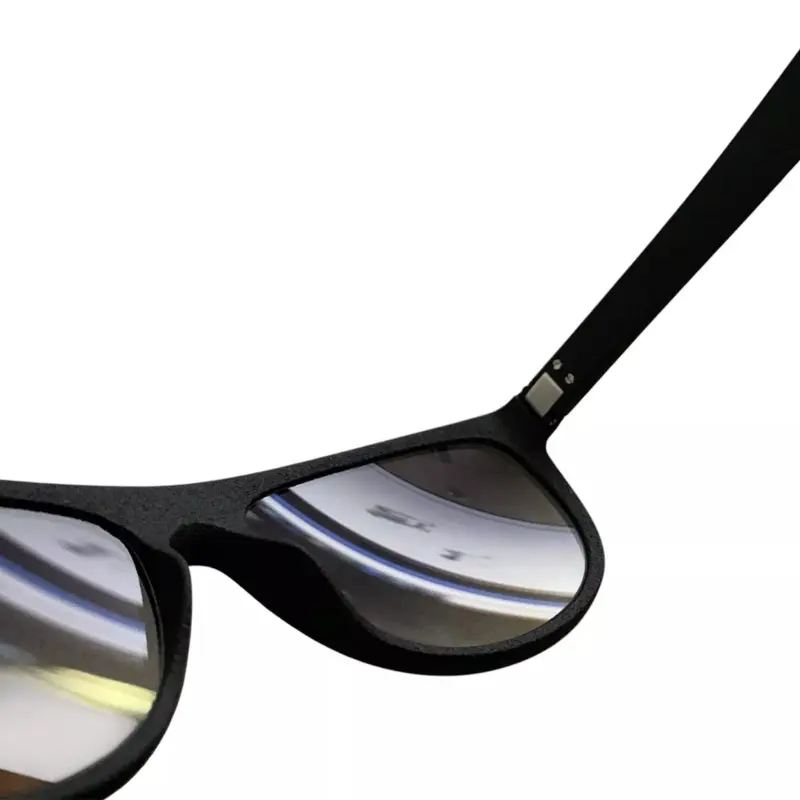
Standard, spring, and molded-in hinges aren’t simply different price points on the same mechanism — they’re genuinely different engineering approaches with different tradeoffs in cost, comfort, and repairability. Standard hinges remain the most common choice for straightforward, repairable, budget-friendly TR90 sunglasses. Spring hinges add real comfort value for active use and a wider range of head sizes, at the cost of more complex repair. Molded-in hinges cut cost and assembly time the most, at the cost of repairability almost entirely. Specifying which one you actually need — rather than leaving “hinge” as an unspecified line on a brief — is what keeps a sample from coming back with a mechanism that doesn’t match what the product needs to do.
Frequently Asked Questions
What’s the most common hinge type used in TR90 sunglasses?
Standard (barrel) hinges are the most common across eyewear generally, including TR90 — they’re simple to manufacture, keep cost down, and are easy to repair. Spring hinges are a less common but well-established upgrade, while molded-in hinges are used on a smaller share of simpler, more basic styles.
Are spring hinges worth the extra cost on TR90 frames?
For active-lifestyle, sports, or daily-wear products, generally yes — the added flex range reduces pressure points and helps the frame hold its fit longer under frequent handling, which can mean fewer fit-related complaints. For straightforward, budget-positioned everyday frames, a standard hinge is often the more practical choice.
Can a molded-in TR90 hinge be repaired if it breaks?
Generally not easily. Because the hinge function is built into the temple itself rather than existing as a separate component, there’s no discrete part to replace the way there is with a standard or spring hinge. A damaged molded-in hinge usually means the temple — or the whole frame — needs replacing rather than repairing.
Why can’t TR90 frames always use metal logos or embedded hardware?
TR90’s flexibility creates a stress point wherever a rigid, fixed element like a metal logo or hinge component is embedded into it. If that junction isn’t engineered carefully, it becomes a common failure point over time, which is why TR90 branding more often relies on printing or engraving rather than embedded metal hardware.
How is a hinge actually installed into a TR90 temple?
Standard and spring hinges in TR90 are typically inserted into a precision-molded cavity and secured using ultrasonic bonding or heat-sealing, rather than the rivets or screw-into-slot methods common on acetate. This installation method is specific to TR90’s flexibility and is worth confirming with your manufacturer rather than assuming it matches acetate’s process.
Should temple thickness change based on hinge type?
Yes, generally. Hinge type and temple thickness should be considered together, since an oversized frame with very thin temples can flex more than intended regardless of hinge type, which can read as a design or quality issue rather than the lightweight feel it was meant to achieve.
Let's get started!
Get in touch with a custom eyewear specialist now for a free consultation and instant price quote.
WHATSAPP ME GO!
📱 Scan with your phone to start chatting