TR90 vs Acetate: Which Frame Material Is Right for Your Line?
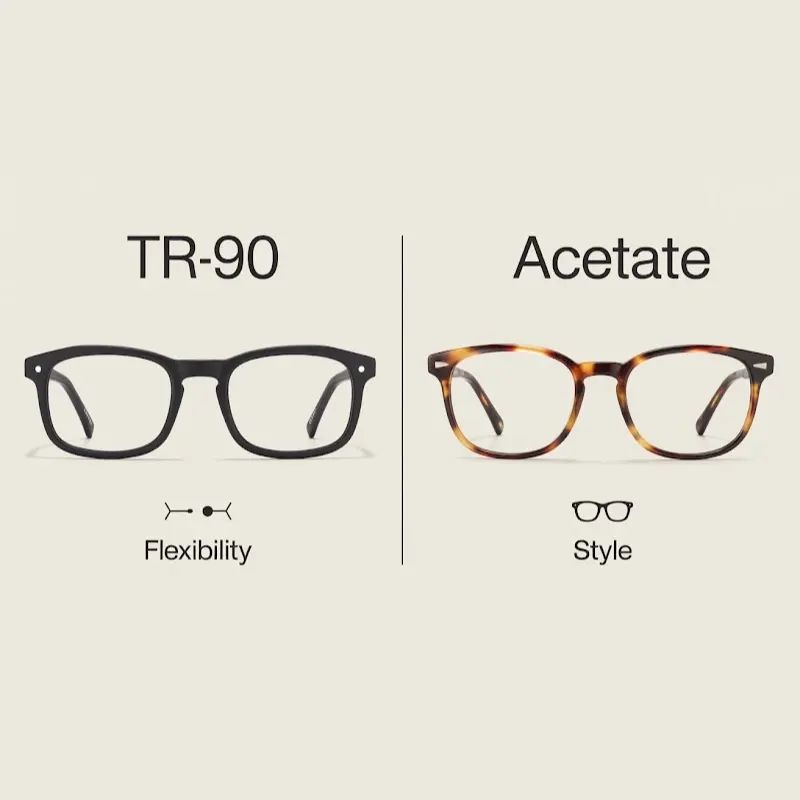
Most content comparing TR90 and acetate ends up picking a winner — usually whichever material the site happens to sell more of. That framing doesn’t actually help a brand make a sourcing decision, because TR90 and acetate aren’t competing for the same product. They’re built differently, priced differently, and suited to different positioning, which means the right question isn’t which material is better — it’s which one matches what you’re actually building.
This guide compares TR90 and acetate on the dimensions that actually affect a sourcing decision: how each is made, how each performs, what each costs to bring to market, and which product positioning each one genuinely supports.
The Core Difference Starts With How Each Material Is Made
TR90 and acetate aren’t different grades of the same kind of material — they’re produced through fundamentally different processes, and that difference is the root of almost every other distinction between them.
Acetate is cut from solid, layered sheet stock using CNC machining, then hand-polished over multiple processing stages — a process we cover in detail in our guide to how acetate sunglasses are made. The color and pattern run through the full thickness of the material, which is why acetate frames hold genuine depth and richness no surface treatment can replicate.
TR90, as covered in more detail in our guide to what TR90 actually is, is injection molded — pellets are heated to a molten state and injected under pressure into a steel mold, where the frame cools and solidifies in seconds rather than days. Color is typically introduced during the molding process itself rather than carved from pre-colored sheet stock.
This single difference in manufacturing approach explains nearly everything else in this comparison: why acetate has a different tactile quality, why TR90 has a different cost structure, and why each material ended up suited to different parts of the eyewear market.
Weight and Flexibility: Where TR90’s Reputation Comes From
TR90’s lightweight, flexible reputation is genuine and traces directly back to its molecular structure, not marketing language.
TR90 belongs to a category of materials sometimes called memory plastics — it flexes significantly under pressure and returns to its original shape rather than staying bent or cracking. Acetate is a more rigid material by comparison; it holds its shape precisely once formed, which is part of its appeal for structured, architectural frame designs, but it doesn’t flex and recover the way TR90 does under the same stress.
This translates into a real functional difference. A TR90 frame that gets sat on, twisted, or knocked during active use has a meaningful chance of returning to its original shape. Acetate under the same stress is more likely to crack or require professional adjustment to restore its shape, since the material doesn’t have TR90’s elastic recovery property. Neither behavior is a flaw — rigidity is exactly what gives acetate its structured, premium feel, and flexibility is exactly what makes TR90 suited to active use — but the practical difference is worth being clear-eyed about when matching material to product.
| Property | TR90 | Acetate |
|---|---|---|
| Manufacturing process | Injection molded | CNC-cut from sheet, hand-polished |
| Flexibility | High — flexes and recovers shape | Low — rigid, holds precise shape |
| Heat sensitivity | More resistant to warping, though extreme or prolonged heat can still soften it | Can soften and warp in heat (e.g., hot car) |
| Color depth | Molded-in color, more limited surface texture range | Color runs through material thickness, rich texture options |
| Typical tooling requirement | Mold required, upfront investment | No mold — CNC cutting from stock sheet |
| Typical market position | Budget-to-mid, sports, kids’ eyewear | Mid-to-premium, fashion-forward collections |

Heat, Durability, and What Actually Breaks Each Material
Acetate’s most well-documented vulnerability is heat — it can soften and warp when left in a hot car or under direct, prolonged sun exposure, a point we cover in detail in our guide to acetate sunglasses care and maintenance. TR90 is meaningfully more resistant to this kind of heat-related warping and holds its shape reliably across the temperature ranges sunglasses encounter in typical daily use — but it isn’t immune to heat. Extended exposure to extreme heat, such as a closed car interior on a hot day over a long period, can still soften TR90 and affect its shape, just at a higher threshold and over a longer timeframe than acetate.

Where acetate holds an advantage is structural precision over time under normal, non-extreme conditions — a well-made acetate frame keeps its exact shape indefinitely under typical handling, which is part of why it suits architectural or structured frame designs where dimensional precision is part of the aesthetic. TR90’s flexibility is a durability advantage against impact and stress, but it’s a different kind of durability than acetate’s dimensional stability — the right comparison depends on which failure mode your product is actually more likely to encounter.
Cost Structure: Why the Price Gap Isn’t Just About Material Cost
The cost difference between TR90 and acetate isn’t simply a matter of one material being more expensive than the other — it comes from fundamentally different production economics tied to the manufacturing processes already covered.
TR90 requires upfront mold tooling investment before any production can begin, but once that tooling exists, per-unit production is fast and highly scalable — injection molding produces consistent, identical frames in seconds each. Acetate requires no mold investment, since CNC cutting works directly from sheet stock, but the multi-stage cutting, shaping, and hand-polishing process takes considerably longer per unit and requires more skilled labor throughout.
The practical result: TR90 tends to favor larger production runs where the upfront mold cost amortizes across volume, while acetate’s no-mold CNC process makes it more accessible for smaller runs or rapid style iteration, even though its per-unit labor cost is higher. Neither structure is universally cheaper — which one favors your economics depends on your order volume and how many distinct styles you’re planning to produce.

Which Material Fits Which Brand Position
A few practical starting points for matching material to product positioning, rather than treating this as a universal “better” decision:
Sports, active-lifestyle, and kids’ eyewear — TR90’s flexibility and impact resistance directly address the real-world stress these products encounter, and its lower per-unit cost at volume supports the price points these categories typically need to hit.
Fashion-forward, premium, or designer-positioned collections — acetate’s color depth, tactile quality, and structural precision support the kind of product story premium positioning depends on, which is part of why it remains the default for luxury and independent designer brands.
Budget-conscious or rapidly scaling private label programs — TR90’s manufacturing economics at volume, combined with its durability advantage for less-careful handling, make it a practical fit for accessible price points and online-first retail models.
Brands wanting frequent style changes or smaller production runs — acetate’s mold-free CNC process makes it easier to iterate on new styles without the upfront tooling commitment TR90 requires, which matters for brands testing multiple designs before committing to volume.
Many brands reasonably use both materials within a single collection — TR90 for a sport-focused or accessible-tier line, acetate for a flagship or fashion-forward range — rather than treating the choice as exclusive across an entire brand.

The Practical Takeaway
TR90 and acetate aren’t competing versions of the same product — they’re built through different processes, priced through different economics, and suited to different positioning. TR90 earns its place where flexibility, impact resistance, and cost efficiency at volume genuinely matter to the product. Acetate earns its place where color depth, tactile quality, and structural precision are part of what the customer is paying for. The right choice depends on matching these real tradeoffs to your specific product and price point, not picking whichever material a given source happens to favor.
If you’re weighing TR90 sunglasses against acetate for an upcoming collection, the deciding factors are usually clearer once you’re specific about target price point, order volume, and how the product will actually be used.
Frequently Asked Questions
Is TR90 better than acetate?
Neither is universally better — they’re suited to different products. TR90 offers flexibility, impact resistance, and cost efficiency at volume, making it well suited to sports, kids’, and budget-conscious lines. Acetate offers color depth, tactile quality, and structural precision, making it well suited to fashion-forward and premium positioning.
Why is acetate more expensive than TR90?
The cost difference comes from manufacturing economics, not just raw material cost. Acetate’s CNC cutting and multi-stage hand-polishing process requires more skilled labor per unit, while TR90’s injection molding is fast and highly scalable once mold tooling is in place — though that tooling requires upfront investment TR90’s process needs and acetate’s doesn’t.
Does TR90 warp in heat the way acetate does?
Not to the same degree, but it isn’t fully heat-proof either. TR90 holds its shape reliably across normal temperature ranges and resists the kind of quick softening that affects acetate in a hot car, but prolonged exposure to extreme heat can still soften it over time. This higher heat tolerance is one of TR90’s practical advantages for everyday and active-use eyewear, even though it isn’t an absolute immunity.
Which material is better for kids’ eyewear, TR90 or acetate?
TR90 is generally the more common choice for kids’ eyewear specifically, since its flexibility and impact resistance hold up well to less careful handling, and its cost structure supports the price points kids’ eyewear programs typically need.
Can a brand use both TR90 and acetate in the same collection?
Yes, and many brands do — TR90 for a sport-focused or accessible-tier line, acetate for a flagship or fashion-forward range. The two materials don’t need to be an exclusive choice across an entire brand; they can serve different parts of a product line based on positioning.
Does TR90 or acetate make more sense for a brand just starting out?
It depends on order volume and how many styles you’re launching with. TR90’s mold tooling requires upfront investment that amortizes better across larger volume, while acetate’s mold-free CNC process is more accessible for smaller runs or testing multiple styles before committing to scale.
Let's get started!
Get in touch with a custom eyewear specialist now for a free consultation and instant price quote.
WHATSAPP ME GO!
📱 Scan with your phone to start chatting