Acetate Sunglasses Pricing Strategy: How to Set Retail Price for Your Collection
Most pricing advice for eyewear brands starts in the wrong place. It starts with a markup formula — double your wholesale cost, or triple it for premium positioning — without ever explaining what’s actually inside that wholesale number to begin with. For a brand sourcing acetate sunglasses, that’s a problem, because the wholesale price isn’t a single line item. It’s the sum of several costs that are easy to underestimate if you’ve never built a tech pack or placed a bulk order.
This guide starts where the math actually starts: the factory EXW price. From there, it walks through what gets added on the way to a wholesale price, how brands commonly set retail price on top of that, and the costs that catch first-time eyewear brands off guard after launch.
Start With What’s Actually in Your Factory Cost
Before any pricing strategy makes sense, you need an accurate number for what you’re actually paying to produce the product — not a rough guess, and not just the quote on the invoice.
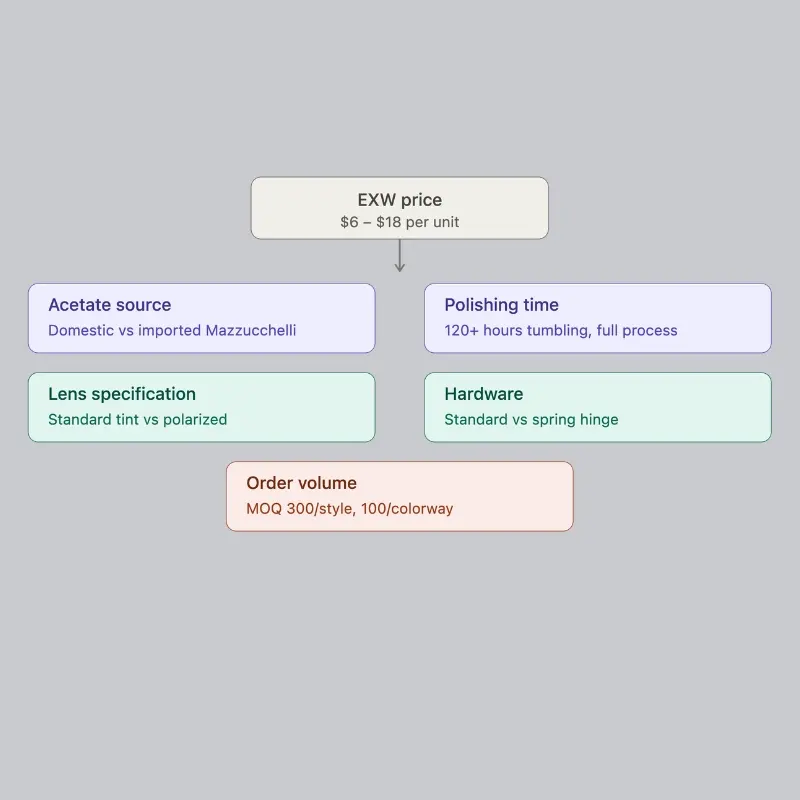
For acetate sunglasses, EXW (ex-works) pricing typically runs $6–$18 per unit, depending on acetate grade, frame complexity, lens specification, and order volume. That range is wide on purpose — a basic acetate frame with standard tinted lenses sits at the lower end, while a frame using imported Mazzucchelli acetate, polarized lenses, and multiple finishing steps sits toward the top.
A few cost drivers that move a quote within that range:
- Acetate source — domestic acetate costs less than imported Italian acetate (commonly Mazzucchelli), and the difference shows up directly in EXW price
- Polishing and finishing time — acetate frames typically require 120+ hours of tumbling and polishing across the full process; more complex finishes add to that
- Lens specification — standard tinted lenses cost less than polarized or photochromic options
- Hardware — hinge type (standard vs. spring) and material affects unit cost, as covered in more detail in our guide to acetate sunglasses hinge types
- Order volume — acetate MOQ is typically 300 pieces per style, 100 per colorway; cost per unit generally improves as volume increases within a style
This EXW number is your starting point, not your full cost. Brands that price off the EXW quote alone consistently underprice their product, because EXW doesn’t include several costs that show up before the product reaches a customer.
What Gets Added Between EXW and Landed Cost
EXW price is what you pay the factory. Landed cost is what the product actually costs you once it’s sitting in your warehouse, ready to sell — and the gap between the two is where a lot of first-time brands miscalculate their margin. For a detailed breakdown of this stage specifically — freight options, duty rates by market, and full project timelines — see our guide on how to import custom sunglasses from China. The summary below covers what matters for pricing purposes.
Freight and shipping. Sea freight is the standard for bulk acetate sunglasses orders given typical production volumes, with air freight reserved for smaller or time-sensitive shipments at a meaningfully higher per-unit cost. Freight cost per unit drops significantly as order volume increases, which is part of why MOQ and shipping cost are connected decisions, not separate ones.
Import duties and tariffs. These vary by destination market and current trade policy, and they apply to the full declared value of the shipment — not just the EXW unit cost. This is one of the most commonly underestimated line items in a first-time brand’s cost model, partly because duty rates change and partly because brands sometimes calculate this against EXW price instead of the fuller landed value.
Customs clearance and handling fees. Smaller, generally predictable, but still a real per-shipment cost that should be in the model rather than absorbed as a surprise.
| Cost Stage | What It Covers | Typical Range (Acetate Sunglasses) |
|---|---|---|
| EXW (factory price) | Material, labor, hardware, lens | $6–$18 per unit |
| + Freight | Sea or air shipping to destination | Varies by volume and method |
| + Duties/Tariffs | Import tax on declared shipment value | Varies by market and HS code |
| + Customs/Handling | Clearance, documentation, local handling | Generally smaller, per-shipment |
| = Landed Cost | Total cost before any markup | Your real pricing baseline |
Landed cost — not EXW price — is the number that should anchor your retail pricing math. Pricing off EXW alone means your “50% margin” is actually smaller than it looks once freight and duties are accounted for.
How Brands Commonly Set Retail Price From There
Once you have an accurate landed cost, the question becomes what multiple to apply to reach a retail price. A few approaches are common in eyewear specifically.
Keystone Pricing (2x Markup)
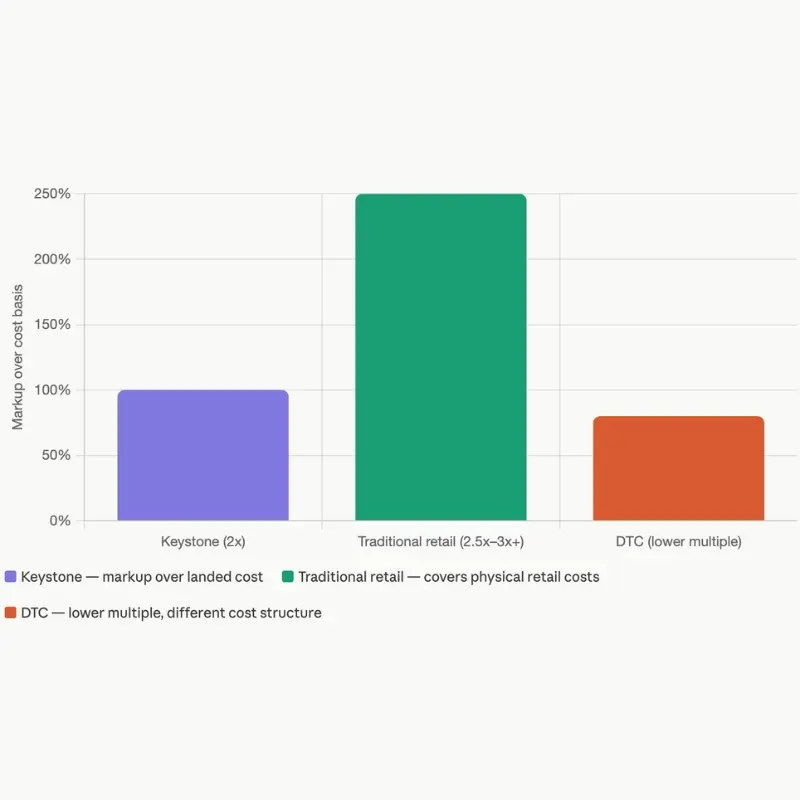
Keystone pricing sets retail price at double the wholesale or landed cost, producing a straightforward 50% gross margin. It’s simple to calculate and widely used as a baseline, particularly for mid-market positioning. The limitation is that a flat 2x multiple doesn’t account for brand positioning, marketing spend, or category-specific costs like returns handling — it’s a starting point, not a complete pricing strategy.
Traditional Optical Retail Markup (2.5x–3x or More)
Traditional optical retail commonly applies markups in the 200%–300% range, with the average landing around 250% — meaning a frame costing $30 wholesale might retail around $105. This higher multiple reflects the cost structure of physical retail: rent, in-store staff, fitting services, and inventory carrying costs that a brand selling direct doesn’t necessarily have. Branded or licensed eyewear can run even higher, sometimes 500%–1000% over wholesale, largely driven by logo licensing fees rather than production cost.
DTC and Direct-to-Brand Pricing (Lower Multiple, Different Cost Structure)
Brands selling direct to consumer typically use a lower markup multiple than traditional retail, since they’ve removed the wholesale-to-retailer step entirely — but a lower multiple doesn’t automatically mean higher margin. DTC brands take on costs that wholesale brands pass to a retailer: customer acquisition (ad spend), fulfillment, customer service, and return processing. Recent data across DTC categories puts eyewear gross margins in the 54%–55% range, which is a useful general benchmark — though your specific number depends heavily on customer acquisition cost and return rate, both of which vary widely by brand and channel.
Costs First-Time Brands Forget to Price In
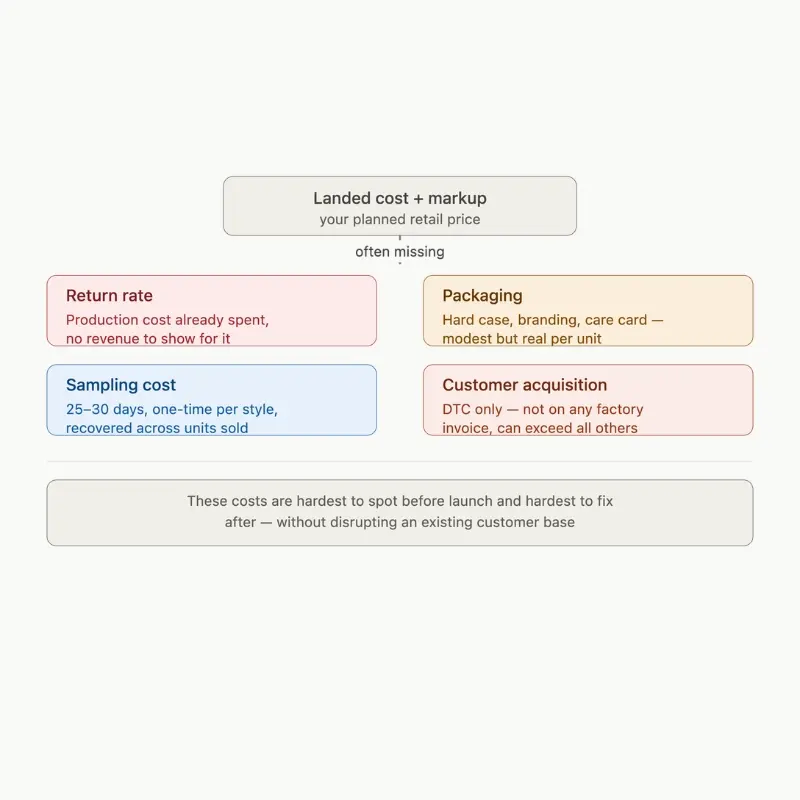
The multiple you choose matters less than whether you’ve actually accounted for every cost the multiple needs to cover. A few that catch new brands off guard after launch, when it’s harder to adjust price without disrupting an existing customer base:
Return rate. Every returned unit is a cost you’ve already incurred — production, freight, duties — with no revenue to show for it, plus the cost of processing the return itself. Acetate sunglasses with well-specified hinges and clear customer care guidance tend to see fewer preventable returns than collections where this wasn’t addressed at the brief stage; this is covered in more detail in our guide to acetate sunglasses care and maintenance.
Packaging and presentation. A hard case, branded packaging, and a printed care card all add real per-unit cost — generally modest individually, but worth building into your cost model deliberately rather than treating as a rounding error.
Sample and development cost. Sampling for acetate sunglasses typically takes 25–30 working days and carries its own cost, separate from bulk production. This is a one-time cost per style rather than a per-unit cost, but it needs to be recovered across the units you eventually sell.
Customer acquisition cost (for DTC brands specifically). This is the cost most likely to be underestimated by a first-time brand, because it doesn’t show up on a factory invoice at all — it shows up in your ad spend once the product launches, and it can be larger than every manufacturing-side cost combined depending on your channel and competition.
A Simple Framework for Setting Your Price
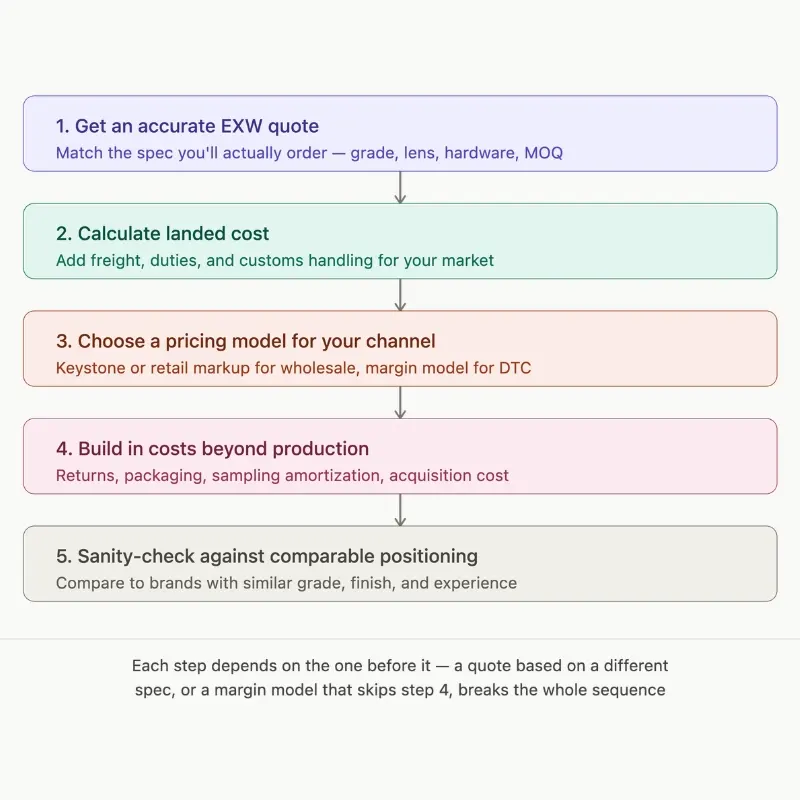
Putting this together into a practical sequence:
- Get an accurate EXW quote for your specific spec — acetate grade, lens type, hardware, and target MOQ all affect this number, so a quote based on a different spec than what you’ll actually order isn’t useful for pricing.
- Calculate landed cost by adding freight, duties, and customs handling for your specific destination market — don’t estimate this from a generic percentage; rates vary enough by market that it’s worth getting specific.
- Choose a pricing model that matches your channel — keystone or traditional retail markup if you’re selling wholesale or through retail partners, a DTC-appropriate margin model if you’re selling direct.
- Build in the costs beyond production — returns, packaging, sampling amortization, and acquisition cost if applicable — rather than treating your markup as covering production cost alone.
- Sanity-check against comparable positioning — look at what brands with a similar acetate grade, finish quality, and customer experience are charging, and make sure your price reflects genuinely comparable quality rather than just comparable material.
The Practical Takeaway
Pricing strategy for acetate sunglasses isn’t really about picking the right multiplier — it’s about making sure the number you’re multiplying actually reflects your full cost, not just the factory invoice. Brands that price off EXW alone, without accounting for landed cost and post-production expenses like returns and customer acquisition, tend to discover their real margin is thinner than planned well after the product has already launched.
If you’re working through cost structure or sourcing specs for an acetate collection and want a clear EXW quote to build your pricing model on, reach out directly via WhatsApp or email — we’re happy to walk through what’s realistic for your target price point and market.
Frequently Asked Questions
What is a typical markup for acetate sunglasses?
It depends on your sales channel. Keystone pricing (2x landed cost) is a common baseline for mid-market positioning. Traditional optical retail commonly runs 200%–300% markup to cover physical retail costs, while DTC brands typically use a lower multiple but carry different costs like customer acquisition that aren’t reflected in the markup itself.
What’s included in EXW price for acetate sunglasses?
EXW (ex-works) price covers material, labor, hardware, and lens cost at the factory, before the product leaves for shipping. It does not include freight, import duties, customs handling, or any costs incurred after the product leaves the factory — those need to be added separately to reach your true landed cost.
Why is my actual margin lower than my markup formula suggests?
This usually happens when retail price is calculated from EXW price instead of landed cost — meaning freight and duties aren’t accounted for — or when ongoing costs like returns, customer acquisition, and packaging aren’t built into the pricing model from the start.
How much does acetate sunglasses MOQ affect per-unit pricing?
Acetate MOQ is typically 300 pieces per style with 100 per colorway, and per-unit cost generally improves at higher volumes within that structure, since tooling and setup costs spread across more units. Smaller orders above MOQ don’t usually unlock meaningfully lower per-unit pricing until volume increases substantially.
Should DTC and wholesale pricing be different for the same product?
Generally yes. Wholesale pricing needs to leave room for a retailer’s own markup on top of what they pay you, while DTC pricing needs to cover the costs a retailer would otherwise absorb — primarily customer acquisition and fulfillment. Using the same price across both channels usually means underpricing one of them.
How do returns affect my pricing strategy?
Every return represents a cost already incurred — production, freight, duties — without corresponding revenue, plus processing cost. A meaningful return rate needs to be priced into your margin assumptions rather than treated as a separate line item, which is part of why product quality and clear customer care guidance directly affect your real-world margin, not just your customer satisfaction.
Let's get started!
Get in touch with a custom eyewear specialist now for a free consultation and instant price quote.
WHATSAPP ME GO!
📱 Scan with your phone to start chatting